

Canine Enrichment: The Complete Guide
Your dog eats from the same bowl every morning. Walks the same route every evening. Sleeps in the same spot every night. And waits for you to come home at the same time every single day. That is not a terrible life. But it is a boring one. And boredom does things to a dog's brain that most owners do not notice until the furniture starts paying the price.
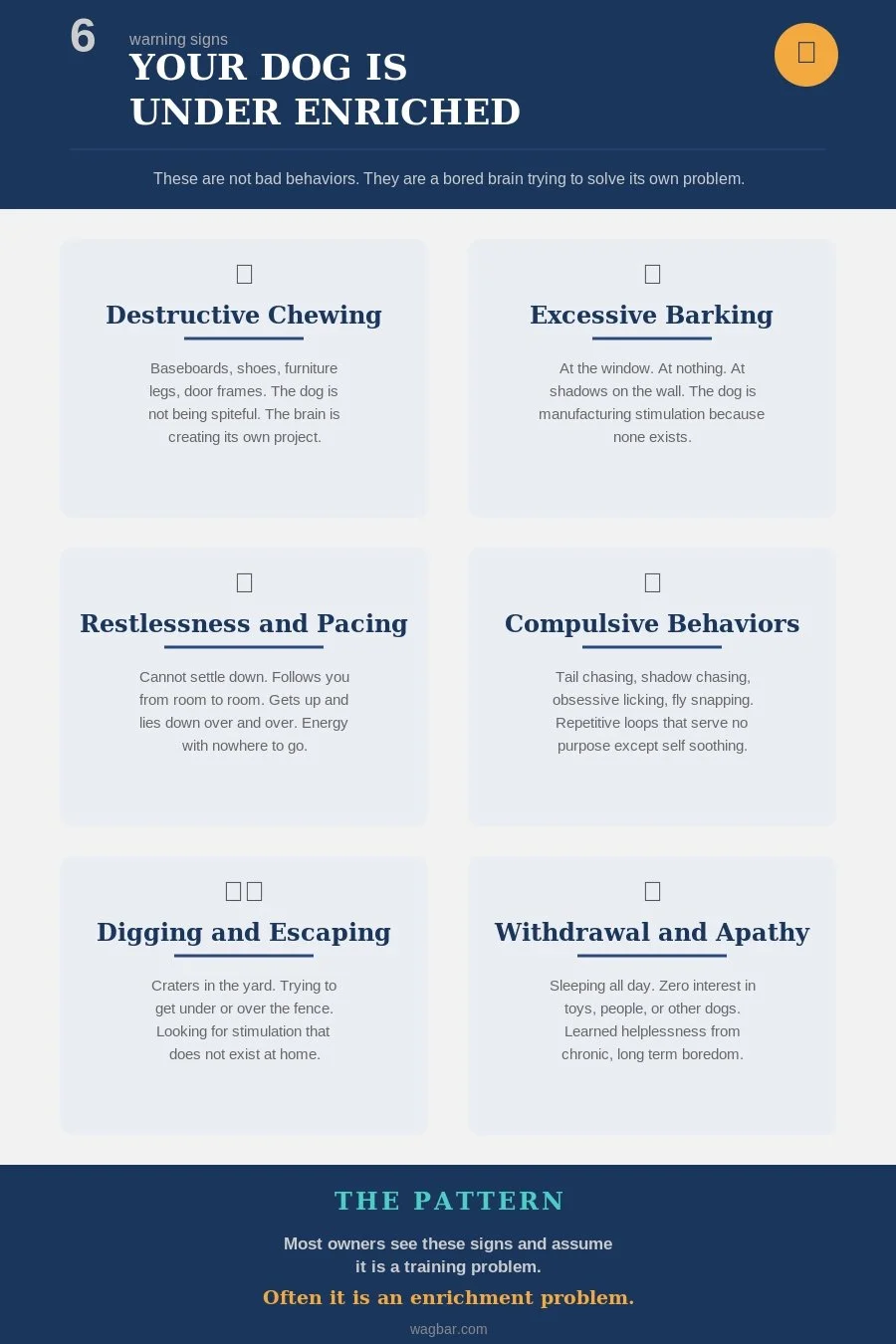
Chewing the baseboards. Barking at nothing. Pacing the hallway at 2 AM. Digging craters in the yard. None of that is bad behavior. That is a dog whose brain is starving for something to do and solving the problem the only way it knows how.
Canine enrichment fixes that. It is a structured way of giving your dog the mental, sensory, and social stimulation their brain was literally built to process. Not as some trendy add on. As a basic need that sits right next to food, water, and shelter on the list of things your dog cannot go without.
This is the starting point. Every section links out to something more specific, so you can go as deep as you want on whatever matters most to your dog right now.

The Foundation
Before you spend money on a single puzzle toy or sign up for a scent work class, you need to understand what enrichment actually is and what happens when a dog does not get enough of it.
The Five Pillars of Dog Enrichment
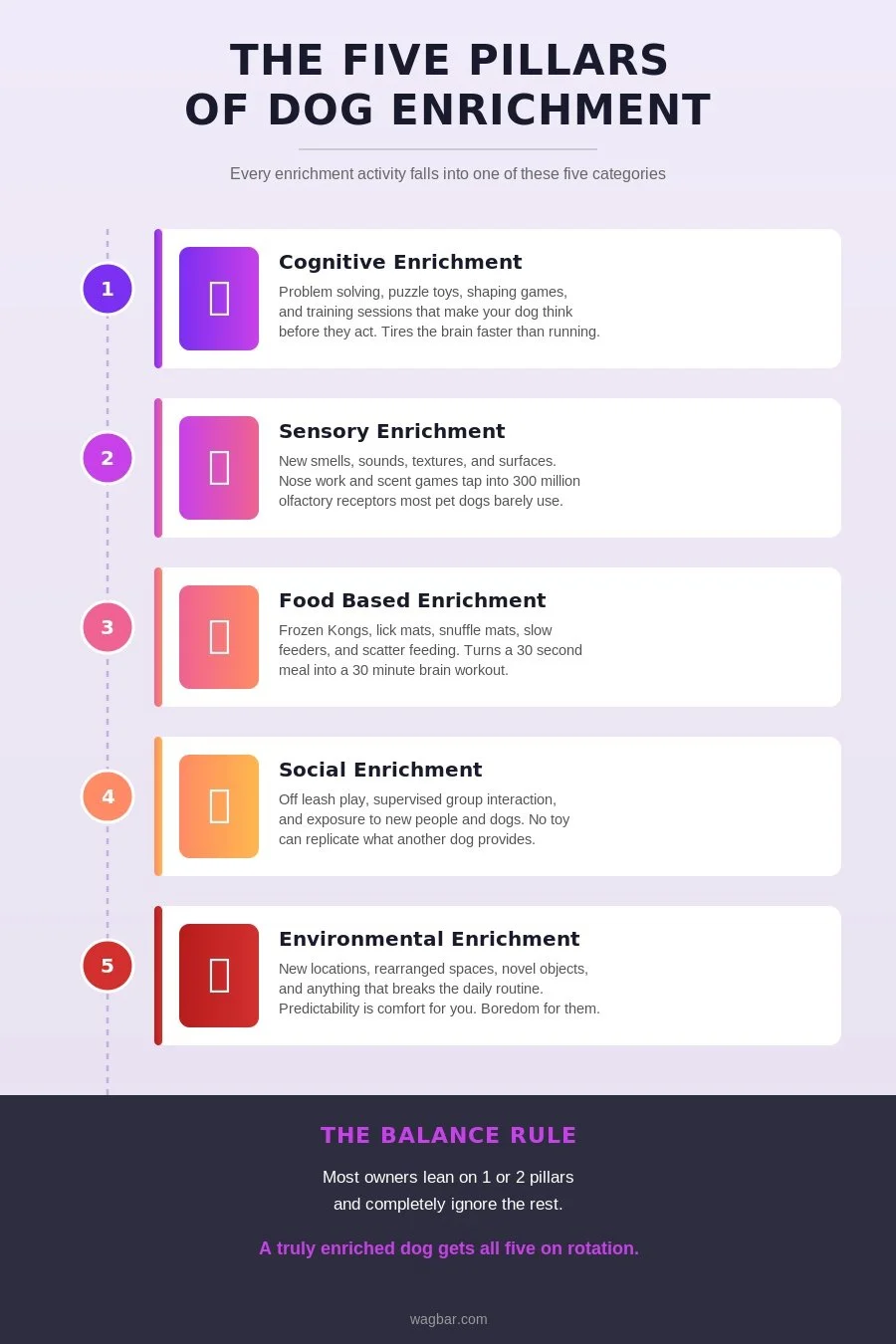
Every enrichment activity falls into one of five categories: cognitive, sensory, food based, social, and environmental. Most owners lean hard on one or two and completely ignore the rest. Understanding all five pillars of dog enrichment gives you a framework for building a balanced routine instead of throwing random activities at the wall and hoping something sticks.
Canine Enrichment vs Physical Exercise
A tired dog is not the same thing as a fulfilled dog. Running laps in the backyard burns calories but it does not challenge the brain. The breakdown of canine enrichment vs exercise explains why mental stimulation and physical activity serve completely different functions, why you need both, and why enrichment often does more for behavior problems than adding another mile to the walk.
Signs of an Under-Enriched Dog
Destructive chewing, nonstop barking, restlessness, shadow chasing, tail chasing, and obsessive licking are all common red flags. Most owners assume these are training problems. A lot of them are enrichment problems. Spotting the signs of an under-enriched dog early means you can fix the root cause before the behaviors get locked in.
Enrichment by Type
Enrichment is not one thing. It is a whole spectrum of experiences that light up different parts of your dog's brain and body. Here is what each type looks like and why it matters.
Cognitive Enrichment for Dogs
Problem solving. Decision making. Learning new patterns. Cognitive enrichment is anything that makes your dog think. Training sessions, puzzle feeders, shaping games, and any activity where the dog has to work something out to earn a reward all count. It is one of the fastest ways to tire a dog out without any physical effort at all.
Sensory Enrichment for Dogs
Dogs process the world through smell, sound, texture, and movement in ways humans cannot fully grasp. Sensory enrichment introduces new textures underfoot, unfamiliar sounds, visual stimulation, and tactile experiences that keep the brain lit up. Something as simple as walking on a different surface counts.
Canine Nose Work and Scent Enrichment
Your dog has up to 300 million olfactory receptors. Most pet dogs barely use a fraction of that hardware. Nose work and scent enrichment channels your dog's most powerful sense into structured activities that build confidence, lower anxiety, and deliver deep mental satisfaction. Scent games work for every dog regardless of age, breed, or physical ability.
Food-Based Enrichment for Dogs
Eating from a bowl takes thirty seconds. Eating from a frozen Kong takes thirty minutes. Food-based enrichment turns your dog's daily meals into an activity that engages the brain, slows down eating, and adds a layer of challenge to something they already do twice a day. Easiest enrichment type to start with and one of the most effective.
Social Enrichment Through Off-Leash Play
Dogs are social animals. They communicate through body language, play styles, and proximity in ways that no toy or puzzle can replicate. Social enrichment through off-leash play goes into why appropriate dog to dog interaction is a form of enrichment that most owners underestimate and how to provide it without putting anyone at risk.
Environmental Enrichment and Novel Experiences
Same house. Same yard. Same park. The predictability that makes humans comfortable can make dogs feel understimulated. Environmental enrichment is about introducing novelty into your dog's world through new locations, new objects, changing the layout of familiar spaces, and giving your dog experiences that break the daily routine wide open.
Enrichment by Life Stage
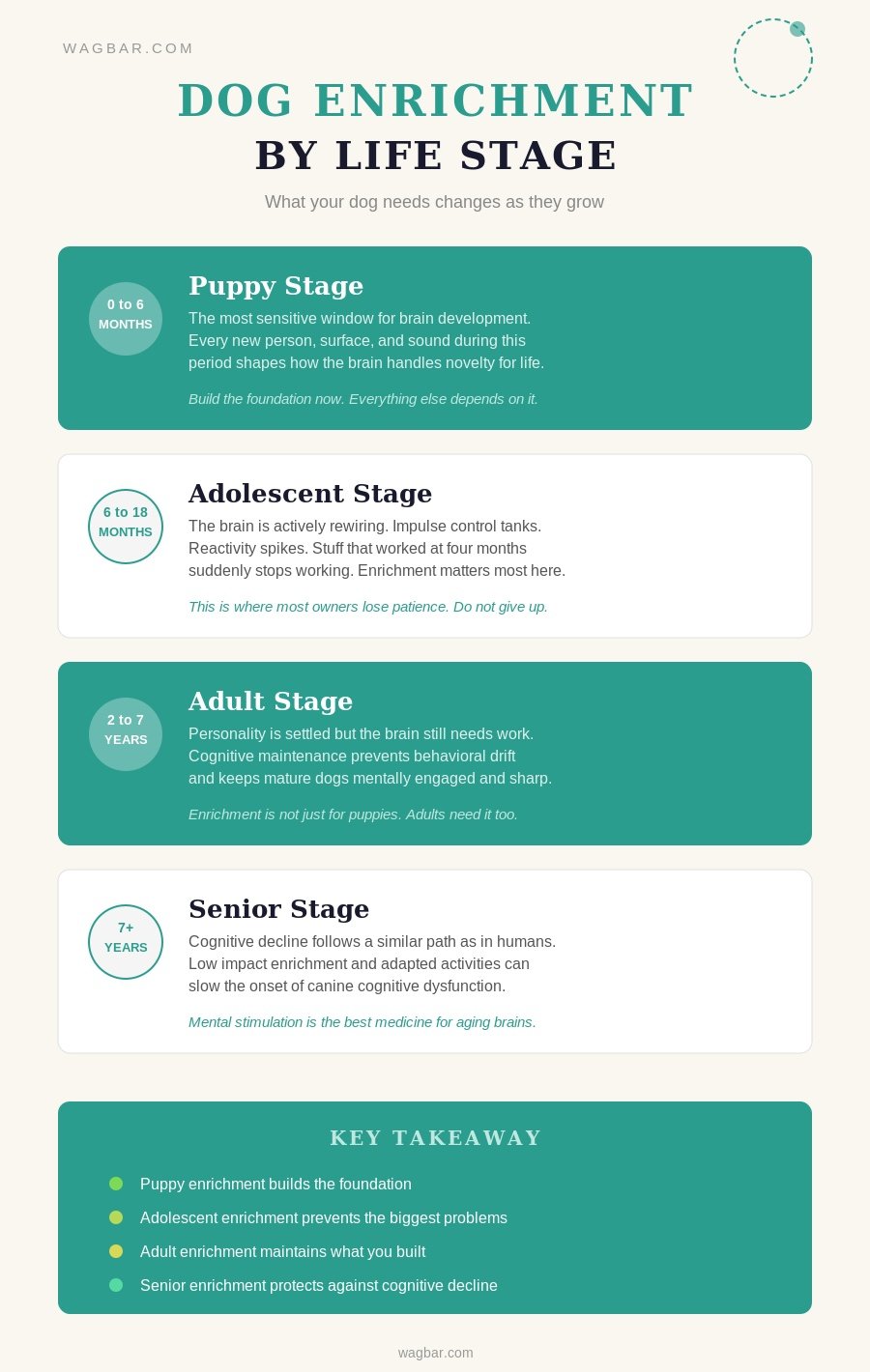
A puppy's enrichment needs look nothing like a senior dog's. What works for an adolescent will overwhelm a fearful older dog. Matching your approach to where your dog actually is in their development right now makes all the difference.
Puppy Enrichment: Birth Through 6 Months
The first six months are the most sensitive window in a dog's entire life. Every new experience during this period shapes how the brain handles novelty for years to come. Puppy enrichment gets into socialization windows, safe exposure protocols, age appropriate challenges, and how to build a foundation that prevents fear and anxiety down the road.
Adolescent Dog Enrichment: The 6 to 18 Month Window
Adolescence is when most owners hit a wall. The dog has energy, opinions, and a brain that is actively rewiring itself. Impulse control tanks. Reactivity spikes. Stuff that worked at four months suddenly stops working. Adolescent dog enrichment addresses why enrichment during this window matters more than almost anything else you can do.
Adult Dog Enrichment and Cognitive Maintenance
Just because your dog graduated from the puppy and adolescent phases does not mean enrichment becomes optional. Adult dog enrichment is about maintaining cognitive sharpness, preventing behavioral drift, and keeping a mature dog mentally engaged through strategies designed for dogs who have settled into their personality but still need their brain working.
Senior Dog Enrichment and Cognitive Decline Prevention
Cognitive decline in dogs follows a similar path to cognitive decline in humans. And just like in humans, mental stimulation can slow it down. Senior dog enrichment gets into low impact strategies, how to adapt activities for dogs with physical limitations, and the research linking lifelong enrichment to delayed onset of canine cognitive dysfunction.
Enrichment for Specific Situations
Not every dog fits neatly into an age bracket. Some dogs have circumstances that call for a more targeted approach.
Enrichment for Home-Alone Dogs
Most pet dogs spend eight to ten hours a day by themselves. That is a long stretch for a social animal with nothing to do. Enrichment for home-alone dogs gets into strategies for keeping your dog mentally occupied while you are at work, including timed feeders, rotating toy systems, and environmental setups that make solo hours less mind numbing.
Enrichment for Anxious and Fearful Dogs
Anxious dogs need enrichment, but the wrong kind can backfire. Overstimulation, unpredictable challenges, and forced social interaction can increase fear instead of reducing it. Enrichment for anxious dogs breaks down how to introduce stimulation gradually, which activities build confidence without overwhelming, and how to read your dog's feedback in real time during enrichment sessions.
High-Energy Breed Enrichment Protocols
Border Collies, Australian Shepherds, Malinois, and other working breeds have enrichment needs that go way beyond what a puzzle toy can handle. These dogs were bred to solve complex problems for hours at a time. High-energy breed enrichment offers protocols designed to match the intensity these breeds require without creating a dog that can never settle down.
Enrichment for Reactive Dogs
Reactivity is often a symptom of frustration, fear, or overstimulation rather than a standalone problem. Enrichment for reactive dogs looks at how targeted enrichment can lower baseline arousal, improve impulse control, and give reactive dogs an outlet for the mental energy that currently fuels their reactions. Not a replacement for behavior modification but a critical piece of the puzzle.
Budget-Friendly DIY Dog Enrichment
You do not need expensive gear to enrich your dog's life. A muffin tin, some tennis balls, a cardboard box, and treats from your kitchen can create activities that are just as effective as anything you would buy at a pet store. DIY dog enrichment is packed with ideas that cost next to nothing.
The Science Behind It
Enrichment is not a feel good trend. It is backed by decades of research in animal behavior, neuroscience, and veterinary medicine.
The Science of Canine Cognition and Enrichment
Dogs can count. They remember sequences. They read human gestures. They solve problems they have never seen before. The science of canine enrichment summarizes the research on canine cognition and how enrichment activities interact with brain chemistry, neural development, and learning capacity. Understanding the science makes you better at designing enrichment that actually hits.
Canine Cognitive Dysfunction: Enrichment as Prevention
Canine cognitive dysfunction affects a significant percentage of dogs over the age of eleven. Symptoms include disorientation, disrupted sleep cycles, loss of house training, and decreased social interaction. Enrichment as prevention for cognitive dysfunction reviews the research on how lifelong mental stimulation can delay or reduce the severity of age related cognitive decline.
Enrichment and Behavior Modification
A lot of behavior problems that owners chalk up to stubbornness or poor training are actually enrichment deficits wearing a different costume. Enrichment and behavior modification examines the research connecting enrichment protocols to measurable improvements in destructive behavior, separation anxiety, compulsive behaviors, and reactivity.
Tools and Products Worth Your Money
The pet industry is overflowing with enrichment products. Some of them are genuinely great. Others are overpriced versions of things you could build with stuff already in your house.
Puzzle Toys and Interactive Feeders
Not all puzzle toys are created equal. Some are too easy and your dog cracks them in seconds. Others are too frustrating and your dog gives up or destroys them out of spite. Puzzle toys and interactive feeders reviews options by difficulty level, durability, and enrichment value so you can match the right toy to the right dog.
Lick Mats, Snuffle Mats, and Slow Feeders
Licking is a self soothing behavior for dogs. Snuffling activates the olfactory system. Slow feeding stretches mealtime from seconds to minutes. Lick mats, snuffle mats, and slow feeders gets into how each of these tools works, when to reach for them, and how to build them into a daily enrichment rotation that does not feel like a chore.
Interactive vs Passive Dog Toys
Some toys require your dog to actively engage with them. Others collect dust in the corner until somebody picks them up and throws them. Both have a place but they serve very different purposes. Interactive vs passive dog toys breaks down the difference and when each type is most useful in your dog's routine.
Enrichment in a Professional Setting
There is a real difference between enrichment at home and enrichment designed by people who study canine behavior for a living.
Enrichment at Wagbar: The Off-Leash Social Model
Wagbar's approach to enrichment goes beyond toys and treats. It is built around the idea that dogs need social enrichment in an off-leash environment where they can interact freely with other dogs under professional supervision. The space, the staffing, the screening process, and the daily routine are all designed to deliver something that most home setups simply cannot replicate.
Supervised Social Enrichment vs Unstructured Dog Park Play
Dog parks and professional enrichment spaces both involve dogs playing together. The similarity ends there. Supervised vs unstructured play goes into why supervision quality, space design, dog screening, and staff training create fundamentally different outcomes for your dog's social development and safety.
The Wagbar Enrichment Experience
What does a visit actually look like from start to finish? The Wagbar enrichment experience walks you through what your dog encounters from the moment you walk in, how staff manage group dynamics throughout the session, and why dogs who visit on a regular basis show noticeable improvements in confidence, social skills, and overall behavior.
Start With One Thing
You do not need to overhaul your dog's entire routine by tomorrow morning. Pick one enrichment activity from one category. A frozen Kong at breakfast. A ten minute sniff walk after dinner. A new texture on the floor. One new experience per week.
Then build from there. Go deeper into whatever your dog responds to most. The goal is not perfection. It is a dog whose brain gets to do what it was built for every single day.
Find your nearest Wagbar and add a supervised play session to your dog's enrichment rotation. Or learn about the franchise opportunity and what it takes to bring Wagbar to your market.