

High-Energy Breed Enrichment: Your Dog Is Not High-Energy, They Are High-Drive With No Job
Top TLDR: Most high-energy breed owners try to solve behavior problems with more exercise. Three-hour walks. Two sessions of fetch. A run before work and a run after. The dog is still wired. The problem is not energy. It is drive. Coppinger's predatory motor sequence research shows that selective breeding amplified different behavioral drives in different breeds. Herding dogs need to problem-solve and control movement. Prey-drive dogs need to chase and catch. Retrievers need to carry and deliver. Guardians need to patrol and assess. A walk satisfies none of these. What follows sorts breeds by drive type, not energy level, and matches each cluster to the enrichment that actually satisfies what their brain was built to do. Four drive clusters. Four protocols. Four weekly schedules.
You walk your dog for an hour every morning. Another hour at night. On weekends, you add a hike. You throw the ball until your arm gives out. And your dog is still destroying furniture, barking at nothing, spinning in circles, or staring at you like you owe them something.
You do not have a high-energy dog. You have a high-drive dog with no job. And no amount of walking will fix that.

Energy vs Drive: The Distinction That Changes Everything
Energy is a gas tank. Drive is a purpose.
A high-energy dog has a large gas tank. They can run farther, play longer, and recover faster than low-energy breeds. But energy is directionless. It does not care what it is spent on. Walking burns energy. So does destroying your couch.
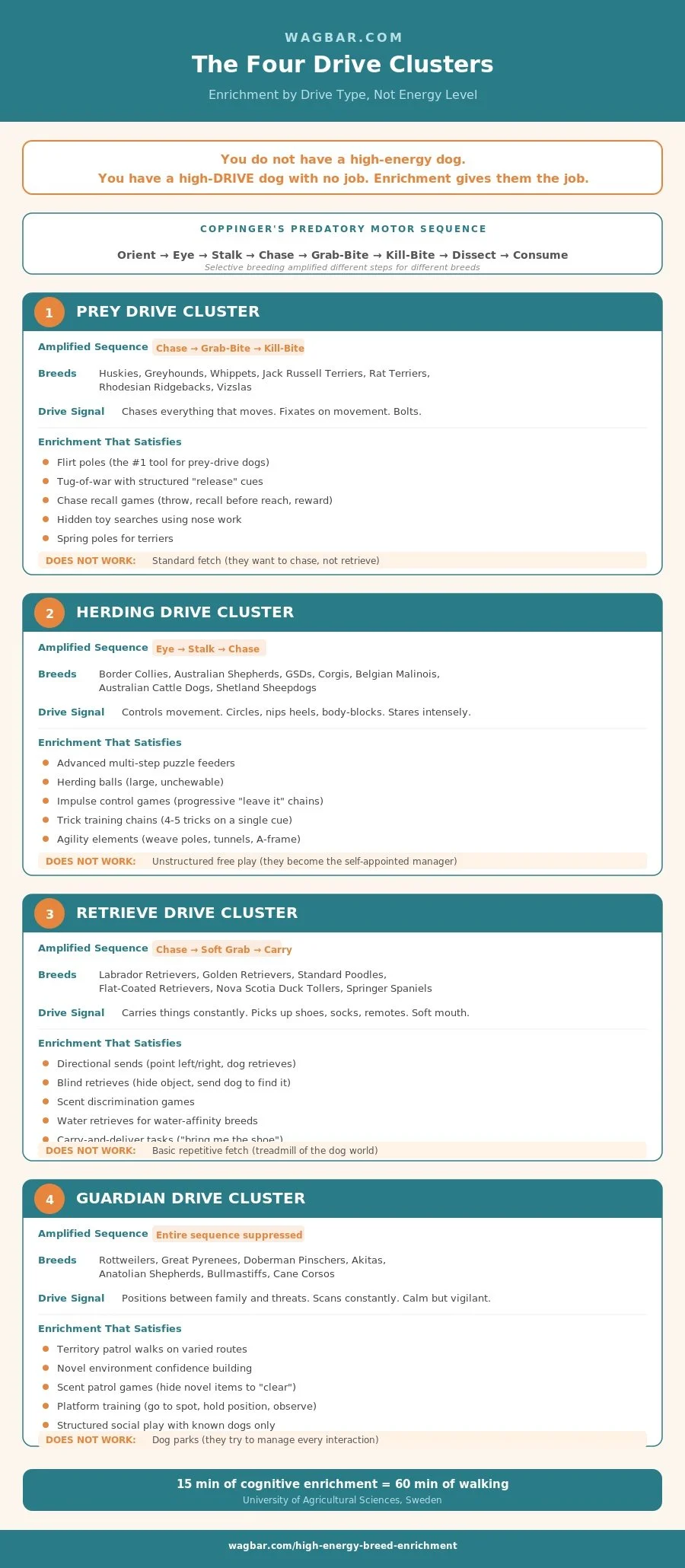
Drive is different. Drive is a behavioral need wired into the breed's genetics over thousands of years of selective breeding. Raymond Coppinger's foundational research on the predatory motor sequence identifies the full chain that wolves use to hunt. Orient, eye, stalk, chase, grab-bite, kill-bite, dissect, consume. Every dog carries this sequence in their DNA. But selective breeding amplified certain steps and suppressed others depending on what humans needed from each breed.
Border Collies were bred with exaggerated eye and stalk. That is the famous "collie eye" that pins sheep in place. Terriers were bred with exaggerated grab-bite and kill-bite. That is why your Jack Russell shakes every toy like it owes them money. Retrievers were bred with amplified chase and a soft grab. That is why your Lab carries things around the house with a gentle mouth. Livestock guardians had the entire predatory sequence suppressed. That is why your Great Pyrenees treats sheep like family instead of food.
When a high-drive dog does not get to express the specific part of the sequence their breed was built for, the drive does not disappear. It redirects. Your Border Collie herds your children. Your Husky chases the cat. Your Lab mouths everything in sight. Your terrier kills every stuffed animal within 30 seconds.
Exercise alone drains the gas tank. Drive-matched enrichment satisfies the purpose. One leaves your dog physically tired but mentally restless. The other leaves your dog genuinely fulfilled.
The Four Drive Clusters
Every high-energy breed falls into one of four drive clusters. Some carry traits from more than one, but one drive always dominates. Match the enrichment to the dominant drive and the behavior problems shrink dramatically.
Prey Drive Cluster

Breeds. Huskies, Greyhounds, Whippets, Terriers (Jack Russell, Rat Terrier, Cairn), Rhodesian Ridgebacks, Vizslas.
What the drive looks like. These dogs chase things. Birds, squirrels, cats, leaves, shadows, light reflections. They fixate on movement. They bolt. They lock onto a target and everything else disappears. The world is divided into two categories. Things that move and things that do not matter.
Enrichment that satisfies it. Flirt poles (the single best tool for prey-drive dogs). Tug-of-war with structured "release" cues. Chase recall games (throw a toy, call the dog back before they reach it, reward the recall). Hidden toy searches where the dog uses nose work to locate a favorite toy. Spring poles for terriers who need to grab and shake.
What does not work. Standard fetch. Prey-drive dogs do not want to bring the ball back. They want to chase it. Endless fetch with no cognitive component is just cardio with extra steps.
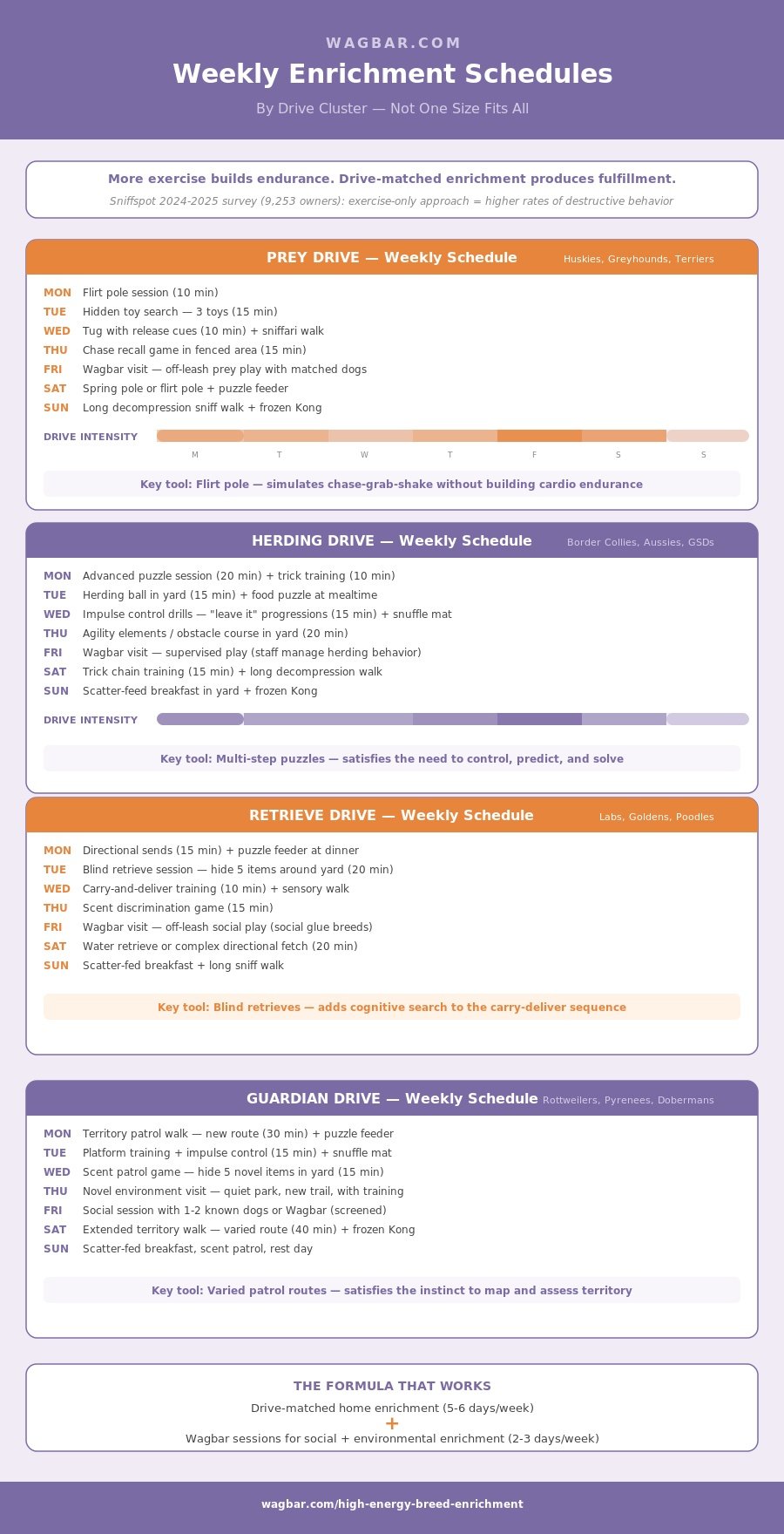
Weekly schedule. Monday, flirt pole session (10 minutes). Tuesday, hidden toy search (3 toys, 15 minutes). Wednesday, tug with release cues (10 minutes) plus a sniffari walk. Thursday, chase recall game in a fenced area (15 minutes). Friday, Wagbar visit for off-leash prey play with matched dogs. Saturday, spring pole or flirt pole plus puzzle feeder. Sunday, long decompression sniff walk plus a frozen Kong.
Herding Drive Cluster
Breeds. Border Collies, Australian Shepherds, German Shepherds, Corgis (Pembroke and Cardigan), Belgian Malinois, Australian Cattle Dogs, Shetland Sheepdogs.
What the drive looks like. These dogs need to control movement. They circle, nip heels, body-block, and position themselves between things. They stare with unnerving intensity. They notice everything and react to everything. A 2024 study published in Science Advances found genomic evidence that herding behavior in dogs represents a genetically selected modification of the predatory motor sequence, with the eye-stalk phase dramatically amplified.
Enrichment that satisfies it. Cognitive puzzles that require multi-step problem-solving (advanced puzzle feeders, stacking puzzles). Herding balls (large, unchewable balls the dog pushes around the yard). Impulse control games (progressive "leave it" chains, "wait" games with escalating distraction). Trick training chains (chain 4 to 5 tricks into a sequence the dog performs on a single cue). Agility elements (weave poles, tunnel, A-frame) that channel the need to control movement through a structured course.
What does not work. Unstructured free play without rules. Herding dogs without a task become the self-appointed manager of every dog in the park. They need structure and a problem to solve, not chaos.
Weekly schedule. Monday, advanced puzzle session (20 minutes) plus trick training (10 minutes). Tuesday, herding ball in the yard (15 minutes) plus a food puzzle at mealtime. Wednesday, impulse control drills (leave it progressions, 15 minutes) plus a snuffle mat. Thursday, agility elements or obstacle course in the yard (20 minutes). Friday, Wagbar visit for supervised play (herding dogs especially benefit from supervised settings where staff manage their tendency to over-manage other dogs). Saturday, trick chain training (15 minutes) plus a long decompression walk. Sunday, scatter-feed breakfast in the yard plus a frozen Kong.
Retrieve Drive Cluster
Breeds. Labrador Retrievers, Golden Retrievers, Standard Poodles, Flat-Coated Retrievers, Nova Scotia Duck Tolling Retrievers, Springer Spaniels.
What the drive looks like. These dogs need to carry things. To find things and bring them back. To put their mouth on something and deliver it somewhere. They pick up shoes, socks, remote controls, anything within reach. They greet you with something in their mouth. The retrieve drive is not about the throw. It is about the find, the carry, and the delivery.
Enrichment that satisfies it. Complex fetch variations that add cognitive components. Directional sends (point left or right, dog retrieves from the indicated direction). Blind retrieves (dog waits while you hide the object, then send them to find it). Water retrieves for breeds with water affinity. Scent discrimination games (3 identical objects, one scented with a target odor, dog retrieves only the scented one). Carry-and-deliver tasks (teach the dog to bring you named items from another room).
What does not work. Basic repetitive fetch (throw, retrieve, throw, retrieve). This satisfies the motor pattern for about 10 minutes. After that, the dog is running on physical autopilot with zero cognitive engagement. It is the treadmill of the dog world.
Weekly schedule. Monday, directional sends (15 minutes) plus a puzzle feeder at dinner. Tuesday, blind retrieve session (hide 5 items around the yard, 20 minutes). Wednesday, carry-and-deliver training (10 minutes of "bring me the shoe" or "find the keys") plus a sensory walk. Thursday, scent discrimination game (15 minutes). Friday, Wagbar visit for off-leash social play (retrievers thrive in social environments and are often the social glue in group settings). Saturday, water retrieve or complex fetch with directional cues (20 minutes). Sunday, scatter-fed breakfast plus a long sniff walk.
Guardian Drive Cluster
Breeds. Rottweilers, Great Pyrenees, Doberman Pinschers, Akitas, Anatolian Shepherds, Bullmastiffs, Cane Corsos.
What the drive looks like. These dogs need to assess and patrol. They position themselves between their family and potential threats. They scan constantly. They are calm when the environment is predictable and vigilant when it is not. The drive is not aggression. It is responsibility. Their brain is wired to evaluate every situation for safety.
Enrichment that satisfies it. Territory patrol walks on varied routes (environmental enrichment that lets the dog map and assess their territory). Novel environment confidence building (controlled introductions to new spaces at the dog's pace). Structured social hierarchy play (predictable interactions with known dogs, not chaotic dog-park free-for-alls). Scent patrol games (hide novel scent items around the yard for the dog to investigate and "clear"). Platform training (teaching the dog to go to a designated spot and hold position, satisfying the instinct to post up and watch).
What does not work. Dog parks. Unscreened off-leash chaos is the worst possible setting for guardian breeds. They will try to manage every interaction, which reads as aggression to other owners and escalates into conflict. Guardian dogs need supervised, structured play with dogs they know.
Weekly schedule. Monday, territory patrol walk on a new route (30 minutes) plus a puzzle feeder at dinner. Tuesday, platform training and impulse control (15 minutes) plus a snuffle mat. Wednesday, scent patrol game in the yard (hide 5 novel items, 15 minutes). Thursday, novel environment visit (quiet park, outdoor shopping area, new trail) with training exercises. Friday, social session with 1 to 2 known dogs or a Wagbar visit with temperament screening. Saturday, extended territory walk (varied route, 40 minutes) plus a frozen Kong. Sunday, scatter-fed breakfast, scent patrol, and a rest day.
Why Off-Leash Social Play Is Non-Negotiable for High-Drive Dogs
High-drive dogs burn cognitive energy fastest in social settings. Not because socializing is physically demanding, but because reading other dogs in real time is the most complex cognitive task a dog can perform.
Research from the University of Agricultural Sciences in Sweden found that dogs performing cognitive tasks showed measurable fatigue comparable to dogs who completed physical exercise. Fifteen minutes of focused scent work produces the same mental fatigue as 60 minutes of walking. Social play combines scent processing, body language reading, spatial awareness, impulse regulation, and real-time decision-making simultaneously. It is the highest-bandwidth cognitive activity a dog can do.
That is why a 90-minute Wagbar session leaves your Border Collie calmer than a 3-hour hike. The hike emptied the gas tank. Wagbar satisfied the drive.
But the setting matters. An unscreened dog park is social chaos. A supervised enrichment environment is structured social complexity. The first creates more arousal. The second resolves it.
When More Exercise Makes Things Worse
Here is the part nobody tells you. More exercise can actually increase behavior problems in high-drive dogs.
A 2024 survey of over 9,000 dog owners by Sniffspot found that owners of high-drive breeds who relied primarily on physical exercise reported higher rates of destructive behavior, excessive barking, restlessness, and reactivity than owners who balanced physical exercise with cognitive enrichment.
The mechanism is simple. Physical exercise builds endurance. A dog who runs 5 miles today needs 6 miles tomorrow to reach the same level of fatigue. You are training an athlete while trying to solve a boredom problem. The gas tank gets bigger. The drive stays unsatisfied.
Cognitive enrichment does the opposite. It produces genuine fatigue without building cardiovascular capacity. And drive-matched enrichment produces the deepest fatigue of all because it satisfies the specific behavioral need the breed was built for.
Your Border Collie does not need a longer walk. They need a harder puzzle. Your Husky does not need more miles. They need a flirt pole. Your Lab does not need more fetch. They need a blind retrieve. Your Rottweiler does not need a bigger yard. They need a varied patrol route and a novel environment to assess.
The Multi-Drive Dog
Some breeds carry strong traits from more than one cluster. German Shepherds carry both herding and guardian drive. Malinois carry herding, prey, and guardian. Vizslas carry prey and retrieve. Springer Spaniels carry retrieve and prey.
For multi-drive dogs, identify the dominant drive (the one that causes the most behavioral problems) and build the weekly schedule around that cluster's protocol. Then add 2 to 3 sessions per week from the secondary drive cluster.
A German Shepherd whose dominant drive is herding gets the herding cluster schedule with 2 guardian sessions added (territory patrol walk and scent patrol game). A Malinois whose dominant drive is prey gets the prey cluster schedule with 2 herding sessions (advanced puzzles and impulse control drills).
The weekly schedule is not a rigid prescription. It is a diagnostic tool. If the behavior problems persist, you are enriching the wrong drive. Switch clusters and observe.
The Wagbar Difference for High-Drive Dogs
Wagbar was designed for dogs like yours. Not the ones who sleep 18 hours a day. The ones who stare at you for 8.
The Wagbar enrichment model combines all five categories simultaneously. Cognitive, sensory, social, environmental, and food. For high-drive dogs, that combination is irreplaceable. No home setup can simulate the social complexity of a multi-dog environment monitored by trained staff. No backyard can provide the environmental novelty of a purpose-built enrichment facility. No fetch session can replicate the cognitive bandwidth of real-time social play.
Two to three Wagbar sessions per week, combined with a drive-matched home enrichment schedule, is the formula that actually works for high-drive breeds. The Wagbar sessions fill the social and environmental tanks. The home schedule maintains drive satisfaction on the days in between. Together, they produce a dog who is genuinely fulfilled, not just tired.
Or explore the franchise opportunity and build the space where every under-enriched high-drive dog in your city finally gets a job.
FAQs
How much enrichment does a high-drive dog need per day?
Minimum 30 minutes of drive-matched cognitive enrichment plus physical exercise. The enrichment and the exercise are not interchangeable. A 30-minute walk plus a 15-minute puzzle session will produce a calmer dog than a 90-minute walk alone. Most high-drive breed owners overinvest in physical exercise and underinvest in cognitive enrichment. Flip the ratio.
Can I use the same enrichment for all high-drive breeds?
No. That is the entire point of drive clustering. A puzzle toy that fulfills a herding dog's need to problem-solve does nothing for a prey-drive dog's need to chase. A flirt pole that satisfies a terrier's grab-bite sequence is pointless for a retriever who wants to carry and deliver. Match the tool to the drive.
What if my high-energy dog is also reactive?
Reactivity in high-drive dogs is almost always under-enrichment wearing a different mask. A dog whose drive has nowhere to go becomes hypervigilant, over-aroused, and unable to regulate in social settings. Start with the home enrichment schedule for your dog's drive cluster. Build drive satisfaction before attempting social enrichment. Many reactive dogs become dramatically calmer once their drive is consistently satisfied.
Is my high-drive dog too much for Wagbar?
High-drive dogs are exactly who Wagbar was built for. The screening process ensures that every dog entering the space can handle the social dynamics, and staff manage high-drive behaviors (herding other dogs, over-the-top play, possessiveness) in real time. A high-drive dog who is consistently enriched at home and attending Wagbar 2 to 3 times per week is a fundamentally different animal than the same dog with no enrichment and no social outlet.
Give Your Dog a Job Before They Give Themselves One
Your dog was bred to work. Herding sheep. Flushing game. Guarding livestock. Retrieving birds from frozen water at dawn. That work does not exist anymore for most of these breeds. But the drive is still there. Every single day. And it will express itself one way or another.
You can either match the enrichment to the drive and watch the behavior problems disappear. Or you can keep adding miles and wondering why your dog is still staring at you at 9 PM like the day has not started yet.
The walk is not enough. The fetch is not enough. The dog park is not enough. The drive needs a job. Give them one.
Bottom TLDR: High-energy breed behavior problems are drive problems, not energy problems. Coppinger's predatory motor sequence research shows that selective breeding amplified different behavioral drives in different breeds. Four drive clusters, each requiring different enrichment. Prey Drive (Huskies, Greyhounds, Terriers) needs flirt poles, chase recall games, tug with release cues. Herding Drive (Border Collies, Aussies, GSDs, Malinois) needs multi-step puzzles, herding balls, impulse control drills, trick chains. Retrieve Drive (Labs, Goldens, Poodles) needs directional sends, blind retrieves, scent discrimination, carry-and-deliver tasks. Guardian Drive (Rottweilers, Great Pyrenees, Dobermans) needs territory patrol walks, novel environment confidence building, platform training. 15 minutes of cognitive enrichment produces the same fatigue as 60 minutes of walking. More exercise without drive-matched enrichment builds endurance while leaving the drive unsatisfied. Two to three Wagbar sessions per week combined with a drive-matched home schedule is the formula that works.