

Enrichment for Reactive Dogs: Reactivity Is a Symptom, Not a Personality

Top TLDR: An estimated 20 to 30% of dogs show some form of leash reactivity. Most reactive dog owners respond by avoiding triggers, which means avoiding other dogs, new environments, and social enrichment entirely. The dog gets less stimulation. The brain gets more frustrated. The reactivity gets worse. This is the frustration-reactivity loop, and avoidance feeds it. Enrichment breaks it. A 3-week Decompression Protocol (zero social pressure, daily nose work, sniffari walks, puzzle feeding) lowers the baseline. A 5-month progression builds from solo enrichment to supervised group play. Some reactive dogs become dog-bar dogs. Some do not. Both outcomes are valid. What matters is that the enrichment path starts.
Your dog lunges at other dogs on walks. They bark, they pull, they lose their mind at the end of the leash. Maybe they have snapped. Maybe they have not, but it looks like they might. You cross the street when you see another dog. You walk at odd hours. You stopped going to the park. You definitely stopped considering places like Wagbar.
You are not alone. Research estimates that 20 to 30% of dogs exhibit some form of leash reactivity. It is one of the most common behavioral concerns pet owners report. And the way most owners manage it, total avoidance, is the exact thing making it worse.
The Frustration-Reactivity Loop
Reactivity is not aggression. It is an emotional over-response to a stimulus the dog cannot process at a manageable arousal level. The dog sees another dog, or a person, or a bicycle, and their nervous system launches past the threshold where rational behavior is possible. They are not choosing to lunge. They are flooded.
Here is what nobody explains. Most reactive dogs are also chronically under-enriched. And those two things are not a coincidence.
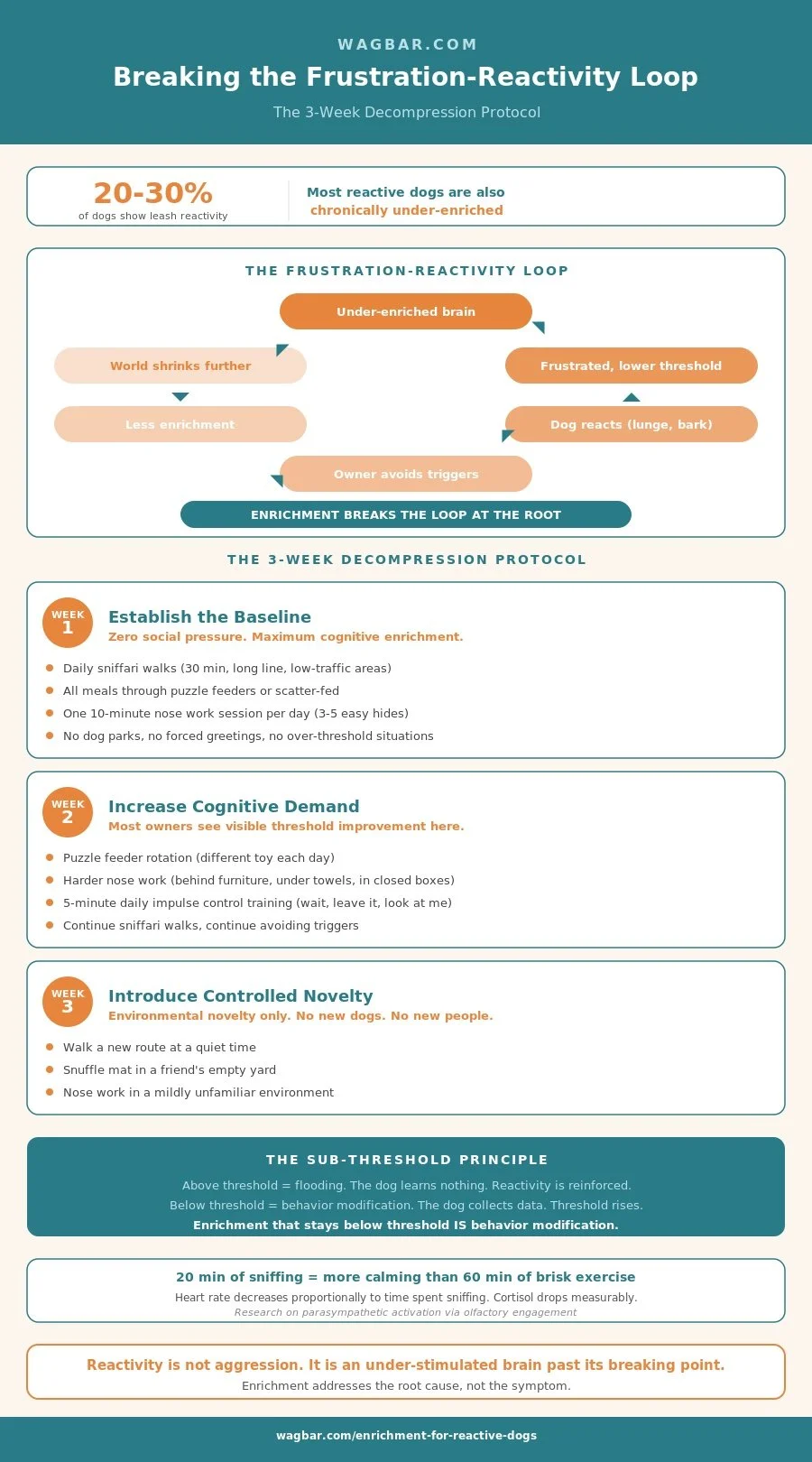
The loop works like this. An under-enriched dog has a frustrated brain. A frustrated brain has a lower threshold for reactivity. The dog reacts. The owner avoids the trigger. Avoidance means fewer walks, fewer environments, fewer social encounters. Less enrichment. The brain gets more frustrated. The threshold drops further. The next reaction comes faster and harder.
The owner did not cause the reactivity. But the avoidance response, the completely understandable avoidance response, accelerates it. Every trigger avoided is enrichment denied. Every walk shortened is cognitive stimulation lost. The dog's world shrinks. Their tolerance shrinks with it.
Enrichment breaks the loop by addressing the root cause (under-stimulated brain), not the symptom (lunging and barking). A dog whose cognitive needs are met has a higher threshold. A higher threshold means fewer reactions. Fewer reactions mean more opportunities for positive experiences. More positive experiences mean a bigger world. The loop reverses.

Why Standard Enrichment Advice Fails Reactive Dogs
Most enrichment advice assumes a dog who can tolerate novelty, social contact, and environmental change. Reactive dogs cannot. Not yet.
Telling a reactive dog owner to take their dog to the park for enrichment is like telling someone with a broken leg to go for a jog. The prescription is correct in principle and catastrophic in timing. The dog needs enrichment desperately. But the type and sequence matter as much as the enrichment itself.
Reactive dogs need enrichment that builds cognitive capacity and emotional regulation without triggering the reactive response. That means starting with zero social pressure and building from there. It means calming enrichment before stimulating enrichment. It means nose work before playdates. It means patience measured in weeks and months, not days.
The 3-Week Decompression Protocol
Before any progression work begins, the reactive dog's nervous system needs a reset. Three weeks. Zero social pressure. Maximum cognitive enrichment.
Week 1. Establish the baseline. Daily sniffari walks (30 minutes of nose-led walking on a long line, in low-traffic areas, at low-traffic times). All meals served through puzzle feeders or scatter-fed in the yard. One 10-minute nose work session per day (hide 3 to 5 treats in easy spots around the house). No dog parks. No forced greetings. No situations where the dog might go over threshold.
Research shows that sniffing activates the parasympathetic nervous system and produces measurable cortisol reduction. Heart rate decreases proportionally to time spent sniffing. Twenty minutes of unhurried sniffing can be more mentally tiring, and more calming, than an hour of brisk exercise.
Week 2. Increase cognitive demand. Add a puzzle feeder rotation (different toy each day to prevent habituation). Increase nose work difficulty (hide treats behind furniture, under towels, in closed boxes). Add a 5-minute training session daily (impulse control exercises like "wait," "leave it," and "look at me"). Continue sniffari walks. Continue avoiding triggers.
Week 3. Introduce controlled novelty. Walk a new route at a quiet time. Bring a snuffle mat to a friend's empty yard and let the dog explore at their own pace. Practice nose work in a mildly unfamiliar environment (a garage, a quiet corner of a parking lot). The novelty is environmental only. No new dogs. No new people.
Most owners report visible threshold improvement by the end of Week 2. The dog is calmer on walks. Less scanning. Less pulling. The reactions that do occur are less intense and recover faster. This is not the dog being "fixed." This is a brain that finally has enough cognitive input to operate below its breaking point.
The Sub-Threshold Principle
The decompression protocol works because it keeps the dog below threshold at all times. This is the single most important concept in reactive dog enrichment.
Above threshold, the dog is learning nothing. They are flooded. Their prefrontal cortex (the part that handles impulse control and decision-making) is offline. The amygdala is running the show. Every above-threshold experience reinforces the reactive pattern. The dog lunges, the other dog moves away, the behavior is rewarded.
Below threshold, the dog can think. They can process. They can learn that the world is not as threatening as their nervous system believes. Every below-threshold experience weakens the reactive pattern. The dog sees another dog at a distance. Nothing bad happens. Data point collected. Threshold moves up slightly.
Enrichment that keeps the dog below threshold is behavior modification. Enrichment that pushes the dog over threshold is flooding. The line between those two things is where most reactive dog owners accidentally make things worse.
The 5-Month Progression Timeline
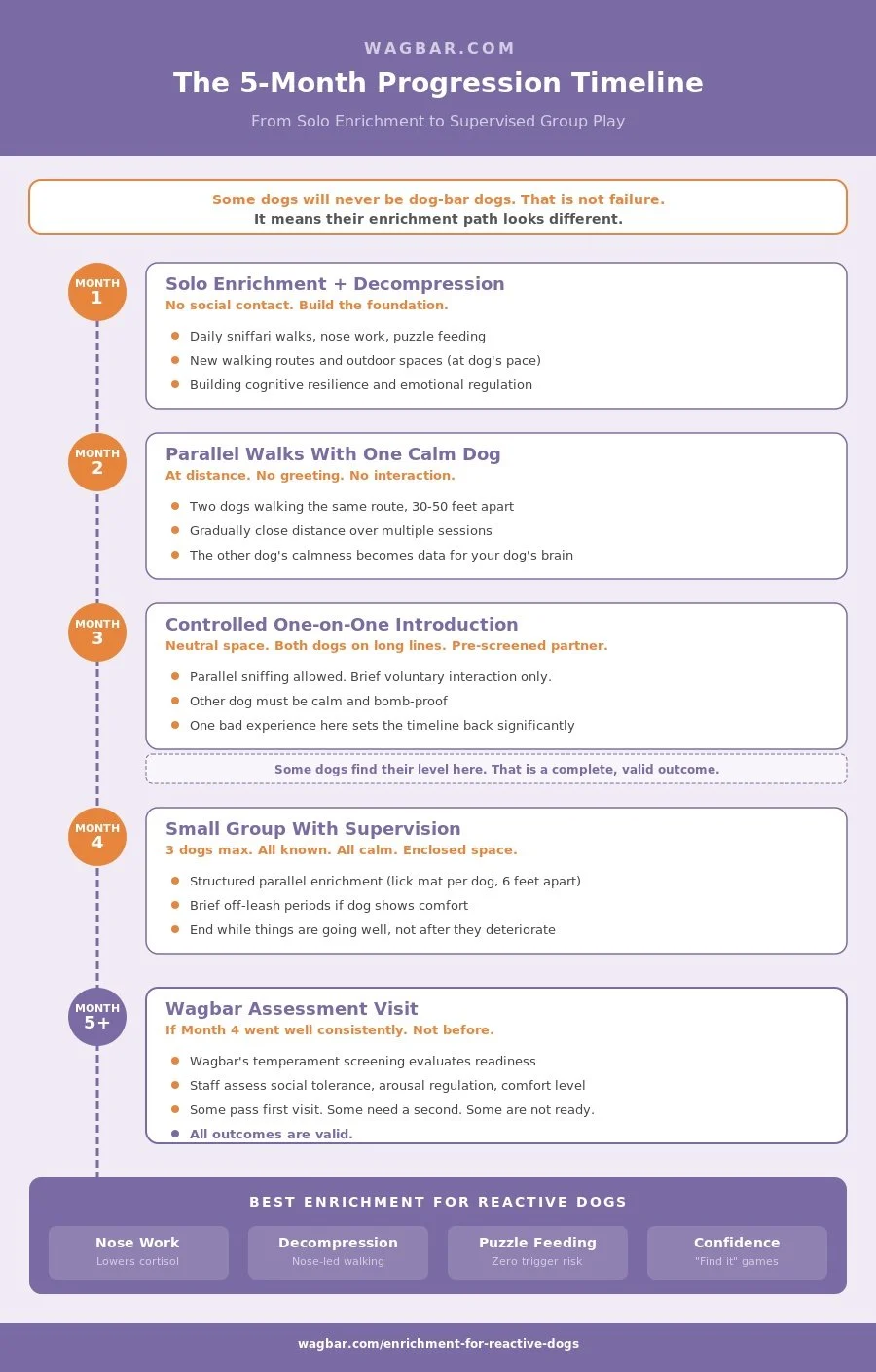
After the 3-week decompression protocol, the progression begins. This is not a rigid schedule. Some dogs move faster. Some move slower. Some skip a month. Some repeat one. The timeline is a map, not a mandate.
Month 1. Solo enrichment plus decompression continuation. Maintain the daily sniffari, nose work, and puzzle feeding routine. Add environmental enrichment (new walking routes, new surfaces, new outdoor spaces) at a pace the dog can handle. The dog is building cognitive resilience and emotional regulation in the absence of social triggers.
Month 2. Parallel walks with one calm dog at distance. Not a greeting. Not a playdate. Two dogs walking the same route, 30 to 50 feet apart, gradually closing the distance over multiple sessions. The reactive dog sees the other dog repeatedly in a calm context. Below threshold. No pressure to interact. The other dog's calmness becomes data. "That dog exists and nothing bad happened."
Month 3. Controlled one-on-one introduction. In a neutral space. Both dogs on long lines. Parallel sniffing allowed. Brief, voluntary interaction only. The other dog must be pre-screened and bomb-proof. One bad experience here sets the timeline back significantly. This is not the month to wing it.
Month 4. Small group with supervision. Three dogs maximum. All known. All calm. In a familiar, enclosed space. Structured parallel enrichment (a lick mat for each dog, 6 feet apart). Brief off-leash periods if the reactive dog shows comfort. End while things are going well, not after they deteriorate.
Month 5 and beyond. Wagbar assessment visit. If the dog has handled Month 4 consistently, they may be ready for Wagbar's screening. The temperament assessment exists for exactly this moment. Staff evaluate whether the dog can handle the social complexity of a multi-dog environment. Some reactive dogs pass on the first visit. Some need a second. Some are not ready.
And some dogs will never be dog-bar dogs. That is not failure. It means their enrichment path looks different. A dog who thrives at Month 3 (one-on-one playdates with known dogs) but cannot handle Month 4 (small groups) is not broken. They have found their level. Their enrichment plan stays at that level, and they live a rich, fulfilled life within it.
Enrichment That Reduces Reactivity
Not all enrichment is equally useful for reactive dogs. The best activities share three traits. They burn cognitive energy. They activate the parasympathetic nervous system. And they build confidence through success.
Nose work. The single most effective enrichment for reactive dogs. Sniffing lowers cortisol, occupies cognitive bandwidth that would otherwise feed hypervigilance, and requires zero social interaction. Start with treats hidden in plain sight. Progress to complex searches. A daily 15-minute nose work session produces more threshold improvement than an hour of walking.
Decompression walks. Long-line walks where the dog leads. No heel. No agenda. No corrections. The dog sniffs whatever they want for as long as they want. The walk is for their nose, not your steps.
Puzzle feeding. Every meal through a puzzle feeder, scatter feed, or snuffle mat. This adds 15 to 30 minutes of daily cognitive work with zero risk of triggering reactivity.
Confidence-building games. "Find it" games where the dog always succeeds. Platform training where the dog learns to go to a designated spot and hold position (gives them a "job" during high-arousal moments). Trick training that produces frequent rewards.
When Enrichment Is Not Enough
Enrichment is behavior modification for the brain. But some reactive dogs have underlying conditions that enrichment alone cannot address.
If the dog shows signs of clinical anxiety (self-harm, inability to eat in any novel context, extreme fear responses that do not diminish over weeks of decompression), consult a veterinary behaviorist. If the reactivity includes genuine aggression (biting with intent, not air-snapping), professional assessment is not optional. If the dog has been reactive for years without intervention, the behavioral patterns may be deeply entrenched and require medication alongside enrichment.
Enrichment is almost always part of the treatment plan. But sometimes it is not the whole plan.
Wagbar's Role in the Reactive Dog Journey
Wagbar is not the starting point for a reactive dog. It may be the destination. Or it may not be.
The Wagbar model was built with screening for a reason. Not every dog is ready for multi-dog social enrichment, and pretending otherwise serves no one. The assessment process evaluates temperament, social tolerance, and arousal regulation. Dogs who pass get access to the highest-bandwidth enrichment experience available. Cognitive, sensory, social, environmental, and food enrichment running simultaneously in a supervised setting.
For reactive dogs who reach this level, the impact is transformative. Regular supervised social play rewires the associations that drive reactivity. The dog learns, through hundreds of sub-threshold repetitions, that other dogs are not threats. That arousal can go up and come back down. That the world contains more data points of safety than danger.
Or explore the franchise opportunity and build the supervised enrichment environment that reactive dog owners in your city have been searching for. Not a dog park. Not a free-for-all. A screened, staffed, enrichment-first space where even the reactive ones get a fair shot.
FAQ
How long does the decompression protocol take to show results?
Most owners see measurable improvement by the end of Week 2. Calmer walks. Less scanning. Faster recovery from mild triggers. Full threshold shifts take 4 to 8 weeks of consistent daily enrichment. The decompression protocol is the foundation, not the fix. The fix is the sustained enrichment practice that follows it.
Can enrichment replace behavior modification training?
Enrichment is a form of behavior modification. It addresses the neurological conditions (under-stimulation, chronic frustration, low threshold) that produce reactivity. Traditional behavior modification techniques (counter-conditioning, desensitization, BAT training) work alongside enrichment. Neither replaces the other. Together, they are more effective than either alone.
Is my reactive dog too dangerous for group enrichment?
Reactivity is not aggression. Most reactive dogs bark and lunge but do not bite. If your dog has a bite history with intent to harm (not air-snapping or muzzle-punching), consult a veterinary behaviorist before any group enrichment. If your dog is reactive but has never caused injury, the 5-month progression timeline will tell you whether group enrichment is achievable. Trust the process, and trust what your dog tells you at each stage.
The Path Is the Point
Your reactive dog may become a Wagbar regular who plays with 10 dogs on a Saturday morning. Or they may top out at one-on-one playdates with two known friends. Both are success. Both represent a dog whose world grew bigger than it was.
The frustration-reactivity loop runs on emptiness. An empty brain, an empty schedule, an empty world shrunk by avoidance. Enrichment fills it. Start the decompression protocol. Run it for three weeks. Watch what happens when a frustrated brain finally gets what it has been asking for.
Bottom TLDR: 20 to 30% of dogs show leash reactivity. Most reactive dogs are also chronically under-enriched. The frustration-reactivity loop works in a cycle. Under-enriched brain, lower threshold, reaction, owner avoidance, less enrichment, worse reactivity. Enrichment breaks the loop by addressing the root cause. The 3-week Decompression Protocol consists of daily sniffari walks, nose work, puzzle feeding, and zero social pressure. Most owners see threshold improvement by Week 2. The 5-month progression builds from solo enrichment (Month 1) to parallel walks at distance (Month 2), controlled one-on-one (Month 3), small group (Month 4), and Wagbar assessment (Month 5+). Some reactive dogs become dog-bar dogs. Some do not. Both outcomes are valid. Enrichment is behavior modification for the brain. Sniffing lowers cortisol and occupies cognitive bandwidth. Fifteen minutes of nose work produces more threshold improvement than an hour of walking.