

Enrichment for Anxious Dogs: Start Where Your Dog Is, Not Where You Want Them to Be
Top TLDR: Roughly 72% of dogs display at least one anxiety-related behavior. Noise sensitivity affects 32 to 39% of dogs. Separation anxiety affects 17%. General fearfulness affects 26%. Standard enrichment advice (puzzle toys, social play, novel environments) can overwhelm an anxious dog and make the problem worse. The Enrichment Ladder is a 5-rung progression that starts with solo calming enrichment at home and builds gradually toward group social enrichment in supervised settings. Research shows that sniffing activates the parasympathetic nervous system and lowers cortisol, making nose work the single best enrichment for anxious dogs. Your dog may not be ready for Rung 5. That is fine. Start at Rung 1.
If your dog is anxious, you have already read a lot of bad advice. Socialize them more. Expose them to the thing they fear until they "get over it." More exercise will tire them out and fix the problem. Enrichment will help. And then you handed your anxious dog a puzzle toy and watched them shut down, walk away, or panic.
That is enrichment for a confident dog forced onto a nervous one. The gap between those two things is where most anxious dog owners lose trust in enrichment entirely.
This is where that trust gets rebuilt.

The Four Faces of Canine Anxiety
Anxiety in dogs is not one condition. It is at least four, and each one responds differently to enrichment.
Noise sensitivity. The most common form, affecting 32 to 39% of dogs (Tiira et al., 2016; Storengen and Lingaas, 2015). Thunder, fireworks, construction, gunshots. The dog is not afraid of everything. They are afraid of specific sounds they cannot predict or control. Enrichment that introduces more unpredictable stimuli makes this worse.
General fearfulness. Affects roughly 26% of dogs. Fear of strangers, unfamiliar dogs, novel objects, and new environments. These dogs are not selectively afraid. Their baseline threat assessment is set too high.
Separation anxiety. Affects about 17% of dogs. Distress triggered by the absence of the attachment figure, not by the environment itself. Enrichment helps, but it does not replace the behavioral modification that addresses the underlying dysfunction.
Situational anxiety. Vet visits, car rides, grooming, specific locations. The anxiety is context-bound. Remove the context and the dog is fine. These dogs often respond fastest to enrichment because the triggers are predictable and containable.
A study of 13,700 Finnish pet dogs published in Scientific Reports found high comorbidity between these categories. Noise-sensitive dogs are significantly more likely to also show signs of fearfulness and separation distress. The anxious dog you are trying to help probably carries more than one of these.
That matters because the enrichment plan has to match the anxiety, not the other way around.
Why Standard Enrichment Can Make Things Worse
Most enrichment advice is written for confident dogs. Puzzle toys, new environments, social play, novel objects, varied walking routes. All of it assumes a baseline emotional state where novelty is interesting rather than threatening.
For an anxious dog, novelty is a trigger. A new puzzle toy is not a challenge. It is an unpredictable object in their safe space. A new walking route is not environmental enrichment. It is a flood of unfamiliar stimuli their already-overwhelmed brain cannot process. A playdate with an unknown dog is not social enrichment. It is a social threat they cannot navigate.
The owner tries enrichment. The dog gets worse. The owner concludes enrichment does not work. The dog gets nothing. Both lose.
Enrichment works for anxious dogs. But the type, intensity, and sequence have to match the dog's current emotional capacity, not the plan you wish they were ready for. That is where the Enrichment Ladder comes in.
The Enrichment Ladder
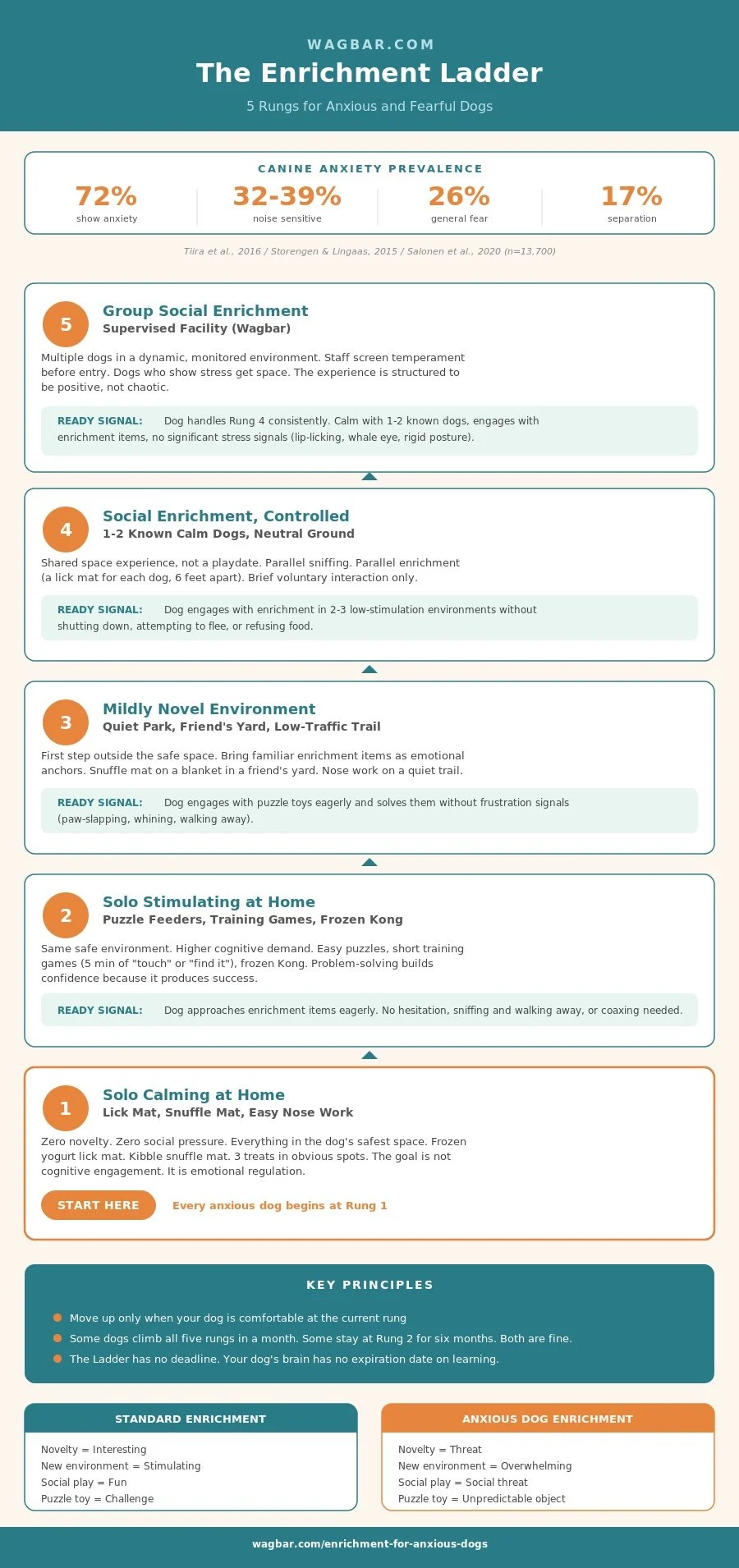
Five rungs. Start at the bottom. Move up only when your dog is comfortable at the current rung. Some dogs climb all five in a month. Some stay at Rung 2 for six months. Both are fine. The ladder is not a race. It is a diagnostic tool.
Rung 1: Solo Calming Enrichment at Home
The starting point for every anxious dog. Zero novelty. Zero social pressure. Zero environmental change. Everything happens in the dog's safest space with items that promote calm, not excitement.
A lick mat with frozen yogurt or pumpkin. Repetitive licking activates the parasympathetic nervous system and releases endorphins. A snuffle mat with kibble scattered through the folds. Gentle nose work in a single familiar room. Hide 3 treats in easy, obvious spots. Let the dog find them at their own pace.
The key word is calming. Not stimulating. Not challenging. Calming. The goal at Rung 1 is not cognitive engagement. It is emotional regulation. You are teaching your anxious dog that enrichment feels safe.
Stay here until your dog approaches enrichment items eagerly. If they hesitate, sniff and walk away, or need coaxing, they are not ready to move up.
Rung 2: Solo Stimulating Enrichment at Home
Same safe environment. Slightly higher cognitive demand. The dog has learned that enrichment items are safe. Now the items ask something of the brain.
Easy puzzle feeders (muffin tin with tennis balls, treat-dispensing ball, slide-and-reveal toy set to beginner level). Short training games (5 minutes of "touch," "spin," or "find it"). A frozen Kong that requires 20 minutes of sustained effort.
These activities ask the dog to problem-solve. Problem-solving builds confidence because it produces success. Every time your anxious dog solves a puzzle, their brain gets evidence that they can handle something unfamiliar. That evidence accumulates.
Stay here until your dog engages with puzzle toys eagerly and solves them without frustration signals (paw-slapping, whining, walking away).
Rung 3: Enrichment in a Mildly Novel Environment
The first step outside the safe space. A friend's quiet backyard. A park at off-hours when no other dogs are present. A quiet trail during a low-traffic time. The environment is new but controlled. Low stimulation. Few surprises.
Bring calming enrichment with you. A snuffle mat on a blanket in the friend's yard. A frozen Kong while sitting on a bench at the quiet park. Nose work on the trail (hide treats under leaves, behind rocks). The familiar enrichment items serve as emotional anchors in an unfamiliar setting.
The purpose of Rung 3 is to teach the dog that enrichment travels. Their calming tools work outside the house. The world can be mildly unfamiliar and still feel safe.
Stay here until your dog can engage with enrichment items in 2 to 3 different low-stimulation environments without shutting down, attempting to flee, or refusing food.
Rung 4: Social Enrichment in a Controlled Setting
The first other dog enters the picture. One dog. Known. Calm. On neutral ground or at one of the dogs' homes.
This is not a playdate. It is a shared space experience. Both dogs do their own thing while existing in proximity. Parallel sniffing. Parallel enrichment (a lick mat for each dog, 6 feet apart). No forced interaction.
If both dogs are comfortable, allow brief direct interaction. A sniff. A loose-body approach. Then redirect to enrichment. The social contact is brief and voluntary. The dog always has something else to do besides being socially "on."
This rung is where many anxious dog owners feel the most resistance. Their dog has been reactive or fearful around other dogs, and the idea of deliberate exposure feels risky. That caution is appropriate. Rung 4 is controlled exposure, not flooding. The other dog is pre-screened. The environment is predictable. And your dog can disengage at any time.
Stay here until your dog can share space with 1 to 2 known calm dogs without significant stress signals (lip-licking, whale eye, rigid posture, avoidance).
Rung 5: Group Social Enrichment in a Supervised Environment
This is Wagbar. Or a facility like it. Multiple dogs. A dynamic environment. Real social complexity.
Your dog may not be ready for this. And that is fine.
Some anxious dogs never reach Rung 5. Some get there after months. Some get there quickly because their anxiety was situational, not generalized. The Ladder does not promise Rung 5. It promises that wherever your dog stops is a better place than where they started.
For dogs who do reach Rung 5, the supervised format matters enormously. Wagbar's screening process exists specifically for this transition. Staff assess temperament before entry. The environment is monitored. Dogs who are overwhelmed get space. The experience is structured to be positive, not chaotic.
The difference between Rung 5 at Wagbar and Rung 5 at a dog park is the difference between a guided introduction and being pushed into a crowd. One builds confidence. The other destroys it.
Calming Enrichment vs Stimulating Enrichment
This is the distinction most enrichment advice skips entirely. Calming enrichment and stimulating enrichment are different tools for different purposes.
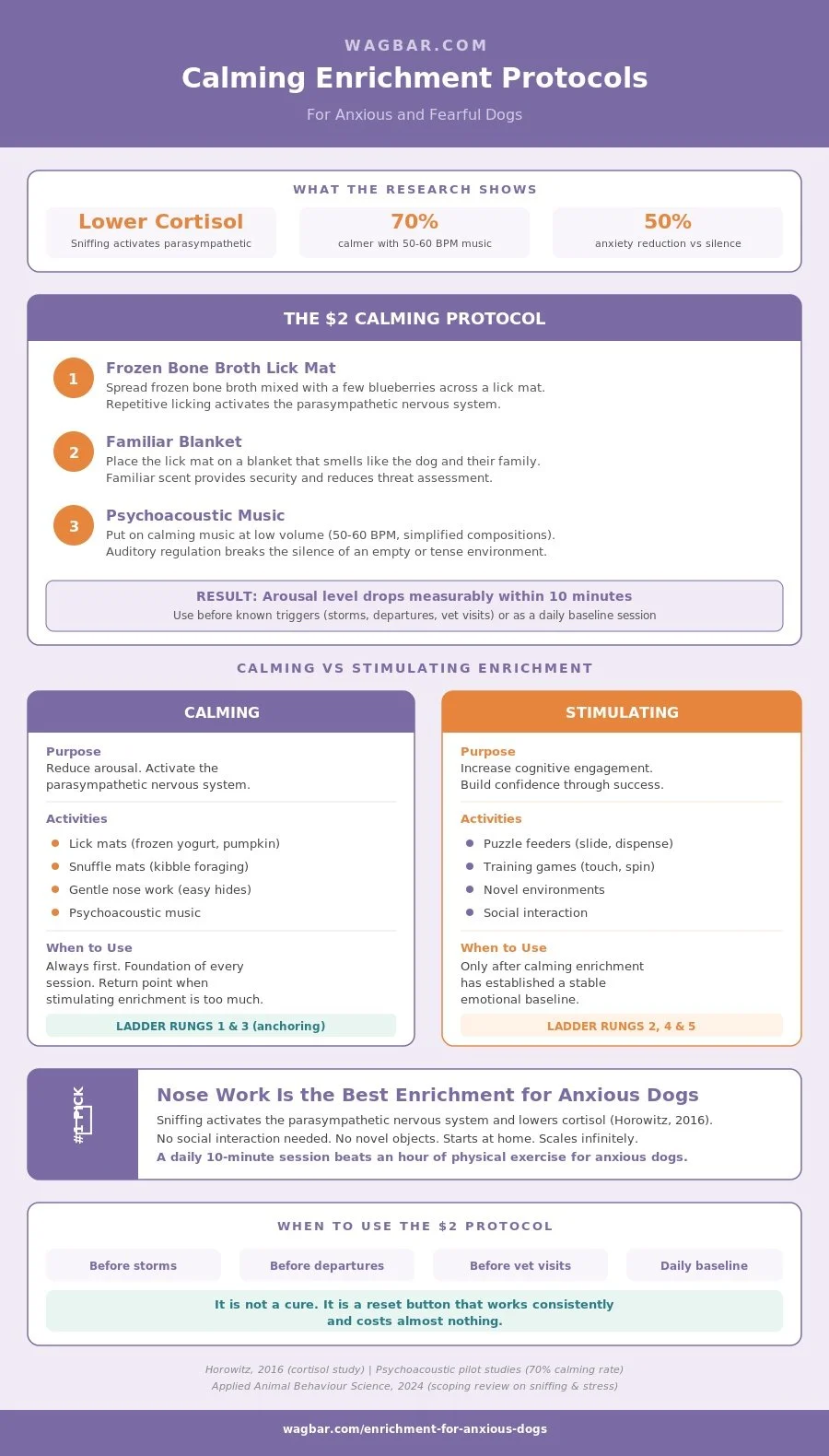
Calming enrichment reduces arousal. Lick mats. Snuffle mats. Gentle nose work. Slow, repetitive activities that activate the parasympathetic nervous system and bring the dog's emotional state down. For anxious dogs, calming enrichment is the foundation. It is where every session starts and where the dog returns when stimulating enrichment becomes too much.
Stimulating enrichment increases cognitive engagement. Puzzle toys. Training games. Novel environments. Social interaction. Activities that ask the brain to work, solve problems, and process new information. For confident dogs, stimulating enrichment is the default. For anxious dogs, it is earned. Only introduced after calming enrichment has established a stable emotional baseline.
The mistake is jumping straight to stimulating enrichment with an anxious dog. That is like asking someone with an anxiety disorder to solve math problems during a panic attack. The cognitive system cannot engage when the emotional system is in overdrive. Calm first. Stimulate second.
Nose Work: The Best Enrichment for Anxious Dogs
If you do one thing for your anxious dog, make it nose work.
Research consistently shows that the act of sniffing activates the parasympathetic nervous system, the branch responsible for rest, digestion, and relaxation. Horowitz (2016) demonstrated that dogs permitted to sniff freely during walks exhibited lower cortisol levels than dogs on structured heel walks. A 2024 scoping review published in Applied Animal Behaviour Science found consistent evidence that sniffing activities reduce physiological stress markers and support emotional self-regulation in dogs.
When a dog puts their nose to work, heart rate drops. Cortisol drops. The brain shifts from threat-scanning mode to information-processing mode. That shift is exactly what an anxious dog needs.
Nose work is also the most accessible enrichment for anxious dogs. No social interaction required. No novel objects (treats are familiar). No environmental change (start in the safest room in the house). Three treats under a towel is Rung 1. A 20-minute scent trail through the house is Rung 2. A nose work session in a new environment is Rung 3.
A daily 10-minute nose work session produces more behavioral improvement than an hour of physical exercise. The body does not need tiring. The brain needs calming. Nose work does both.
The $2 Calming Protocol
This is a clinical-grade calming routine that costs almost nothing and works.
Spread frozen bone broth mixed with a few blueberries across a lick mat. Place it on a familiar blanket (one that smells like the dog and their family). Put on psychoacoustically designed calming music at low volume. Pilot studies on psychoacoustic music for dogs found that over 70% of dogs became calmer with simplified, 50 to 60 beats-per-minute compositions, and anxiety behaviors were reduced by half compared to silence.
Three elements. Repetitive licking (parasympathetic activation). Familiar scent (security). Calming sound (auditory regulation). Total cost is roughly $2 in bone broth and blueberries. Total impact is a dog whose arousal level drops measurably within 10 minutes.
Use this before known anxiety triggers (thunderstorms, departures, vet visits). Use it as the daily baseline calming session. Use it whenever your dog is showing early stress signals. It is not a cure. It is a reset button that works consistently and costs almost nothing.
Social Enrichment for Anxious Dogs
Social enrichment matters for anxious dogs. But the parameters are different from what works for confident dogs.
Small groups only. One or two dogs maximum until the anxious dog demonstrates comfort with more. The cognitive load of reading multiple dogs simultaneously is too high for an anxious brain.
Familiar faces. The same calm dog or dogs, repeatedly, over weeks. Familiarity reduces threat assessment. Novel dogs spike it. Build a small rotation of 2 to 3 known companions rather than constantly introducing strangers.
Predictable environments. The same yard, the same room, the same supervised facility. Anxious dogs need to know the space before they can process the social dynamics within it. A novel environment plus a novel dog is two variables too many.
Short sessions. Twenty minutes is a full session for an anxious dog in a social setting. Thirty is pushing it. End while the dog is still comfortable, not after they start signaling distress. Ending on a positive note builds positive association. Ending after a shutdown builds negative association.
Escape routes always available. The anxious dog must be able to disengage. A corner to retreat to. A familiar blanket to lie on. A handler ready to remove them if needed. Forced proximity with no exit is flooding, not enrichment.
When Your Dog Is Ready for Wagbar
You will know because the Enrichment Ladder told you.
If your dog handles Rung 4 consistently (calm in the presence of 1 to 2 known dogs, able to engage with enrichment items, no significant stress signals), they are a candidate for Rung 5. Not guaranteed to succeed. But ready to try.
Wagbar's approach aligns with the Enrichment Ladder philosophy. The screening process exists because not every dog is ready for group social enrichment, and pretending otherwise helps no one. Staff assess temperament. The off-leash environment is monitored. Dogs who show stress get space and support. The experience is designed to be positive or it does not continue.
That is why anxious dog owners trust Wagbar over dog parks. A dog park says "all dogs welcome." Wagbar says "your dog is welcome when they are ready, and we will help you figure out when that is." Anxious dogs need the second approach.
Or explore the franchise opportunity and build the kind of facility that anxious dog owners in your city have been looking for. Not a dog park. Not a free-for-all daycare. A supervised, screened, enrichment-first environment where even the nervous ones get what they need.
FAQs
How do I know if my dog's anxiety is too severe for enrichment alone?
If your dog shows extreme distress responses (self-harm, destroying exit points, prolonged vocalization, refusal of all food) or if anxiety behaviors are worsening despite consistent Rung 1 enrichment, consult a veterinary behaviorist. Enrichment is part of the treatment plan for clinical anxiety, but it may need to be paired with behavioral modification protocols and sometimes medication. The Enrichment Ladder does not replace professional assessment for severe cases.
Will enrichment cure my dog's anxiety?
Enrichment does not cure anxiety. It manages it, reduces its intensity, and builds coping capacity over time. A dog who does daily calming enrichment and gradually progresses through the Ladder develops a larger window of tolerance. The things that used to trigger a full shutdown may eventually produce only mild wariness. That is meaningful progress, even if it is not a cure.
Can anxious dogs do nose work?
Nose work is the single best enrichment for anxious dogs. It requires no social interaction, starts in the safest environment (home), scales in difficulty at the dog's pace, and actively reduces cortisol through parasympathetic activation. If your dog will eat treats, they can do nose work. Start with 3 treats in plain sight on the floor of their favorite room. That is nose work. Build from there.
Is my anxious dog too nervous for Wagbar?
Maybe right now. And that is an honest answer, not a rejection. The Enrichment Ladder gives you a way to assess readiness. If your dog cannot handle Rung 4 (one calm dog in a controlled setting), they are not ready for Rung 5 (Wagbar). Work the Ladder. Build the foundation. When your dog is ready, Wagbar's screening will confirm it.
Start Where Your Dog Is
Your anxious dog is not broken. They are overwhelmed. And the fix is not more stimulation. It is the right kind of stimulation, at the right intensity, in the right sequence.
Start at Rung 1. Lick mat. Snuffle mat. Three hidden treats in a quiet room. Let your dog teach you how fast they can climb. Some will surprise you. Some will take months. Both are doing it right.
The Enrichment Ladder has no deadline. Your dog's brain has no expiration date on its ability to learn that the world is less scary than it seems.
Bottom TLDR: 72% of dogs show at least one anxiety-related behavior. The four types (noise sensitivity, generalized fear, separation anxiety, situational anxiety) require different enrichment approaches. Standard enrichment overwhelms anxious dogs because it assumes confidence. The Enrichment Ladder has 5 rungs. Rung 1 is solo calming enrichment at home (lick mat, snuffle mat, easy nose work). Rung 2 is solo stimulating enrichment (puzzle feeders, training games). Rung 3 is enrichment in a mildly novel environment. Rung 4 is social enrichment with one known calm dog. Rung 5 is group social enrichment at a supervised facility like Wagbar. Calming enrichment (parasympathetic activation) comes before stimulating enrichment (cognitive challenge). Nose work is the best enrichment for anxious dogs because sniffing lowers cortisol and shifts the brain from threat-scanning to information-processing. A $2 calming protocol (frozen bone broth lick mat + familiar blanket + psychoacoustic music) reduces anxiety behaviors by half. Your dog may not be ready for Rung 5. That is fine. Start at Rung 1.