

Signs of an Under-Enriched Dog: What Your Dog's Worst Behaviors Are Really Saying
You are not reading this because everything is going great. Something your dog does brought you here. The shredded couch cushion. The barking that starts the second you leave. The pacing, the spinning, the way your dog cannot settle no matter how long you walked them.
Those behaviors are not personality flaws. They are not spite. They are symptoms. And the diagnosis is almost always the same. Your dog's brain is not getting what it needs.
An under-enriched dog is a dog whose mental, sensory, and social needs are not being met. The brain fills that gap the only way it knows how. It creates its own projects. And those projects look a lot like the stuff that makes you want to pull your hair out. Every behavior on this list is fixable. Not with more discipline. Not with more walks. With the right kind of mental stimulation.

Destructive Chewing
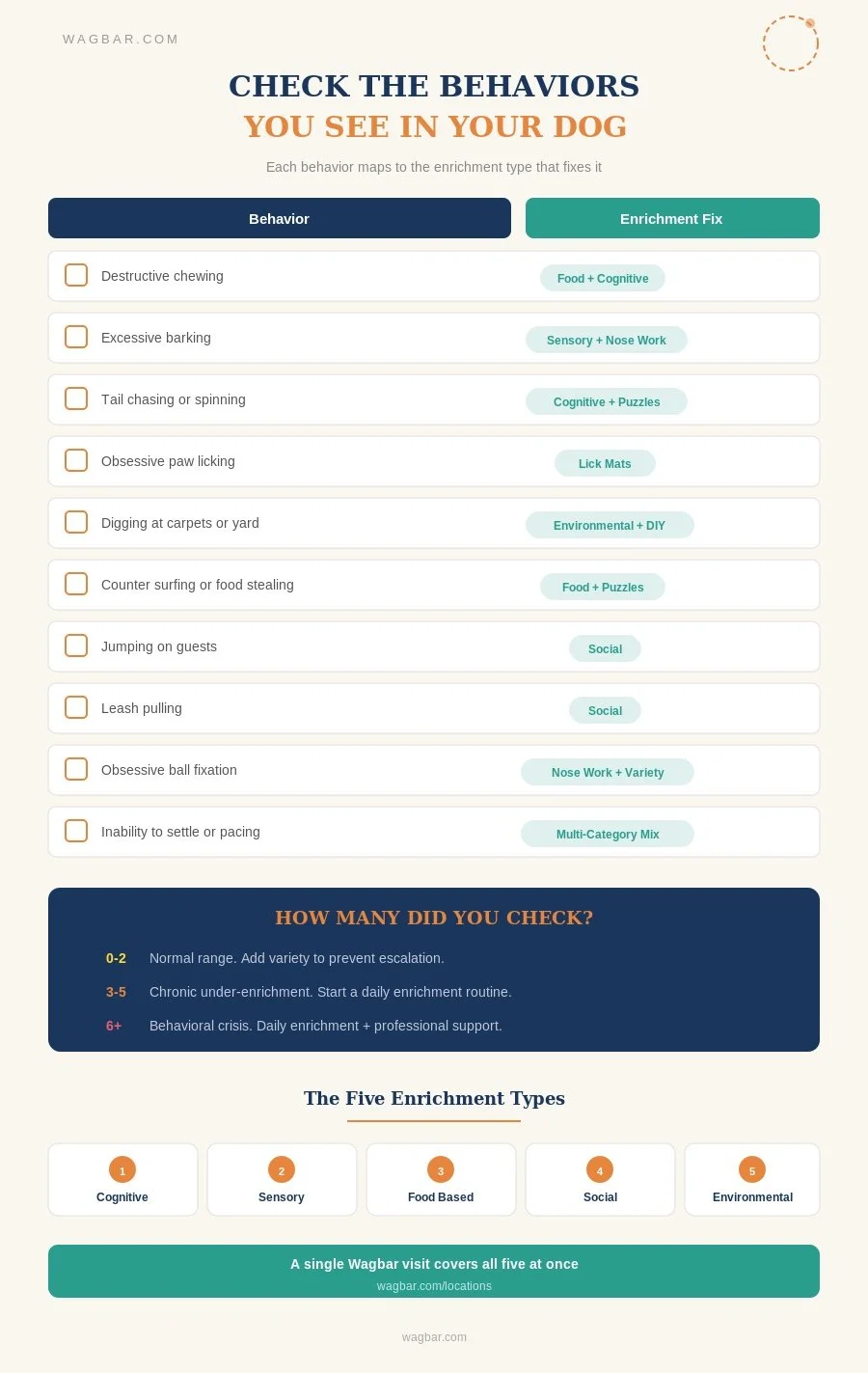
Not puppy teething. Not the occasional stolen shoe. This is the dog who systematically destroys furniture, baseboards, door frames, and anything left within reach. The chewing is focused and determined, not playful, and usually happens when the dog is alone or after a period of inactivity. Destructive chewing is self-soothing behavior for an under-stimulated brain. The repetitive jaw motion releases endorphins. The dog is essentially medicating itself for boredom.
What addresses it. Food-based enrichment redirects the chewing instinct toward appropriate targets. Frozen Kongs, bully sticks, and snuffle mats give the jaw something to work on while engaging the brain. Cognitive challenges reduce the underlying boredom driving the behavior.
Excessive Barking
An under-enriched dog barks at nothing, at everything, and for extended stretches that seem to have no trigger. This is not alert barking at a real stimulus. It is a dog broadcasting frustration into the void because it has nothing else to do. Barking releases tension the same way pacing does. It is an outlet for mental energy that has nowhere productive to go.
What addresses it. Sensory enrichment gives the brain real input to process instead of manufacturing its own. Nose work is especially effective because it occupies the brain so completely that barking stops being necessary.
Tail Chasing and Spinning
Occasional tail chasing in puppies is normal. In adult dogs, repetitive spinning signals serious cognitive under-stimulation. The dog has created a self-reinforcing loop because nothing in its environment provides adequate mental engagement. This one escalates fast. What starts as an occasional spin becomes a compulsive pattern that is genuinely difficult to interrupt once established.
What addresses it. Cognitive enrichment breaks the loop by giving the brain a real problem to solve. Puzzle toys and training sessions redirect the neural pathways that have been stuck in the spin cycle.
Obsessive Licking
Licking surfaces, licking paws until they are raw, licking furniture, licking you nonstop. When licking becomes repetitive and excessive, it is a self-soothing mechanism. The tongue motion triggers a calming response in the brain. Rule out veterinary causes first. But once allergies, skin conditions, and pain are off the table, obsessive licking almost always points back to an under-stimulated brain looking for ways to regulate itself.
What addresses it. Lick mats provide a structured outlet for the licking while delivering calming benefits. The combination of licking and food acquisition engages the brain enough to reduce the compulsive pattern over time.
Pacing and Inability to Settle
The dog who walks the same circuit through the house over and over. Who cannot lie down for more than a few minutes before getting up and restarting the loop. Who seems physically tired but mentally wired. Pacing is a displacement behavior. The brain is looking for something to engage with and finding nothing, so it defaults to movement. Adding more walks usually makes it worse because you are building stamina without addressing the actual deficit.
What addresses it. A combination of enrichment types works best here. Sensory stimulation gives the brain something to process. Food-based enrichment provides a task to focus on. Social interaction with other dogs burns cognitive energy in ways that pacing cannot.
Digging at Carpets, Furniture, and Yards
Digging is natural behavior that becomes problematic when there is no appropriate outlet. Compulsive digging at indoor surfaces is a red flag. The dog is not looking for a place to lie down. It is looking for something to do.
What addresses it. Environmental enrichment gives the dog novelty and new surfaces to interact with. Scatter feeding in the yard channels the digging instinct into foraging. A DIY enrichment setup using a sandbox or towel-wrapped treats redirects the behavior productively.
Counter Surfing and Food Stealing
A dog who constantly patrols counters, tables, and trash cans is not just hungry. The brain is running a foraging program with no appropriate outlet. In the wild, food acquisition takes hours. In your kitchen, it takes two seconds of bowl eating and then the brain goes looking for more.
What addresses it. Food enrichment that turns meals into 20 to 30 minute activities satisfies the foraging drive. Puzzle feeders and scatter feeding give the brain the challenge it is searching for on your countertops.
Jumping on Guests and Leash Pulling
Both come from the same root. Over-arousal combined with zero impulse control. Any novel input, a visitor, a walk, another dog, creates a tidal wave of excitement the brain cannot regulate. The jumping and pulling are not disobedience. They are a brain running on empty that suddenly gets flooded.
What addresses it. Regular social enrichment in controlled settings teaches the brain to handle stimulation without overloading. Dogs who regularly interact with other dogs in supervised environments develop impulse control naturally because the brain stops treating every interaction as a once-in-a-lifetime event.
Obsessive Ball or Toy Fixation
The dog who will not stop dropping the ball at your feet. Who whines, stares, and nudges it for hours. This is not a dog who just loves fetch. This is a brain that has latched onto one repetitive activity because nothing else provides stimulation. The difference between exercise and enrichment matters here.
What addresses it. Replace some fetch sessions with nose work, puzzle toys, and interactive play. Give the brain multiple outlets instead of one obsessive channel.
Real Talk: Your Dog Is Not Broken
If you made it this far and you are sitting there like "this is literally my dog," same. So many of us grew up thinking a walk and a bowl of kibble was enough. Nobody mentioned the brain stimulation thing until now. But now you know.
Your dog is not acting out because they are bad or dumb or spiteful. They are acting out because their brain has zero input and it is creating its own chaos. Think about how you feel after three hours of scrolling with nothing to do. Now imagine that is your entire life. Every. Single. Day.
The fix is honestly not even that hard. A frozen Kong at breakfast, a ten minute sniff walk after dinner, a puzzle toy on the weekend. That is enough to start seeing changes within a week. Your dog's brain has been starving for this stuff, and the second you start feeding it, the destructive behavior drops off a cliff.
And if you want to skip the trial-and-error phase entirely, places like Wagbar exist for exactly this reason. One visit hits social, cognitive, sensory, and environmental stimulation at the same time. Your dog comes home and actually sleeps instead of eating the couch.
The Severity Spectrum: Where Does Your Dog Fall
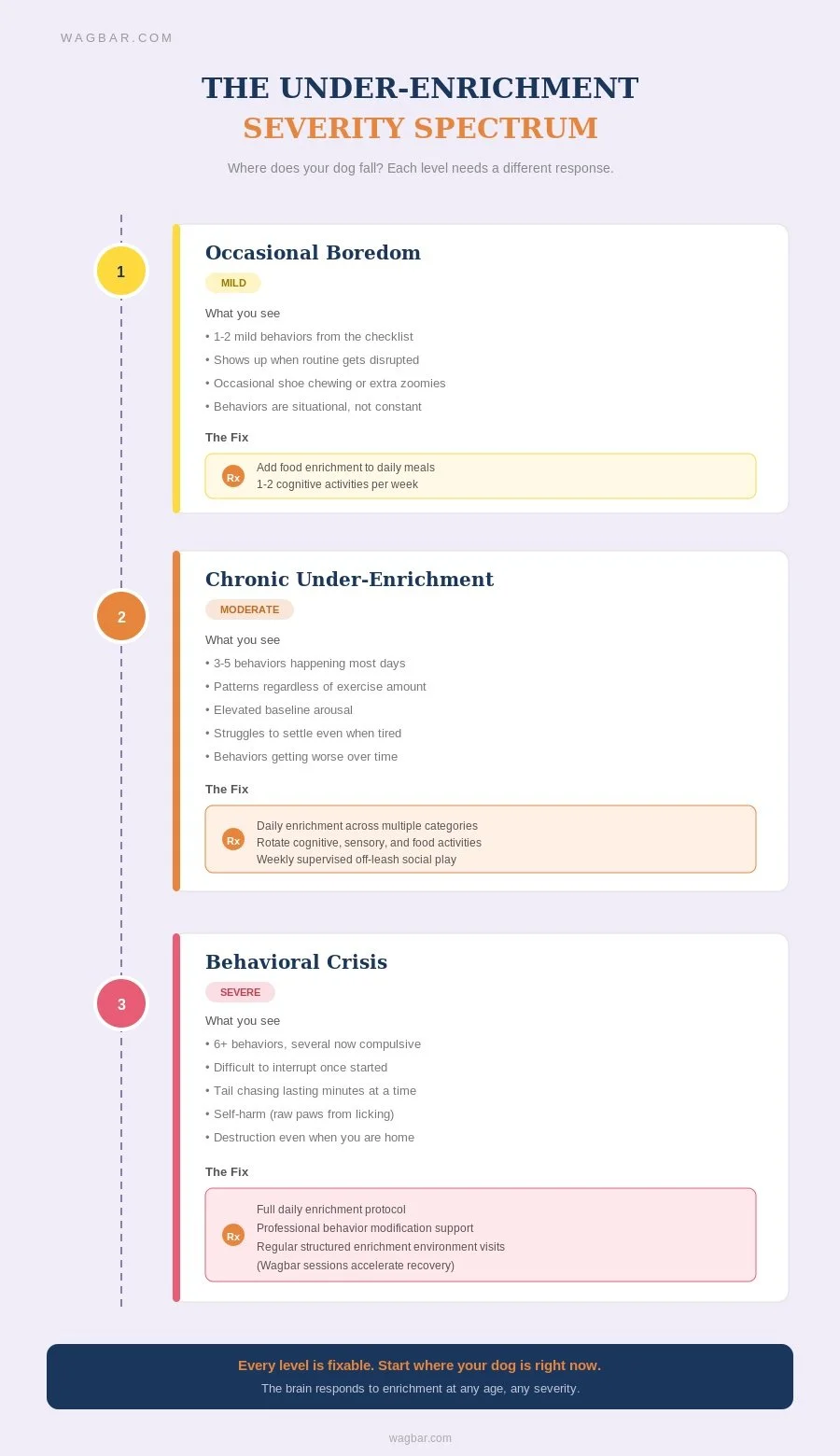
Not all under-enrichment looks the same. The behaviors exist on a spectrum, and knowing where your dog falls determines how much intervention is needed.
Occasional boredom. Your dog shows one or two mild behaviors from the list above. Maybe some shoe chewing when left alone too long or extra zoomies in the evening. The behaviors are situational, not constant. At this level, adding food-based enrichment to daily meals and one or two cognitive activities per week is usually enough to resolve it.
Chronic under-enrichment. Your dog shows three to five behaviors from the list, and they happen most days regardless of how much exercise the dog gets. The behaviors are predictable patterns. The dog's baseline arousal is elevated. Restless even when tired, and getting worse over time. This level needs a daily enrichment routine across multiple categories. Rotate between cognitive, sensory, and food-based activities. Add regular social enrichment at least once a week.
Behavioral crisis. Your dog shows five or more behaviors, and several have become compulsive patterns that are difficult to interrupt. Tail chasing that goes on for minutes. Paw licking that has caused raw spots. Destruction even when you are home. At this level, enrichment alone may not reverse patterns that have become neurologically entrenched. Combine a full daily enrichment protocol with professional behavior modification. Regular visits to a structured enrichment environment accelerate progress because the brain gets varied stimulation that is hard to replicate at home.
What Changes When Enrichment Is Consistent
The shift happens faster than most owners expect. Within the first week, most dogs show a noticeable decrease in at least one problem behavior. The chewing slows down. The barking becomes less frequent. By week two or three, the dog starts settling faster. The pacing decreases. The obsessive behaviors lose their grip because neural pathways are getting redirected toward productive challenges.
By month two, you are looking at a different dog. Same personality. But a brain that is finally functioning the way it was designed to. Dogs who get consistent enrichment across all five categories show lower cortisol, better impulse control, and a calm confidence that exercise alone never produces.
Dogs who visit Wagbar on a regular schedule show these changes faster because every visit delivers social, cognitive, sensory, and environmental stimulation simultaneously. Supervised off-leash play teaches the dog to regulate itself in real social situations with real consequences and real rewards.
FAQs
How do I know if my dog is bored or has a medical problem?
Start with a vet visit to rule out pain, allergies, thyroid issues, and other medical causes. If the vet clears your dog and behaviors persist, under-enrichment is the most likely explanation. Medical conditions produce consistent symptoms regardless of activity level. Enrichment-related behaviors worsen during low-stimulation periods and improve after engaging days.
How quickly will enrichment fix my dog's behavior problems?
Most owners see noticeable improvement within seven to fourteen days of consistent daily enrichment. The timeline depends on how long the behaviors have been established and how many enrichment categories you are addressing. Long-standing patterns take longer to redirect than recent ones.
Can older dogs develop under-enrichment symptoms?
Yes. Senior dogs are especially vulnerable because owners often reduce stimulation as the dog ages, assuming the dog "just wants to rest." Cognitive decline accelerates when the brain stops getting challenged. Gentle activities like scent work and slow feeders keep the brain active and can slow canine cognitive dysfunction.
Is one type of enrichment enough or do I need to do all of them?
One type is better than none, but the biggest changes come from variety across multiple enrichment categories. A dog who gets puzzle feeders but no social interaction will still show social-related symptoms. A dog who plays with other dogs but eats from a bowl in thirty seconds will still show food-related compulsive behaviors. Cover as many categories as possible throughout the week.
Every Behavior on This List Is Your Dog Asking for Help
Your dog cannot tell you their brain is starving. So they show you. Every shredded cushion, every hour of barking, every lap around the house is communication.
Find your nearest Wagbar and give your dog a session that feeds the brain, not just the body. Or explore the franchise opportunity and bring Wagbar to your community.