

Cognitive Enrichment for Dogs: 12 Activities That Actually Tire Your Dog's Brain
Your dog can run five miles and still destroy the house. That is not a fitness problem. That is a brain problem. The body is exhausted but the brain is wide awake, bored, and looking for something to chew on. Usually something expensive.
Cognitive enrichment is the fix. It is any activity that forces your dog to think, problem solve, make decisions, or learn something new. Twenty minutes of real cognitive work tires a dog's brain the way sixty minutes of running tires the body. And a brain-tired dog does not eat baseboards. A brain-tired dog lies down and sleeps.
This is not a new concept. The science behind canine cognition has been building for decades. Dogs can count, remember sequences, read human gestures, and solve problems they have never encountered before. Their brains are built for complex work. Most pet dogs just never get asked to use them.
That changes today. Here are twelve cognitive enrichment activities ranked by difficulty, with setup times, engagement windows, and a clear progression path from beginner to advanced.
The Difficulty Rating System
Every activity below gets a difficulty rating from Level 1 to Level 5.
Level 1. No prior experience needed. Any dog can do this on the first try.
Level 2. Requires basic problem solving. Most dogs figure it out within a few minutes.
Level 3. Requires sustained focus and multi-step thinking. Some dogs need a demonstration first.
Level 4. Requires experience with easier challenges. Dogs who have never done cognitive work may get frustrated here.
Level 5. Advanced problem solving. Only appropriate for dogs who have built up through the lower levels.
Start at Level 1 regardless of how smart your dog is. The goal is to build confidence and teach the dog that thinking leads to rewards. Jumping straight to Level 4 creates frustration, not enrichment.

Level 1 Activities
Muffin Tin Game
Put treats in a few cups of a muffin tin. Cover all cups with tennis balls. Your dog has to remove the balls to find the treats. Simple problem, clear reward, and it teaches the foundational concept that thinking produces food.
Setup. 2 minutes. Engagement. 5 to 10 minutes. Progression. Increase the number of cups used. Add a second muffin tin. Place only treats in some cups so your dog has to learn which balls are worth removing.
Scatter Feeding
Instead of a bowl, toss your dog's entire meal across the yard or a room. The dog uses their nose and brain to locate every piece. This activates foraging circuits that have been dormant since your dog's ancestors stopped hunting.
Setup. 1 minute. Engagement. 10 to 20 minutes. Progression. Scatter in taller grass, over a larger area, or hide small piles behind furniture. Layer in snuffle mats for a combined sensory and cognitive challenge.
Three Cup Shell Game
Put a treat under one of three cups while your dog watches. Let the dog choose. Once they get it consistently, start shuffling the cups slowly. This tests memory, visual tracking, and impulse control all at once.
Setup. 1 minute. Engagement. 5 to 15 minutes. Progression. Shuffle faster. Add a fourth cup. Use opaque cups and shuffle out of sight to test memory over visual tracking.
Level 2 Activities
Frozen Kong Stuffing
Layer peanut butter, banana, kibble, and yogurt inside a Kong. Freeze overnight. Your dog has to work the frozen mass with their tongue, teeth, and jaw to extract the food. This is not just licking. The brain is constantly adjusting strategy based on what is working.
Setup. 5 minutes plus freeze time. Engagement. 20 to 40 minutes. Progression. Pack tighter. Use harder-to-extract fillings. Layer in larger treats that require jaw manipulation. Graduate to puzzle feeders that require sliding, lifting, or rotating mechanisms.
Name That Toy
Teach your dog the names of specific toys. Start with one. Hold the toy, say its name, reward when the dog touches it. Once the dog reliably identifies three to five toys by name, scatter them and ask for a specific one. This is pure cognitive work. The dog is processing language, matching it to memory, and making a decision.
Setup. None for practice sessions. Engagement. 10 to 15 minutes per session. Progression. Add more toys. Increase the distance. Place named toys in another room and send your dog to retrieve the right one.
Towel Wrap Puzzle
Lay treats across a towel, then roll it up. Your dog has to figure out how to unroll the towel to access the food. Simple dogs will just rip it. Smarter dogs will paw at it, nose it open, or hold one end and pull.
Setup. 2 minutes. Engagement. 5 to 15 minutes. Progression. Use multiple towels layered on top of each other. Tie loose knots. Fold instead of rolling so the dog has to change strategy.
Level 3 Activities
DIY Obstacle Course
Build a course using household items. A broomstick across two chairs for jumping, a blanket draped over a table for crawling under, cushions for balancing on. Lead your dog through the sequence with treats. The cognitive work comes from processing each new obstacle, planning the body movement, and remembering the sequence.
Setup. 10 minutes. Engagement. 15 to 25 minutes. Progression. Add new obstacles weekly. Change the order. Introduce obstacles that require specific behaviors like sitting before proceeding or waiting at a station before moving to the next.
Problem Solving Boxes
Put a treat inside a closed cardboard box. Your dog has to figure out how to open it. Start with a loosely closed box. Progress to boxes inside boxes. Then boxes with flaps tucked in. Then boxes secured with a simple latch or sliding mechanism.
Setup. 3 minutes. Engagement. 10 to 30 minutes depending on difficulty. Progression. Create multi-step sequences where solving one box reveals a clue or key to the next. This is DIY enrichment at its most effective.
New Trick Training Sessions
Teaching a new trick is one of the most cognitively demanding activities you can do with your dog. The brain has to process the cue, figure out what behavior is being rewarded, refine the behavior through trial and error, and commit it to long-term memory. Fifteen minutes of new trick training burns more cognitive energy than an hour of practicing tricks your dog already knows.
Setup. None. Engagement. 10 to 15 minutes. Keep sessions short. A fatigued brain stops learning. Progression. Chain tricks together into sequences. Teach tricks that require multi-step behaviors. Introduce hand signals, verbal cues, and distance commands separately so the dog has to process different types of communication.
Level 4 Activities
Scent Discrimination
Different from basic nose work. Scent discrimination asks the dog to identify a specific scent among multiple options. Put the target scent on one object and neutral scents on others. The dog has to identify and indicate the correct one. This activates the olfactory cortex at full capacity while simultaneously requiring decision making and impulse control.
Setup. 5 minutes. Engagement. 15 to 25 minutes. Progression. Increase the number of distractors. Use increasingly similar scents. Add a time delay between exposure to the target scent and the search.
Advanced Puzzle Toys
Beyond basic puzzle feeders. Level 4 puzzles require the dog to complete multiple different actions in sequence. Slide a panel, then lift a lever, then spin a disc. Each step reveals a clue about the next. If your dog solved a Level 2 puzzle in under a minute, it is no longer enrichment. It is just feeding with extra steps. The challenge has to match the dog's current cognitive ability.
Setup. 2 minutes. Engagement. 15 to 40 minutes. Progression. Rotate puzzles so the brain encounters new challenges regularly. Combine two puzzles so solving one gives access to the next.
Level 5 Activities
Social Problem Solving in Novel Groups
This is the top of the cognitive enrichment hierarchy and it cannot be replicated at home. Place your dog in a supervised group of unfamiliar dogs and watch the brain light up. Every second requires real-time decision making. Reading body language from dogs they have never met. Adjusting play intensity based on the other dog's responses. Navigating approach-and-retreat sequences. Deciding when to engage and when to disengage. Processing multiple social signals simultaneously from multiple dogs.
No puzzle toy replicates this level of cognitive demand. No training session comes close. Off-leash social play is cognitively demanding precisely because the variables are unpredictable and the consequences are immediate.
Setup. None. Engagement. 1 to 3 hours at a supervised facility. Progression. Regular visits with different groups. The novelty of new dogs and new social dynamics means the cognitive challenge stays fresh indefinitely. This is what makes Wagbar visits different from a backyard playdate with the same two dogs every weekend.
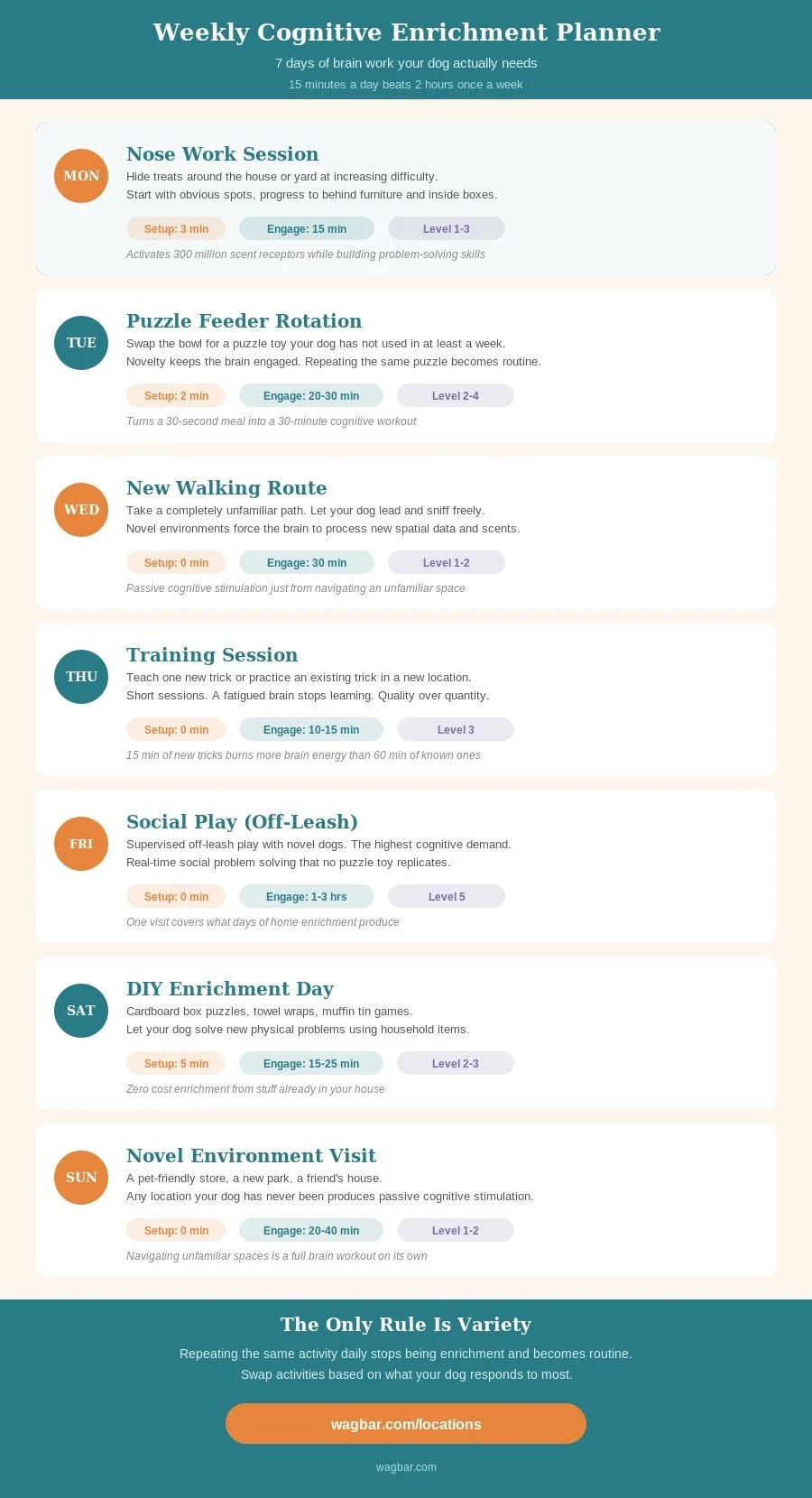
The Weekly Cognitive Enrichment Planner
Consistency beats intensity. A fifteen minute cognitive session every day produces better results than a single sixty minute session once a week. Here is a sample rotation that covers different types of cognitive work throughout the week without overwhelming your schedule.
Monday. Nose work session. Hide treats around the house or yard. 15 minutes of engagement from 3 minutes of setup. Level 1 to 3 depending on hiding difficulty.
Tuesday. Puzzle feeder rotation. Swap your dog's bowl for a puzzle toy they have not used in at least a week. 20 to 30 minutes of engagement from 2 minutes of setup.
Wednesday. New walking route. Take a completely unfamiliar path. Let your dog lead and sniff. The novelty forces the brain to process new spatial information, scents, and visual inputs. 30 minutes.
Thursday. Training session. Teach one new trick or practice a trick in a new location. 10 to 15 minutes. Keep it short and positive.
Friday. Social play at a supervised off-leash environment. 1 to 3 hours of the highest level cognitive enrichment available. One visit covers what would take you days to replicate at home.
Saturday. DIY enrichment day. Cardboard box puzzles, towel wraps, muffin tin games. Let your dog solve new physical problems. 15 to 25 minutes from 5 minutes of setup.
Sunday. Novel environment visit. A pet-friendly store, a new park, a friend's house. Any location your dog has never been. 20 to 40 minutes of passive cognitive stimulation just from navigating an unfamiliar space.
This is a starting point. Swap activities based on what your dog responds to most. The only rule is variety. Doing the same puzzle every day stops being cognitive enrichment and starts being routine.
How to Progress Without Frustrating Your Dog
The sweet spot for cognitive enrichment is where your dog has to work at it but still succeeds. Too easy and the brain does not engage. Too hard and the dog gives up or gets stressed.
Watch for these signals. If your dog solves something in under a minute, it is too easy. Move up a level. If your dog walks away, whines, or starts showing displacement behaviors like yawning or lip licking, it is too hard. Drop back a level and build confidence before trying again.
Progression should happen within activities, not just between them. Make a Level 2 muffin tin game slightly harder before jumping to a Level 3 obstacle course. The brain builds on what it already knows. Gradual increases in difficulty teach the dog that persistence leads to rewards.
Puppies should stay at Level 1 and 2 until their brains develop enough sustained focus for harder challenges. That usually happens around six months. Senior dogs may plateau at Level 3 for physical reasons but can still get tremendous cognitive benefit from activities at that level. The research on cognitive dysfunction prevention shows that consistent mental stimulation at any difficulty level slows age-related cognitive decline.
Signs It Is Working
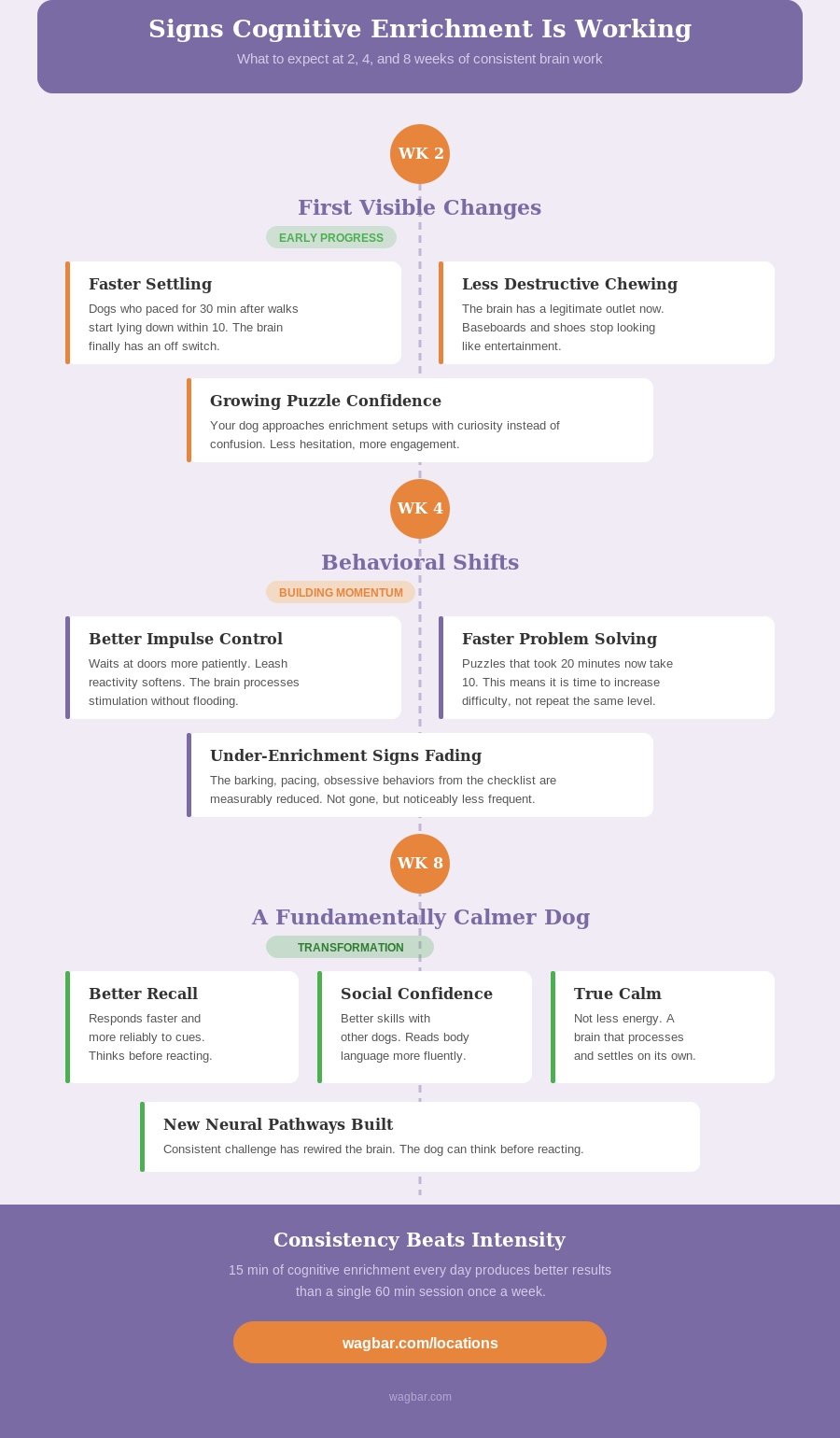
Consistent cognitive enrichment produces measurable behavioral changes. Here is what to expect.
By week two. The first behavior change is usually settling speed. Dogs who used to pace for thirty minutes after a walk start lying down within ten. Destructive chewing decreases because the brain has a legitimate outlet. You may notice your dog approaching puzzle toys and enrichment setups with more confidence and less hesitation.
By week four. Impulse control improves noticeably. The dog waits at doors more patiently. Reactivity on leash starts to soften because the brain is better at processing stimulation without flooding. Problem solving speed on familiar puzzles increases, which means it is time to increase difficulty. The signs of under-enrichment you noticed before, the barking, the pacing, the obsessive behaviors, should be measurably reduced.
By week eight. You are looking at a fundamentally calmer dog. Not a less energetic dog. A dog whose brain knows how to process stimulation and settle afterward. Dogs at this stage show better recall, improved social skills with other dogs, more confidence in new environments, and an overall calm that owners consistently describe as "a different dog." The brain has built new neural pathways through consistent challenge, and those pathways produce a dog who can think before reacting.
What Wagbar Adds That Home Cannot
Every activity on this list is valuable. But there is one thing no home setup replicates. Unpredictable social cognition with novel partners.
Your dog can master every puzzle toy you own. They can learn thirty tricks. They can do advanced scent discrimination in their sleep. And they will still benefit enormously from walking into a room full of dogs they have never met and having to navigate that social complexity in real time.
Wagbar's environment is designed around this principle. The dogs change daily. The group dynamics shift every session. The staff are trained to read body language and manage interactions so every dog gets positive social cognitive experiences. A single visit combines Level 5 social problem solving with environmental enrichment from the novel space and sensory enrichment from the rotating scent profiles of different dogs.
Dogs who visit regularly build cognitive skills that no amount of home enrichment produces on its own. Reading unfamiliar body language. Calibrating play intensity with different temperaments. Making split-second approach-or-retreat decisions. These are high-level cognitive tasks that only happen in real social environments with real social consequences. That is what makes it Level 5.
FAQs
How much mental stimulation does my dog need per day?
Most adult dogs benefit from 15 to 30 minutes of structured cognitive enrichment daily. This can be split across two or three shorter sessions. High-drive breeds like Border Collies and Malinois may need 30 to 45 minutes. The key is consistency rather than duration. Fifteen minutes every day beats two hours once a week.
Can cognitive enrichment replace physical exercise?
No. They serve different functions. Physical exercise burns physical energy. Cognitive enrichment builds neural pathways and burns mental energy. Your dog needs both. But if you had to prioritize one for behavior problems, cognitive enrichment usually produces faster results.
What if my dog gets frustrated with puzzle toys?
The difficulty is too high. Drop back to a Level 1 activity where your dog can succeed easily. Build three to five successful sessions at each level before moving up. Frustration during cognitive enrichment teaches the dog that thinking is stressful, which is the opposite of what you want. Success teaches the dog that thinking is rewarding.
At what age should I start cognitive enrichment?
Immediately. Puppies benefit from cognitive enrichment starting at eight weeks. Keep activities at Level 1 and 2, keep sessions short (five minutes for young puppies), and focus on building the association between thinking and rewards. Early cognitive enrichment during critical development windows produces measurable differences in learning speed and emotional resilience that last the dog's entire life.
Your Dog's Brain Was Built for This
Every single activity on this list taps into something your dog's brain already wants to do. Problem solving, foraging, social navigation, pattern recognition. These are not tricks you are teaching. They are drives you are finally letting the dog express.
Find your nearest Wagbar and add Level 5 social cognition to your dog's enrichment rotation. Or explore the franchise opportunity and bring Wagbar to your city.