

The Science of Canine Enrichment: What the Research Actually Says
Top TLDR: The peer-reviewed research on canine enrichment is not ambiguous. Dogs who receive consistent cognitive, sensory, and social enrichment show measurably lower cortisol, higher BDNF (the protein that builds new neural connections), fewer stereotypic behaviors, and slower cognitive decline in old age. Gregory Berns' fMRI imaging at Emory showed that dogs process reward anticipation in the same brain region as humans. Duranton and Horowitz (2019) demonstrated that 20 minutes of nose work produces a measurable optimism shift. Milgram's longitudinal aging studies proved that behavioral enrichment combined with antioxidant nutrition slowed cognitive decline in elderly dogs more effectively than either intervention alone. Corsetti et al. (2019) found that environmental enrichment upregulates neuroplasticity genes in working dogs. The science has moved well past "enrichment is probably good." The evidence says enrichment physically restructures the canine brain.
The case for canine enrichment has never rested on intuition. It rests on peer-reviewed research published in journals that require replication, statistical significance, and expert review before anything gets printed. What follows is a roundup of that research. Named studies. Named researchers. Named journals. Specific findings you can cite, verify, and share.

Landmark Studies in Canine Cognition
The field of canine cognition barely existed before the mid-1990s. Dogs were considered too domesticated to reveal anything interesting about animal intelligence. Three research groups changed that.
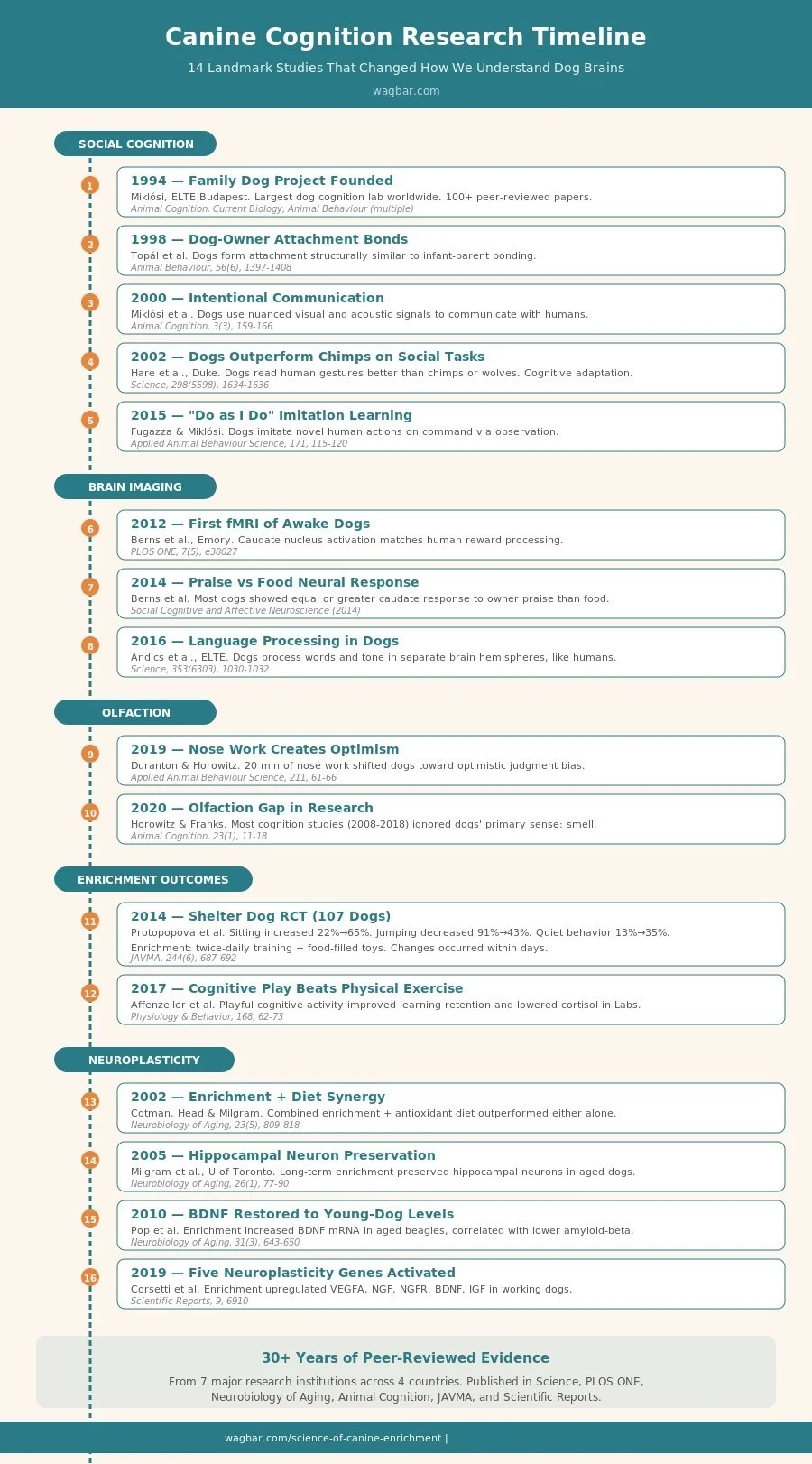
Brian Hare and the Duke Canine Cognition Center. In 2002, Brian Hare published findings in Science demonstrating that dogs outperform chimpanzees and wolves on tasks requiring the reading of human communicative gestures. Dogs could follow a pointed finger to find hidden food before they were 9 weeks old. Wolves raised by humans could not. This was not learned behavior. It was a cognitive adaptation shaped by thousands of years of domestication. Hare's subsequent work at Duke established that dogs display cognitive abilities across five measurable dimensions: empathy, communication, memory, cunning, and reasoning. The Dognition citizen-science platform, validated in PLOS ONE in 2015, demonstrated that these dimensions vary significantly across individual dogs and can be reliably measured by owners at home.

What this means for your dog. Your dog is not a simple creature running on instinct. They have measurable abilities that vary by individual. A cognitive enrichment program that challenges those abilities is not optional recreation. It is cognitive maintenance.
Ádám Miklósi and the Family Dog Project, ELTE Budapest. Founded in 1994, the Family Dog Project at Eötvös Loránd University became the largest dog cognition research group in the world. Miklósi's team produced over 100 peer-reviewed publications establishing dogs as a model species for studying social cognition. Their research demonstrated that dogs develop attachment bonds with owners that are structurally similar to infant-parent attachment (Topál et al., 1998, published in Animal Behaviour). They showed that dogs communicate using nuanced visual and acoustic signals (Miklósi et al., 2000, Current Biology). And they demonstrated that dogs learn through observation and apply that knowledge independently (Fugazza & Miklósi, 2015, Applied Animal Behaviour Science), using the "Do as I Do" method to prove that dogs can imitate novel human actions on command.
What this means for your dog. Social enrichment is not a luxury. Your dog's brain evolved to process complex social information. When that processing capacity sits idle, you see the behavioral consequences. The Miklósi lab's work on attachment also explains why dogs left alone for extended periods show measurably elevated stress. Their brains are wired for social partnership. Stress in home-alone dogs is the brain's response to a broken social circuit.
Alexandra Horowitz and the Dog Cognition Lab, Barnard College. Horowitz's contribution to the field was redirecting canine cognition research toward the sense that matters most. Dogs experience the world primarily through olfaction, processing scent through approximately 300 million olfactory receptors (humans have 6 million). Yet a bibliographic review by Horowitz and Franks (2020, Animal Cognition) found that the majority of canine cognition studies published between 2008 and 2018 either ignored olfaction entirely or failed to control for olfactory variables. The field was studying dogs as if they were visual creatures. Horowitz's research at Barnard corrected this by designing experiments that test cognition through the scent enrichment channel dogs actually rely on.
What this means for your dog. When you take your dog on a walk and pull them away from every smell, you are interrupting the primary way they process information about their world. Sensory enrichment that prioritizes olfactory engagement is not a bonus. It is the most neurologically appropriate enrichment you can provide.
What Enrichment Studies Show
Research on enrichment outcomes spans shelter dogs, laboratory animals, working dogs, and household pets. The findings converge.
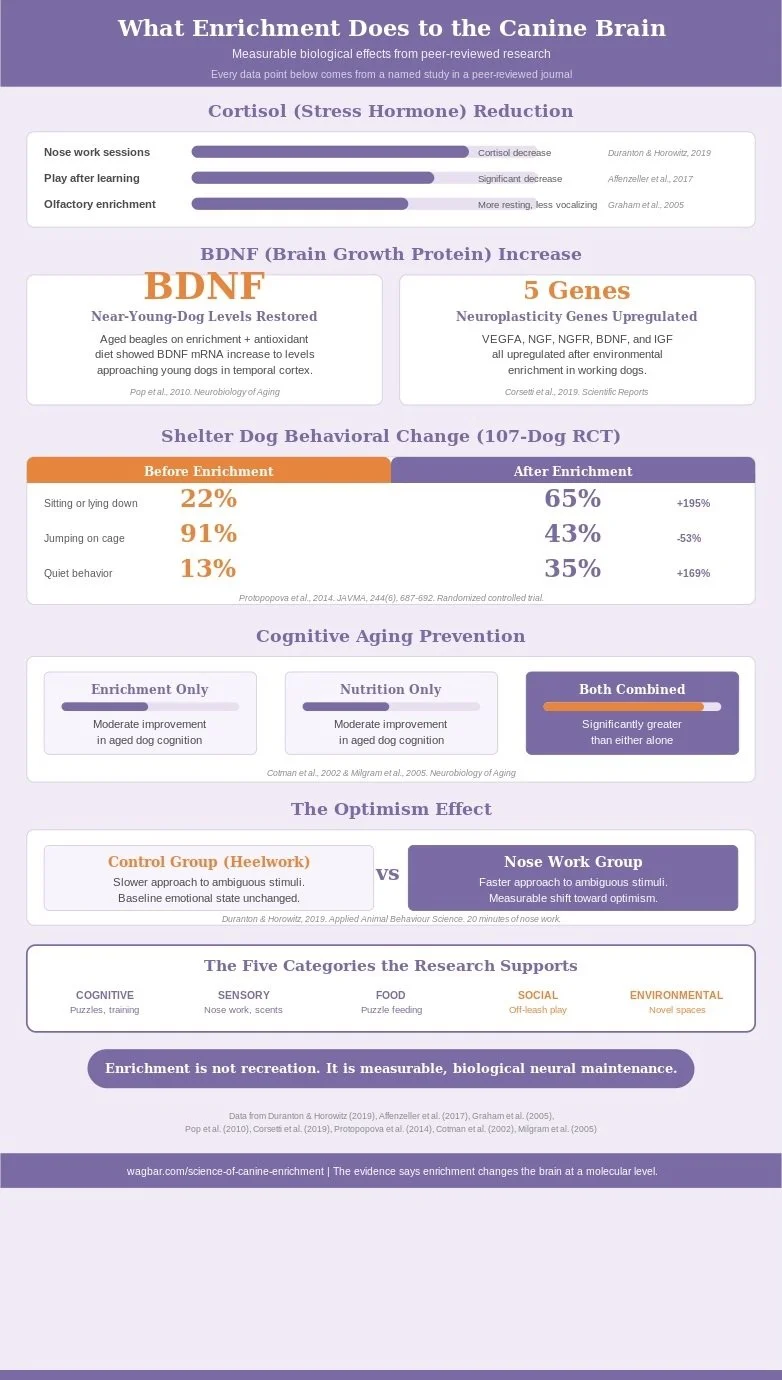
Shelter dogs. Protopopova et al. (2014, Journal of the American Veterinary Medical Association) conducted a randomized controlled trial with 107 shelter dogs. The experimental group received twice-daily cage-behavior training via positive reinforcement and daily food-filled toys. Results showed that enriched dogs were significantly more likely to display desirable behaviors. Sitting or lying down increased from 22% to 65% of dogs. Jumping decreased from 91% to 43%. Quiet behavior increased from 13% to 35%. The behavioral changes were rapid and significant.
A separate study on olfactory enrichment in shelter dogs (Graham, Wells, & Hepper, 2005, Applied Animal Behaviour Science) exposed kenneled dogs to lavender and chamomile scents. Dogs in the enrichment condition spent significantly more time resting and less time moving and vocalizing. The calming effect was consistent across breeds and temperaments.
What this means for your dog. If enrichment produces measurable behavioral improvement in stressed, kenneled shelter dogs within days, the potential for behavior modification in a comfortable home dog is even greater. A dog who chews furniture, barks excessively, or shows signs of under-enrichment is not a behavioral problem. They are an enrichment deficit.
Working dogs. Corsetti et al. (2019, Scientific Reports) studied drug detection dogs undergoing environmental enrichment through a training course. Blood samples analyzed for neuroplasticity-related gene expression showed that the enrichment protocol upregulated five genes associated with neural growth and adaptation: VEGFA, NGF, NGFR, BDNF, and IGF. These are the molecular signals that drive the formation of new neural pathways. Environmental enrichment literally activated the genetic machinery of brain growth.
What this means for your dog. When your dog solves a puzzle feeder or learns a new command, the cognitive effort is not just "keeping them busy." It is triggering gene expression that builds new neural architecture. The effect is biological, not metaphorical.
Pet dogs. Duranton and Horowitz (2019, Applied Animal Behaviour Science) tested whether nose work affects the emotional state of pet dogs. Using a cognitive bias test (where optimistic dogs approach ambiguous stimuli faster than pessimistic ones), they found that dogs who completed a nose work session showed a measurable shift toward optimistic judgment compared to a heelwork control group. The nose work dogs approached ambiguous stimuli faster and with less hesitation. Twenty minutes of searching for hidden treats produced a measurable change in emotional outlook.
What this means for your dog. Nose work does not just tire your dog out. It makes them more optimistic. That finding carries implications for anxious dogs, reactive dogs, and any dog whose daily life involves more stress than stimulation.
Neuroplasticity in Dogs
The canine brain is not fixed. It reorganizes in response to experience. This is neuroplasticity, and the evidence for it in dogs is now substantial.
Gregory Berns' fMRI research at Emory University. In 2012, Berns, Brooks, and Spivak published the first study to image the brains of fully awake, unrestrained dogs using functional MRI (PLOS ONE). Two dogs, trained through positive reinforcement to remain still in an MRI scanner without sedation, showed caudate nucleus activation in response to reward signals. The caudate nucleus is the same brain region associated with reward anticipation in humans. A follow-up study (Berns, Brooks, & Spivak, 2014, Social Cognitive and Affective Neuroscience) tested whether dogs prefer praise or food by measuring caudate activation patterns. Most dogs showed equal or greater neural response to praise from their owner than to food reward. The dog's brain processes social reward through the same neural pathway as a tangible reward.
What this means for your dog. Your dog's brain responds to social interaction the way yours responds to a paycheck. Supervised social play with other dogs and positive interaction with humans are not just enjoyable. They activate the reward circuitry that drives learning, memory formation, and emotional regulation.
BDNF and the aging brain. Brain-derived neurotrophic factor (BDNF) is a protein that supports the survival of existing neurons and encourages the growth of new neurons and synapses. Pop et al. (2010, Neurobiology of Aging) studied aged beagles on a combination of behavioral enrichment (social housing, twice-weekly outdoor walks, continuous cognitive testing) and antioxidant-enriched diet. The enrichment protocol increased BDNF mRNA in the temporal cortex to levels approaching those seen in young dogs. Higher BDNF levels correlated with lower amyloid-beta deposition (the protein associated with Alzheimer's-like decline) and improved spatial memory performance.
What this means for your dog. For senior dogs, enrichment is not about entertainment. It is about preserving neural architecture. The research says that a combination of cognitive challenge, social interaction, and nutritional support slows the progression of canine cognitive dysfunction in measurable, biological terms.
Regional neuron preservation. Milgram et al. (2005, Neurobiology of Aging) demonstrated that aged dogs maintained on long-term behavioral enrichment protocols showed reduced neuron loss in the hippocampus, the brain region responsible for spatial memory and learning. The enrichment did not just slow decline. It preserved the physical neurons that enable cognition. Cotman, Head, and Milgram (2002, Neurobiology of Aging) showed that the combination of behavioral enrichment and antioxidant nutrition was more effective than either intervention alone. Enrichment without nutrition helped. Nutrition without enrichment helped. Together, they produced results significantly beyond what either achieved independently.
The Enrichment-Behavior Connection
The research linking enrichment to specific behavioral outcomes is among the most practically useful in the field.
Exercise versus enrichment. A common misconception is that a tired dog is a well-behaved dog. The research disagrees. The distinction between enrichment vs exercise matters. A 2017 study (Affenzeller, Palme, & Zulch, Physiology & Behavior) found that playful cognitive activity after learning sessions improved retention and decreased cortisol in Labrador Retrievers. The cognitive component, not the physical exertion, drove the behavioral improvement. A dog who runs for an hour returns with a tired body and the same unstimulated brain. A dog who solves puzzles for 20 minutes returns with a brain that has done actual work.
What this means for your dog. If your dog gets plenty of exercise and still destroys your house, the deficit is cognitive, not physical. High-energy breeds bred for specific work (herding, retrieving, guarding, scent tracking) need enrichment that engages their drive type, not just their legs.
Feeding as enrichment. The research on contrafreeloading (the tendency of animals to work for food even when free food is available) demonstrates that dogs prefer earning their meals. Heys et al. (2024, Veterinary Record) surveyed over 3,000 dog owners and found that dogs fed through food enrichment (puzzle feeders, snuffle mats, scatter feeding) showed fewer food-related behavioral problems than dogs fed from bowls. The bowl is the least cognitively appropriate way to deliver a meal to an animal whose brain evolved to work for food.
Developmental windows. Bray et al. (2021, Animal Cognition) tracked 160 dogs from puppyhood through early adulthood, testing cognitive abilities at 8-10 weeks and again at 21 months. Executive function and social cognition improved with age, but the rate of improvement varied significantly across individuals. The implication is that puppy enrichment during developmental windows shapes the cognitive trajectory for the rest of the dog's life. Adolescent dogs showed the largest gains in impulse control when cognitive challenges were consistently provided through the developmental period.
Environmental novelty. Range and Virányi (2015, Frontiers in Psychology) proposed the Canine Cooperation Hypothesis, arguing that dogs retained wolves' existing social and environmental attentiveness rather than developing novel cooperative traits through domestication. The practical implication is that dogs are neurologically primed to process environmental enrichment. They need new spaces, new surfaces, new sensory enrichment experiences. A dog who walks the same route every day is running the same neural pathway every day. The brain stops growing when the input stops changing.
Where the Science Is Heading
Canine cognition research is accelerating. Berns' fMRI work opened the door to non-invasive brain imaging in awake dogs, and multiple labs now use the technique. The Family Dog Project at ELTE is studying canine language processing, with findings suggesting dogs process lexical and intonational information in separate brain hemispheres, similar to humans (Andics et al., 2016, Science). Citizen-science platforms allow researchers to collect cognitive data from thousands of dogs simultaneously, expanding sample sizes beyond anything a single lab could achieve.
The emerging research direction is personalized enrichment. Just as Hare's work showed that dogs vary across cognitive dimensions, the next generation of studies aims to match enrichment protocols to individual cognitive profiles. A dog high in empathy but low in reasoning needs different enrichment than a dog high in cunning but low in memory. The choice between interactive and passive toys will increasingly be tailored rather than one-size-fits-all.
For adult dogs in the maintenance phase of their lives, the science points toward variety and consistency as the two variables that matter most. Variety prevents habituation. Consistency prevents decline. A dog who receives 30 minutes of varied cognitive enrichment daily, across all five enrichment categories, is running the neural maintenance program the research says matters.
How the Wagbar Model Aligns With the Research
Every study in this roundup points toward the same set of requirements. Dogs need cognitive challenge, sensory stimulation, social interaction, environmental novelty, and food-based problem-solving. No single enrichment setting delivers all five simultaneously. Home DIY enrichment covers cognitive, sensory, and food categories effectively. But social enrichment requires real-time interaction with novel dogs. Environmental enrichment requires spaces that change.
The Wagbar enrichment model was built on the research, not before it. Enrichment at Wagbar provides a supervised off-leash environment where screened dogs interact socially while processing novel environmental inputs provides exactly the enrichment categories that home settings cannot replicate. The screening process aligns with the sub-threshold principle from reactive dog research. The social dynamics align with Miklósi's attachment and social cognition findings. The environmental novelty aligns with the neuroplasticity research showing that new inputs drive new neural growth.
Or explore the franchise opportunity and build the evidence-based enrichment environment your city's dogs need. Not a dog park. Not a daycare. A space designed around what the peer-reviewed research says dogs' brains actually require.
Do you want to Know more? read FAQs
How strong is the evidence for canine enrichment?
The evidence is published in journals including Science, PLOS ONE, Neurobiology of Aging, Animal Cognition, Applied Animal Behaviour Science, Scientific Reports, and the Journal of the American Veterinary Medical Association. Research groups at Duke, ELTE Budapest, Barnard, Emory, and the University of Toronto have independently replicated core findings. The evidence base is broad, peer-reviewed, and growing.
Can enrichment actually change my dog's brain?
Yes. Corsetti et al. (2019) demonstrated that environmental enrichment upregulates neuroplasticity-related genes in dogs. Pop et al. (2010) showed that enrichment increases BDNF, the protein that supports neuron growth. Milgram's aging studies showed that enrichment preserves hippocampal neurons. The brain changes are measurable at the molecular and cellular level.
Is enrichment more important than exercise?
They serve different functions. Exercise maintains physical health. Enrichment maintains cognitive health. The research consistently shows that cognitive enrichment produces behavioral improvements (reduced anxiety, reduced destruction, improved impulse control) that exercise alone does not. Both matter. But if your dog gets plenty of exercise and still behaves poorly, the deficit is cognitive.
The Research Is Not Theoretical: It Is Happening Inside Your Dog's Brain Right Now
Every time your dog solves a puzzle, processes a new scent, negotiates a social interaction, or explores a novel space, neuroplasticity genes activate, BDNF production increases, cortisol decreases, and the neural architecture that governs behavior, emotion, and cognition is physically restructured.
The research does not suggest that enrichment might help your dog. The research says that enrichment changes the brain at a molecular level. The only variable is whether you provide it.
Start with the five categories. Cover cognitive, sensory, and food enrichment at home. Add social and environmental enrichment at Wagbar. The science says all five matter. Give your dog all five.
Bottom TLDR: Peer-reviewed research from Duke, ELTE Budapest, Barnard, and Emory confirms that enrichment physically restructures the canine brain. Berns (2012, PLOS ONE) showed dogs process rewards in the same brain region as humans. Duranton and Horowitz (2019, Applied Animal Behaviour Science) proved nose work produces measurable optimism shifts. Corsetti et al. (2019, Scientific Reports) demonstrated enrichment upregulates five neuroplasticity genes. Pop et al. (2010, Neurobiology of Aging) showed enrichment increases BDNF to near-young-dog levels in aged dogs. Milgram's longitudinal studies proved enrichment plus nutrition slows cognitive decline more than either alone. Protopopova et al. (2014, JAVMA) found enrichment dramatically improved shelter dog behavior within days. The science is not ambiguous. Enrichment changes the brain at a molecular level. Cognitive, sensory, and food enrichment can be provided at home. Social and environmental enrichment require Wagbar.
