

Enrichment for Home-Alone Dogs: What Your Dog Does While You Are Gone Matters More Than You Think
Top TLDR: Most dogs spend 8 to 10 hours home alone on workdays with zero cognitive stimulation. A 2020 University of Lincoln study (2,700+ dogs) found that separation-related distress is not one condition but four distinct forms, and boredom is one of them. Boredom and anxiety sit on the same spectrum. A chronically bored dog becomes an anxious dog. A peanut butter Kong at the door is distraction. A daily rotation of cognitive challenges is enrichment. One masks the problem. The other solves it. What follows covers three departure kits by prep time (5, 15, and 30 minutes), a Sunday batch-prep system, enrichment rotation to prevent habituation, camera-based monitoring, and when home enrichment is not enough.
You leave for work. Your dog watches you pick up your keys, put on your shoes, and close the door. Then they stand there. For 8 hours.
What happens next determines whether your dog spends that time coping or deteriorating. Most owners assume their dog sleeps all day. Some do. Many do not. They pace. They stare. They bark at nothing. They chew things they know they should not chew. They lick their paws until the fur thins. They wait.
And the fix most people try is a Kong with peanut butter dropped at the door on the way out. That lasts 20 minutes. The other 7 hours and 40 minutes are empty.
That is not enrichment. That is a bribe. And your dog knows the difference.

The Boredom-Anxiety Spectrum
Bored and anxious are not the same thing. But they live on the same spectrum, and one feeds the other.
A 2020 study from the University of Lincoln analyzed separation-related behavior in over 2,700 dogs across more than 100 breeds. The researchers found that what owners call "separation anxiety" is not a single condition. It is at least four distinct forms of distress. Some dogs are trying to escape the house. Some are trying to reach something outside. Some are reacting to external sounds and events. And some are simply bored.
That last category is the one most owners miss entirely. A dog left in a quiet house with no cognitive input for 8 hours is not anxious because something bad happened. They are anxious because nothing happened. The brain is wired to process information. When no information arrives, the brain starts generating its own stimulation. Pacing. Barking. Destructive chewing. Compulsive licking. These are not misbehaviors. They are a brain filling a void.
The distinction matters because the interventions are different. True separation anxiety requires behavioral modification and sometimes medication. Boredom-driven distress requires enrichment. And most dogs labeled "anxious" are actually just bored.
Enrichment vs Distraction: The Most Important Distinction
A peanut butter Kong at the door is distraction. A daily rotation of cognitive challenges is enrichment. One masks the problem. The other solves it.
Distraction is a single item given at the moment of departure to reduce the emotional spike of you leaving. It works for 15 to 30 minutes. Then the dog is right back where they started. Alone with nothing to do in a house that has not changed since yesterday.
Enrichment is a system. Multiple items. Varied types. Rotated daily. Designed to provide cognitive engagement across the full duration of your absence, not just the first 20 minutes. Enrichment treats the underlying problem (cognitive deprivation) rather than the symptom (departure distress).
Your dog does not need a better Kong. They need a departure enrichment system. And it takes less effort than you think.
The Departure Enrichment Kits
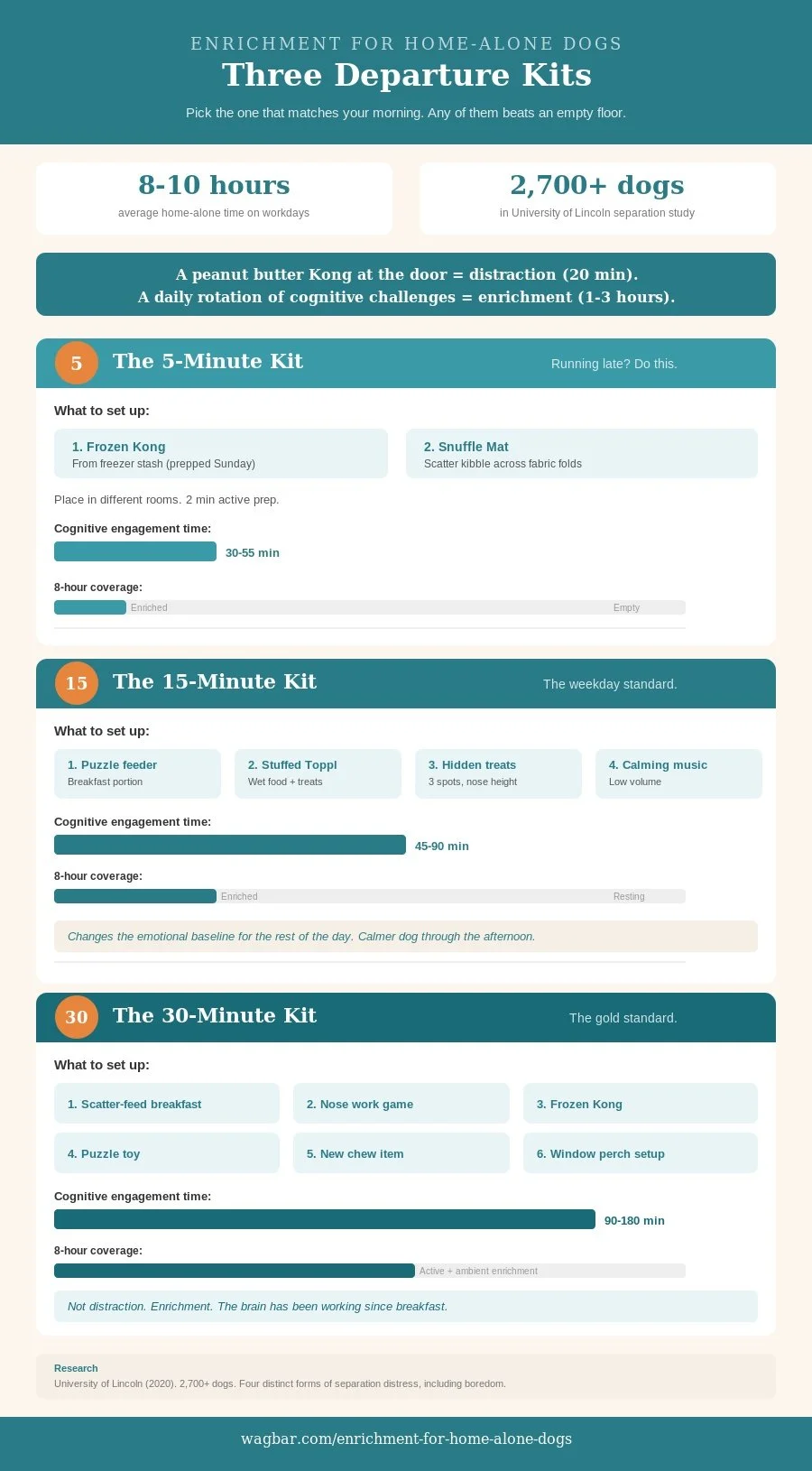
Three tiers. Pick the one that matches your morning. The 5-minute version is better than nothing. The 30-minute version is better than everything.
The 5-Minute Kit
For mornings when you are already late. Minimum viable enrichment.
Pull a frozen Kong from your freezer stash (prepped on Sunday). Scatter a handful of kibble across a snuffle mat. Place both on the floor in different rooms.
That is it. Two minutes of active prep. The frozen Kong provides 20 to 40 minutes of sustained oral and cognitive work. The snuffle mat provides 10 to 15 minutes of nose-driven foraging. Your dog gets 30 to 55 minutes of engagement instead of zero.
Is it enough for 8 hours? No. Is it dramatically better than a bowl of kibble and a closed door? Yes.
The 15-Minute Kit
The weekday standard. This is what a consistent enrichment practice looks like.
Set up a puzzle feeder with a portion of breakfast. Stuff a Toppl or West Paw toy with wet food and a few treats (pull from freezer if pre-stuffed). Hide 3 treats around the house at nose height. Different spots every day. Turn on calming music or a pet-specific playlist at low volume.
Total cognitive engagement time. 45 to 90 minutes across the morning. The puzzle feeder and stuffed toy handle the first hour. The hidden treats give the dog a reason to move through the house and use their nose after the toys are done. The ambient sound provides low-level sensory enrichment that breaks the silence of an empty house.
This is the kit that turns a bored dog into a dog who had a productive morning. It will not cover the full 8 hours, but it changes the emotional baseline your dog operates from for the rest of the day. A dog who spent the first 90 minutes problem-solving enters the remaining hours calmer and more settled than one who spent the first 90 minutes staring at a door.
The 30-Minute Kit
The gold standard. For days you have the time, weekends before you leave, or dogs who need maximum support.
Scatter-feed breakfast in the yard or across multiple rooms (5 minutes of natural foraging). Run a quick nose work game. Hide 5 to 8 treats in progressively harder spots (behind furniture, under a towel, inside a loosely closed box). Set up a frozen Kong in one room and a puzzle toy in another. Introduce a new chew item (bully stick, yak chew, dental chew) that the dog has not seen this week. Move a bed or blanket to a window with a good view and set up a "window perch" for passive environmental watching.
Total engagement. 90 to 180 minutes. The scatter feed and nose work burn cognitive energy before you even leave. The frozen Kong and puzzle toy extend engagement through mid-morning. The chew item bridges the gap. The window perch provides ambient stimulation for the rest of the day.
This is enrichment, not distraction. The dog's brain has been working since breakfast, the environment has been deliberately varied, and the cognitive runway extends well past the departure moment.
The Sunday Prep Session
The reason most owners fail at home-alone enrichment is not motivation. It is morning logistics. You are not going to stuff a Kong and hide treats around the house at 6.45 AM when you are also showering, making coffee, and finding your keys. The solution is batch prep.
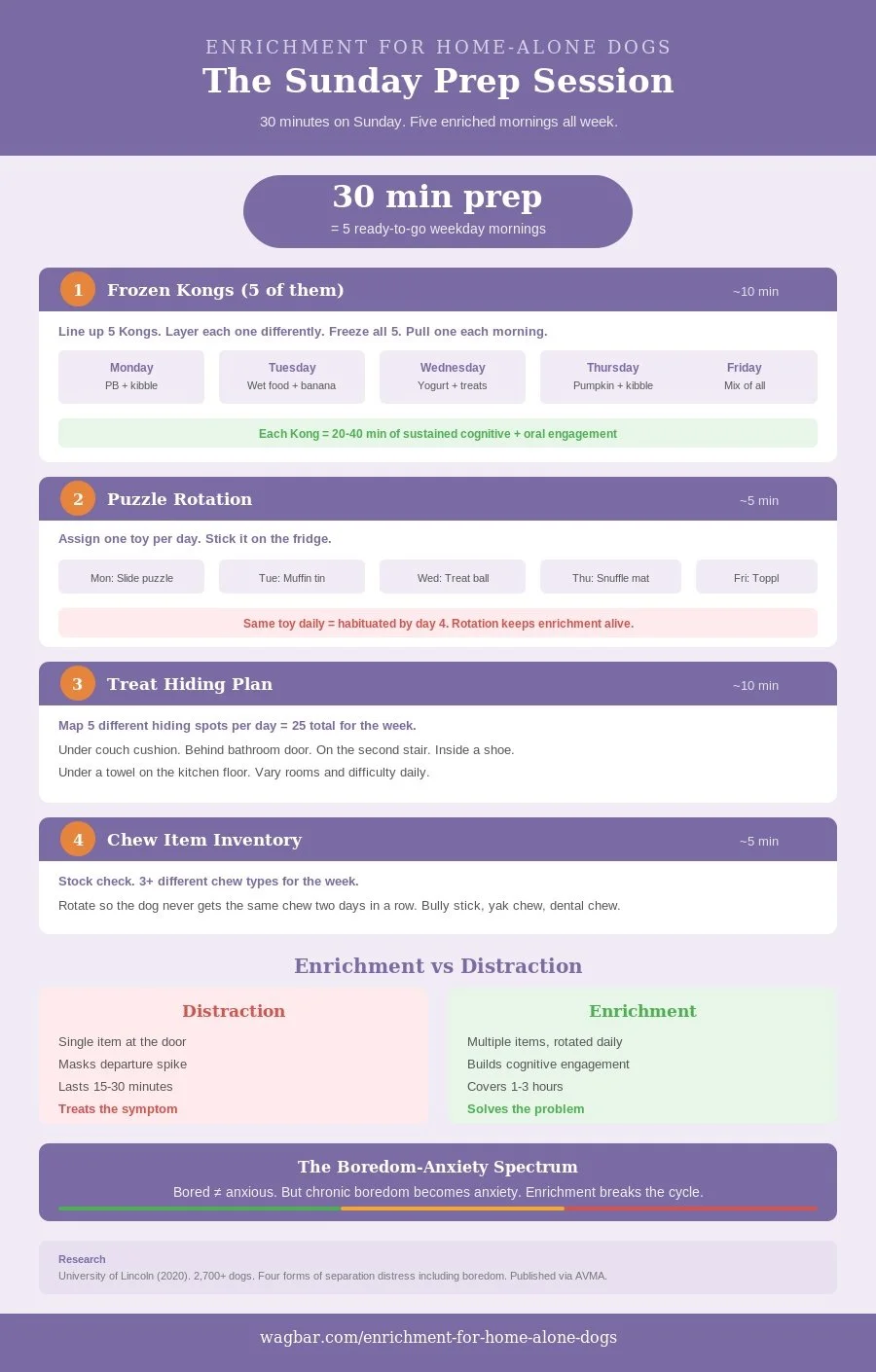
Sunday afternoon. 30 minutes. Set up the entire week.
Frozen Kongs (5 of them). Line up five Kongs or similar stuffable toys. Layer each one differently. Kong 1 gets peanut butter and kibble. Kong 2 gets wet food, banana, and a few blueberries. Kong 3 gets plain yogurt and crushed treats. Kong 4 gets pumpkin puree and kibble. Kong 5 gets a mix of all of the above. Freeze all five. Pull one each weekday morning. 10 minutes of prep covers the entire week.
Puzzle rotation. Lay out the week's puzzle feeders and food enrichment toys. Assign one per day. Monday gets the slide-and-reveal. Tuesday gets the muffin tin with tennis balls. Wednesday gets the treat-dispensing ball. Thursday gets the snuffle mat. Friday gets the Toppl. Write it on a sticky note on the fridge if you need to. The rotation matters because the brain habituates to the same toy within 3 to 4 uses. Rotating prevents the enrichment from becoming background noise.
Treat hiding plan. Mentally map 5 different hiding spots per day, 25 total for the week. Under the couch cushion. Behind the bathroom door. On the second stair. Inside a shoe (clean). Under a towel on the kitchen floor. Vary the rooms and difficulty. Your dog should never predict where the treats will be.
Chew item inventory. Check your stock. You need at least 3 different chew types for the week. Rotate them so the dog never gets the same chew two days in a row.
This takes 30 minutes once. It eliminates 5 mornings of scrambling. And it turns a good intention into an actual system.
Rotation Prevents Habituation
The biggest mistake in home-alone enrichment is doing the same thing every day. Monday's frozen Kong is exciting. By Friday, the same frozen Kong is furniture. The brain habituated. The enrichment value dropped to near zero.
Rotation is the mechanism that keeps enrichment effective over weeks and months. Rotate the toy type. Rotate the filling. Rotate the hiding spots. Rotate the room where enrichment happens. Rotate the background sound. The goal is that your dog's morning is slightly different every single day.
This is the same principle that makes environmental enrichment work. The brain engages with novelty and disengages from sameness. A dog who has encountered the same setup every day for two weeks is getting physical calories from the food but zero cognitive value from the activity. Change one variable daily and the enrichment stays alive.
Camera-Based Enrichment Monitoring
A pet camera is not just for checking whether your dog chewed the couch. It is a diagnostic tool for your enrichment system.
Watch what happens in the first 30 minutes after you leave. Does your dog go straight to the enrichment? Good. Do they ignore it and pace by the door? The enrichment is not engaging enough, or departure anxiety is overriding it. Do they finish everything in 10 minutes and then pace? You need more volume or harder difficulty. Do they not touch the puzzle feeder at all? That toy has habituated. Rotate it out.
Watch what happens at the 2-hour mark. Is your dog settled? The enrichment did its job. Are they restless or destructive? The cognitive runway was too short. Add another element.
The camera lets you calibrate. Without it, you are guessing. With it, you can adjust difficulty, volume, and variety based on what your actual dog actually does when you are actually gone.
When Home Enrichment Is Not Enough
Some dogs need more than a well-stocked departure kit. Dogs with high social needs. High-energy breeds who burn through enrichment in an hour. Dogs who have developed genuine anxiety that enrichment alone cannot address. Dogs left alone for 10+ hours regularly.
Home enrichment covers the cognitive gap. It does not replace the social, environmental, and sensory enrichment that dogs are wired to need. A puzzle feeder is great. It is not a substitute for interacting with other dogs, exploring a novel environment, and processing the kind of complex social information that only happens in real-world settings.
This is where out-of-home enrichment becomes necessary. A morning at Wagbar before your afternoon shift. A midday visit from a dog walker who takes a sniffari route instead of a quick lap around the block. A regular drop-off at a supervised enrichment facility where your dog gets the five categories simultaneously.
The dogs who handle home-alone time best are dogs who have a mix. Regular out-of-home enrichment sessions 2 to 3 times per week plus a solid departure kit system for the days in between. The out-of-home sessions fill the social and environmental tanks. The departure kits maintain cognitive engagement on the solo days. Together, they cover the full spectrum.
Wagbar's membership model was built for exactly this pattern. Not daily daycare. Regular, structured enrichment visits that give your dog the social complexity and environmental novelty that no home setup can replicate, on a schedule that works with yours. A morning at Wagbar before your afternoon shift is not a luxury. For some dogs, it is the difference between coping and thriving.
Or explore the franchise opportunity and build the space where every home-alone dog in your city gets what they are missing.
FAQs
How long can I leave my dog alone with enrichment?
Enrichment extends the quality of home-alone time but does not eliminate the need for breaks. Most dogs handle 4 to 6 hours well with a solid departure kit. Beyond 6 hours, consider a midday visit from a walker or a morning enrichment session at a facility like Wagbar before you leave. The departure kit keeps the brain engaged for the first 1 to 3 hours. After that, social and physical needs start building.
Will enrichment cure my dog's separation anxiety?
Enrichment addresses boredom-driven distress, which accounts for a significant portion of what owners call separation anxiety. True clinical separation anxiety requires behavioral modification and sometimes medication. If your dog shows extreme distress (howling, self-harm, destroying exit points) within minutes of departure, consult a veterinary behaviorist. Enrichment is still part of the treatment plan, but it is not the whole plan.
What if my dog ignores the enrichment after I leave?
Two possibilities. The enrichment has habituated (rotate immediately) or departure anxiety is overriding cognitive engagement. For the second scenario, set up enrichment 10 minutes before you leave rather than at the moment of departure. Let the dog engage with the puzzle while you are still home so the activity is already in progress when you walk out. This decouples the enrichment from the departure trigger.
Does leaving the TV or music on actually help?
Research on auditory enrichment in shelters shows that classical music reduces barking and promotes resting behavior compared to silence or heavy metal. Leaving calming music or low-volume talk radio on provides ambient sensory input that breaks the acoustic emptiness of a vacant house. It is low-impact enrichment, not a solution on its own, but it contributes to the overall environment.
Every Morning Is a Setup for the Next 8 Hours
The 5 minutes before you leave the house determine the 8 hours after. A bare floor and a closed door is one kind of day. A frozen Kong, a puzzle feeder, hidden treats, and a snuffle mat is a completely different kind of day. Same dog. Same house. Same 8 hours. Different brain.
Start the Sunday prep. Build the system. And on the days when a departure kit is not enough, get your dog to Wagbar before you leave. Your dog's worst hours do not have to be empty ones.

Bottom TLDR: Most dogs spend 8 to 10 hours home alone with no cognitive stimulation. University of Lincoln research (2,700+ dogs) identified boredom as one of four distinct forms of separation distress. A peanut butter Kong at the door is distraction (20 minutes). A daily rotation of cognitive challenges is enrichment (1 to 3 hours of engagement). Three departure kits by prep time. The 5-Minute Kit (frozen Kong + snuffle mat). The 15-Minute Kit (puzzle feeder + stuffed toy + 3 hidden treats + calming music). The 30-Minute Kit (scatter feed + nose work + frozen Kong + puzzle + new chew + window perch). A Sunday batch-prep session (30 minutes) covers the entire week. Rotation prevents habituation. Camera monitoring calibrates the system. When home enrichment is not enough, regular Wagbar visits fill the social and environmental gaps that no departure kit can cover.