

Environmental Enrichment for Dogs: Your Dog's World Is Too Small and Too Predictable
Your dog lives in the same house, walks the same three blocks, sniffs the same fire hydrant, and sees the same fence line every single day. That is not an environment. That is a loop. And your dog's brain stopped processing it weeks ago.
Environmental enrichment is the fix. It is the practice of changing a dog's physical surroundings to trigger natural behaviors like exploring, foraging, investigating, and problem-solving. The concept comes directly from zoo and animal welfare science, where researchers figured out decades ago that animals in static environments develop stress behaviors, cognitive decline, and emotional flatness. The same thing happens to pet dogs. It just happens slowly enough that most owners do not notice until the dog is chewing drywall or barking at nothing.
Wagbar was built on this principle. A supervised, off-leash environment where the physical space, the dogs, the scents, and the social dynamics change every single day. It is zoo-grade environmental enrichment applied to pet dogs, and your dog can walk through the door and experience it firsthand. But whether you visit Wagbar or not, every dog owner should understand what environmental enrichment means and how to build it into daily life.

What Environmental Enrichment Actually Means
The term "environmental enrichment" was formalized in zoo science in the 1970s. Researchers observed that animals in bare, unchanging enclosures developed stereotypic behaviors. Pacing. Self-harm. Repetitive movements with no function. The fix was not medication or training. It was changing the environment.
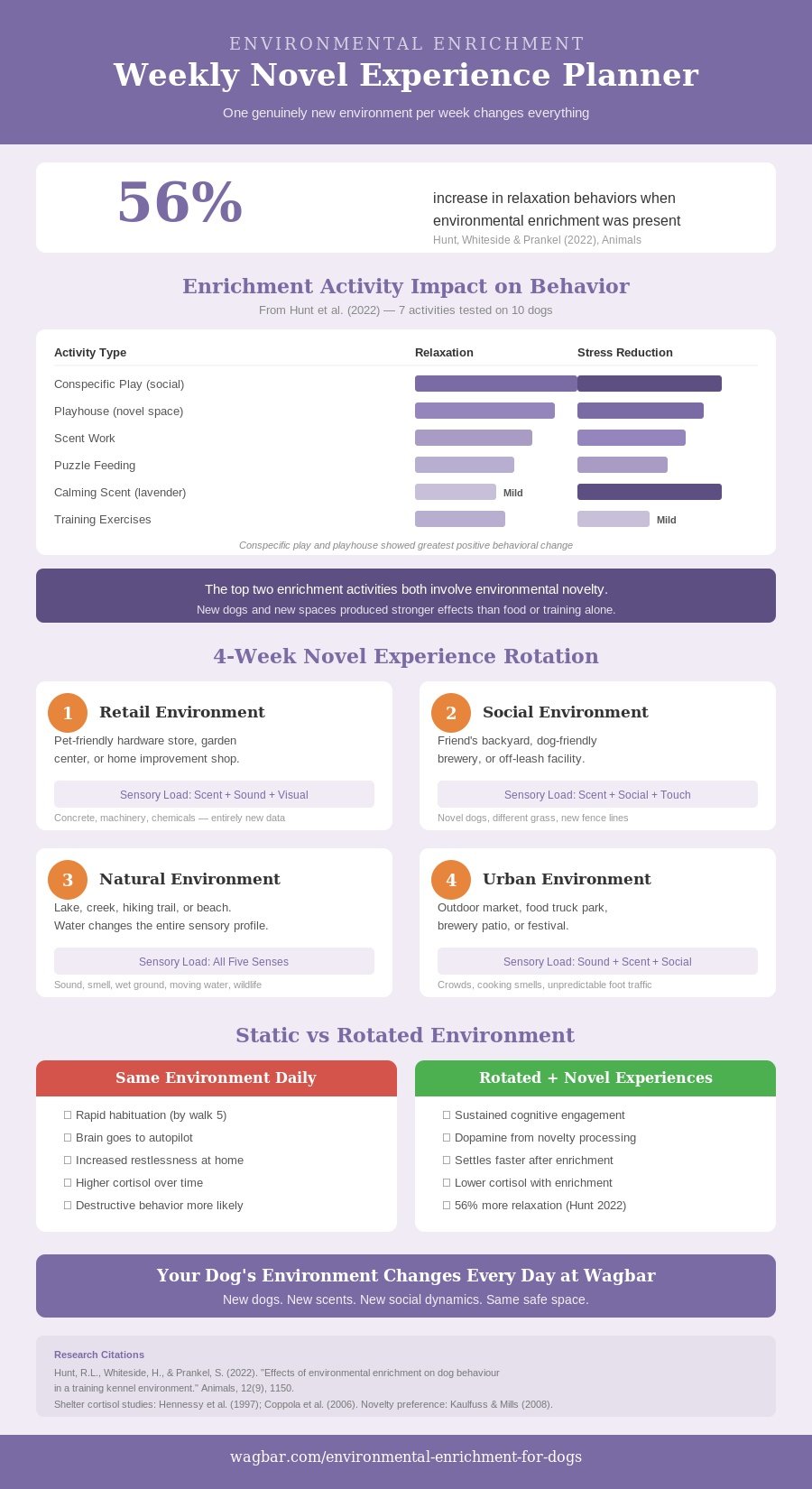
The core insight is simple. Animals are wired to interact with complex, variable surroundings. When the environment is static, the brain has nothing to process. When it is dynamic, the brain stays engaged. Hunt, Whiteside, and Prankel (2022), publishing in Animals, tested seven environmental enrichment activities on dogs in an office training environment. They found a significant increase in relaxation behaviors and a significant reduction in alert and stress behaviors when enrichment was present.
That matters because relaxation is not the absence of stimulation. It is what happens after the brain has been appropriately stimulated. A dog who has processed novel environmental input settles. A dog trapped in a monotonous environment stays vigilant because the brain is scanning for something, anything, to process.
Environmental enrichment falls into overlapping categories. Physical enrichment changes the space itself. New objects, new surfaces, new layouts. Sensory enrichment introduces new smells, sounds, and textures. Food enrichment changes how and where meals are delivered. Social enrichment changes who is in the environment. All four interact. A truly enriched environment engages all of them simultaneously.
Why the Same Walk Gets Stale
Dogs habituate. That is the scientific term for what every owner sees but does not name. The first time your dog walks a new route, every bush is interesting. Every scent is data. Every sound gets an ear flick. By the tenth time, the dog walks that route on autopilot. Head forward, leash tight, pulling toward home.
This is not laziness. It is neurological efficiency. The brain has already mapped that environment. It knows what is there. It stops allocating cognitive resources to processing stimuli it has already catalogued. The walk still burns calories but it no longer engages the brain. And enrichment without cognitive engagement is just exercise.
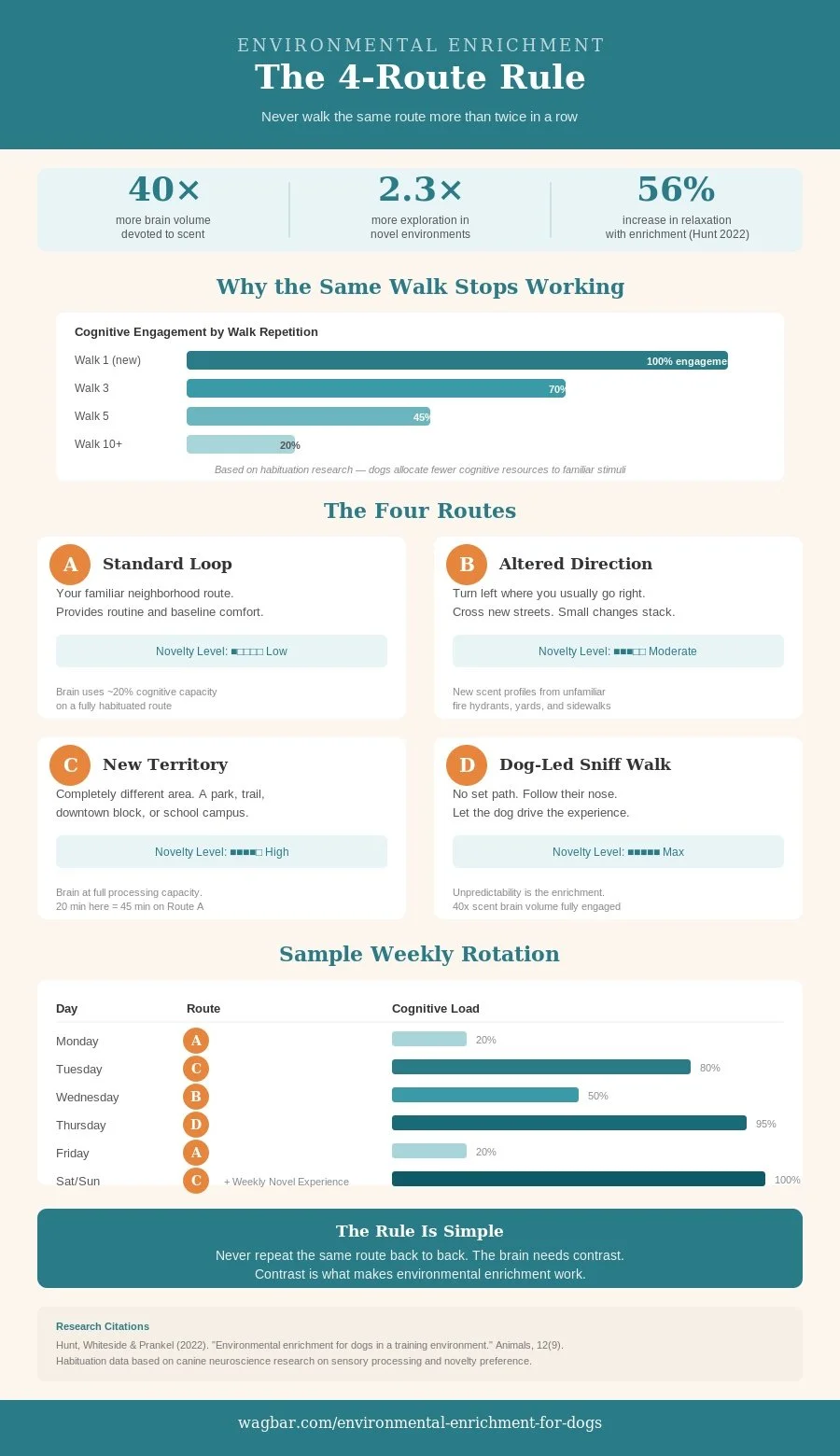
Dogs devote approximately 40 times more brain volume to processing scent than humans do. A new walking route does not just look different to your dog. It smells like an entirely new world. Every fire hydrant, every patch of grass, every crack in the sidewalk carries chemical information your dog has never encountered. That is why a 20-minute walk on a new route tires a dog's brain the way 45 minutes on a familiar route does not.
The practical application is what we call the 4-Route Rule.
The 4-Route Rule
Never walk the same route more than twice in a row. Maintain a minimum rotation of four distinct routes and cycle through them. This is not about distance or duration. It is about novelty.
Route A. Your standard neighborhood loop. Familiar but necessary for routine.
Route B. A different direction from your front door. Cross a street you normally do not cross. Turn left where you usually turn right. Even small changes introduce new scent profiles and visual inputs your dog has not processed recently.
Route C. A completely different area. A park, a downtown block, a trail, a school campus after hours. This is the high-novelty route. Everything is new. The brain is working at full capacity.
Route D. A variable route. No set path. Let your dog lead. Follow their nose. Change direction when they show interest in something. This is the nose work walk. The dog is driving the experience, and the unpredictability is the enrichment.
Rotate A, B, C, D across the week. Never repeat the same route back to back. The brain needs contrast. Contrast is what makes environmental enrichment work.
The Weekly Novel Experience
Beyond walk rotation, schedule one genuinely new experience for your dog every week. Not a new treat. Not a new toy. A new environment.
Week 1. A pet-friendly hardware store. Wide aisles, strange smells, forklifts beeping, concrete floors. Your dog has never processed this combination of stimuli.
Week 2. A friend's backyard. New scents from different dogs, different grass, different fence lines. Even a space this mundane is rich with novel environmental data.
Week 3. A lake, creek, or pond. Water introduces an entirely different sensory profile. The sound, the smell, the feel of wet ground, the visual movement of the surface. Sensory enrichment and environmental enrichment stack here.
Week 4. A busy outdoor market, brewery patio, or food truck park. Human crowds, cooking smells, unpredictable foot traffic. This is high-intensity environmental enrichment that also builds confidence and social tolerance.
The goal is not the specific location. The goal is novelty. Any environment your dog has not experienced recently qualifies. Rotate through enough of them and your dog's brain never runs out of new data to process.
How Facilities Engineer Environmental Enrichment
Home-based environmental enrichment is valuable but limited. You can rearrange furniture, rotate toys, change walking routes, and introduce new surfaces and textures. But you control one household. The novelty ceiling is real.
Purpose-built facilities solve this by engineering environments that change constantly without any effort from the owner. Agility elements that rotate weekly. Varied terrain surfaces (grass, gravel, rubber, dirt, sand). Shade structures that shift available space. Water features that appear seasonally. These are the same design principles zoos use, scaled for dogs.
Wagbar's environment takes this further. The outdoor space is the fixed variable. Everything else changes. The dogs are different every day, which means the scent profile is different every day. The social dynamics shift with every new dog that walks in. Weather variation changes the physical experience. Food trucks on the human side create rotating scent profiles that drift through the dog area.
That combination of fixed space and rotating variables is exactly what zoo enrichment science recommends. The animal knows the space well enough to feel safe. But the stimuli within that space change constantly, which keeps the brain engaged without triggering anxiety. It is the sweet spot between familiarity and novelty.
Enrichment at Home: Rotation Strategies That Work
You do not need to rebuild your house. You need a rotation system.
Object rotation. Keep 15 to 20 toys and put out only 4 to 5 at a time. Swap every three days. A toy your dog has not seen in two weeks is neurologically closer to a new toy than one that has been on the floor since Tuesday. This is the same principle zoos use when rotating enrichment items through animal enclosures.
Surface variation. Put a yoga mat on the kitchen floor. Lay a piece of artificial turf on the patio. Set up a kiddie pool with an inch of water. A snuffle mat on a tile floor is a different experience than a snuffle mat on carpet. The texture change itself is enrichment.
Spatial rearrangement. Move your dog's bed to a different room once a month. Change where the water bowl sits. Shift furniture enough to alter the sightlines from your dog's favorite spot. The brain has to re-map the space, and that re-mapping is cognitive work.
Scent introduction. Bring a pinecone home from a hike. Set a used towel from a friend's dog near the door. Rub a small amount of vanilla extract on a baseboard. Your dog will spend ten minutes investigating each one. That is ten minutes of cognitive enrichment from something that costs nothing and takes thirty seconds to set up.
Sound variation. Play nature sounds (birds, rain, ocean waves) at low volume for an hour. Then switch to classical music. Then silence. The auditory changes create environmental novelty that most owners never consider.
The Novelty Principle: Why It All Works
Every strategy above is built on one principle. The brain engages with change and disengages from sameness.
This is not specific to dogs. It is a fundamental property of mammalian neurology. Novel stimuli trigger dopamine release, which drives exploration, learning, and positive emotional states. Familiar stimuli trigger habituation, which conserves energy but produces no cognitive benefit.
The science of enrichment shows that environmental complexity and variability are the two strongest predictors of welfare outcomes in captive animals. Pet dogs are not "captive" in the zoo sense, but they are environmentally constrained. They cannot choose where to go. They depend entirely on their owners to introduce novelty.
Dogs showing signs of under-enrichment like excessive barking, destructive chewing, pacing, or compulsive licking are often not anxious or badly behaved. They are bored. Their environment is too predictable, too static, and too small. Environmental enrichment is the most direct fix because it addresses the root cause. Not the dog. The world the dog lives in.
This is true across every life stage. Puppies need environmental complexity to build confident, adaptable brains during critical development windows. Adolescent dogs need novel challenges to channel their energy productively. Adult dogs need variety to prevent behavioral stagnation. And senior dogs need ongoing stimulation to slow cognitive decline.
FAQs
How do I know if my dog needs more environmental enrichment?
Watch for decreased interest in walks, restlessness after exercise, destructive behavior aimed at household objects, or excessive barking at nothing in particular. These are signs the brain is scanning for stimulation and not finding any. Dogs who are environmentally enriched tend to settle faster, sleep more deeply, and show less reactive behavior on leash.
Can too much novelty stress a dog out?
Yes. Dogs who are anxious or under-socialized can become overwhelmed by too much environmental change at once. Start small. A new walking route, not a crowded festival. A new object on the floor, not a complete furniture rearrangement. Build novelty tolerance gradually the same way you build physical fitness. The goal is a dog who gets excited by new environments, not one who shuts down.
Is environmental enrichment different from sensory enrichment?
They overlap significantly. Environmental enrichment changes the physical space. Sensory enrichment targets specific sensory channels (smell, sound, sight, touch, taste). In practice, changing the environment almost always changes the sensory input. They work best together. The five pillars of enrichment are interconnected, not separate categories to check off.
Do dogs that go to daycare still need environmental enrichment at home?
Yes. Daycare provides social enrichment and some environmental stimulation, but your dog spends more hours at home than anywhere else. If the home environment is static, the non-daycare hours are still understimulating. The rotation strategies above keep the home base dynamic. The combination of an enriched home and regular visits to a dynamic social environment produces the best behavioral outcomes.
Same World, New Eyes
The walk is the same length. The yard is the same size. The house has the same four walls. But the route changed. The objects rotated. The scent is different. The surface underfoot is unfamiliar. And your dog is awake, alert, processing, and engaged instead of pacing, chewing, or staring at the wall.
That is environmental enrichment. It does not require more space, more money, or more time. It requires more variety. And if you want the highest-impact version, walk into a Wagbar and let your dog experience an environment that is engineered to never be the same twice. Or explore the franchise opportunity and build the environment your city's dogs are missing.
