

Enrichment at Wagbar: The Off-Leash Social Model
Top TLDR: A single Wagbar visit delivers all five pillars of canine enrichment in one supervised session. Cognitive enrichment happens when your dog reads the body language of 15 to 30 unfamiliar dogs and makes real-time social decisions. Sensory enrichment comes from dozens of new scent profiles, weather, and varied textures underfoot. Social enrichment is genuine off-leash play with self-selected partners. Environmental enrichment is a space that changes daily. Nutritional enrichment includes pup cups and staff-given treats. At home, covering all five pillars would take five separate activities. At Wagbar, it takes two hours. The one thing you cannot replicate at home is the social pillar. You can stuff a Kong. You can build a snuffle mat. You cannot DIY a pack.
Most dog owners do a good job with one or two pillars of enrichment without even knowing they exist. A frozen Kong at breakfast covers the nutritional and cognitive pillars. A walk through a new neighborhood covers environmental and sensory. But there is one pillar that almost every home enrichment routine misses entirely, and it happens to be the one dogs are wired for above all others.

Social enrichment.
Real, unscripted, off-leash interaction with other dogs. Not a passing sniff on a leash walk. Not a parallel stroll with a neighbor's dog. Full-body, self-directed play with dogs your dog has never met, in a space large enough to run, chase, wrestle, and disengage freely.
That is what Wagbar was built around. And when you map a single visit against the five pillars of dog enrichment, you start to see why regular visitors report behavioral changes that puzzle toys and long walks alone never produced.
The Five Pillars in a Single Visit
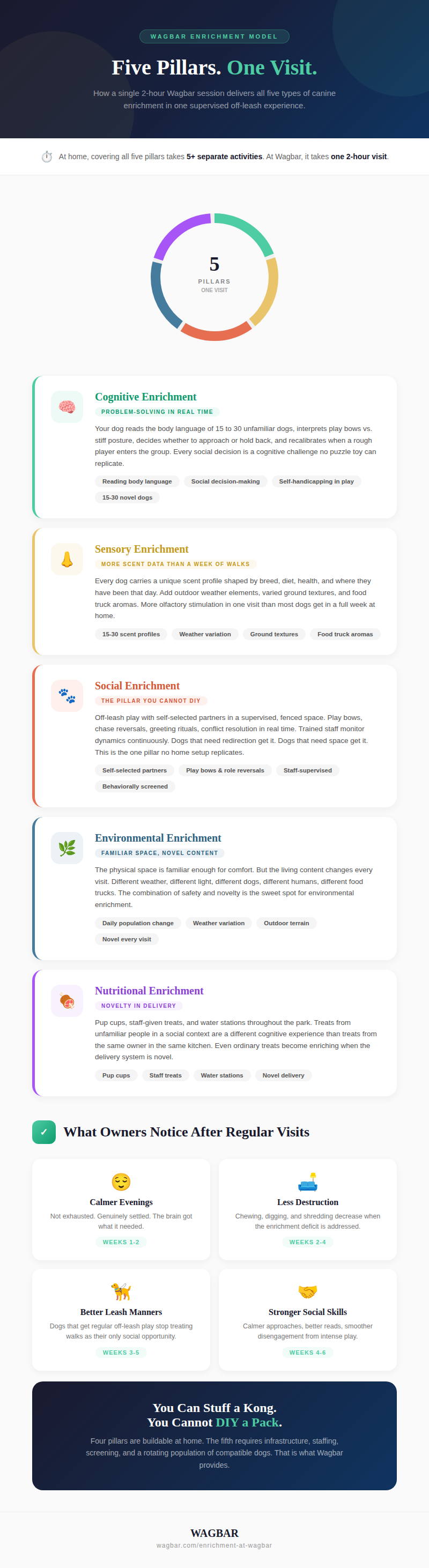
Cognitive Enrichment
Walk into any Wagbar location and watch a dog during its first ten minutes. The ears go forward. The head tilts. The body posture shifts every few seconds.
Your dog is processing. Every new dog in the park is a cognitive challenge. Reading body language, interpreting play bows versus stiff posture, deciding whether to approach or hold back, recalibrating when a rough player shows up. These are real-time social decisions that activate the same problem-solving circuits a puzzle toy targets, except the "puzzle" is alive, unpredictable, and different every single visit.
Sommerville, O'Connor, and Asher (2017) published research on why dogs play and what it means for welfare, finding that play behavior involves sophisticated cognitive processing. Dogs monitor social signals, adjust their play style to match their partner, and practice self-handicapping, which means a larger dog deliberately plays below its full strength to keep a smaller dog engaged. None of that happens with a Kong.
At Wagbar, with 15 to 30 dogs present during a typical session, your dog's brain processes more novel social information in two hours than it would in a month of walks around the neighborhood.
Sensory Enrichment
Every dog at Wagbar carries a different scent profile. Breed, diet, health, grooming products, the other dogs they live with, the places they have been that day. When your dog sniffs a new arrival, it is reading a biological autobiography.
Multiply that by 15 to 30 dogs and you have more scent data in a single visit than most dogs encounter in a week.
Then add the outdoor elements. Weather changes the sensory environment constantly. Rain brings out different ground smells. Wind carries new scent trails across the park. Sun-warmed surfaces feel different underfoot than morning dew. Food trucks parked near the bar add another layer of novel olfactory stimulation that indoor environments never provide.
Sensory enrichment is about exposing the brain to novel stimuli that demand attention. Wagbar's outdoor, multi-dog format does that passively. Your dog does not need a structured sniff walk to get sensory enrichment here. It happens by default.
Social Enrichment
This is the pillar you cannot build at home. Not with toys. Not with puzzles. Not with training. Not with a dog park where nobody supervises and aggressive dogs go unchecked.
Social enrichment through off-leash play requires specific conditions. Dogs need enough space to approach and retreat freely. They need compatible play partners. They need an environment where escalation is interrupted before it becomes conflict. And they need to practice the full range of canine social behavior. Play bows, chase reversals, role switches where the chaser becomes the chased, mutual arousal regulation where two dogs ramp up and then both settle without intervention.
Wagbar provides all of that. Trained staff monitor play dynamics continuously. Dogs that show signs of stress or inappropriate behavior are redirected. The fenced outdoor space gives dogs room to self-select their play partners. Nobody forces interaction. Nobody prevents retreat.
Ottenheimer Carrier et al. (2013) studied social behavior and cortisol levels in dogs at off-leash parks and found that social play in appropriate settings was associated with positive behavioral outcomes. The key qualifier is "appropriate settings." Unmonitored public dog parks often produce negative social experiences. Supervised, screened environments produce positive ones. That distinction is why Wagbar requires vaccination records, spay/neuter status, and behavioral screening before any dog enters the park.
Environmental Enrichment
Environmental enrichment means exposure to spaces that differ from the dog's daily routine. For a dog that spends 22 hours a day in the same house and yard, any novel environment is enriching. But Wagbar adds something most novel environments do not. It changes every single visit.
The weather is different. The light is different. The ground is wet or dry or muddy or sun-baked. The population of dogs is never the same twice. The humans are different. The food truck is different. Every visit is a genuinely new environment, even though the physical location is familiar.
That combination of physical familiarity and social novelty is the sweet spot for environmental enrichment. The dog feels safe enough to explore fully because it knows the space. But the living content of that space is new enough to demand engagement. Familiar and novel at the same time.
Nutritional Enrichment
The fifth pillar is the simplest. Pup cups and treats from staff. Water stations placed throughout the park. Occasional food truck fare designed for dogs.
Nutritional enrichment at Wagbar is not the primary draw. But it is worth noting that treats delivered by unfamiliar people in a social context are a different cognitive experience than treats delivered by the same owner at the same time in the same kitchen. Novelty in the delivery system matters, even when the treat itself is ordinary.
What Owners Notice After Regular Visits
The behavioral changes that regular Wagbar visitors report tend to follow a pattern. They do not happen immediately. They build over 3 to 6 weeks of consistent weekly visits.
Calmer evenings. The most common observation. Dogs that visit Wagbar on Saturday afternoon are noticeably settled by Saturday evening. Not exhausted in the collapsed, overtired way that a long hike produces, but genuinely calm. The brain got what it needed. The social and cognitive demands of a 2-hour play session leave the dog mentally satisfied in a way that physical exercise alone does not accomplish.
Less destructive behavior. Chewing, digging, barking at nothing, shredding cushions. These are symptoms of under-enrichment, and they tend to decrease when the enrichment deficit is addressed at the source. Puzzle toys reduce them. Regular social play reduces them further. The combination of both often resolves behaviors that owners had assumed were personality traits.
Improved leash manners. This one surprises people. Dogs that get regular off-leash social play tend to become better on leash, not worse. The logic is straightforward. A dog that never gets to interact freely with other dogs treats every leash walk as the only opportunity. It pulls, lunges, and reacts because this is its one chance and the leash is preventing it. A dog that knows it will get off-leash play every week stops treating leash walks as the entire social calendar. The frustration drops. The reactivity drops with it.
Better social skills overall. Dogs that attend regularly learn to read other dogs more accurately. They approach new dogs more calmly. They disengage from play that is getting too intense without needing intervention. These are practiced skills, not innate traits. Dogs get better at socializing the same way humans get better at conversation. They need practice in safe settings.
Wagbar vs DIY Enrichment: An Honest Comparison
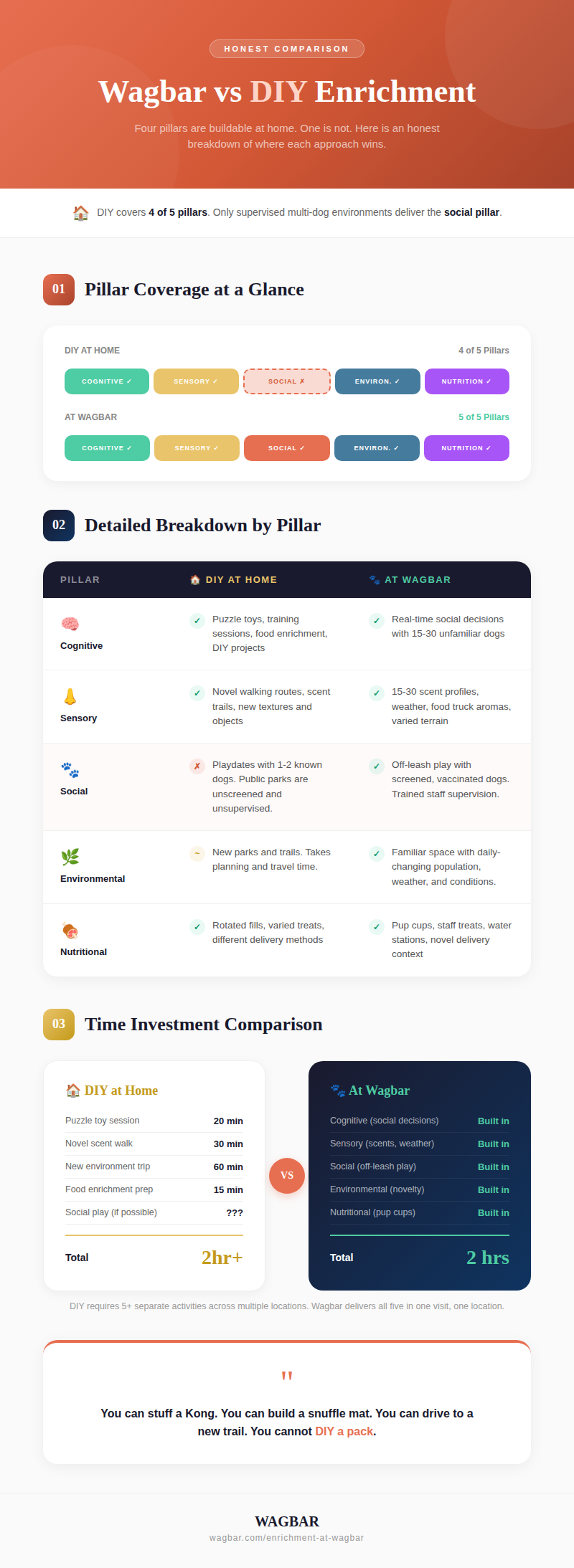
We are not going to pretend that Wagbar is the only way to enrich your dog. That would be dishonest, and the rest of the articles on this site prove otherwise.
Cognitive enrichment at home is completely achievable. Puzzle toys, training sessions, food enrichment through Kongs and snuffle mats, DIY dog enrichment projects that cost almost nothing. You can build a strong cognitive enrichment routine without leaving your kitchen.
Sensory enrichment at home is doable. New walking routes, scent trails in the backyard, novel objects and textures introduced weekly. It takes planning, but it works.
Environmental enrichment at home takes more effort but is possible. New parks, pet-friendly stores, different hiking trails, car rides to unfamiliar areas. The more you break routine, the more environmental enrichment your dog receives.
Nutritional enrichment at home is easy. Rotate fills in puzzle toys. Use different treats. Vary the delivery method. Done.
Social enrichment at home is where the plan falls apart. You can arrange playdates with one or two dogs you know. You can try the public dog park and hope for the best. But you cannot replicate 15 to 30 behaviorally screened dogs in a supervised, fenced outdoor space with trained staff monitoring play dynamics in real time.
You can build four pillars at home. The fifth pillar requires infrastructure, staffing, screening, and a rotating population of compatible dogs. That is what Wagbar provides.
The time comparison tells the story. To cover all five pillars at home, an owner would need a puzzle toy session (20 minutes), a novel scent walk (30 minutes), a trip to a new environment (60 minutes), food enrichment prep (15 minutes), and somehow arranging multi-dog social play (unpredictable). That is over two hours of separate activities across different locations, assuming you can find appropriate social play at all.
At Wagbar, all five pillars are delivered in a single 2-hour visit. Your dog arrives and immediately begins processing novel scents, reading new body language, navigating a changing environment, interacting with other dogs, and receiving treats from staff. Five pillars, one location, one session.
Your Dog's Weekly Enrichment Appointment
Think of a Wagbar visit the way you think of a veterinary checkup or a grooming appointment. Not optional. Not a luxury. A scheduled part of your dog's wellness routine.
Dogs that visit once a week build on the social skills and behavioral improvements from the previous visit. Dogs that visit sporadically start over each time. Consistency is what turns a fun outing into genuine enrichment.
Wagbar membership makes the commitment easy. Monthly and annual plans remove the friction of day passes and make it simple to build Wagbar into your weekly schedule. Walk in, let your dog off leash, order a drink, and watch all five pillars happen without you needing to plan, prep, or supervise a single one.
If you have never visited, start with a first visit. Bring vaccination records. Let your dog explore the space. Watch how it responds to the environment and the other dogs. Most owners see the difference within the first 30 minutes. The dog is engaged in a way that toys and walks never fully replicate.
Your dog's brain was built for this. Give it the full experience.
Bottom TLDR: A single Wagbar visit covers all five pillars of canine enrichment. Cognitive enrichment comes from reading the body language of 15 to 30 unfamiliar dogs. Sensory enrichment comes from dozens of new scent profiles and outdoor elements. Social enrichment is genuine off-leash play with compatible partners in a supervised setting. Environmental enrichment is a space that changes every visit. Nutritional enrichment includes pup cups and staff treats. Regular visitors report calmer evenings, less destructive behavior, improved leash manners, and better social skills over 3 to 6 weeks. Four of the five pillars can be built at home through puzzle toys, scent walks, new environments, and food enrichment. The social pillar cannot. You can stuff a Kong. You cannot DIY a pack. Wagbar membership makes it a weekly appointment, not a sporadic outing.
