

Social Enrichment Through Off-Leash Play: The One Type of Enrichment You Cannot Fake
You can buy a puzzle feeder. You can stuff a Kong. You can scatter kibble across the yard, build an obstacle course out of couch cushions, and run through every cognitive enrichment activity on the internet. And your dog will benefit from all of it.
But none of it replaces what happens when your dog walks into a room full of unfamiliar dogs and has to figure out, in real time, how to read them, respond to them, and navigate a social environment where every variable is unpredictable.
That is social enrichment. It is the only form of enrichment that requires another living, thinking, reacting being as the enrichment itself. No toy simulates it. No human interaction replicates it. And the published research makes a strong case that it is the single most cognitively demanding type of enrichment a dog can experience.

What Social Enrichment Actually Is
Social enrichment is any experience that engages a dog's social cognition. That means reading body language, interpreting vocal signals, calibrating behavior based on another individual's responses, and making real-time decisions about approach, retreat, play intensity, and conflict avoidance.
The five pillars of enrichment (cognitive, sensory, food, environmental, and social) overlap constantly. A nose work session is primarily sensory but also cognitive. A frozen Kong is primarily food-based but engages problem-solving circuits too.
Social enrichment is different because the "puzzle" is alive. It reacts. It changes behavior mid-interaction. It has moods, preferences, thresholds, and communication styles your dog has never encountered before. A puzzle toy is solved once and then it is just a feeding mechanism. A social interaction is never the same twice.
This distinction matters. Bradshaw et al. (2015) reviewed the function and welfare implications of play in domestic dogs and concluded that social play develops motor skills, trains animals for unexpected situations, and builds social cohesion. Those three outcomes, motor development, adaptability, and social bonding, are exactly the skills that deteriorate fastest in dogs who live without regular peer-to-peer interaction.
The Research on Play as Cognitive Development
Play is not recreation. That is the first thing the science makes clear.
Marc Bekoff, professor emeritus of ecology and evolutionary biology at the University of Colorado, has studied canine play for over four decades. His research (Bekoff and Pierce, 2009) established that play in canids is governed by a sophisticated set of social rules. Dogs use play bows, role reversals, and self-handicapping behaviors to negotiate cooperative interactions in real time. These behaviors require theory of mind, impulse control, and rapid decision-making. They are cognitively expensive.
Bekoff's field research on wild coyotes revealed something striking. Juvenile coyotes that did not play fair, that violated the cooperative rules of play, often left their packs. Those individuals were up to four times more likely to die than juveniles who maintained cooperative play relationships. Play was not a luxury. It was survival training.
Domestic dogs retain these same social play circuits. Bauer and Smuts (2007), publishing in Animal Behaviour, conducted a three-year study of play fighting in domestic dog pairs. They documented role reversals, self-handicapping, and complex cooperative strategies that dogs used to maintain play sessions. Older dogs performed more attacks and pursuits. Younger dogs engaged in more self-handicapping. The social negotiation required to keep play going was constant, nuanced, and cognitively demanding.
A 2021 study published in Animal Cognition (Mehrkam and colleagues) found that dogs played significantly more when an attentive owner was present, suggesting that social play is not a simple instinct but a context-dependent behavior influenced by audience effects and social confidence. Dogs are reading the social environment on multiple levels simultaneously.
The Four Types of Social Play

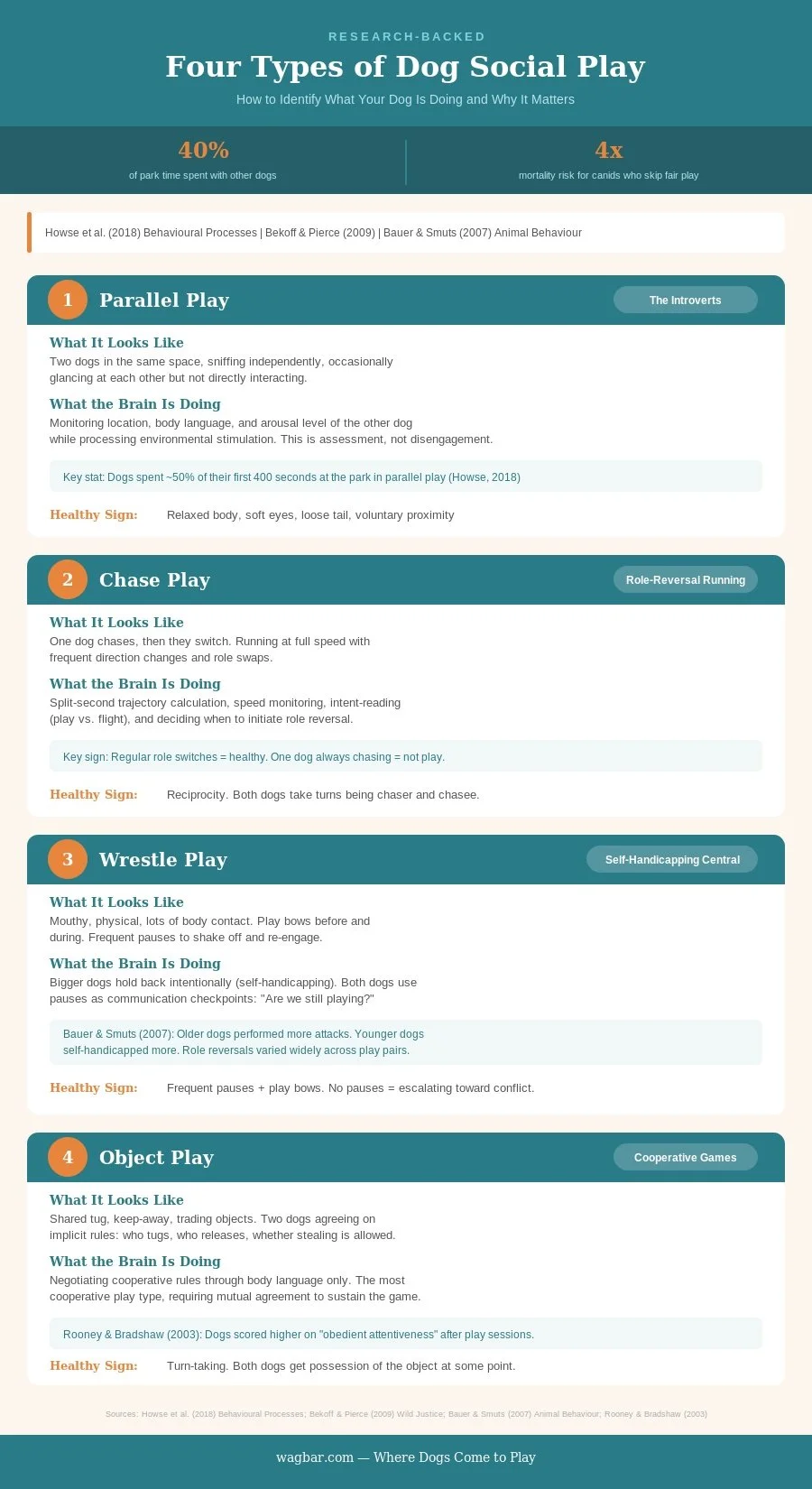
Not all social play looks the same. Research identifies four distinct play styles, each with its own cognitive demands and behavioral indicators. Learning to recognize them tells you a lot about what your dog is getting from any social interaction.
Parallel Play
Two dogs occupying the same space, moving independently, sniffing different things, occasionally glancing at each other but not directly interacting. This is the introvert version of social play. It looks like nothing is happening, but the cognitive work is real. Both dogs are monitoring the other's location, body language, and arousal level while processing environmental stimulation from the shared space.
Parallel play is the most common first behavior when dogs enter an off-leash environment. Howse et al. (2018), studying 69 dogs in an off-leash park, found that dogs spent roughly 50% of their first 400 seconds alone and nearly 40% engaged with other dogs. That initial solo period is not disengagement. It is assessment. The dog is gathering social data before deciding how to interact.
Chase Play
Role-reversal running. One dog chases, then they switch and the other dog chases. The cognitive key is reciprocity. Healthy chase play involves regular role switches. If one dog is always the chaser and never the one being chased, the dynamic has shifted from play to something else.
Chase play builds cardiovascular fitness and burns physical energy, but its real value is the split-second decision-making it demands. The dog being chased has to monitor speed, terrain, distance, and the pursuer's trajectory while simultaneously deciding when to stop, turn, or invite a role reversal. The chaser has to read the other dog's intent (play vs. actual flight) and calibrate pursuit intensity accordingly. This is high-speed cognitive processing wrapped in physical movement.
Wrestle Play
Mouthy, physical, lots of body contact, and, critically, lots of pausing. Wrestle play is where self-handicapping becomes most visible. A large dog playing with a smaller dog will lie down, roll over, use a softer mouth, and generally reduce their physical advantage to keep the play going. Bauer and Smuts (2007) documented these asymmetries in detail. The bigger dog does not have to hold back. It chooses to. That is a sophisticated social decision.
The pauses matter. Dogs engaged in healthy wrestle play stop frequently. They shake off. They play bow. They re-engage. Those pauses are communication checkpoints. Each one is the dog asking "are we still playing?" and the other dog answering. If the pauses disappear, the interaction has shifted from play to conflict. This is exactly the kind of dynamic that trained supervision can read and manage in real time.
Object Play
Shared tug, keep-away, or trading objects back and forth. This is the most cooperative play type because both dogs have to agree on the rules of the game. Who tugs, who releases, who chases the dropped toy, whether stealing is allowed.
Rooney and Bradshaw (2003) found that dogs who engaged in regular rough-and-tumble play, including object play, with their owners scored higher on "obedient attentiveness" after play sessions than before. Social play did not make dogs wilder or less controllable. It made them more focused, more responsive, and more socially calibrated. Object play between dogs produces the same effect but with the added cognitive layer of negotiating with a partner who communicates entirely through body language.
What Dogs Learn from Dogs That Humans Cannot Teach
You can teach your dog to sit, stay, come, shake, and roll over. You can teach impulse control, leash manners, and place training. What you cannot teach is how to be a dog around other dogs.
Dogs learn three things from peer-to-peer social interaction that no amount of human training replicates.
Bite inhibition calibration. Puppies learn the basics of bite inhibition from their littermates. But adult dogs continue to refine this skill with every new play partner. Every dog has a different threshold. Every dog communicates discomfort differently. Playing with a variety of dogs teaches your dog to read and respect a range of individual boundaries, not just one or two familiar ones.
Arousal regulation under social pressure. Dogs who only interact with humans learn to regulate arousal based on human cues. Humans are predictable. They use words. They use leashes. They control the environment. Other dogs do none of that. Playing with unfamiliar dogs forces your dog to self-regulate arousal in an unpredictable social environment where the consequences of miscalibration are immediate. Overdo it and the other dog disengages or snaps. Underdo it and the play dies. The dog has to find the sweet spot on its own, with no help from you. That is a skill that transfers directly to better behavior in social settings.
Conflict de-escalation without human intervention. Most dogs never learn to resolve social tension on their own because their owner steps in every time. Off-leash play in a supervised environment gives dogs the space to practice approach-and-retreat sequences, appeasement signals, and disengagement strategies with staff nearby to ensure safety but not micromanaging every interaction. Dogs who develop these skills are calmer, less reactive, and more confident in novel social situations.
Why Group Play Beats One-on-One Playdates
A backyard playdate with your neighbor's Golden Retriever every Saturday is better than nothing. But it is not social enrichment in any meaningful sense after the first few sessions.
Here is why. Social enrichment depends on novelty. Once your dog has fully mapped another dog's communication style, play preferences, arousal thresholds, and behavioral patterns, the cognitive demand drops to near zero. The dogs fall into a routine. They play the same way every time. The brain is on autopilot.
Group play with rotating participants is fundamentally different. Every new dog is a new puzzle. New body language to read. New play style to negotiate. New thresholds to map. New arousal levels to match. The cognitive demand stays high because the social variables keep changing.
Howse et al. (2018) documented this in their off-leash park study. Dog density influenced social behavior patterns, with more dogs creating more complex social dynamics. This is not about more dogs being "more fun." It is about more dogs creating more cognitive work, more decision points, and more opportunities to practice the social skills that keep a dog emotionally and behaviorally healthy.
This is also where enrichment differs from exercise. Two dogs running in a backyard is exercise. Six unfamiliar dogs navigating greeting sequences, establishing play dynamics, and self-regulating in a shared space is enrichment. The physical activity might be similar. The cognitive and emotional processing is in a different category entirely.
The Social Enrichment Deficit in Single-Dog Households
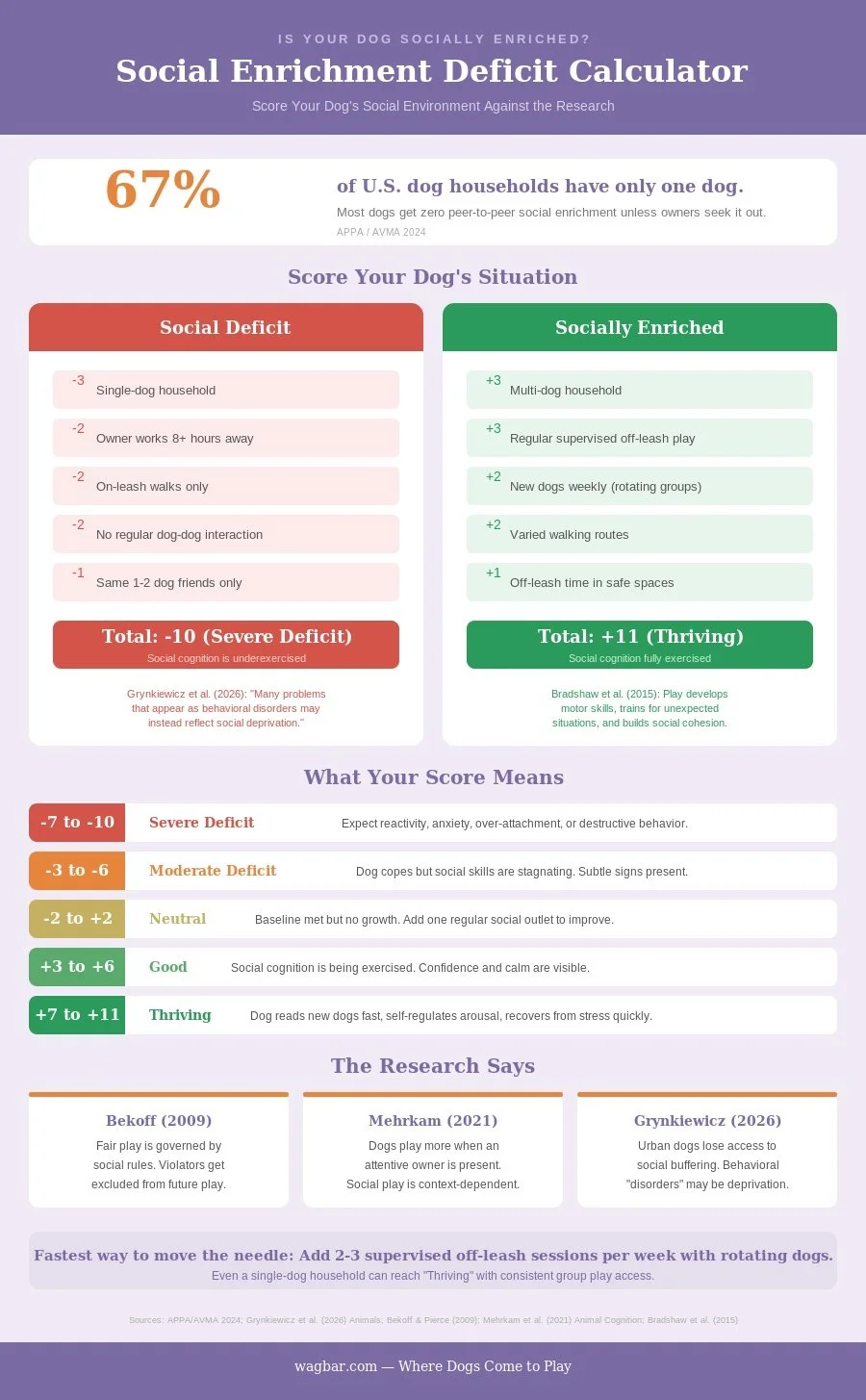
Sixty-seven percent of U.S. dog-owning households have only one dog. That means most pet dogs in America get zero peer-to-peer social enrichment unless their owner actively seeks it out.
Grynkiewicz et al. (2026), publishing in Animals, reviewed how urban living conditions reshape the emotional lives of domestic dogs. Their paper, titled "Disconnected Lives," found that most pet dogs live in single-dog households and experience limited opportunities for sustained same-species bonds. Housing rules, work schedules, and constant supervision have constrained the social environment so severely that many dogs have functionally lost access to the kind of social buffering that helps them recover from stress.
The behavioral consequences are predictable. Dogs without regular social interaction develop what looks like anxiety, reactivity, or over-attachment to their owner. But these are not personality flaws. They are symptoms of social deprivation. The dog's social cognition is understimulated, underexercised, and underdeveloped. Not because the owner is failing but because the modern structure of dog ownership makes social enrichment the hardest type to provide.
Think about it this way. A single-dog household where the owner works eight hours, walks on-leash only, and has no regular off-leash social outlets is a dog living in severe social enrichment deficit. Add a few puzzle toys and snuffle mats and you have covered cognitive, food, and sensory enrichment. But the social column is still empty. And the signs will show up eventually.
A multi-dog household with regular visits to a supervised off-leash environment, varied walking routes, and exposure to new dogs on a weekly basis is a dog living in social abundance. The difference in behavior, confidence, and emotional resilience between these two scenarios is dramatic and well-documented.
How Rotating Social Novelty Creates Maximum Enrichment
The most effective social enrichment environments share one feature. The dogs change.
A backyard with two dogs who have known each other for three years is a social environment but not a socially enriching one. The science of enrichment requires novelty, challenge, and engagement. Familiarity eliminates all three.
Wagbar's model works precisely because the social composition shifts constantly. Different dogs visit on different days. Group dynamics change every session. The greeting sequences, play negotiations, and social calibrations your dog goes through on a Tuesday are completely different from those on a Friday. That means the cognitive and emotional benefits of social enrichment never plateau. Every visit is novel input for a brain designed to process social complexity.
This matters across every life stage. Puppies in their critical socialization window need exposure to a variety of play styles, body types, and temperaments to build robust social cognition. Adolescent dogs need practice managing their own arousal in group settings. Adult dogs need consistent social challenges to maintain the skills they built. And senior dogs benefit from gentle parallel play and low-intensity social interaction that keeps the brain engaged without overtaxing the body. Cognitive decline prevention in older dogs is directly linked to sustained social and cognitive stimulation.
The dogs who visit a supervised facility regularly, two or three times a week, build social skills that compound over time. They read new dogs faster. They calibrate play intensity more accurately. They recover from social stress more quickly. They become the dogs that other dogs want to play with, which creates a positive feedback loop of increasingly rich social experiences.
FAQs
Is off-leash play safe for all dogs?
Most dogs benefit from supervised off-leash play, but readiness varies. Dogs with a history of aggression, severe fear, or no prior socialization may need gradual exposure through parallel play before joining group play. High-energy breeds often thrive in off-leash settings because the social and physical demands match their drive. The key is supervision. Unstructured, unsupervised off-leash play carries risk. Supervised play with trained staff who can read body language and intervene early is a fundamentally different experience.
How often should my dog get social enrichment?
Two to three sessions per week produces the most consistent behavioral improvements. Once a week maintains baseline social skills. Less than that and dogs tend to lose ground, especially if they live in a single-dog household with limited peer contact. Consistency matters more than duration. A ninety-minute session three times a week is better than one five-hour marathon on a weekend.
Can dog-human play replace dog-dog play?
No. They serve different functions. Playing tug or fetch with your dog builds your bond and provides physical and cognitive exercise. But it does not develop same-species social skills. Your dog cannot practice reading unfamiliar body language, negotiating play intensity with an unknown partner, or self-regulating arousal in an unpredictable social group by playing with you. Both types of play matter. Neither replaces the other.
My dog seems fine without other dogs. Does that mean social enrichment is unnecessary?
Not necessarily. Dogs are adaptable. A dog in a single-dog household can appear calm and well-adjusted because it has adapted to its social environment. That does not mean its social cognition is being exercised or that it would not benefit from regular peer interaction. Many owners report noticeable changes in confidence, settling behavior, and overall calmness after introducing regular off-leash social play, even in dogs they thought were perfectly content.
What is the difference between socialization and social enrichment?
Socialization is the developmental process (primarily during the first sixteen weeks) where puppies learn to accept and interact with other dogs, people, and environments. Social enrichment is the ongoing practice of engaging a dog's social cognition through interaction with other dogs throughout their entire life. Socialization builds the foundation. Social enrichment maintains and strengthens it. A well-socialized dog who never interacts with other dogs as an adult will gradually lose social skills, just like a person who was social as a child but isolates as an adult.

Your Dog Has Friends They Haven't Met Yet
Every single benefit listed above, the cognitive processing, the arousal regulation, the conflict de-escalation, the social confidence, happens when your dog walks into a space where new dogs are waiting and trained staff are watching. That is what Wagbar does every single day.
Find your nearest Wagbar and give your dog the social enrichment that no puzzle toy, training session, or backyard playdate will ever replicate. Or explore the franchise opportunity and build the social enrichment solution your city is missing.