

Canine Enrichment vs Physical Exercise: Why a Tired Dog Is Not Always a Happy Dog
You walked your dog for an hour this morning. You threw the ball forty times at the park. You took the long route through the neighborhood. And thirty minutes after getting home, your dog ripped apart a couch cushion, barked at the wall, and started digging at the carpet.
You are not doing anything wrong. You are doing the wrong thing.
Physical exercise and mental enrichment are not the same thing. They serve completely different functions in a dog's brain and body. One burns calories. The other burns cognitive energy. And the dog who gets a two hour walk but zero mental stimulation will consistently outperform in destructive behavior compared to the dog who gets a thirty minute walk paired with fifteen minutes of brain work.
That is not intuition. That is what canine cognition research shows over and over again. A physically tired dog with a bored brain is just a tired dog with enough energy left to destroy things.

What Exercise Actually Does
Exercise is important. Nobody is arguing that it is not. It builds cardiovascular health, maintains muscle tone, supports joint function, regulates weight, and burns excess energy. A dog who never gets physical activity will develop health and behavior problems. That part is not up for debate.
But here is what exercise does not do. It does not challenge the brain. Running a straight line at the park uses the same motor patterns your dog has repeated thousands of times. Fetch is physically demanding but cognitively simple. Your dog is not thinking during fetch. The ball goes out, the dog runs, the dog brings it back. Repeat. The body works hard. The brain is on autopilot.
Walking is slightly better because it involves environmental scanning, scent processing, and spatial navigation. But most owners walk the same route at the same pace every day, which means even the sensory input becomes predictable. The brain stops processing what it already knows.
And here is the part that trips up almost every owner. The more exercise you give a high energy dog, the fitter that dog becomes. The fitter the dog becomes, the more exercise it takes to tire them out. You are not solving the problem. You are building an athlete who still has a bored brain. You end up on a treadmill of escalating walks and runs that never actually addresses what is driving the destructive behavior.
What Enrichment Actually Does
Canine enrichment targets the brain. Problem solving, decision making, sensory processing, social navigation, and foraging behavior all activate neural pathways that physical movement does not touch. When those pathways fire, the brain consumes glucose, releases serotonin and dopamine, and produces a state of calm satisfaction that no amount of running creates.
The difference in outcomes is measurable. Twenty minutes of structured cognitive work, a puzzle feeder, a training session, a scent game, tires a dog's brain the way sixty minutes of walking tires the body. And a brain-tired dog does not chew the baseboard. A brain-tired dog lies down, sighs, and sleeps.
This is why a dog can come home from a five mile run and immediately start looking for something to destroy. The body is tired. The brain is still wide awake and hunting for something to do. The destruction is not spite. It is a bored brain creating its own project because you did not give it one.
The Border Collie Who Ran Five Miles a Day
This scenario shows up constantly in dog training communities and behavioral consultations. The details change but the pattern is always the same.
An owner has a Border Collie. Or an Australian Shepherd. Or a Malinois. Or any breed that was built to work eight hours a day solving complex problems in the field. The owner is doing everything "right" by conventional standards. Five mile runs in the morning. Long walks in the evening. Weekend hikes. The dog is getting more physical activity than 95% of pet dogs in the country.
And the dog still shreds the couch. Still barks obsessively. Still spins in circles. Still cannot settle down in the house even after hours of exercise.
The fix is almost embarrassingly simple. Cut the run from five miles to two. Replace the other thirty minutes with a frozen Kong, a ten minute scent game, and a five minute training session where the dog has to solve a new problem.
Within a week, the destructive behavior drops. The dog settles faster after coming inside. The barking decreases. The spinning stops. Not because the dog is more tired. Because the brain is finally getting fed.
This is not unique to working breeds. It happens with Labs, Golden Retrievers, Poodles, and mixed breeds too. The working breeds just make the pattern more obvious because their cognitive needs are so high that exercise alone literally cannot fill the gap.
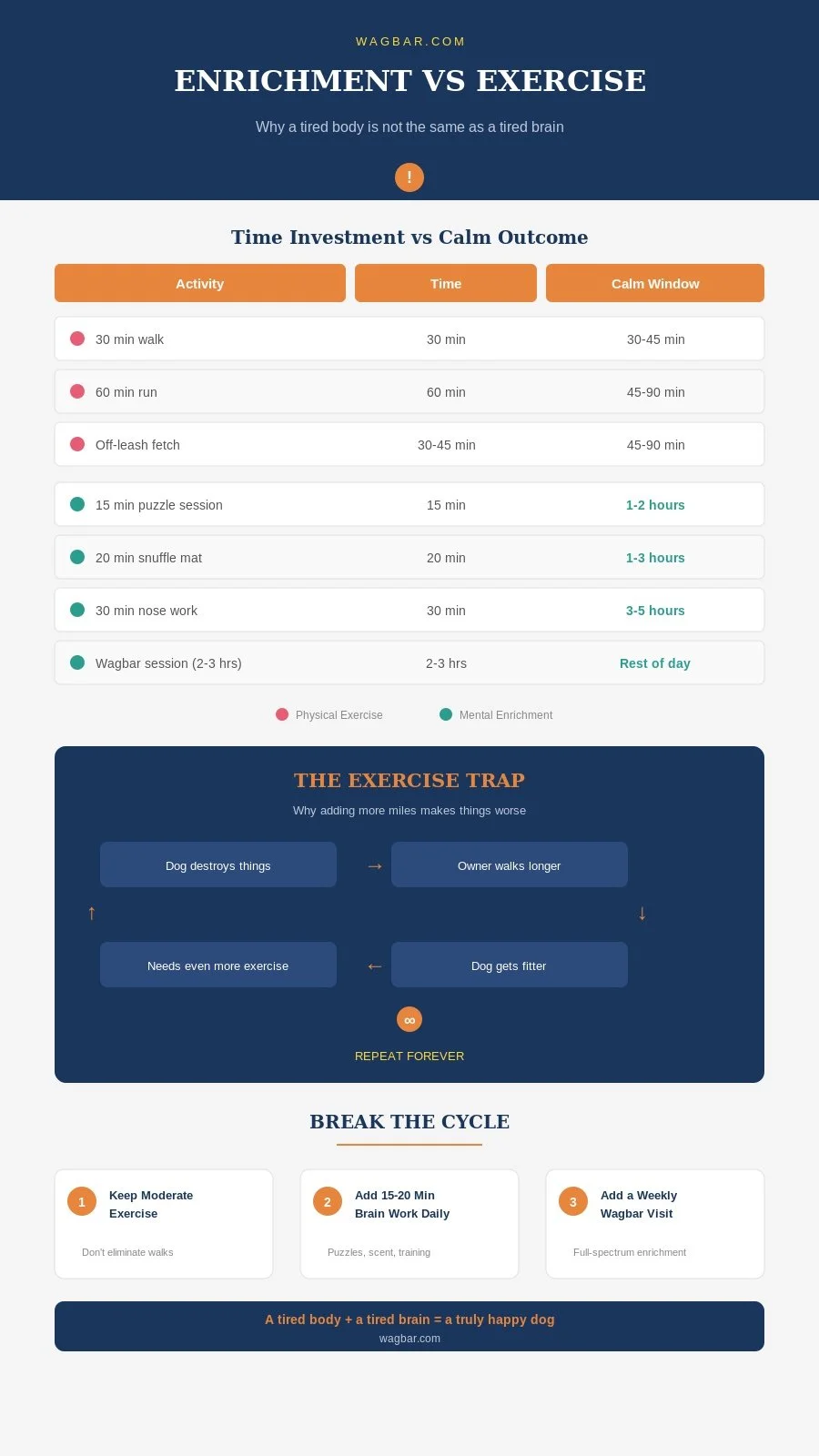
Time Investment vs Outcome
The numbers here are not exact science. Every dog is different. But the general pattern holds across breeds, ages, and energy levels, and it lines up with what behavioral researchers and trainers see consistently.
A 30 minute walk produces roughly 30 to 45 minutes of calm behavior afterward. A 60 minute run produces roughly 45 to 90 minutes. An off-leash fetch session produces similar results to a run. The calm window is directly tied to how long it takes the body to recover, and once the body recovers, the restless behavior starts right back up.
A 15 minute puzzle session produces roughly 1 to 2 hours of calm. A 20 minute snuffle mat or scatter feed produces 1 to 3 hours. A 30 minute dedicated nose work session can produce calm that lasts the rest of the afternoon. And a 2 to 3 hour session at a supervised off-leash environment that combines social, cognitive, sensory, and environmental stimulation can produce calm behavior for the rest of the day.
The brain takes longer to "recover" from stimulation than the body takes to recover from movement. That is why enrichment produces longer windows of calm. The neural pathways that fired during a cognitive challenge need time to reset, and during that reset period, the dog is genuinely settled. Not exhausted. Settled.
What Most Owners Get Wrong
The biggest mistake is doubling down on exercise when behavior gets worse. Dog chewed the rug? Walk longer tomorrow. Dog barked all afternoon? Add a second fetch session. Dog cannot settle at night? Run them harder in the morning.
This creates a cycle that never resolves. More exercise builds a fitter dog. A fitter dog needs even more exercise to reach the same level of fatigue. And the brain stays bored the entire time. You end up with a dog who can run a marathon and still destroy the house.
The second most common mistake is assuming that enrichment replaces exercise. It does not. Both are necessary. A dog who gets puzzle feeders but never moves will develop different problems. Joint stiffness, weight gain, pent up physical energy that comes out as zoomies or rough play. The goal is not to choose one over the other. The goal is to do both in the right proportion.
For most dogs, that proportion looks something like this. Moderate daily exercise that matches the dog's breed, age, and fitness level, plus daily cognitive stimulation that makes the brain work hard for at least 15 to 20 minutes. The exercise can be simple. The enrichment should be varied.
The third mistake is treating exercise as enrichment just because the dog seemed to enjoy it. Your dog loves fetch. That does not mean fetch is enriching their brain. Joy and cognitive stimulation are not the same thing. A dog can love something that is repetitive and still need mental challenges on top of it.
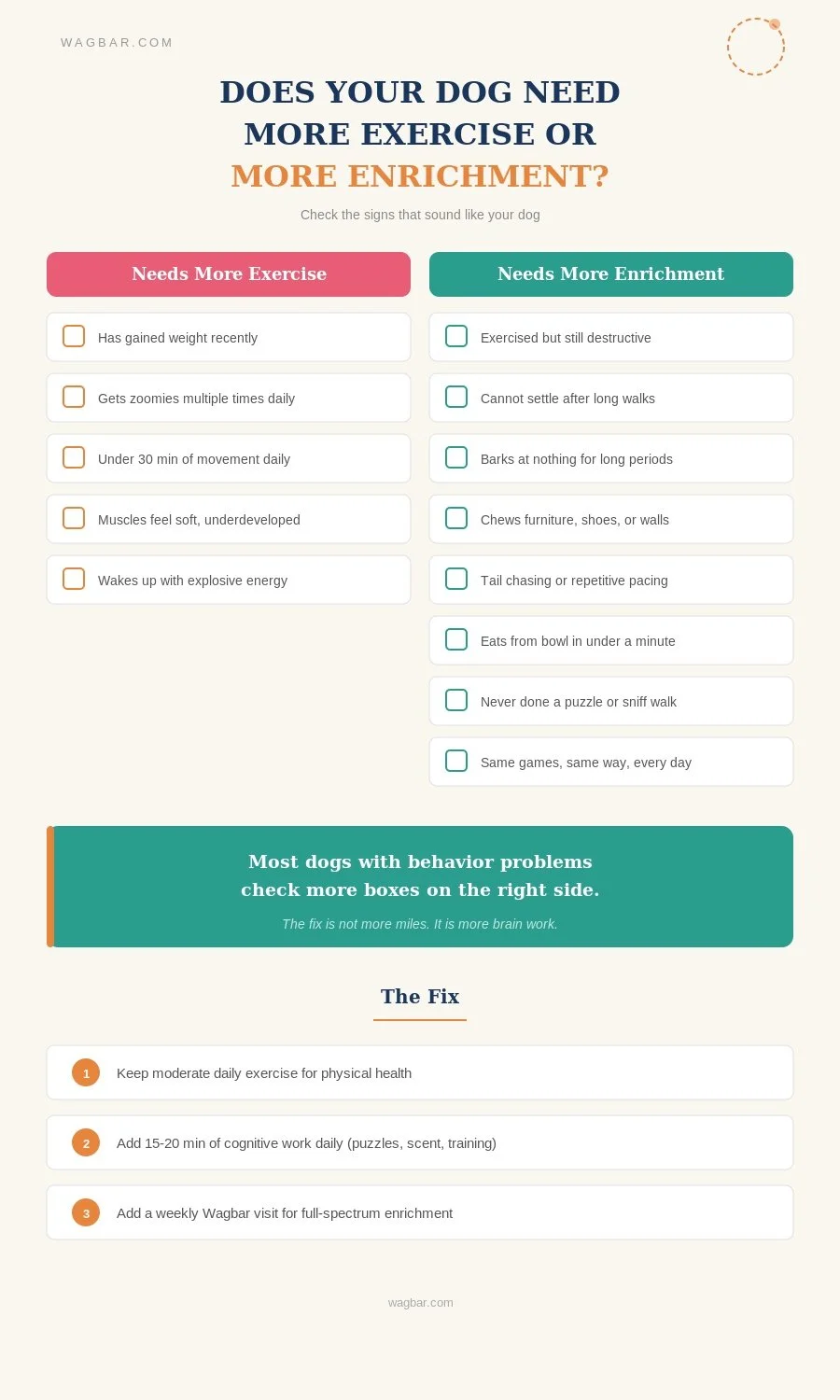
Does Your Dog Need More Exercise or More Enrichment: A Quick Check
Read each statement. If more of them sound like your dog, you know where the gap is.
Signs your dog needs more physical exercise. Your dog has gained weight recently. Your dog gets the zoomies multiple times a day. Your dog is young, healthy, and gets less than 30 minutes of movement daily. Your dog's muscles feel soft and underdeveloped. Your dog sleeps well but wakes up with explosive energy.
Signs your dog needs more enrichment. Your dog gets plenty of exercise but still destroys things. Your dog is restless and cannot settle even after a long walk. Your dog barks at nothing or for extended periods. Your dog chews furniture, shoes, or walls. Your dog does repetitive behaviors like tail chasing or pacing. Your dog eats from a bowl in under a minute and has no other cognitive challenges. Your dog has never done a puzzle toy, a sniff walk, or a training session that required real thinking. Your dog plays the same games in the same way every single day.
Most dogs with behavior problems land heavily in the second group. Not all of them. But most.
Wagbar Combines Both
Most solutions force you to choose. A walk or a puzzle. A run or a training session. A dog park or a scent game. Wagbar does not work that way.
A single visit to Wagbar delivers physical exercise through off-leash play, cognitive stimulation through social problem solving, sensory input through a rotating environment of new dogs, new sounds, and new scents, and social enrichment through supervised interaction with other dogs. The body moves. The brain works. Both get what they need at the same time.
Dogs who visit Wagbar regularly show the kind of calm at home that owners cannot get from exercise alone. Not because they are exhausted. Because their brains got what they actually needed.
FAQs
Why is my dog still destructive after a long walk?
Because the walk tired the body but not the brain. Destructive behavior in dogs who get plenty of physical exercise is almost always a sign of cognitive under-stimulation. The brain is looking for something to do, and chewing, digging, or barking are the solutions it comes up with. Adding 15 minutes of mental work like a puzzle feeder or scent game after the walk will produce better results than making the walk longer.
How much mental stimulation does a dog need per day?
Most adult dogs benefit from at least 15 to 30 minutes of structured mental stimulation daily. This can be broken into smaller sessions throughout the day. A frozen Kong at breakfast, a short training session at lunch, and a sniff walk in the evening adds up fast. High energy breeds need more. Senior dogs may need shorter, gentler sessions. The key is consistency rather than duration.
Can I replace walks with enrichment activities?
No. Physical exercise and mental enrichment serve different functions and your dog needs both. Exercise maintains cardiovascular health, joint function, and muscle tone. Enrichment maintains cognitive sharpness and emotional regulation. Cutting one in favor of the other will create new problems. The goal is to find the right balance for your dog's breed, age, and energy level.
What is the fastest way to mentally tire out my dog?
Nose work. A dog's olfactory system contains up to 300 million receptors and the brain region dedicated to processing smell is 40 times larger than in humans. A 15 to 20 minute dedicated scent session, hiding treats around the house, scattering kibble in tall grass, or running a nose work course, will mentally exhaust most dogs faster than any other single activity. Combine it with a moderate walk and you have a dog who settles for hours.
A Tired Body and a Tired Brain: That Is the Whole Formula
The walk matters. The run matters. The fetch matters. But none of it matters enough on its own. Your dog's brain needs work the same way their body needs movement, and the dog who gets both in the right balance is the dog who comes home, lies down, and actually rests.
Find your nearest Wagbar and give your dog a session that works the body and the brain at the same time. Or explore the franchise opportunity and bring Wagbar to your city.