

Puzzle Toys and Interactive Feeders: Complete Guide
Top TLDR: A 2024 Veterinary Record study found that dogs using enrichment feeders instead of bowls showed meaningful reductions in stress, food-seeking problems, and behavioral issues. This guide introduces a 5-level difficulty framework — from beginner Kongs to expert multi-stage puzzle chains — that matches toy complexity to your dog's actual problem-solving experience. Categories covered: sliding puzzles, treat-dispensing balls, multi-step puzzles, and electronic feeders. Includes safety protocols, rotation strategy, Wagbar Staff Picks, and guidance on when puzzle toys are not enough.
Your dog finishes dinner in 90 seconds. Inhales it. Does not chew. Looks up at you like something went wrong. Then spends the next 4 hours with nothing to do.
That is the standard feeding experience for most pet dogs. A bowl on the floor, food gone before the owner reaches the couch, and a brain that got zero engagement from the most motivating event of the day. Mealtime is the highest-value enrichment opportunity most owners waste completely.
Puzzle toys and interactive feeders fix that. Not by making eating harder for the sake of difficulty, but by turning a 90-second event into a 20- to 45-minute cognitive session that engages the same problem-solving circuits your dog's brain was built for. The difference between a dog that eats from a bowl and a dog that works for its food is not about the food. It is about what the brain does during the process.

A 2024 study published in Veterinary Record titled "Bowls Are Boring" found that owners using enrichment feeders reported reductions in food-seeking behavior, stress presentations, and behavioral problems compared to bowl feeding (Heys et al., 2024). The title of the study tells you what the field thinks of the status quo.
This is not a top-10 list. Not a product roundup with affiliate links. This is a category-level reference for understanding what makes a puzzle toy effective, how to match difficulty to your dog's experience, and how to build a rotation system that keeps enrichment from becoming routine.
What Makes a Puzzle Toy Effective (Not Just Difficult)
The worst puzzle toys are the ones that are hard for the sake of being hard. A dog stares at a contraption it cannot figure out, gets frustrated, flips the whole thing over, and walks away. The owner thinks their dog is "not a puzzle toy dog." The dog is fine. The toy was wrong.
An effective puzzle toy does three things.
First, it provides a solvable challenge at the dog's current skill level. Success is the point. The dopamine release that makes cognitive enrichment effective comes from solving the problem, not from being presented with one. A puzzle the dog cannot solve is not enrichment. It is frustration wearing a different costume.
Second, it extends feeding time meaningfully. A good puzzle toy extends a 90-second bowl meal to 10 minutes minimum. A great one extends it to 30 or more. The 2024 Veterinary Record study found that engagement duration correlated with behavioral improvements. Time on task matters.
Third, it provides variable reinforcement. The best puzzle toys require different actions, different angles, different levels of effort for each reward. This mirrors natural foraging, where food discovery is unpredictable, and it keeps the dog's brain engaged rather than running a memorized motor pattern.
A Kong Classic stuffed with kibble and peanut butter meets all three criteria. A puzzle that dispenses a treat every time the dog pushes a single lever meets one. Know the difference before you spend money.
The 5-Level Difficulty System
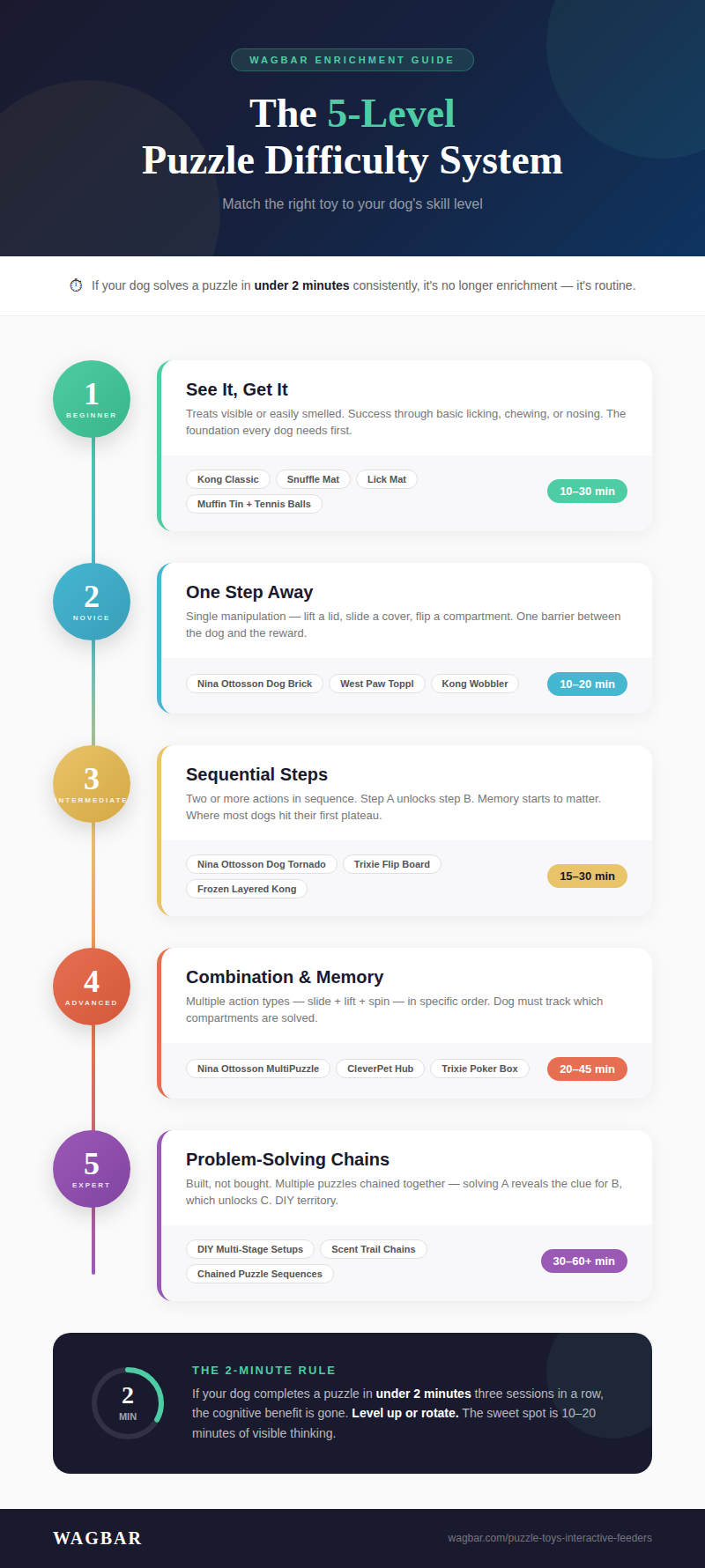
Nina Ottosson's product line uses a 4-level system. Useful, but not granular enough for building a real progression. The gap between "see treat, grab treat" and "perform a multi-step manipulation" is wider than one level suggests.
This 5-level framework adds the nuance progression actually requires. Use it to match toys to your dog's current ability, and use the leveling-up criteria to know when to move forward.
Level 1 — Beginner: See It, Get It
The dog can see or smell treats directly. Minimal manipulation required. Success comes from licking, chewing, or nosing.
Toys at this level: Kong Classic (stuffed, unfrozen), snuffle mats, lick mats with soft spread, open treat-dispensing balls, muffin tin with treats under tennis balls.
Who this is for: Dogs new to puzzle toys. Puppies. Senior dogs starting cognitive enrichment programs. Dogs recovering from behavioral issues where frustration tolerance is low.
Level 1 is not baby stuff. It is the foundation. A dog that has never worked for food needs to learn that interacting with an object produces a reward. Skipping this step is why dogs "hate" puzzle toys. They were never taught the game.
Level 2 — Novice: One Step Away
The treat is hidden behind a single manipulation — lifting a lid, sliding a cover, flipping a compartment, nosing a lever. The action-to-reward connection is direct and repeatable.
Toys at this level: Nina Ottosson Dog Brick, West Paw Toppl (stuffed and frozen), Kong Wobbler, Outward Hound Spin-a-Wheel, basic sliding puzzles with one mechanism type.
Who this is for: Dogs that complete Level 1 puzzles consistently in under 5 minutes.
Level 2 introduces the concept of a barrier between the dog and the food. The dog cannot get the treat by licking or nosing alone. It must perform a deliberate physical action. This is where food enrichment starts building real problem-solving skills.
Level 3 — Intermediate: Sequential Steps
The treat requires two or more sequential actions. Step A before step B becomes available. Memory begins to matter — the dog needs to track which compartments have been solved.
Toys at this level: Nina Ottosson Dog Tornado, Trixie Flip Board, Nina Ottosson Dog Casino, multi-chamber Kongs (frozen with layered fillings), Trixie Move2Win.
Who this is for: Dogs that solve Level 2 puzzles in under 5 minutes consistently.
Level 3 is where most dogs hit their first plateau. The jump from one action to sequential actions is cognitively significant. If your dog pushes a Level 3 puzzle around the room or flips it instead of working the mechanisms, drop back to Level 2 for another 2 to 3 weeks. Frustration is not learning. It is the opposite of learning.
Level 4 — Advanced: Combination and Memory
The puzzle requires combining different action types — sliding and lifting and spinning in a specific order. Memory means tracking which compartments have been opened and which actions unlock which sections.
Toys at this level: Nina Ottosson MultiPuzzle, CleverPet Hub, Trixie Poker Box, Nina Ottosson Dog Worker, stacked or chained Nina Ottosson puzzles (two Level 2 puzzles presented simultaneously).
Who this is for: Dogs that solve Level 3 puzzles consistently. High drive and high frustration tolerance.
The CleverPet Hub deserves special mention. It is the only consumer puzzle toy that uses adaptive difficulty — the puzzle gets harder as the dog improves, using light-based prompts and touchpad interactions. It tracks performance over time and adjusts automatically. For dogs that blow through mechanical puzzles, it is the only product that scales indefinitely.
Level 5 — Expert: Problem-Solving Chains
No single commercial toy lives at Level 5. This level is built, not bought. It involves chaining multiple puzzles into a sequence where solving puzzle A reveals a clue needed for puzzle B, which unlocks puzzle C. This is DIY enrichment territory — scent trails leading to locked boxes, multi-room searches where each puzzle cues the next location.
Who this is for: Dogs that have exhausted commercial options. Working breeds with exceptional problem-solving drive. Dogs enrolled in professional nose work or scent detection. Most dogs will find their sweet spot at Level 3 or Level 4 with proper rotation. Level 5 exists so you know the ceiling, not because every dog needs to reach it.
How to Know When to Level Up
If your dog completes a puzzle in under 2 minutes consistently (three sessions in a row), it is no longer enrichment. It is routine. The dog has memorized the solution and is running a motor pattern, not problem-solving. The cognitive benefit is gone.
Level up by one step, not two. And when you introduce a new level, go back to easy wins within it. The first Level 3 puzzle should be loaded with high-value treats and have only half its compartments filled, so the dog gets frequent rewards while learning the new mechanics.
Signs your dog is at the wrong level (too hard): pawing without trying mechanisms, walking away after under a minute, barking at the toy, flipping or destroying it. Signs it is too easy: completing it without visible engagement, going through motions mechanically, losing interest before the food is gone.
The sweet spot is a puzzle that takes 10 to 20 minutes with visible thinking — pausing, trying different approaches, returning to unsolved sections. That is cognitive enrichment working.
Puzzle Toy Categories: What Each Type Does
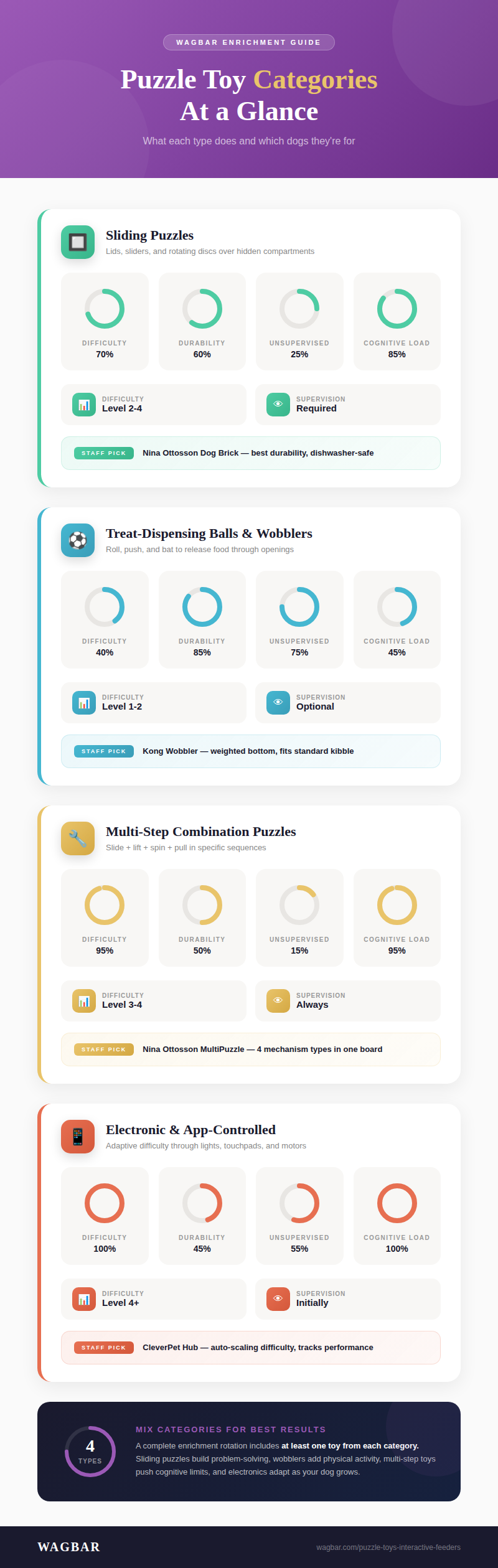
Sliding Puzzles
How they work: Treats are hidden in compartments covered by sliders, lids, or rotating discs. The dog moves the covers to reveal the food.
Best for: Building sequential problem-solving. Teaching the concept that hidden does not mean gone.
Top picks: Nina Ottosson Dog Brick (Level 2) is the gold standard entry point — durable, dishwasher-safe, intuitive for beginners. Nina Ottosson Dog Tornado (Level 3) adds rotating layers requiring compartment alignment. Trixie Flip Board (Level 3) combines flipping, sliding, and lifting in one unit.
Limitation: Dogs learn the pattern. A sliding puzzle that challenged your dog for 3 weeks will bore them in week 5. Sliding puzzles are progression tools, not permanent solutions. Rotate them.
Treat-Dispensing Balls and Wobblers
How they work: Treats are loaded inside a ball or weighted container. The dog rolls, pushes, or bats the toy to dispense food through an opening.
Best for: Physical and cognitive engagement simultaneously. Self-directed play. Extended feeding for dogs with food-seeking behaviors.
Top picks: Kong Wobbler (Level 2) — weighted bottom, large opening for kibble-sized treats. West Paw Toppl (Level 2, frozen fills push to Level 3) — soft enough to stuff, durable enough for power chewers. Omega Paw Tricky Treat Ball (Level 1-2) — adjustable difficulty through opening size.
Limitation: High-movement toys. They roll under furniture. They bang into walls at 6 AM. Not ideal for apartments with downstairs neighbors or dogs that get overstimulated by chase-type play. If your dog's issue involves arousal and reactivity, calming tools like lick mats work better than dispensing balls that ramp energy up.
Multi-Step and Combination Puzzles
How they work: Multiple mechanism types (sliding, lifting, spinning, pulling) combined in a single unit. Solving requires learning and remembering different actions for different compartments.
Best for: Dogs at Level 3 and above. Building sustained focus and replacing destructive behaviors driven by cognitive boredom.
Top picks: Nina Ottosson MultiPuzzle (Level 4) — four different mechanism types in one board. Trixie Poker Box (Level 4) — pull ropes, push levers, and lift cones in combination. Nina Ottosson Dog Casino (Level 3) — bone-shaped sliders over compartments require directional pushing.
Limitation: Supervised toys only. Frustrated dogs will try to destroy what they cannot solve, and small sliding parts become choking hazards when chewed off. Use during active enrichment sessions, not as leave-alone entertainment.
Electronic and App-Controlled Puzzles
How they work: Battery-powered or connected devices that present challenges through lights, touchpads, or motorized compartments. Some adapt difficulty automatically based on the dog's performance.
Best for: Dogs that have exhausted mechanical options. Owners who want performance data. Long-duration enrichment for dogs with separation distress (with appropriate safety precautions).
Top pick: CleverPet Hub (Level 4) — touchpad-based system with three illuminated pads. The dog presses specific pads in response to light cues. Difficulty scales automatically. A companion app tracks performance.
Limitation: Cost and failure points. Electronic toys introduce batteries that die, motors that jam, touchpads that lose sensitivity. They are additions to the mechanical puzzle library, not replacements for it.
Wagbar Staff Picks: What We Use and Why
The Wagbar enrichment team tests puzzle toys under conditions most owners never encounter — multiple dogs, daily use, varying breed types, and every skill level. These are not sponsorships. These are the toys that survived daily institutional use.
The Kong Classic (Level 1-2) is the foundation of every enrichment rotation at Wagbar. Stuffed with kibble, peanut butter, and banana, then frozen overnight, it provides 20 to 40 minutes of sustained engagement depending on fill density. The reason it endures is that it scales. A loosely filled Kong is Level 1. A tightly packed, frozen, layered Kong is pushing Level 3. No other single product covers that range.
The West Paw Toppl (Level 2) is the Kong's partner. Easier to fill and clean, the wider opening works better for dogs that get frustrated with narrow Kong openings, and two Toppls connect together for a longer challenge. Staff use the Toppl for dogs showing early frustration with the Kong because the faster initial reward rate builds confidence.
The Nina Ottosson Dog Brick (Level 2) is the go-to introduction for sliding puzzles. The sliding covers and flip-up bone pieces teach two different manipulation types in one session. It holds up to daily washing and heavy-pawed breeds better than any other sliding puzzle on the market.
The snuffle mat (Level 1) is the single most underrated enrichment tool. Staff use snuffle mats for newly arriving dogs, anxious dogs, and post-play cooldowns. Repetitive nosing and sniffing activates the parasympathetic nervous system, which is why a dog that comes off the play yard wired can be lying down calmly within 10 minutes of working a snuffle mat. The science behind nose work and scent enrichment explains why sniffing is the most reliably calming activity in the canine behavioral repertoire.
The lick mat with frozen filling (Level 1) is used for dogs with anxiety presentations. Repetitive licking activates the same parasympathetic pathways as sniffing. Frozen yogurt or pureed pumpkin extends the session to 15 to 25 minutes. Wagbar staff consider lick mats and snuffle mats the two most important calming tools in the enrichment toolkit — more effective minute-for-minute than any mechanical puzzle at reducing visible stress.
Puzzle Toy Safety: What You Need to Know
Puzzle toys are tools, not babysitters. The safety protocols matter and most product packaging does not cover them adequately.
Supervision requirements scale with difficulty. Level 1 toys (Kongs, lick mats, snuffle mats) are generally safe for unsupervised use with non-destructive chewers. Level 2 and above sliding puzzles should be supervised — small plastic components can be chewed off and swallowed. Electronic toys should always be supervised until the owner has confirmed the dog will not attempt destruction.
Material quality is non-negotiable. Look for food-grade, BPA-free plastics. Silicone lick mats should be food-grade silicone, not TPR (thermoplastic rubber), which degrades faster and can flake. Natural rubber (Kong's proprietary compound) remains the gold standard for stuffable toys because it resists tearing at a level no other material matches.
Choking hazards are real. The number-one puzzle toy injury veterinary emergency rooms report is intestinal blockage from swallowed plastic components. This happens when dogs get frustrated and switch from problem-solving to destruction. A dog chewing on a Nina Ottosson slider instead of sliding it is at the wrong difficulty level or has been left unsupervised too long. Remove the toy. Drop the difficulty. Try again tomorrow.
Size matching matters. A toy designed for a 60-pound dog in a 15-pound dog's mouth is a choking hazard. A toy designed for a 15-pound dog in a 60-pound dog's mouth is a destruction target. If you are between sizes, go up.
Cleaning protocols: Puzzle toys that hold food need washing after every use. Bacteria growth in crevices is a real concern with wet fills. Dishwasher-safe toys are worth the premium. If a toy cannot be fully disassembled for cleaning, it is a hygiene problem waiting to happen.
Rotation Strategy: How to Prevent Habituation
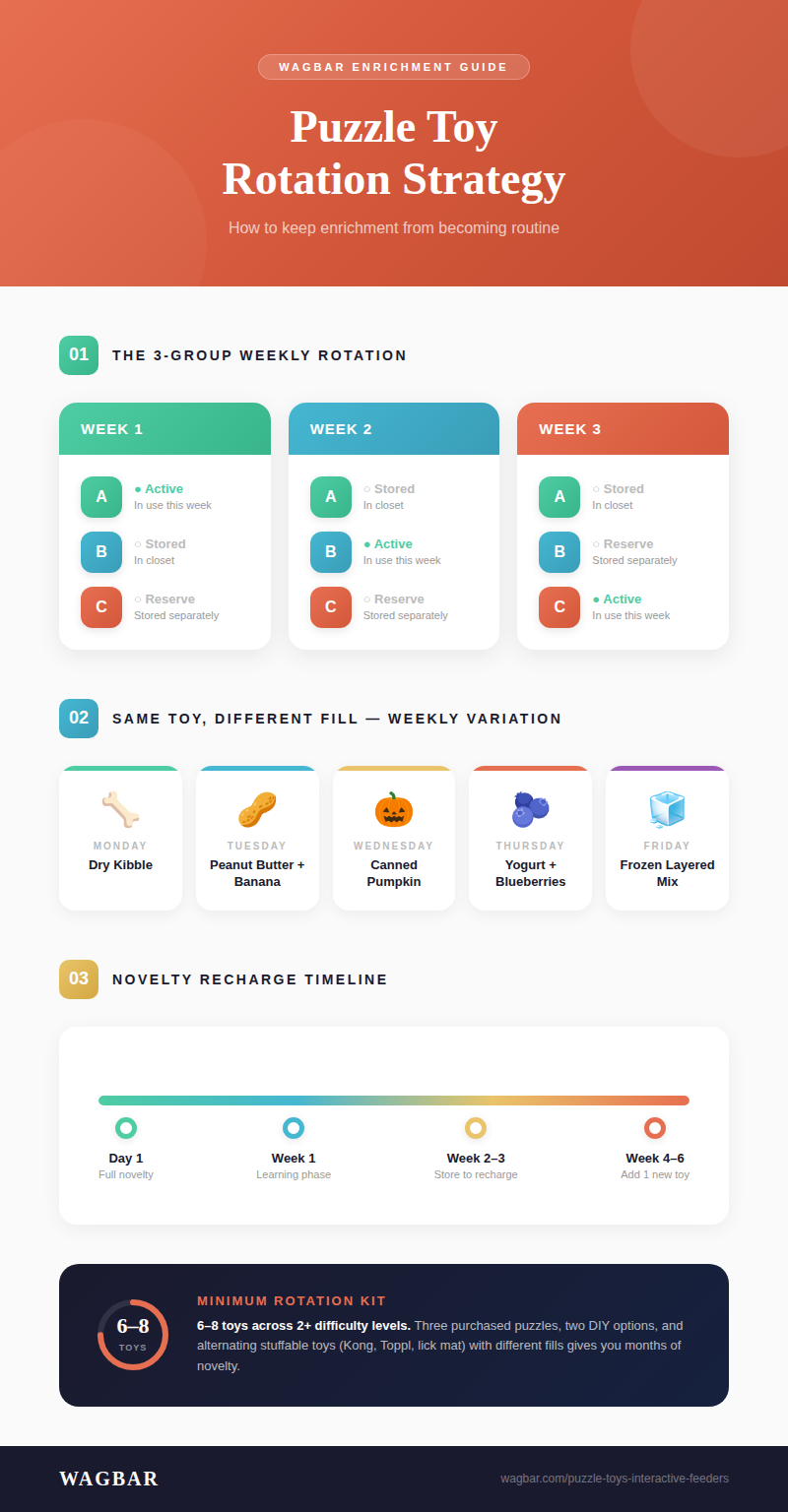
Habituation is the enrichment killer. A puzzle toy your dog solved last week activates problem-solving circuits. The same puzzle toy solved every day for 3 months activates nothing. The dog goes through the motions because food is involved, but the cognitive benefit is gone.
Research on interactive versus passive toys consistently shows that novelty drives engagement. A toy the dog has not seen in 2 weeks produces more sustained interaction than one available every day. Familiar stimuli get filtered out. Novel stimuli get full neurological attention.
The rotation system that works: Divide your puzzle toys into three groups. Group A is available this week. Group B is in a closet. Group C is stored separately. Each week, rotate. Every 3 weeks, each toy feels novel again.
Within each weekly rotation, vary the fills. Kibble on Monday. Peanut butter and banana on Wednesday. Canned pumpkin and blueberries on Friday. Same toy, different problem. That keeps the cognitive challenge alive between full rotations.
Introduce one genuinely new toy every 4 to 6 weeks. A DIY puzzle made from a muffin tin and tennis balls is novel if the dog has never seen it. Novelty is about the dog's experience, not the price tag.
When Puzzle Toys Are Not Enough
Puzzle toys are one pillar of enrichment. They are not all five.
The five pillars of dog enrichment — cognitive, social, sensory, environmental, and nutritional — work as a system. Puzzle toys cover cognitive and nutritional. The other three need separate strategies. A dog that gets daily puzzle feeding but no social interaction with other dogs is enriched cognitively but deprived socially. A dog that solves puzzles in a living room every day but never explores new environments is enriched nutritionally but deprived environmentally.
The sign that puzzle toys alone are not enough is a dog on a solid rotation for weeks that still exhibits behavioral problems. The destructive chewing stopped but the leash reactivity did not. The barking decreased but the separation distress persists. Puzzle toys lowered the cognitive deficit. The remaining issues need interventions a plastic puzzle cannot provide.
That is where social enrichment through supervised off-leash play becomes essential. Dogs need interaction with other dogs in safe, managed settings. Places like Wagbar exist because this type of enrichment requires infrastructure — fenced spaces, trained supervisors, behavioral screening — that most owners cannot build in a backyard.
Start with puzzle toys and food enrichment because they are the easiest to implement at home. Build the rotation. Watch behavior change. When the easy gains plateau, add social enrichment. When social enrichment is established, layer in environmental enrichment through novel walks, scent trails, and new locations. The puzzle toy is not the destination. It is the on-ramp.
FAQs
How much should I spend on puzzle toys?
You do not need to spend much. A Kong Classic runs under $15. A snuffle mat is under $20. A muffin tin and tennis balls cost almost nothing. The budget-friendly DIY approach is legitimate enrichment, not a compromise. A $12 Kong used daily with creative fills provides more cognitive benefit than a $40 puzzle used once and forgotten in a closet.
Can puppies use puzzle toys?
Yes, starting at Level 1. Puppies as young as 8 weeks can work a loosely stuffed Kong or a scatter-fed snuffle mat. Early puzzle toy exposure during the socialization window builds problem-solving confidence that carries into adulthood. Start easy. Let the puppy succeed every time. Difficulty increases should follow the puppy's development, not the owner's ambition.
My dog destroys puzzle toys instead of solving them. What do I do?
Drop the difficulty level immediately. A dog destroying a puzzle is frustrated, overstimulated, or has never learned that puzzle toys are for solving rather than chewing. Go back to Level 1. Use a Kong with treats visible and easily accessible. Let the dog learn that gentle interaction produces food. If destruction persists at Level 1, the issue may not be enrichment-related — consult a trainer or veterinary behaviorist.
How many puzzle toys do I need for a good rotation?
A minimum of 6 to 8 across at least two difficulty levels. You do not need 6 to 8 commercial products. Three purchased puzzles, two DIY options, and alternating stuffable toys (Kong, Toppl, lick mat) with different fills gives you a rotation that stays novel for months.
Are puzzle toys a replacement for walks and exercise?
No. Puzzle toys are cognitive enrichment, not physical exercise. A dog needs both. A dog that gets 3 hours of exercise but no cognitive enrichment will still exhibit under-enrichment behaviors. A dog that gets daily puzzle feeding but no physical activity will still have excess energy. They solve different problems. Treat them as separate line items in the daily enrichment budget.
Bottom TLDR: Puzzle toys and interactive feeders turn a 90-second bowl meal into a 20- to 45-minute cognitive session that measurably reduces stress and boredom-driven behaviors. The 5-level difficulty system gives you a framework for matching toys to your dog's actual ability. If your dog solves a puzzle in under 2 minutes consistently, it is no longer enrichment — level up or rotate. Wagbar staff rely on Kongs, Toppls, Nina Ottosson Dog Bricks, snuffle mats, and lick mats because they survive institutional use and cover the broadest skill range. Puzzle toys are the cognitive and nutritional pillars of enrichment. They are not all five. When the easy gains plateau, add social enrichment. The puzzle toy is the on-ramp, not the destination.