

Interactive vs Passive Dog Toys: Which Your Dog Actually Needs
Top TLDR: Interactive toys require participation — yours or another dog's. Passive toys let the dog work alone. Most owners buy roughly 80% passive toys without realizing it, then wonder why their dog ignores the toy basket. A 2026 Royal Society Open Science study found that adding just a few extra minutes of interactive play daily strengthened the human-dog bond within four weeks. This guide defines both categories, explains when each is appropriate, includes a Toy Audit to rebalance your collection, and provides a rotation system that makes old toys feel new again. The recommendation: aim for a 50/50 ratio. Interactive toys build the relationship. Passive toys build independence. Your dog needs both.
Your dog has a basket full of toys and does not play with any of them. You have spent hundreds of dollars on balls, ropes, chews, and stuffed animals. They sit in a pile. The dog walks past them. You assume the dog is spoiled, picky, or just not a toy dog.
The dog is none of those things. The problem is almost certainly a category imbalance — too many passive toys, not enough interactive ones, and zero rotation. Once you understand the difference between these two categories, the toy basket stops being a graveyard and starts being a system.

What Makes a Toy Interactive vs Passive
The distinction is simple: who has to show up for the toy to work?
Interactive toys require participation. A human throws, tugs, directs, or responds. Or another dog engages. The toy is the medium, but the relationship is the point. Tug ropes, flirt poles, fetch balls, frisbees, training toys with handler cues — these are all interactive. Remove the human or the second dog, and the toy loses its function. A tennis ball sitting on the floor is not an interactive toy. A tennis ball being thrown and retrieved is.
Passive toys let the dog work independently. The dog chews, licks, noses, or manipulates the toy without needing another participant. Kongs, puzzle toys, chew bones, lick mats and snuffle mats, treat-dispensing balls — these are all passive. The dog engages alone. The owner can leave the room.
Neither category is better. They serve completely different needs, and a dog that gets only one type is missing half the enrichment equation.
Why Interactive Play Builds the Bond Passive Toys Cannot
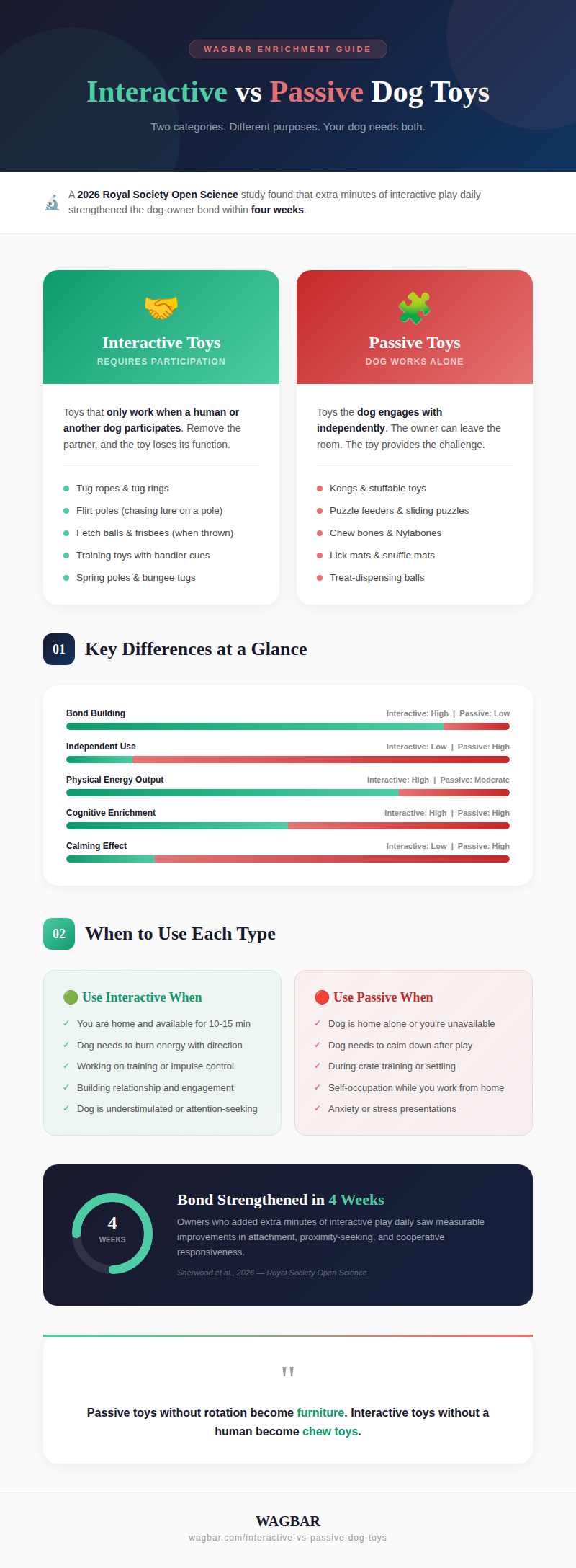
A 2026 study published in Royal Society Open Science found that owners who added just a few extra minutes of interactive play to their daily routine saw measurable improvements in the human-dog relationship within four weeks (Sherwood et al., 2026). The effect was specific to interactive play — activities where the human and dog were engaged together. The researchers measured changes in attachment behavior, proximity-seeking, and cooperative responsiveness. Play was the variable. The bond was the outcome.
This builds on earlier experimental work by Rooney and Bradshaw (2003), who demonstrated that interactive play sessions directly increased dogs' cooperative and affiliative behaviors toward their owners. Dogs that played more with their owners were more responsive to commands, showed more attention-seeking behavior, and demonstrated stronger attachment bonds.
Passive toys do not produce this effect. A Kong keeps your dog busy. A tug session keeps your dog connected — to you. Both have value. But if your dog's entire enrichment routine is "stuff a Kong and walk away," you are building independence without building the relationship.
Interactive play also provides something passive toys cannot match: real-time feedback. During a tug game, the dog reads your body language, adjusts grip pressure, responds to your movements, and makes split-second decisions based on what you do. During fetch, the dog tracks your throwing motion, anticipates direction, and returns to re-engage. These are cognitively demanding social behaviors that activate entirely different neural circuits than solo puzzle-solving.
When Each Type Is Appropriate
Use interactive toys when:
You are home and available. Interactive play is the single best use of 15 minutes with your dog. A focused tug session, a backyard fetch game, or a flirt pole workout provides physical exercise, cognitive enrichment, and relationship building simultaneously. No passive toy does all three.
The dog needs to burn energy with direction. A dog that is bouncing off walls needs interactive play, not a puzzle feeder. The physical and mental output of a structured tug or fetch game surpasses what any stationary toy provides.
You are working on training or behavior. Interactive toys are training tools. Tug is used as a reward in professional dog training precisely because it requires cooperation. The dog learns impulse control (waiting for the cue to grab), self-regulation (releasing on cue), and collaborative play (matching intensity to the handler). A toy that teaches the dog to work with you is worth ten toys that teach it to work alone.
Use passive toys when:
The dog is home alone. This is the primary function of passive enrichment. A frozen Kong, a snuffle mat scatter-fed with breakfast, a treat-dispensing ball with kibble — these keep the dog occupied and mentally engaged during the hours you are away. Enrichment for home-alone dogs depends almost entirely on passive toys because no one is there to participate in interactive ones.
The dog needs to calm down, not ramp up. After a play session, after arriving home, during thunderstorms, during crate training — passive chewing and licking activate the parasympathetic nervous system. A lick mat with frozen yogurt does the opposite of what a tug rope does. Both are necessary. Timing determines which one is right.
You need the dog to self-occupy while you work from home. A stuffed Kong buys you 30 minutes of quiet. A tug game buys you an exhausted dog 20 minutes later and a stronger relationship. Plan both into your day.
The Common Mistake: All Passive, No Interactive
Walk into most homes with dogs and look at the toy basket. Count. You will find chew toys, stuffed animals, a few balls no one throws anymore, maybe a Kong, probably a rope that has never been tugged by a human — just chewed solo. Eighty percent or more of the toys in most homes are passive, and the interactive ones have functionally become passive because no one picks them up.
This happens because passive toys are easier for the owner. Buy it, fill it, put it down, walk away. No commitment. No sweat. No schedule. Interactive play requires you to be present, engaged, and consistent. It requires 10 to 15 minutes you could spend scrolling your phone. The toy industry reinforces this because passive toys have higher margins and repeat purchases — another Kong, another puzzle, another chew.
The result is a dog that has learned to entertain itself but has no collaborative play skills, weak engagement with the owner, and a toy basket full of objects it has completely habituated to.
The Toy Audit: Categorize What You Own
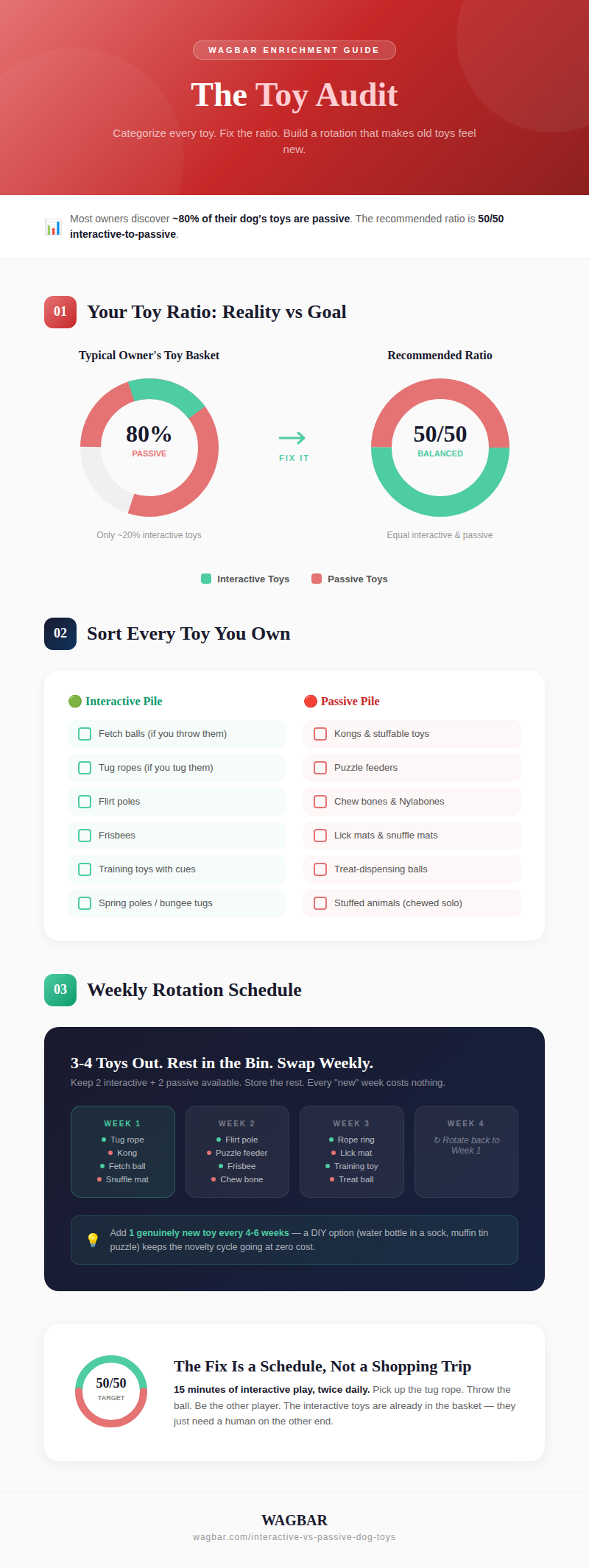
Do this right now. Pull every toy your dog has access to. Sort them into two piles.
Interactive pile: Toys that only work when you or another dog participates. Fetch balls (if you actually throw them), tug ropes (if you actually tug), flirt poles, frisbees, training toys.
Passive pile: Toys the dog uses alone. Kongs, puzzle feeders, chew bones, stuffed animals, treat balls, lick mats.
Now count. If your ratio is 80/20 passive-heavy, you are typical. The recommendation is 50/50 — and that does not mean buying more interactive toys. It means using the ones you already have. That rope in the bottom of the basket is an interactive toy that has been collecting dust because no one picks up the other end.
The fix is not a shopping trip. It is a schedule. Fifteen minutes of interactive play, twice a day. Morning and evening. Pick up the tug rope, the fetch ball, or the flirt pole. Be the other player.
Toy Rotation: Making Old Toys New Again
Pullen, Merrill, and Bradshaw (2012) studied toy habituation in dogs and found that interest in a toy decreases rapidly with repeated exposure — but presenting a previously withdrawn toy restores engagement to near-original levels. Dogs habituate to familiar toys the way humans habituate to background noise. The toy does not break. It becomes invisible.
The rotation system is straightforward: keep 3 to 4 toys available at a time. Store the rest in a closed bin. Swap weekly. Every toy that comes out of the bin feels novel again. A $10 rope toy rotated out for 3 weeks gets the same engagement response as a brand-new purchase.
Weekly rotation example:
Week 1 available: tug rope, Kong, fetch ball, snuffle mat. Week 2 available: flirt pole, puzzle feeder, chew bone, treat ball. Week 3 available: frisbee, lick mat, stuffed toy, rope ring. Week 4: rotate back to Week 1's toys.
Within each week, balance the category. Two interactive and two passive toys available at all times maintains the 50/50 ratio and ensures the dog has appropriate options whether you are present or away.
Introduce one genuinely new toy every 4 to 6 weeks. DIY dog enrichment options — a water bottle in a sock, a muffin tin with tennis balls, a cardboard box puzzle — keep the novelty cycle going without spending money.
The Insight That Changes Everything
Your dog has a basket of toys and ignores all of them. That is not because the dog is spoiled. It is because passive toys without rotation become furniture. And interactive toys without a human become chew toys.
A tug rope on the floor is a piece of fabric. A tug rope in your hand is a relationship. A Kong in the same spot every day is a habit. A Kong that appears after 3 weeks away is a discovery.
The toy is not the variable. How it is used and when it appears — those are the variables.
Why No Toy Replaces Off-Leash Social Play
Interactive toys simulate social engagement. They are the best simulation available. But a tug rope does not read body language. A fetch ball does not teach de-escalation. A flirt pole does not model appropriate play bows, role reversals, or self-handicapping — the complex social signals dogs use with each other.
The ultimate interactive enrichment is off-leash social play with other dogs — something no toy replicates. At Wagbar, dogs get what no product can deliver: real-time social interaction with other dogs in a supervised, behaviorally screened environment. The play bows, the chase reversals, the mutual arousal regulation — these are social enrichment behaviors that exist only between dogs.
Interactive toys with humans are second best. They build the human-dog bond and provide physical and cognitive exercise. They are essential. But if your dog has never experienced off-leash play with compatible dogs, there is a layer of enrichment no product in any toy basket provides.

Start with the Toy Audit. Fix the ratio. Build the rotation. Add interactive play to your daily schedule and when you are ready to give your dog the one thing no toy can replicate, bring them to Wagbar.
Bottom TLDR: Interactive toys require participation — tug, fetch, flirt poles build the human-dog bond. Passive toys let the dog work alone — Kongs, puzzles, chew toys build independence. Most owners own 80% passive toys without realizing it. The recommendation is 50/50. A 2026 Royal Society study found that adding extra minutes of daily interactive play strengthened the owner-dog relationship within four weeks. Rotation prevents habituation: 3-4 toys available, swap weekly, and every old toy feels new. The insight worth sharing: passive toys without rotation become furniture, and interactive toys without a human become chew toys. No toy replaces off-leash social play with other dogs — that is what Wagbar provides.