
DIY Dog Enrichment: 30 Ideas That Cost Less Than What Your Dog Destroyed Last Month
Top TLDR: The average dog causes roughly $392 in destructive damage per year. Most of that damage happens because the dog has nothing to do. A complete home enrichment program costs about $20 per month. Your recycling bin, your kitchen, and your backyard already contain everything you need for the free tier. What follows is 30+ specific enrichment ideas sorted by cost ($0, under $5, under $20), each with materials, setup time, and engagement time. You do not need to spend money to enrich your dog. You need to spend 5 minutes repurposing what you already have.
You spent $85 replacing that couch cushion. $40 on new blinds. $22 on another pair of shoes. Your dog has destroyed more than you have spent on entertainment for them.
That is not a bad dog. That is a bored dog with a budget surplus going to the wrong places.

The $0 Tier: Free Enrichment From What You Already Own
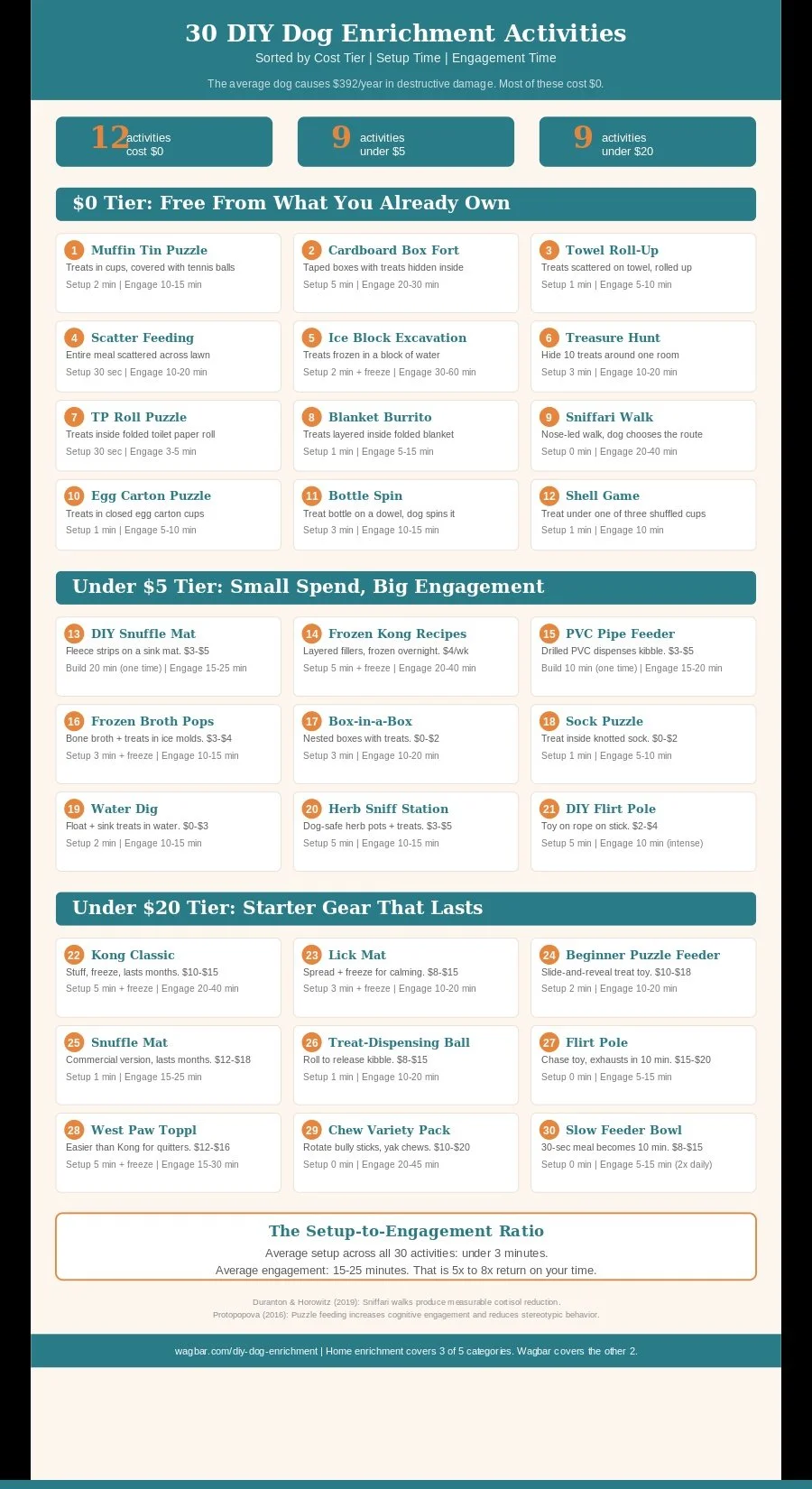
Everything in this tier uses items from your recycling bin, pantry, or yard. Zero dollars. Five minutes of setup. Thirty minutes of a dog who is not eating your furniture.
1. Muffin tin puzzle. Drop a treat or piece of kibble in each cup. Cover every cup with a tennis ball. Dog removes balls to get treats. Setup. 2 minutes. Engagement. 10 to 15 minutes.
2. Cardboard box fort. Tape several cardboard boxes together with treats hidden inside. Cut small holes the dog can reach through or tear open. Setup. 5 minutes. Engagement. 20 to 30 minutes. Use delivery boxes you were going to recycle anyway.
3. Towel roll-up. Lay a towel flat. Scatter treats across it. Roll the towel up. Dog unrolls it to find the treats. Setup. 1 minute. Engagement. 5 to 10 minutes. Increase difficulty by knotting the towel.
4. Scatter feeding. Take your dog's entire meal and scatter it across the lawn. Instead of eating from a bowl in 30 seconds, they spend 15 minutes foraging through the grass using their nose. Setup. 30 seconds. Engagement. 10 to 20 minutes. The simplest enrichment that exists.
5. Ice block excavation. Fill a container with water, drop in treats, toys, or chunks of fruit. Freeze overnight. Give the dog the entire block the next day. Setup. 2 minutes (plus overnight freeze). Engagement. 30 to 60 minutes. Perfect for summer.
6. The treasure hunt. Put your dog in a "wait" or behind a door. Hide 10 treats around one room at nose height. Release the dog to find them. Setup. 3 minutes. Engagement. 10 to 20 minutes. This is nose work with zero equipment.
7. Toilet paper roll puzzle. Take an empty toilet paper roll. Put a few treats inside. Fold both ends shut. Dog figures out how to tear it open. Setup. 30 seconds. Engagement. 3 to 5 minutes. Make 5 of them for a longer session.
8. Blanket burrito. Place treats on a blanket. Fold the blanket over itself 3 to 4 times so the treats are buried in layers. Dog unfolds the blanket to reach the treats. Setup. 1 minute. Engagement. 5 to 15 minutes.
9. Sniffari walk. Instead of a structured heel walk, take your dog on a long line and let them lead. They sniff whatever they want for as long as they want. The walk is for their nose, not your step count. Research shows that 20 minutes of unhurried sniffing is more cognitively tiring than 60 minutes of brisk walking. Setup. 0 minutes. Engagement. 20 to 40 minutes. The best free enrichment walk available.
10. Egg carton puzzle. Put treats in an empty egg carton. Close the lid. Dog opens the lid, then figures out the individual cups. Setup. 1 minute. Engagement. 5 to 10 minutes.
11. Bottle spin. Thread a wooden dowel or stick through the handle of a plastic bottle with treats inside. Dog paws or noses the bottle to spin it and release treats. Setup. 3 minutes. Engagement. 10 to 15 minutes.
12. The shell game. Place a treat under one of three cups. Shuffle the cups. Let the dog pick. When they get it right, reward. Setup. 1 minute. Engagement. 10 minutes of genuine problem-solving.
The Under $5 Tier: Small Spend, Big Engagement
These ideas require a small purchase or a few dollars in ingredients. Most items are reusable. The cost amortizes to near zero over weeks.
13. DIY snuffle mat. Cut fleece strips and tie them through the holes of a rubber sink mat or cooling rack. Scatter kibble through the fleece. Dog sniffs and forages. Materials. $3 to $5 (sink mat + fleece remnants from a craft store). Setup. 20 minutes to build (one time). Engagement. 15 to 25 minutes per use. A snuffle mat you can make for a fraction of retail price.
14. Frozen Kong recipes. Layer peanut butter (xylitol-free), banana, kibble, and plain yogurt inside a Kong. Freeze overnight. Rotate recipes daily. Monday is peanut butter and kibble. Tuesday is pumpkin and blueberries. Wednesday is yogurt and banana. Materials. $4 per week in fillers (Kong itself is in the under $20 tier). Engagement. 20 to 40 minutes per frozen Kong.
15. PVC pipe feeder. Drill holes slightly larger than kibble in a short PVC pipe. Cap both ends. Fill with kibble. Dog rolls the pipe to release food. Materials. $3 to $5 at a hardware store. Setup. 10 minutes to build (one time). Engagement. 15 to 20 minutes.
16. Frozen bone broth pops. Fill ice cube trays or silicone molds with low-sodium bone broth. Drop a treat or blueberry in each. Freeze. Give 3 to 4 as a snack. Materials. $3 to $4 per batch. Engagement. 10 to 15 minutes. Repetitive licking activates the parasympathetic nervous system for calming.
17. Box-in-a-box-in-a-box. Put treats in a small box. Put that box in a medium box. Put that in a large box. Close each one. Dog has to problem-solve through layers. Materials. Free (recycled boxes) to $2 if you need tape. Engagement. 10 to 20 minutes.
18. Sock puzzle. Put a treat or ball inside a sock. Tie a knot. Dog figures out how to get it out. Materials. $0 to $2 (old socks). Engagement. 5 to 10 minutes. Supervise to prevent sock ingestion.
19. Water dig. Fill a shallow container with water. Drop treats that float (apple slices, kibble for some brands) and treats that sink. Dog fishes them out. Materials. $0 to $3. Engagement. 10 to 15 minutes. Messy. Do it outside.
20. Herb garden sniff station. Plant or buy small pots of dog-safe herbs (rosemary, mint, basil, thyme). Place them at nose height. Scatter treats among them. Dog explores novel scents while foraging for treats. Materials. $3 to $5. Engagement. 10 to 15 minutes.
21. DIY flirt pole (basic). Tie a stuffed toy to a rope. Tie the rope to a stick. Swing it around for your dog to chase. Materials. $2 to $4. Engagement. 10 minutes (very high intensity).
The Under $20 Tier: Starter Gear That Lasts
These are entry-level commercial products or DIY builds that provide long-term daily enrichment value.
22. Kong Classic. The Swiss Army knife of dog enrichment. Stuff it, freeze it, and it lasts 20 to 40 minutes. Practically indestructible. Pair it with the $5 tier frozen recipes for months of daily use. Cost. $10 to $15.
23. Lick mat. Spread peanut butter, yogurt, pumpkin, or wet food on a textured lick mat. Freeze for longer engagement. Repetitive licking is calming and reduces anxiety-related behaviors. Cost. $8 to $15. Engagement. 10 to 20 minutes (frozen).
24. Beginner puzzle feeder. A slide-and-reveal or flip-and-treat toy at the beginner level. The dog learns to move pieces to access hidden treats. The dog builds problem-solving skills over time. Cost. $10 to $18. Engagement. 10 to 20 minutes.
25. Snuffle mat (commercial). If you do not want to make one, a commercial snuffle mat runs $12 to $18 and lasts months. Cost. $12 to $18. Engagement. 15 to 25 minutes.
26. Treat-dispensing ball. A ball with a small hole. Dog rolls it around to release kibble one piece at a time. Turns a 30-second meal into a 15-minute foraging session. Cost. $8 to $15. Engagement. 10 to 20 minutes.
27. Flirt pole (commercial). The best interactive toy for prey-drive dogs. Simulates chase without building cardio endurance. Ten minutes exhausts most dogs. Cost. $15 to $20. Engagement. 5 to 15 minutes.
28. West Paw Toppl. A stuffable toy that is easier to fill than a Kong and better for dogs who give up on hard puzzles. Cost. $12 to $16. Engagement. 15 to 30 minutes (frozen).
29. Chew variety pack. Bully sticks, yak chews, or dental chews. Rotate types so the dog never gets the same one twice in a row. Cost. $10 to $20 for a weekly rotation. Engagement. 20 to 45 minutes per chew.
30. Slow feeder bowl. Ridges and obstacles turn a 30-second meal into a 10-minute food puzzle. Cost. $8 to $15. Engagement. 5 to 15 minutes per meal, twice daily.
The Monthly Math
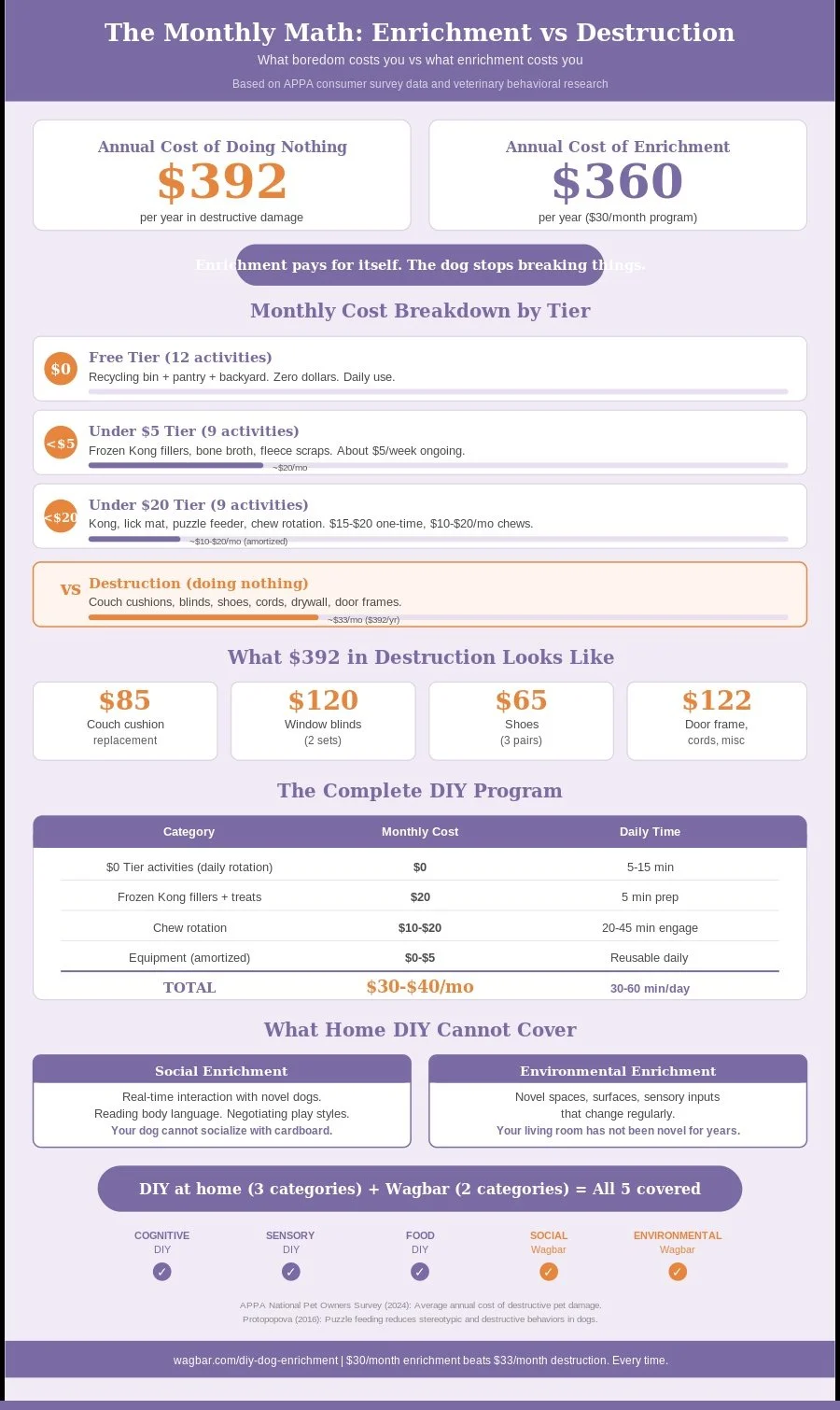
A complete DIY enrichment program costs less than most people think.
Frozen Kong fillers (peanut butter, yogurt, pumpkin, banana). About $5 per week, $20 per month. A few puzzle feeders from the under $20 tier. $15 to $20 one-time cost, amortized to near zero over months. Everything from the $0 tier. Free, every single day, using items you already own. Chew rotation. $10 to $20 per month.
Total ongoing cost. Roughly $30 to $40 per month for a complete home enrichment program that provides 30 to 60 minutes of daily cognitive engagement.
The average dog causes $392 per year in destructive damage. That is $33 per month in broken things. A $30 per month enrichment program replaces a $33 per month destruction habit. The math is not complicated.
The Enrichment You Cannot DIY
Home enrichment covers cognitive, sensory, and food enrichment. Three of the five categories. The other two, social and environmental, require things no home setup can replicate.
Social enrichment means real-time interaction with novel dogs in a dynamic environment. Reading body language. Negotiating play styles. Processing complex social information at full bandwidth. No DIY substitute exists for this. Your dog cannot socialize with cardboard.
Environmental enrichment means novel spaces, novel surfaces, novel sensory inputs that change regularly. Your living room is not novel. It has not been novel for years.
This is where Wagbar fills the gap. Not as a replacement for home enrichment, but as the complement that completes it. A Wagbar membership plus a DIY enrichment program at home covers all five categories. The home program fills the daily cognitive, sensory, and food tanks. Wagbar fills the social and environmental tanks 2 to 3 times per week.
Or explore the franchise opportunity and build the space that gives every DIY enrichment enthusiast in your city access to the two categories they cannot build at home.
FAQs
How many enrichment activities does my dog need per day?
Minimum two. One food-based (puzzle feeder, scatter feed, or frozen Kong at mealtime) and one cognitive (nose work, treasure hunt, or training session). If your dog shows signs of under-enrichment (destructive chewing, excessive barking, restlessness), add a third. Most of the $0 tier activities take under 5 minutes to set up.
Are DIY enrichment toys safe?
Supervise any DIY enrichment that involves cardboard, fabric, or small pieces. Remove and discard items once the dog starts swallowing pieces rather than manipulating them. Toilet paper rolls, egg cartons, and cardboard boxes are meant to be destroyed. Replace them every session. Reusable items like the PVC pipe feeder and DIY snuffle mat should be inspected regularly for damage.
What if my dog finishes everything in 2 minutes?
Increase difficulty. Freeze the Kong longer. Add more layers to the blanket burrito. Use smaller treat pieces in the snuffle mat. Add obstacles (put the puzzle feeder inside a cardboard box inside another cardboard box). The goal is 15 to 30 minutes of engagement. If the dog beats it in under 5, the challenge is too easy.
$30 a Month Beats $400 in Damage Every Time
Your dog is not destructive because they are bad. They are destructive because their brain has nothing to do and they are solving that problem with your furniture.
Thirty enrichment ideas. Three cost tiers. Five minutes of setup. The $0 tier starts right now with whatever is in your recycling bin. The under $5 tier starts with your next grocery run. The under $20 tier starts with one Kong and a jar of peanut butter.
And when you are ready to give your dog the social and environmental enrichment that no home setup can replicate, Wagbar is where the other two categories live.
Bottom TLDR: The average dog causes $392 per year in destructive damage. A complete DIY enrichment program costs $30 to $40 per month. Thirty ideas across three cost tiers. The $0 Tier uses items from your recycling bin. Muffin tin puzzle (2 min setup, 15 min play). Cardboard box fort (5 min, 30 min). Towel roll-up (1 min, 10 min). Scatter feeding (30 sec, 20 min). Ice block (2 min, 60 min). Treasure hunt (3 min, 20 min). Sniffari walk (0 min, 40 min). The Under $5 Tier includes DIY snuffle mats ($3), frozen Kong recipes ($4/week), PVC pipe feeders ($4), frozen bone broth pops ($3). The Under $20 Tier includes Kong Classic ($12), lick mats ($10), beginner puzzle feeders ($15), flirt poles ($18). Home enrichment covers cognitive, sensory, and food categories. Social and environmental enrichment require Wagbar. A DIY program plus Wagbar membership covers all five categories.