

Canine Nose Work and Scent Enrichment: Why Sniffing Is the Most Underrated Thing Your Dog Can Do
You are spending an hour walking your dog every day and wondering why they still come home wired. Here is what is actually happening. Your dog's legs are tired but their brain is starving. The nose, the single most powerful sensory organ your dog has, barely got used. The leash pulled them past every interesting scent. The route was the same one they already have memorized. The walk checked the exercise box but left the biggest cognitive need completely unmet.
Nose work fixes this. Not as a supplement to your routine. As the centerpiece of it. A 20-minute nose work session tires a dog's brain more thoroughly than an hour of structured walking. That is not an exaggeration. That is what the research shows.

The Science of Canine Olfaction
Your dog's nose is not a slightly better version of yours. It is a fundamentally different organ operating on a scale that is difficult to comprehend.
Dogs have approximately 300 million olfactory receptors. Humans have about 6 million. The olfactory bulb, the part of the brain that processes scent data, takes up proportionally 40 times more brain space in dogs than in humans. When your dog sniffs the base of a fire hydrant, they are not just detecting that another dog was there. They are processing the other dog's sex, reproductive status, stress level, health condition, diet, and approximate time of visit. All from one sniff.
Dogs can detect certain odors at concentrations of one part per trillion. To put that in perspective, that is the equivalent of detecting one drop of liquid in 20 Olympic-sized swimming pools. Their nostrils even operate independently, allowing them to determine the direction a scent is coming from and how recently it was deposited.
Every breath your dog takes splits into two airstreams. One goes to the lungs. The other goes directly to the olfactory region for analysis. This means your dog is continuously sampling the chemical environment while breathing normally. The nose never turns off.
This is not trivia. This is the foundation of why nose work is the single most efficient form of enrichment you can provide.
Why Sniffing Calms Your Dog Down
This is the part that surprises most owners. Sniffing is not just mentally stimulating. It is physiologically calming.
When a dog engages in focused sniffing, it activates the parasympathetic nervous system. That is the branch of the autonomic nervous system responsible for rest, digestion, and recovery. Heart rate drops. Stress hormones decrease. The body shifts from a state of arousal into a state of processing and calm.
A 2019 study published in Applied Animal Behaviour Science (Duranton & Horowitz) found that dogs who practiced nose work daily for two weeks showed significantly more optimistic responses on a cognitive bias test compared to dogs who practiced heelwork for the same period. The nose work group approached ambiguous situations with more confidence and less hesitation. The researchers interpreted this as evidence that nose work improves overall emotional wellbeing, not just momentary mood.
This is why a 30-minute sniffari walk, where the dog leads and sniffs freely, produces deeper calm and longer rest periods than a 90-minute structured walk at heel. The structured walk exercises the body. The sniffari exercises the brain and simultaneously activates the calming nervous system. Dogs who come home from sniff-focused outings sleep more soundly and for longer stretches because the brain got the kind of input it was built to process.
Think about what this means for anxious dogs. An activity that naturally lowers heart rate, reduces stress hormones, and builds optimism. That is not a training exercise. That is a therapeutic intervention.
Types of Scent Enrichment
Not all nose work is the same. The spectrum runs from casual sniffing to structured detection work, and each type serves a different purpose.
Casual Sniffing
The simplest form. Let your dog sniff on walks instead of pulling them along at your pace. Stop when they find an interesting scent mark. Let them investigate fully before moving on. This alone is a massive upgrade from the way most owners walk their dogs.
Casual sniffing is baseline sensory enrichment. It costs nothing, requires no equipment, and the only thing you have to change is your mindset about what a walk is for.
Scatter Feeding
Toss your dog's meal across the yard or a room. The dog uses their nose to locate every piece. This converts a 30-second bowl meal into a 15-minute foraging session. The brain stays engaged because each piece requires independent scent detection.
Scatter feeding works on any surface but is most effective in grass, where the visual component is removed and the dog must rely entirely on scent. This is beginner-level nose work that any dog can do from day one.
Hide and Seek with Treats
Place treats in various locations around the house while your dog waits in another room. Start with obvious spots. Under a towel, next to a chair leg, on a low shelf. As your dog gets better, increase the difficulty. Behind closed doors, inside loosely closed boxes, on elevated surfaces.
This is where nose work starts to become genuinely cognitively demanding. The dog is not just following a scent gradient. They are making decisions about where to search, how to access hidden locations, and when to move on from an area they have already cleared.
Snuffle Mats and Scent Dispensers
Snuffle mats are fabric mats with deep folds and pockets where treats are hidden. The dog has to root through the fabric with their nose to find food. The tactile and olfactory combination keeps the brain engaged for 10 to 20 minutes depending on difficulty.
These are excellent for indoor enrichment on rainy days, during recovery from surgery or injury, and for senior dogs who need low-impact cognitive work.
Scent Trails
Drag a treat along a path through the yard, changing direction multiple times. Place a jackpot reward at the end of the trail. The dog follows the scent path like a tracking dog, nose to the ground, brain fully locked in.
Start with short, straight trails. Progress to longer trails with turns. Eventually introduce gaps where the trail lifts off the ground (drag the treat across a raised surface) and the dog has to problem-solve where the scent went.
Buried Treasure
Bury treats at shallow depths in a sandbox, dirt pile, or under leaf litter. The dog has to detect the scent through a barrier and then figure out how to access it. This combines olfactory work with physical problem solving and is a legitimate DIY enrichment project that costs almost nothing.
Structured Nose Work (Detection Training)
This is the formal version. Teach your dog to identify a specific target scent (birch oil, anise, or clove are commonly used in competitive nose work) and indicate when they find it. Start by pairing the scent with treats in a simple container. Progress to searching a line of containers, then a room, then a vehicle, then an outdoor area.
Structured nose work is the most cognitively demanding form of scent enrichment. The dog is not just following food smells. They are identifying a specific odor among hundreds of background scents, making a decision about its location, and communicating their find to you. Professional detection dogs do this for a living. Pet dogs can learn the basics in a few weeks.
Sniffari Walks
A sniffari is a walk with one rule. The dog chooses where to go and how long to sniff. You hold the leash and follow. There is no destination, no pace requirement, no pulling them away from a scent they are investigating.
The name sounds casual but the cognitive effect is intense. During a sniffari, the dog is processing an uninterrupted stream of olfactory data, making independent decisions about what to investigate, and regulating their own arousal level through the calming mechanism of sustained sniffing.
Twenty minutes of a sniffari walk produces more visible fatigue than an hour of heel walking. The dog comes home and sleeps because the brain, not just the body, actually worked.
Progressive Difficulty: Beginner to Advanced
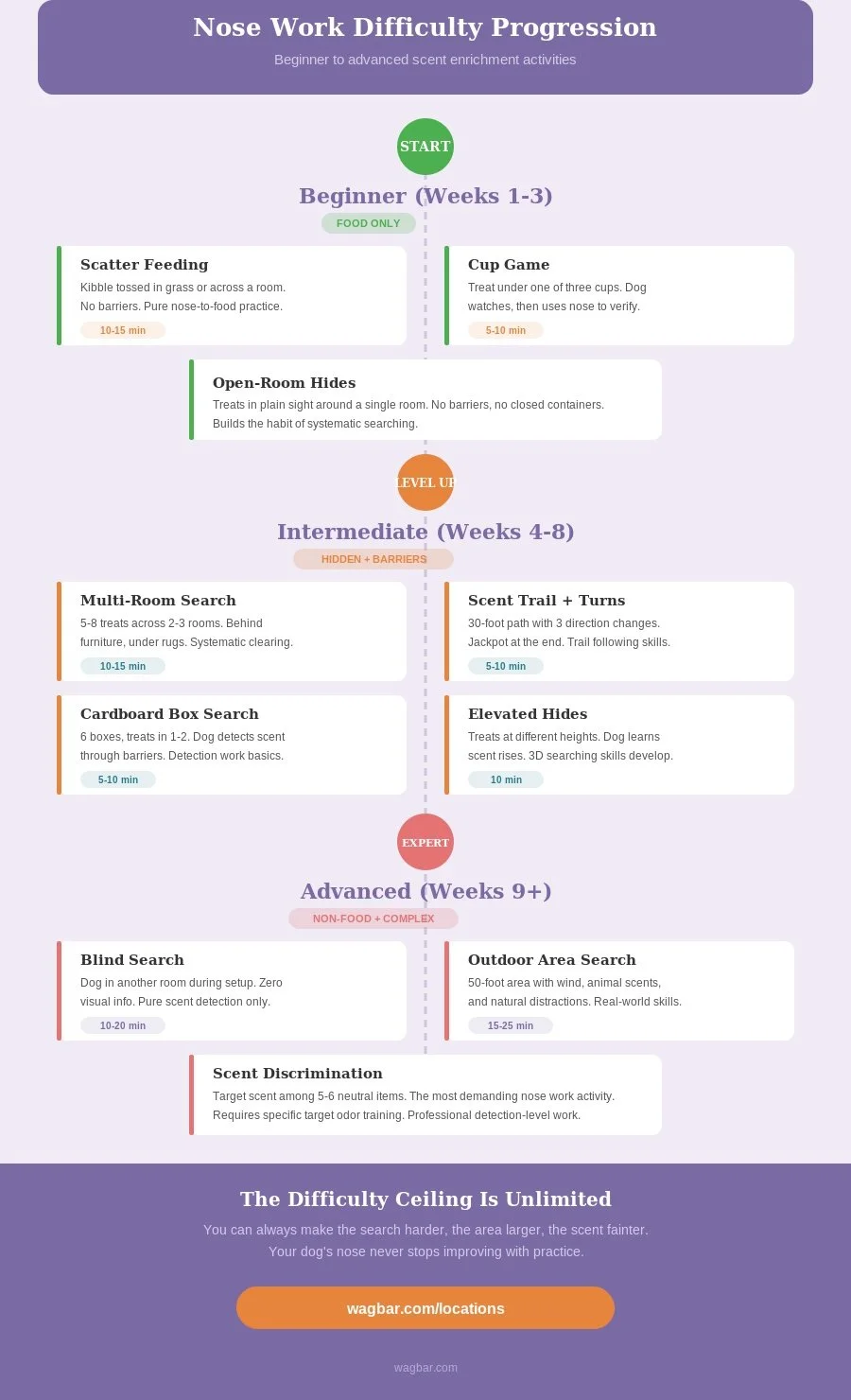
Nose work should start easy and build. Moving too fast creates frustration instead of enrichment. Here is how to progress.
Beginner (Weeks 1 to 3)
All activities use food as the target scent. The rewards are obvious and easy to access. The search areas are small and contained.
Scatter feeding in short grass. Toss 20 pieces of kibble in a 10-foot area. The dog practices using their nose to locate food without any barriers. 5 minutes of setup, 10 to 15 minutes of engagement.
Two-cup game. Place a treat under one of two cups while the dog watches. Let them choose. Success rate should be near 100%. This teaches the dog that using their nose leads to rewards. 1 minute of setup, 5 minutes of engagement.
Open-room hide. Place three treats in plain sight around a single room. Release the dog to find them. No barriers, no closed containers. 2 minutes of setup, 3 to 5 minutes of engagement.
Intermediate (Weeks 4 to 8)
Search areas get larger. Some treats are partially hidden. The dog starts making decisions about where to search next.
Multi-room search. Hide five to eight treats across two or three rooms. Place some on low shelves, behind furniture legs, under the edge of a rug. The dog has to systematically clear rooms and track diminishing scent concentrations. 5 minutes of setup, 10 to 15 minutes of engagement.
Cardboard box search. Set up six empty boxes in a row. Place treats in one or two boxes. The dog sniffs each box and learns to indicate which ones contain rewards. This is the foundation of formal detection work. 3 minutes of setup, 5 to 10 minutes of engagement.
Scent trail with turns. Drag a treat along a 30-foot path with three direction changes. Place a high-value jackpot at the end. The dog follows the trail and learns to navigate turns without losing the scent. 5 minutes of setup, 5 to 10 minutes of engagement.
Elevated hides. Place treats at different heights. A chair seat, a low shelf, a step stool. The dog has to detect scent rising from elevated positions and figure out how to access the reward. This teaches the dog that scent moves upward and diffuses in three dimensions, not just along the ground. 3 minutes of setup, 10 minutes of engagement.
Advanced (Weeks 9 and Beyond)
The dog searches larger areas, works with non-food scents, and solves multi-step problems.
Blind search. Hide treats while the dog is in a completely separate room with the door closed. The dog has no visual information about placement. They must rely entirely on scent detection. 5 minutes of setup, 10 to 20 minutes of engagement.
Outdoor area search. Hide treats in a 50-foot outdoor area with natural distractions (wind, animal scents, environmental noise). The dog works against air currents and competing scents to locate rewards. 5 minutes of setup, 15 to 25 minutes of engagement.
Vehicle search. Place a scented item near a parked car. The dog searches the exterior and identifies the location. This is real detection work and requires experience with easier searches first. 3 minutes of setup, 5 to 15 minutes of engagement.
Scent discrimination. Place the target scent on one item among five or six similar items with neutral scents. The dog identifies and indicates the correct one. This requires training with a specific target odor and is the most demanding nose work activity outside of professional detection. 5 minutes of setup, 10 to 20 minutes of engagement.
The 7-Day Nose Work Challenge
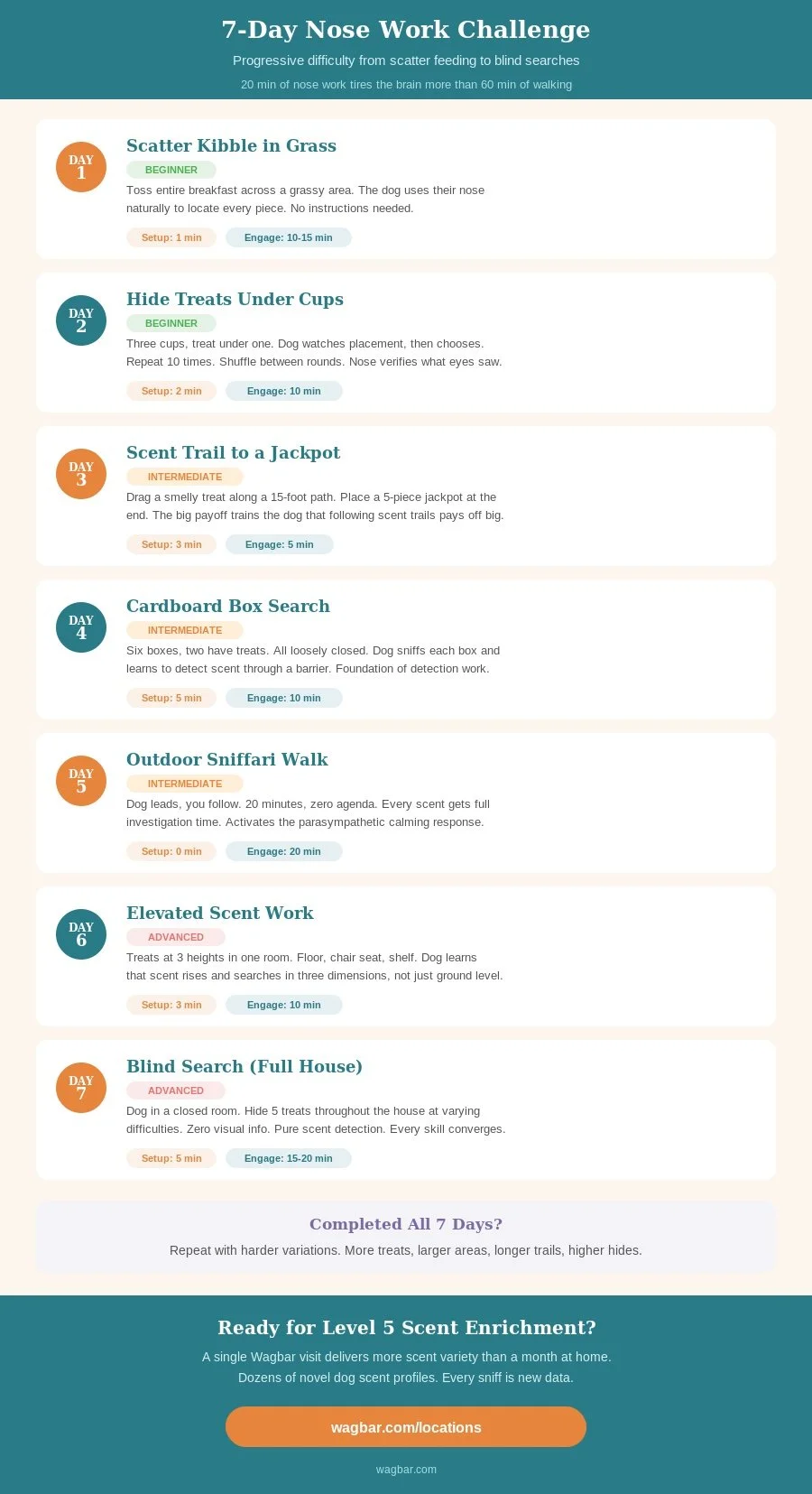
Seven days, seven activities, progressive difficulty. Each day builds on the skills from the previous day. By the end of the week, your dog will have a foundation of nose work experience that you can build on indefinitely.
Day 1. Scatter Kibble in Grass. Take your dog's entire breakfast and scatter it across a grassy area. No instructions needed. The dog uses their nose naturally. This establishes the baseline concept. Using the nose produces food. 1 minute of setup, 10 to 15 minutes of engagement.
Day 2. Hide Treats Under Cups. Place three cups on the floor. Put a treat under one while your dog watches. Let them choose. Repeat ten times. Shuffle the cups between rounds. The dog learns to use their nose to verify what their eyes saw. 2 minutes of setup, 10 minutes of engagement.
Day 3. Scent Trail to a Jackpot. Drag a smelly treat (cheese, hot dog, liver) along a 15-foot path through the yard. Place five pieces of the same treat at the end as a jackpot reward. Release the dog at the start of the trail. 3 minutes of setup, 5 minutes of engagement. The payoff trains the dog that following scent trails leads to something exceptional.
Day 4. Cardboard Box Search. Set up six cardboard boxes in your living room. Place treats in two of them. Close all boxes loosely (flaps folded, not sealed). Release the dog and let them search. They have to detect scent through the cardboard barrier and figure out how to access the reward. 5 minutes of setup, 10 minutes of engagement.
Day 5. Outdoor Sniffari Walk. Leash your dog and go outside with zero agenda. Your dog leads. You follow. Every time the leash goes tight in your direction, stop. Every time your dog wants to investigate a scent, let them take as long as they need. Set a 20-minute timer and do nothing but follow. 0 minutes of setup, 20 minutes of engagement.
Day 6. Elevated Scent Work. Hide treats at three different heights in one room. One on the floor behind a chair. One on a chair seat. One on a shelf at waist height. Release the dog and watch them figure out that scent rises. They will check the ground first, then lift their nose and begin searching higher. 3 minutes of setup, 10 minutes of engagement.
Day 7. Blind Search. Put your dog in a closed room. Hide five treats throughout the rest of the house at varying difficulties (one easy, two medium, two hard). Open the door and let the dog search with zero visual information about where you placed them. This is the culmination of the week. Every skill from the previous six days converges here. 5 minutes of setup, 15 to 20 minutes of engagement.
After day seven, repeat the challenge with harder variations. More treats, larger areas, longer scent trails, higher hides. The difficulty ceiling for nose work is effectively unlimited because you can always make the search harder.
Structured Nose Work vs Casual Sniffing
Both matter. They serve different purposes and they are not interchangeable.
Casual sniffing on walks is maintenance. It gives the olfactory brain regular input and activates the calming parasympathetic response. Every walk should include some free sniffing. This is the baseline that prevents sensory deprivation.
Structured nose work is training. It builds problem-solving skills, teaches the dog to work independently, improves focus and impulse control, and produces deeper mental fatigue. Three structured nose work sessions per week is enough to see behavioral changes.
The combination is where the real transformation happens. Daily sniffing on walks plus two to three structured nose work sessions per week produces a dog whose olfactory brain is fully engaged and whose overall enrichment needs are substantially met through a single sensory channel.
What a Multi-Dog Environment Adds
Everything above works at home. But there is one scent enrichment experience that no home setup replicates.
Walking into Wagbar is like walking into an olfactory library. Every dog who visited that day left a unique chemical signature. The floor, the furniture, the outdoor areas are layered with scent data from dozens of dogs across breeds, ages, diets, and stress levels. Your dog reads all of it. Every sniff produces novel information that the brain has to process, categorize, and respond to.
This is not passive background scent. It is active olfactory work. Your dog is simultaneously detecting individual scent profiles from multiple dogs, reading social information (who is friendly, who is stressed, who is in play mode), navigating scent trails that cross and overlap, and processing the environmental enrichment of a space that smells completely different from home.
Dogs who visit regularly develop sharper olfactory discrimination because the brain gets constant practice with novel scent profiles. They become better at reading other dogs through scent alone, which improves social interactions and reduces the over-arousal that comes from encountering unfamiliar dogs in uncontrolled settings.
A single visit delivers more olfactory variety than a month of home-based scent enrichment. Not because home enrichment is weak. Because the scent complexity of a multi-dog supervised environment is genuinely impossible to manufacture at home.
What People want to Know:
How long should a nose work session last?
Keep sessions between 10 and 20 minutes for most dogs. Mental fatigue from nose work accumulates faster than physical fatigue from exercise. A dog who seems energetic during the session will often crash hard within minutes of finishing. If your dog starts losing interest or searching randomly instead of systematically, the brain is done. End the session on a success.
Can any breed do nose work?
Every breed has the olfactory hardware. Scent hounds like Bloodhounds and Beagles have more olfactory receptors, but even brachycephalic breeds like Bulldogs and Pugs benefit enormously from nose work. The key is adjusting difficulty to the individual dog. A Bulldog may need shorter sessions with easier hides, but their brain still gets the same cognitive benefit from the work.
Is nose work good for reactive dogs?
Extremely. Nose work builds confidence, reduces overall arousal, and teaches the dog to focus on a task instead of reacting to environmental triggers. The parasympathetic activation from sustained sniffing directly counteracts the sympathetic overdrive that produces reactive behavior. Many trainers use nose work as a primary tool in behavior modification programs for reactive dogs.
Do I need special equipment to start?
No. You need treats and a flat surface. Scatter feeding, hide-and-seek, and sniffari walks require zero equipment. As you progress, cardboard boxes, cups, towels, and snuffle mats add complexity. Formal detection work uses specific target scents (birch, anise, clove) but that is entirely optional for pet dogs.
How often should I do nose work with my dog?
Daily casual sniffing on every walk. Two to three structured nose work sessions per week. This combination keeps the olfactory brain engaged without turning nose work into a chore. Dogs who do nose work on this schedule show measurable improvements in overall calm, focus, and cognitive function within two to four weeks.
Their Nose Knows: Let It Work
Every walk you take, every meal you serve, every room your dog enters is an opportunity for scent enrichment. The nose is already doing the work. You just have to stop rushing past the good parts.
Find your nearest Wagbar and drop your dog into the richest scent environment they have ever experienced. Or explore the franchise opportunity and build a space where hundreds of noses get to do what they were built for.