

Supervised Social Enrichment vs Unstructured Dog Park Play: Why the Model Matters More Than the Space
Top TLDR: Not all off-leash play qualifies as enrichment. Unstructured dog parks with no staff, no behavioral screening, and no intervention protocols can produce what this guide calls negative enrichment, where the brain is fully engaged but the dog is learning fear, avoidance, and reactivity instead of social confidence. Industry data estimates that roughly 1 in 4 dog park visits involve some form of aggressive interaction. The number one reason owners stop going to public parks is other owners, not other dogs. Supervised social enrichment at Wagbar removes those variables through trained staff, vaccination verification, temperament assessment, and active play monitoring. The space is not the differentiator. The model is.
The concept of enrichment assumes the experience is positive. A puzzle toy that challenges the dog is enrichment. A novel walk through a new neighborhood is enrichment. Off-leash play with compatible dogs is enrichment.

But what about off-leash play with incompatible dogs? What about a dog park where a 90-pound unneutered male pins your 30-pound retriever mix against the fence while the other owner scrolls their phone? What about a space where nobody screens for vaccinations, nobody monitors play quality, and nobody steps in when roughhousing crosses the line into bullying?
That is not enrichment. That is something the field does not talk about enough, and it is the reason millions of dog owners have stopped going to public dog parks entirely.
The Problem with "Enrichment" as a Blanket Term
The five pillars of dog enrichment framework assumes good experiences. Cognitive enrichment means productive problem-solving. Sensory enrichment means novel but non-threatening stimulation. Social enrichment means positive interaction with compatible partners.
But the framework rarely addresses what happens when the experience goes wrong. When a dog is overwhelmed, frightened, attacked, or persistently bullied in a social setting, the brain is still active. The dog is still processing. It is still forming associations and learning behavioral responses. The problem is that it is learning the wrong ones.
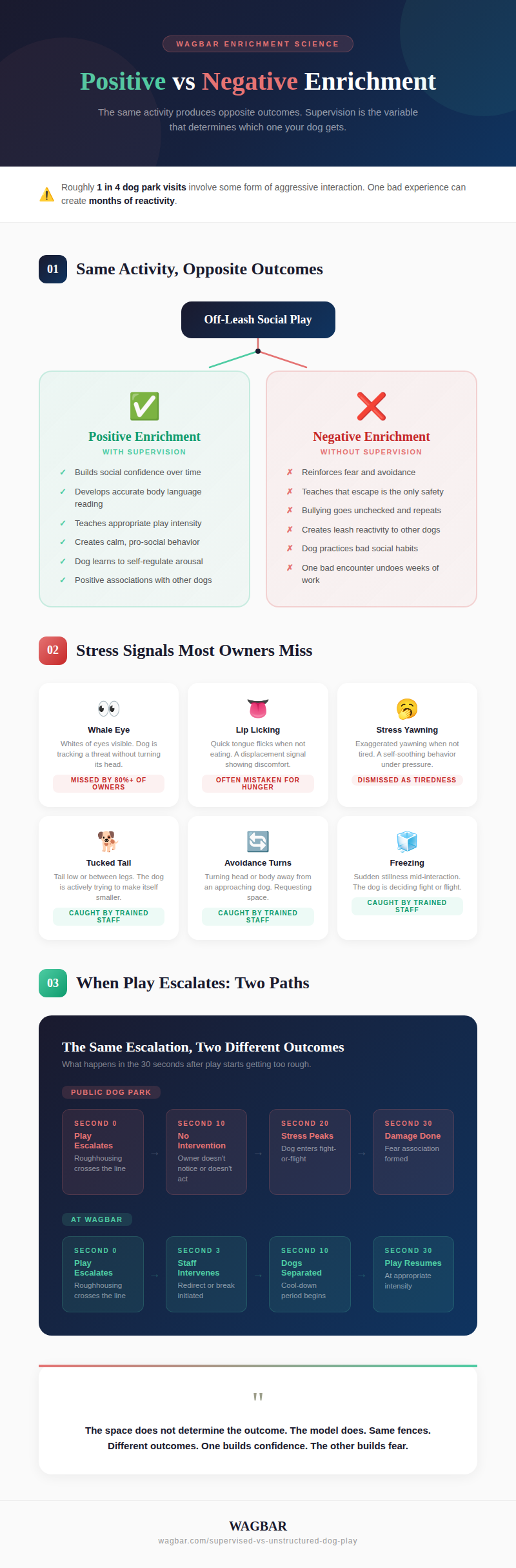
A dog that gets pinned by a larger dog at a public park and nobody intervenes does not learn "play is fun." It learns "unfamiliar dogs are dangerous, escape is the only option, and my owner will not protect me." That association is fast, durable, and difficult to undo. One bad experience at a dog park can create months of leash reactivity. Veterinary behaviorists see this pattern constantly. The owner says the dog used to love other dogs and then "something happened at the park."
That something was negative enrichment. The brain was fully engaged. The learning was real. But the outcome was harm.
What Unstructured Dog Park Play Actually Looks Like
Public dog parks are open-access, unmonitored, unscreened spaces. Anyone can enter. No vaccination records are checked at the gate. No temperament assessments are performed. No staff exists to intervene when play escalates.
Industry data paints a clear picture. Surveys estimate that approximately 1 in 4 dog park visits involve some form of aggressive interaction, ranging from resource guarding over water bowls to full contact altercations. A significant percentage of dog owners report avoiding public parks entirely due to past negative experiences.
The top reason people stop visiting dog parks is not the dogs. It is the other owners. Owners who do not recall their dogs. Owners who do not recognize stress signals. Owners who bring reactive or aggressive dogs and assume "they'll work it out." Owners who treat the dog park as a drop-off zone where the dogs supervise themselves.
The result is a social environment where the quality of every dog's experience depends entirely on which other dogs and owners happen to show up that day. Some days, the park is full of well-socialized dogs and attentive owners, and everyone has a great time. Other days, one undersocialized or aggressive dog changes the entire dynamic of the space, and every other dog in the park absorbs that stress.
Rezac et al. (2011) studied factors affecting dog-dog interactions in public spaces and found that leash status, sex, size, and owner behavior all influenced conflict rates. The presence of intact males increased agonistic interactions. The density of dogs in the space affected stress levels. These are variables that no public dog park controls for, because nobody is there to control them.
What Supervised Social Enrichment Actually Looks Like
Supervised social enrichment is a different model entirely. It is not a park with a nicer fence. It is a fundamentally different approach to how dogs interact in shared space.
At Wagbar, the model works on layers of screening and active management that start before any dog enters the play area.
Layer one is verification. Every dog must have current vaccination records on file. Proof of spay/neuter is required. This is not optional or honor-system. It is checked.
Layer two is temperament assessment. Dogs are observed during their initial visit. Staff evaluate how the dog responds to the space, to other dogs, and to increasing social pressure. Dogs that show persistent aggression, extreme fear, or an inability to read basic social cues are not admitted to open play. This screening removes the variable that makes public parks unpredictable.
Layer three is active monitoring. Trained staff watch play dynamics continuously. They are not behind a counter selling treats. They are in the play area, reading body language, tracking arousal levels, and intervening before escalation reaches conflict.
Layer four is intervention protocol. When play gets too rough, staff redirect. When arousal spikes, staff initiate breaks. When two dogs are mismatched in play style or intensity, staff separate them before the mismatch becomes stressful. The dog never has to figure out on its own how to escape an overwhelming situation. Someone is watching. Someone will step in. That changes everything about what the dog learns.
The Comparison That Matters
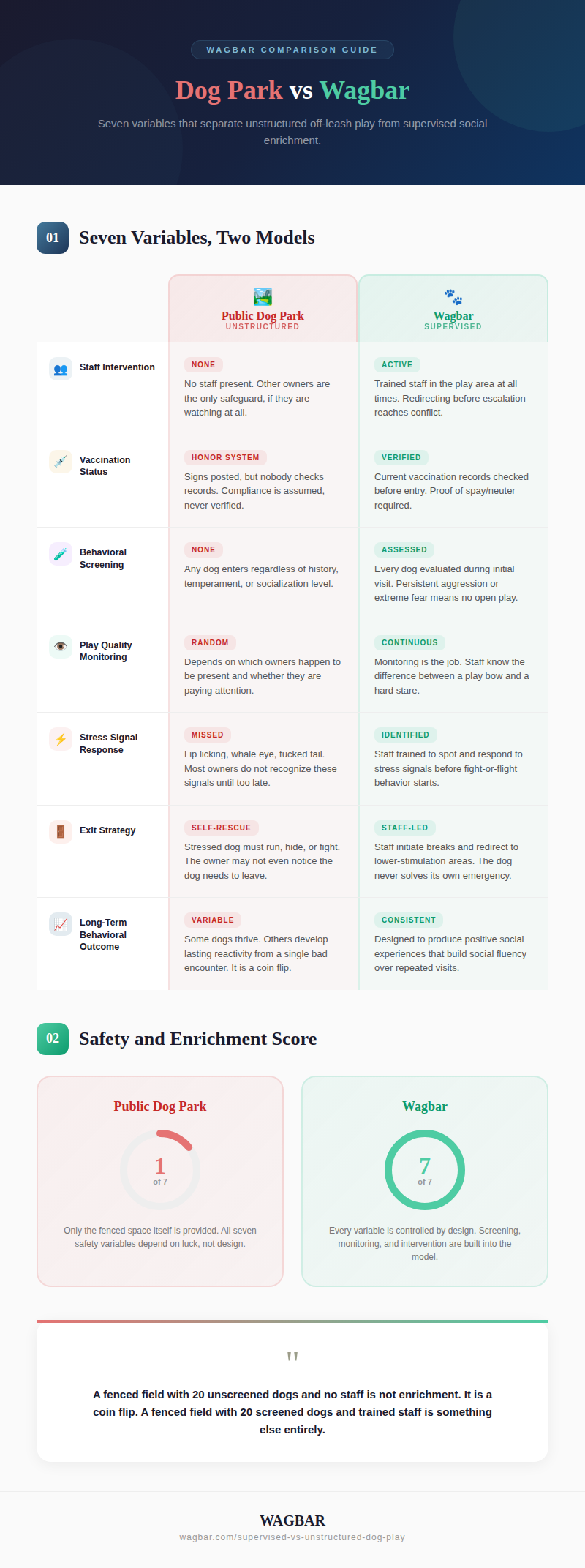
The physical spaces might look similar. Fenced outdoor areas with dogs running off-leash. But the experiences those spaces produce are entirely different, and the difference comes down to seven variables.
Staff intervention. Public dog parks have none. Wagbar has trained staff in the play area at all times. This single variable changes the trajectory of every interaction that starts heading in the wrong direction.
Vaccination status. Public parks operate on the honor system. Most post a sign saying dogs should be vaccinated. Nobody checks. Wagbar verifies records before entry. Every dog in the space is current on vaccinations.
Behavioral screening. Public parks screen for nothing. Any dog can enter regardless of history, temperament, or socialization level. Wagbar assesses every dog before admitting them to open play.
Play quality monitoring. In public parks, play quality depends on whether attentive owners happen to be present. At Wagbar, monitoring is the job. Staff know the difference between healthy play and play that is about to go wrong. They know what a play bow looks like, and they know what a stiff forward lean with hard eye contact looks like. Most dog owners cannot tell the difference until it is too late.
Stress signal response. In public parks, stress signals go unnoticed by the majority of owners. Lip licking, whale eye, tucked tail, avoidance behaviors, yawning when not tired. Most people miss these entirely. At Wagbar, staff are trained to identify and respond to stress signals before they escalate into fight-or-flight behavior.
Exit strategy. In a public park, the stressed dog's only option is to run, hide, or fight. The owner may not even notice the dog needs to leave. At Wagbar, staff initiate breaks and redirect dogs to lower-stimulation areas. The dog does not have to solve its own emergency.
Long-term behavioral outcome. Public dog parks produce variable outcomes. Some dogs thrive. Others develop lasting reactivity from a single bad encounter. Wagbar's model is designed to produce consistently positive social experiences that build confidence over repeated visits.
How Staff Intervention Changes What Dogs Learn
The learning that happens during social play is constant and automatic. Dogs do not need a training session to form associations. Every interaction teaches something. The question is whether it teaches the right thing.
In an unstructured park, a dog that gets bullied learns that other dogs are threatening and escape is the only safety strategy. A dog that successfully bullies a smaller dog learns that intimidation works and rough play has no consequences. Both dogs had their brains fully engaged. Both learned behavioral patterns that will repeat and strengthen over time.
In a supervised setting, neither of those lessons gets reinforced. The bully gets redirected before the behavior produces a reward. The bullied dog gets removed from the situation before fear takes root. Instead, both dogs experience play that stays within appropriate arousal levels, with partners that match their size, energy, and play style.
Over weeks of repeated positive experiences, the supervised dog builds what behaviorists call social fluency. The ability to read other dogs accurately, approach appropriately, disengage when play gets too intense, and re-engage at a lower energy level. These are skills, not personality traits. They develop through practice in safe settings. They deteriorate in unsafe ones.
Ottenheimer Carrier et al. (2013) studied relationships between social behavior, personality, and cortisol levels in dogs at off-leash parks. Their findings showed that the social context matters as much as the social interaction itself. Dogs in well-managed social settings showed different cortisol patterns than dogs in high-stress environments. The quality of the social experience, not just its existence, determined the physiological outcome.
Who Benefits Most from the Supervised Model
Every dog benefits from supervised social play. But certain dogs benefit disproportionately.
Dogs with limited social experience. Puppies and adolescent dogs that are still building their social repertoire need positive encounters to develop confidence. One traumatic experience at a public park during the adolescent enrichment window can undo weeks of careful socialization work. The supervised model ensures those early social experiences stay positive.
Dogs recovering from negative experiences. Dogs that have already had bad encounters at public parks and developed avoidance or reactivity. These dogs need controlled re-exposure to other dogs in a setting where they will not be overwhelmed. Staff can manage the pace, the proximity, and the intensity of social contact. Enrichment for anxious dogs depends on this kind of controlled, positive exposure.
High-energy breeds that play hard. Breeds with naturally rough play styles, like pit bulls, boxers, and German shepherds, are frequently misread at public parks. Their intense play is normal for the breed but can frighten other dogs and owners. In a supervised setting, staff match these dogs with compatible play partners who match their energy and style. The high-energy breed enrichment page covers why these dogs need outlets that match their intensity, not suppress it.
Small dogs. Small dogs in a mixed-size public park are at constant physical risk. A large dog playing at normal intensity can injure a small dog without any aggressive intent. Supervised settings manage size-based play groups and intervene when size mismatches create safety concerns.
The Real Question Is Not "Dog Park or Not"
The debate is not about whether dogs need off-leash social play. They do. The science of canine enrichment is clear that social interaction with other dogs is a biological need, not a luxury.
The real question is whether the social play your dog receives is building confidence or building fear. Whether the experiences are positive enrichment that strengthens social skills, or negative enrichment that reinforces avoidance and reactivity. Whether someone is watching and ready to step in when things go sideways, or whether your dog is on its own in a space full of strangers and hoping for the best.
The space does not determine the outcome. The model does. A fenced field with 20 unscreened dogs and no staff is not enrichment. It is a coin flip. A fenced field with 20 screened dogs and trained staff monitoring play quality is something else entirely.

That is the difference between a dog park and Wagbar. Same fences. Different outcomes.
Bottom TLDR: Not all off-leash play qualifies as enrichment. Unstructured dog parks with no screening, no vaccination checks, and no staff can produce negative enrichment, where the dog's brain is active but it is learning fear, avoidance, and reactivity. Roughly 1 in 4 dog park visits involve aggressive interactions, and the top reason owners quit going is other owners, not other dogs. Supervised social enrichment at Wagbar removes those variables through vaccination verification, temperament assessment, trained staff in the play area, and active intervention protocols. The space is not the differentiator. The model is. A fenced field with unscreened dogs and no staff is a coin flip. A fenced field with screened dogs and trained staff is social enrichment. Same fences. Different outcomes.