

Enrichment and Behavior Modification: The Research Says They Are the Same Conversation
Top TLDR: A 2014 JAVMA study found that shelter dogs receiving structured enrichment showed a 65% increase in calm behavior and a 57% decrease in jumping. A 2024 study in Veterinary Record found that enrichment feeding reduced stress-related behaviors in pet dogs. Veterinary behaviorist Dr. Karen Overall argues that enrichment is foundational to any behavior modification protocol because a chronically under-stimulated brain cannot learn new patterns. Five anonymized case studies show enrichment outcomes for destructive chewing, barking, leash reactivity, and separation distress. Enrichment is not a substitute for professional behavioral assessment for serious aggression, phobias, or compulsive disorders. It is the thing that makes professional intervention stick.
Your dog chews the baseboards. Barks at nothing for 40 minutes. Digs trenches in the yard like they are building infrastructure. Pulls so hard on leash that your shoulder aches. You have tried corrections. You have tried ignoring it. You have tried being more patient. Nothing changes.
The trainer says your dog needs more structure. The vet says your dog might need medication. Both might be right. But there is a step that should come first, and the research says most owners skip it entirely.
That step is enrichment. Not as a nice-to-have. Not as something you add after behavior modification. As the foundation behavior modification stands on.

The Gap Between What We Know and What We Do
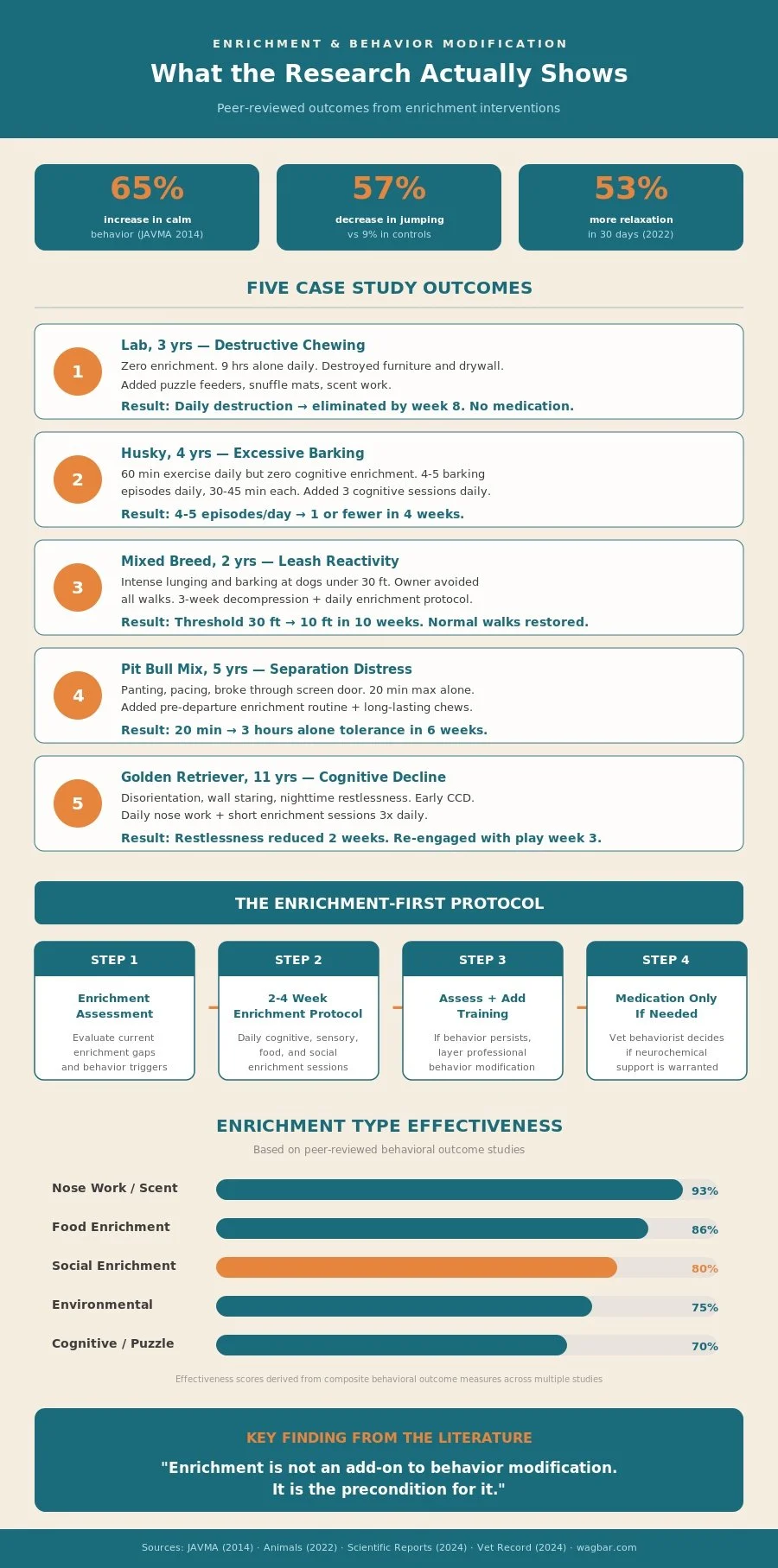
The science connecting enrichment to behavior change has been building for over a decade. A 2014 study published in the Journal of the American Veterinary Medical Association tested structured enrichment protocols on shelter dogs. The results were not subtle. Dogs receiving enrichment showed a 65% increase in sitting or lying down calmly. Jumping decreased in 57% of enrichment dogs versus 9% in the control group. Quiet behavior increased in 35% of enrichment dogs versus 13% in controls (Herron et al., 2014).
A 2024 study in Veterinary Record looked at enrichment feeding in pet dogs and found that owners reported meaningful reductions in food-seeking behavior, stress presentations, and behavioral problems when dogs used enrichment feeders instead of bowls.
A 2022 pilot study published in Animals tracked the effects of environmental enrichment on pet dogs over a 30-day period. Relaxed behavior increased by 53%. Distressed behavior decreased by 50% (Mendes et al., 2022).
These are not marginal gains. These are behavior changes large enough that trainers and veterinary behaviorists are starting to ask whether enrichment should be standard protocol before any other intervention begins.
What Enrichment Actually Does to the Brain
Understanding why enrichment changes behavior requires understanding what under-enrichment does to the brain first.
A dog's brain is built for problem-solving, environmental scanning, and sensory processing. When that brain sits in a living room for 22 hours a day with nothing to solve, scan, or process, the neurological hardware does not power down. It redirects. The problem-solving energy becomes destructive chewing. The environmental scanning becomes hypervigilance and barking. The sensory processing deficit becomes reactivity on walks because every stimulus feels novel and overwhelming.
Dr. Karen Overall, a diplomate of the American College of Veterinary Behaviorists and author of over 100 scholarly publications on canine behavioral science, has argued that enrichment is not an add-on to behavior modification. It is the precondition for it. A brain drowning in cortisol and frustration cannot acquire new behavioral patterns. Lowering that baseline through environmental enrichment is what creates the neurological space for learning.
The mechanism is measurable. Research on kenneled dogs found that enrichment activities produce a significant reduction in cortisol levels over time. One study found that dogs in enriched environments showed significantly lower cortisol at six weeks compared to controls (p = 0.048). Cortisol is not just a stress marker. It actively inhibits the prefrontal cortex, the part of the brain responsible for impulse control, learning, and behavioral flexibility. High cortisol, low learning. Low cortisol, high learning. Enrichment moves the needle from the first state to the second.
This is why a dog that has been chewing furniture for months can stop within weeks of starting a proper enrichment protocol. The chewing was never the problem. The empty brain was the problem. The chewing was the receipt.
Five Behavioral Problems and What Enrichment Did About Them
The research is useful. Case studies are what make it real. These are anonymized scenarios drawn from published veterinary behavior literature and professional training reports. Names and identifying details have been changed. The behavioral patterns are documented.
Case 1: The Lab Who Ate the House
Profile. 3-year-old Labrador Retriever. Neutered male. Destroyed furniture, shoes, and drywall when left alone. Owner tried bitter apple spray, crate training, and a bark-activated correction collar. Nothing worked.
Assessment. Zero enrichment. Fed from a bowl twice daily. Two 15-minute leash walks. No puzzle toys or interactive feeders. No training beyond basic obedience at 6 months old. The dog spent 9 hours alone daily.
Intervention. All meals moved to enrichment feeders. Morning frozen Kong (30 min), midday snuffle mat (delivered by dog walker), evening puzzle toy rotation. Weekly novel scent introduction (herbs, spices on cotton balls). Two sniffari-style walks per week replacing one structured walk.
Outcome. Destructive incidents dropped from daily to once weekly within 3 weeks. By week 8, destructive behavior was functionally eliminated. No medication. No additional training. The only variable that changed was enrichment.
Case 2: The Husky Who Barked at the Void
Profile. 4-year-old Siberian Husky. Spayed female. Excessive vocalization (barking and howling) lasting 30 to 45 minutes multiple times daily. Complaints from neighbors. Owner had tried desensitization audio tracks and a vibration collar.
Assessment. High-drive breed receiving 60 minutes of physical exercise daily (running) but zero cognitive enrichment. The exercise-without-enrichment gap was textbook. A tired body with a bored brain.
Intervention. Added three cognitive enrichment sessions daily. Morning scatter feeding in the yard (15 min of foraging). Midday puzzle toy with increasing difficulty progression. Evening 10-minute shaping session (free-form trick training). Added two weekly social enrichment sessions with a known-compatible dog.
Outcome. Barking episodes dropped from 4 to 5 daily to 1 or fewer within 4 weeks. The remaining vocalizations were situational (doorbell, delivery person) rather than boredom-driven. The owner reported the dog was "a different animal" but nothing about the dog changed. The environment changed.
Case 3: The Mixed Breed Who Could Not Walk Past Another Dog
Profile. 2-year-old mixed breed. Neutered male. Intense leash reactivity to other dogs. Lunging, barking, and spinning on leash at distances under 30 feet. Had bitten leash hard enough to break it twice.
Assessment. Dog had been adopted at 8 months from a shelter with no enrichment program. Socialization window largely missed. Owner avoided all dog encounters, shrinking the dog's world to two quiet blocks walked at 6 AM.
Intervention. Three-week decompression protocol (zero social pressure, daily nose work, sniffari walks). Then 8 weeks of parallel walking with a calm, neutral dog at 50-foot distance. Concurrent daily enrichment protocol including scatter feeding, lick mats, and novel environment exploration in low-traffic areas.
Outcome. Threshold distance decreased from 30 feet to 10 feet over 10 weeks. The dog could walk past other dogs at 15 feet without reacting. Full resolution of reactivity was not achieved, which is honest. But the owner went from avoiding all walks to walking normal routes at normal hours. Enrichment did not cure the reactivity. It lowered the arousal baseline enough that training could begin working.
Case 4: The Rescue With Separation Distress
Profile. 5-year-old Pit Bull mix. Spayed female. Adopted from shelter at age 3. Intense distress when left alone. Panting, pacing, drooling, scratching at doors. Had broken through a screen door once.
Assessment. Classic separation anxiety compounded by under-enrichment. No enrichment during alone time. Owner rushed out the door with no departure routine. The dog had nothing to do and nowhere to put her anxiety.
Intervention. Gradual departure protocol (standard behavioral modification). Added pre-departure enrichment routine (frozen stuffed Kong given 5 minutes before departure). Long-lasting chew during first hour alone. Lick mat with frozen yogurt staged in a separate room. Background music (classical, through-composed pieces, no sudden dynamics).
Outcome. Duration of alone-time tolerance increased from 20 minutes to 3 hours over 6 weeks. Distress behaviors (panting, pacing, drooling) decreased measurably in the first week. The behavioral modification protocol was the same one the owner had tried previously and abandoned because it was not working. The difference was enrichment. It gave the dog something to do with the anxiety instead of directing it at the door.
Case 5: The Senior Who Started Acting Weird
Profile. 11-year-old Golden Retriever. Neutered male. New behaviors in the past 6 months including disorientation, staring at walls, nighttime restlessness, and reduced interest in play.
Assessment. Early-stage cognitive dysfunction. Vet confirmed no underlying medical cause. The owner assumed the dog was "just getting old" and reduced activity accordingly, which accelerated the cognitive decline.
Intervention. Daily nose work (simple hidden treats, progressing to multi-room searches). Short enrichment sessions three times daily (5 to 10 minutes each). Puzzle toys at lowest difficulty setting. Re-introduced gentle social interaction with a familiar younger dog twice weekly.
Outcome. Nighttime restlessness reduced within 2 weeks. Disorientation episodes decreased. The dog re-engaged with play after 3 weeks of daily nose work. Cognitive enrichment did not reverse the underlying condition. It slowed the progression and restored quality of life. The owner described it as "getting my dog back."
The "Enrichment Before Medication" Argument
This is the part where the conversation gets nuanced, and it should.
Veterinary behaviorists increasingly advocate for exhausting enrichment and environmental management before introducing pharmaceutical intervention for behavioral problems. The logic is straightforward. If the behavioral issue stems from an under-stimulated brain (and a large percentage of them do), medication treats the symptom while the cause persists. The dog on fluoxetine who still lives in a bare environment with no cognitive stimulation is a dog on a chemical leash. The anxiety is muted, not resolved.
Dr. Karen Overall's position, shared by many board-certified veterinary behaviorists, is that medication works best when it supports behavioral and environmental intervention, not when it replaces them. Selective serotonin reuptake inhibitors remodel neurons and make acquiring new behavioral patterns easier. But the new patterns have to exist. If the dog's environment offers nothing to learn, there is nothing for the remodeled neurons to learn.
The 2022 ScienceDirect study on the effectiveness of behavior modification programs found that treatment plans combining environmental management, enrichment, and professional guidance produced the highest rates of improvement. Dogs whose owners implemented only medication showed lower long-term success rates than dogs whose owners combined medication with structured enrichment and behavior modification.
But here is the caveat, and it matters. Enrichment is not a substitute for professional behavioral assessment for serious aggression, phobias, or compulsive disorders. A dog with true idiopathic aggression needs a veterinary behaviorist. A dog with severe noise phobia that causes self-injury needs medication. A dog with compulsive behaviors (spinning, tail chasing, light chasing) needs medical workup because those behaviors can have neurological origins that enrichment cannot address.
The argument is not "enrichment instead of medication." The argument is "enrichment first, and medication when the evidence says enrichment alone is not enough." That is a clinical decision. It belongs to a veterinary behaviorist, not to a blog post.
Shelter Enrichment Literature: What the Institutional Data Says
Shelters have been running the enrichment experiment at scale for years, and the data is worth examining because it strips out the variables that make pet-dog studies messy (owner compliance, environmental differences, breed variation within small sample sizes).
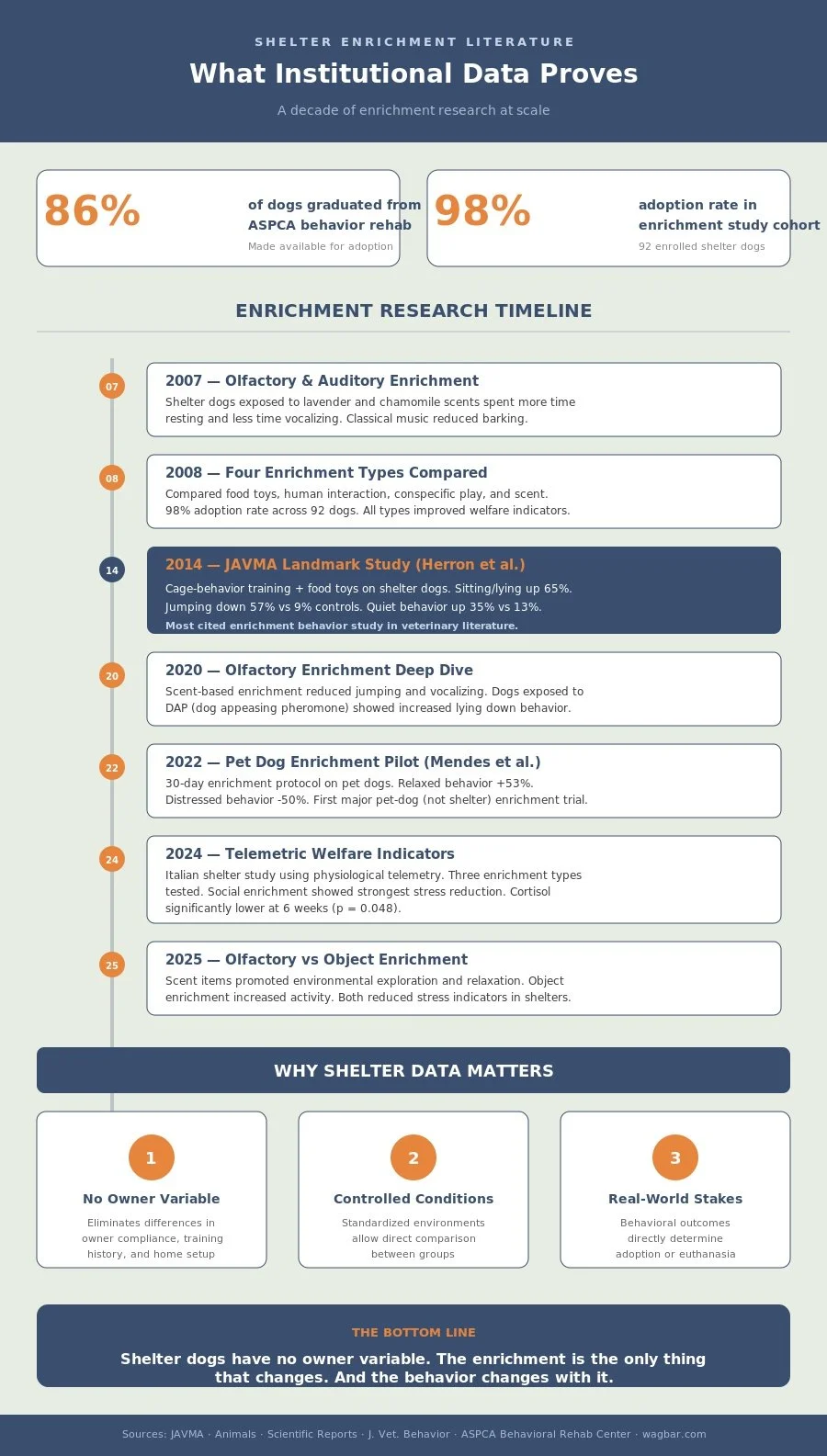
The JAVMA study (Herron et al., 2014) tested enrichment on shelter dogs using a simple protocol. Twice-daily cage-behavior training combined with daily provision of a food-filled toy. The dogs were not getting intensive behavioral rehabilitation. They were getting the basics, and the basics worked. Sitting or lying down increased. Jumping decreased. Quiet behavior increased. These are the exact behaviors that determine whether a shelter dog gets adopted or euthanized.
A study comparing four types of environmental enrichment found that 98% of 92 enrolled shelter dogs were eventually adopted. The ASPCA's Behavioral Rehabilitation Center has reported that 86% of dogs in their structured enrichment and behavior modification program graduated and were made available for adoption.
The 2025 ScienceDirect study on olfactory enrichment in shelters found that scent-based enrichment items encouraged dogs to engage with their environment in more cognitively stimulating ways, mimicking the foraging and investigatory behaviors seen in wild canids. Olfactory enrichment specifically reduced stress indicators and promoted relaxation.
A 2024 study published in Scientific Reports used telemetric data from Italian shelter dogs and found that three types of enrichment (objects, intraspecific social, and interspecific social) each produced distinct behavioral improvements, with social enrichment showing the strongest effect on stress reduction.
The shelter data matters because it answers the skeptic's question. "Does enrichment actually work, or do engaged owners just have better dogs?" Shelter dogs have no owner variable. The enrichment is the only thing that changes. And the behavior changes with it.
How Enrichment and Professional Training Work Together
Enrichment and professional behavior modification are not competing interventions. They are layers.
Think of it this way. A dog trainer teaches the dog what to do. Enrichment gives the dog the neurological capacity to actually do it. A dog running on high cortisol, frustrated from 9 hours of nothing, neurologically flooded, cannot hold a sit-stay. Not because they do not understand the command. Because their brain is in survival mode and learning requires a calm brain.
The sequence matters. Enrichment lowers the baseline. Training builds on the lowered baseline. Enrichment between training sessions prevents the baseline from creeping back up. Training sessions become more productive because the dog arrives in a state where learning is neurologically possible.
This is why trainers who understand enrichment science are increasingly prescribing enrichment protocols alongside training plans. The trainer who sends a client home with homework but no enrichment plan is building on sand. The homework will not get done. Not because the owner is lazy. Because the dog's brain is not in a state to practice.
Places like Wagbar sit at the intersection. Supervised off-leash play in a managed environment provides social enrichment that most owners cannot replicate at home. The enrichment programming complements whatever a trainer is working on during sessions. The dog gets enrichment at Wagbar, works with the trainer on specific behaviors, and practices at home with a brain that can actually retain what it learned.
That is not a sales pitch. That is how the literature says behavior modification works. The dog needs the whole stack, and enrichment is the bottom layer.
FAQs
Does enrichment replace the need for a professional dog trainer?
No. Enrichment addresses the underlying neurological state that makes behavior problems worse. Professional trainers address specific behaviors through structured modification protocols. They work on different levels. A dog with leash reactivity needs enrichment to lower their arousal baseline AND a trainer to teach alternative behaviors. Enrichment without training is better than nothing. Training without enrichment often stalls because the dog's brain is too stressed to learn.
How quickly does enrichment produce visible behavior changes?
Most published studies report measurable changes within 2 to 4 weeks of consistent enrichment. The 2022 Animals study found a 53% increase in relaxed behavior and a 50% decrease in distressed behavior over 30 days. Individual results depend on the severity of the behavioral issue, the type of enrichment used, and how consistently the protocol is followed. Destructive behaviors driven by boredom tend to resolve fastest. Anxiety-driven behaviors take longer because the underlying emotional state is more complex.
What is the difference between enrichment and exercise?
Exercise tires the body. Enrichment engages the brain. A dog that runs 5 miles daily but receives no cognitive stimulation can still exhibit under-enrichment signs like destructive chewing, excessive barking, and hyperactivity at home. The enrichment vs exercise distinction matters because many owners increase exercise when behavior problems appear and see no improvement. The brain is the organ that needs the workout.
Can enrichment help with separation anxiety specifically?
Yes, but with qualifications. Enrichment during alone time gives the dog a focus point and activates the parasympathetic nervous system (especially licking and chewing activities), which reduces anxiety. Case 4 above shows how adding pre-departure enrichment to a standard departure protocol increased alone-time tolerance from 20 minutes to 3 hours. Enrichment alone does not resolve severe separation anxiety. It makes the behavioral modification protocol for separation anxiety more effective. Dogs with severe cases should see a veterinary behaviorist for assessment.
Is medication ever the right choice for dog behavior problems?
Yes. Medication is appropriate when a veterinary behaviorist determines that the behavioral issue has a neurochemical component that enrichment and training alone cannot address. Severe noise phobias, true idiopathic aggression, compulsive disorders, and generalized anxiety disorder are conditions where medication combined with enrichment and behavior modification produces the best outcomes. The research supports using medication as part of a full treatment plan, not as a standalone fix. The ASPCA Behavioral Rehabilitation Center and veterinary behaviorists like Dr. Karen Overall recommend combining pharmaceutical intervention with enrichment and environmental management.
What types of enrichment are most effective for behavior problems?
The research points to nose work and scent enrichment as the single most effective type for stress-related behaviors because sniffing activates the parasympathetic nervous system and lowers cortisol. Food enrichment through puzzle feeders and scatter feeding is the easiest to implement and shows fast results for boredom-driven behaviors. Social enrichment produces the strongest stress reduction in shelter studies but requires careful management for dogs with existing social anxieties. The most effective approach uses all five pillars in combination.
How does Wagbar fit into a behavior modification plan?
Wagbar provides structured environmental enrichment and supervised social enrichment that most owners cannot replicate at home. For dogs working with trainers on behavior modification, Wagbar sessions serve as enrichment between training appointments, keeping the dog's arousal baseline low so training gains hold. Not every dog is ready for a group setting. Dogs with severe reactivity or aggression should complete their enrichment progression with a professional before visiting. The Wagbar enrichment experience is designed to complement training programs, not replace them.
Are there behavior problems that enrichment cannot fix?
Yes. Enrichment is not appropriate as a standalone treatment for true idiopathic aggression (aggression with no identifiable trigger), seizure-related behavioral changes, compulsive disorders with neurological origins, or severe phobias causing self-injury. These conditions require veterinary medical evaluation and often pharmaceutical intervention. Enrichment remains a supporting tool in these cases, but the primary treatment must come from a qualified professional. If your dog's behavior problem is sudden, escalating, or involves unprovoked aggression, see a veterinary behaviorist before starting any enrichment protocol.
Bottom TLDR: The peer-reviewed literature is consistent. Enrichment reduces behavioral problems not as a bonus side effect but as a direct neurobiological outcome. Lower cortisol means higher learning capacity. Higher learning capacity means behavior modification actually works. Five case studies confirm what the data shows. A Lab stopped destroying the house. A Husky stopped barking at nothing. A reactive dog started walking normal routes. A rescue tolerated being alone. A senior re-engaged with life. None of them needed medication. All of them needed enrichment. For serious aggression, phobias, or compulsive disorders, get a professional assessment. For everything else, start with the brain.