

Puppy Enrichment: A Week-by-Week Calendar from 8 to 24 Weeks
Your puppy's brain is under construction. Right now. Every single day between 8 and 24 weeks, neural pathways are forming, strengthening, or dying off based entirely on what your puppy experiences. The experiences you provide during this window will shape your dog's behavior, temperament, and emotional resilience for the next 10 to 15 years. That is not an exaggeration. That is developmental neuroscience.
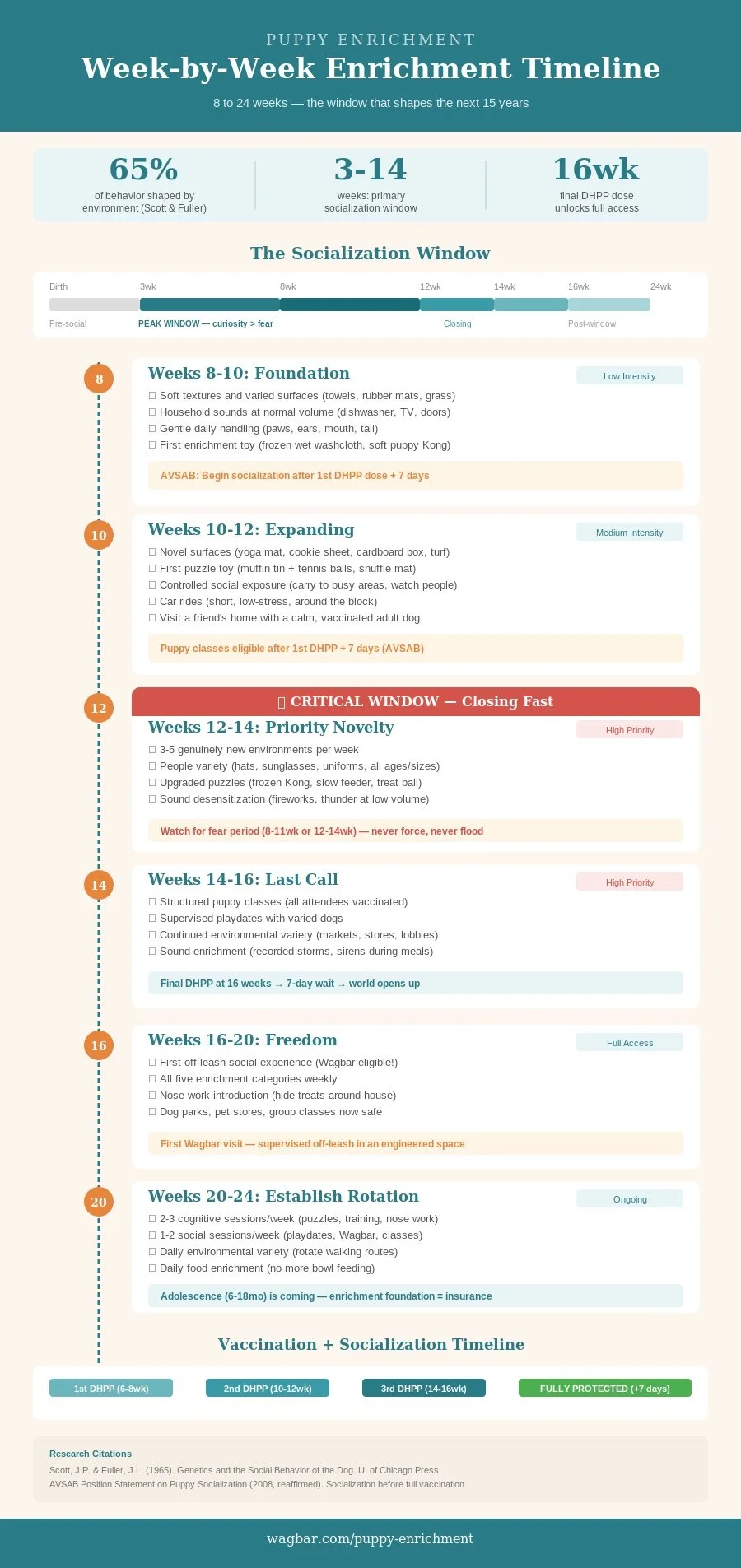
Scott and Fuller's landmark 13-year study at the Jackson Laboratory established that a dog's behavioral makeup is approximately 35% genetic and 65% environment. Socialization, enrichment, nutrition, and early experience account for nearly two-thirds of who your dog becomes. The window for maximum impact is short. And it is open right now.
Wagbar exists because this window matters. A supervised, off-leash environment where puppies can experience novel dogs, new scents, varied surfaces, and real social dynamics in a space designed for safe exploration. But your puppy is not ready for Wagbar on day one. This calendar tells you exactly what enrichment is appropriate at each stage, why it matters, and when your puppy is ready for the real thing.

The Socialization Window: Why Timing Is Everything
The primary socialization period runs from approximately 3 to 14 weeks of age. During this window, your puppy's brain is neurologically primed to approach new stimuli with curiosity instead of fear. Novel sounds, surfaces, people, and animals get categorized as "normal" rather than "threatening." After this window begins closing around 12 to 14 weeks, unfamiliar stimuli increasingly trigger avoidance and fear responses.
The American Veterinary Society of Animal Behavior (AVSAB) states that it should be the standard of care for puppies to receive socialization before they are fully vaccinated. The behavioral risks of inadequate socialization far outweigh the disease risks of controlled, safe exposure during the vaccination series. That does not mean take your 9-week-old to a dog park. It means structured, intentional enrichment starting immediately.
This is where most new puppy owners get it wrong. They wait. They wait for all the shots. They wait until the puppy is "old enough." They wait until the puppy "settles in." And by the time they start, the most critical developmental window has closed or is closing. The calendar below eliminates the guesswork.
Weeks 8 to 10: Foundation Building
Your puppy just left its littermates. Everything is new and potentially overwhelming. The goal is gentle, low-intensity enrichment that builds confidence without flooding.
Textures and surfaces. Place a towel on a tile floor. Let your puppy walk on grass for the first time. Set a rubber mat near the food bowl. Introduce carpet if your puppy has only known concrete, or concrete if your puppy has only known carpet. Each new surface is sensory enrichment that builds the brain's database of "normal."
Household sounds. Run the dishwasher while your puppy eats. Turn on the vacuum in another room (not the same room). Play the TV at normal volume. Close a cabinet door. These sounds need to become background noise, not triggers. Pair every new sound with something positive. Food, play, calm attention.
Gentle handling. Touch your puppy's paws, ears, mouth, and tail every day. Not roughly. Not for long. Just enough to build tolerance for grooming, vet visits, and general human contact. A puppy who has never had its paws handled at 9 weeks becomes a dog who bites during nail trims at 2 years.
First enrichment toy. A frozen wet washcloth is the perfect starter. It soothes teething gums, introduces a novel texture, and gives your puppy something to work on. Supervise closely as the washcloth thaws and frays. A soft puppy Kong stuffed with a small amount of wet food and refrigerated (not frozen solid yet) is the next step.
Weeks 10 to 12: Expanding the World
Your puppy has settled into your home. Now expand what "normal" looks like.
New surfaces. Artificial turf, a yoga mat, a cookie sheet (the wobble and sound are enrichment), a piece of plywood, a shallow cardboard box to climb into. Each surface teaches the brain that unfamiliar footing is not dangerous. Dogs who miss this window often become adults who refuse to walk on grates, bridges, or slippery floors.
First puzzle toy. Introduce a basic puzzle feeder. A muffin tin with tennis balls covering kibble in each cup. A paper towel roll with treats inside and the ends folded shut. A snuffle mat with kibble scattered through the fabric. Keep it easy. The goal at this age is not difficulty. It is the concept that working for food is normal and fun.
Controlled social exposure. Carry your puppy to a busy sidewalk. Sit on a bench outside a coffee shop and let your puppy watch people walk by. Visit a friend's house where a calm, vaccinated adult dog lives. The AVSAB recommends starting puppy classes after the first DHPP vaccination plus a 7-day waiting period. That window opens now.
Car rides. Your puppy needs to learn that cars are normal. Short, low-stress trips. Around the block and back. To the drive-through. To a friend's driveway. Dogs who never ride in cars during this period often develop lifelong motion anxiety.
Weeks 12 to 14: The Window Is Closing
This is the most important enrichment period. The socialization window is actively narrowing. Every novel experience your puppy has now carries more developmental weight than it will in two weeks. Prioritize variety.
Novel environments. Pet-friendly stores, outdoor patios, a friend's backyard, a quiet park (carry your puppy if vaccination series is incomplete). The goal is 3 to 5 genuinely new environments per week during this period. Not the same three places. New ones.
People variety. Your puppy needs to meet people who look, sound, and move differently. People wearing hats, sunglasses, uniforms, and backpacks. People with beards. People in wheelchairs. Children (supervised, calm interactions only). Tall people. Short people. People with deep voices and high voices. The brain is building a template for "human," and that template needs to be broad.
First fear period. Many puppies hit their first fear period around 8 to 11 weeks, and some experience a second one around 12 to 14 weeks. If your puppy suddenly seems afraid of something they were fine with yesterday, do not push through it. Do not flood. Do not force exposure. Give space, keep the experience positive, and try again another day. A negative experience during a fear period can create a permanent phobia.
Enrichment progression. Upgrade from basic food enrichment to slightly more challenging puzzles. A frozen Kong (fully frozen now, not just refrigerated). A slow feeder bowl for meals instead of a regular bowl. A treat-dispensing ball that requires rolling. The cognitive challenge should increase gradually, matching your puppy's growing problem-solving ability.
Weeks 14 to 16: Last Call for the Socialization Window
The primary socialization window is closing. Enrichment remains critical but the emphasis shifts from "introduce everything new" to "consolidate and deepen."
Structured social experiences. Puppy classes with proof of vaccination from all attendees. Supervised playdates with known, healthy dogs of varied sizes and temperaments. This is social enrichment at its most impactful. Your puppy is learning dog body language, play styles, and conflict resolution skills that no human interaction can teach.
Continued environmental variety. Outdoor markets, busy parking lots, hardware stores, vet clinic lobbies (ask to do a "happy visit" with no procedures). Every new environment your puppy processes before 16 weeks gets filed as "normal." Every environment they encounter for the first time after 16 weeks requires more effort, more counter-conditioning, and more patience.
Sound enrichment. Fireworks recordings at low volume. Thunder sounds. Sirens. Construction noise. Play these during meals and play sessions so the puppy builds a positive association. Dogs who first hear fireworks on the Fourth of July at 8 months old often develop noise phobias that last a lifetime. Dogs who heard those sounds at 12 weeks during dinner usually sleep through them.
Vaccination timeline. Most puppies receive their final DHPP dose at 16 weeks. After this dose plus a 7-day waiting period, the world opens up. Dog parks, pet store floors, group classes, and off-leash facilities become safe. Mark this date on your calendar. It matters.
Weeks 16 to 20: Post-Vaccination Freedom
Your puppy's immune system is now protected. The socialization window is largely closed, but enrichment needs do not stop. They shift.
First off-leash social experience. This is when your puppy is eligible for a Wagbar visit. A supervised, off-leash environment where dogs of all sizes interact, where the scent profile changes daily, where the social dynamics are real and varied. Your puppy has been preparing for this since week 8. Every texture they walked on, every sound they heard, every calm dog they met was building the neural foundation for this moment.
Wagbar's supervised environment is built for exactly this transition. It is not a dog park with a fence and a prayer. It is a staffed, monitored space where your puppy's first real off-leash experience happens under conditions designed to be positive. The difference between a good first off-leash experience and a bad one can define your dog's relationship with other dogs for years. Choose the environment carefully.
Enrichment variety. Rotate through all five enrichment categories weekly. Cognitive puzzles, sensory experiences, food enrichment, social play, and environmental novelty. Your puppy's brain is still developing rapidly. The foundation is set, but the structure needs ongoing input.
Nose work introduction. Hide treats in easy locations around the house. Under a towel. Behind a chair leg. In an open box. Let your puppy's nose drive the experience. This is the beginning of scent enrichment, and puppies at this age take to it immediately because their olfactory system is fully developed even when the rest of their brain is still catching up.
Weeks 20 to 24: Establishing the Rotation
By 20 weeks, your puppy should have a regular enrichment rotation in place. Not the same thing every day. A deliberate, varied schedule that hits multiple enrichment types each week.
Weekly structure. Two to three cognitive enrichment sessions (puzzle feeders, training games, nose work). One or two social enrichment sessions (playdates, Wagbar visits, puppy classes). Daily environmental variety (different walking routes, new objects in the home). Daily food enrichment (meals served in enrichment feeders, not bowls).
Adolescence is coming. Between 6 and 18 months, your dog will enter adolescence. Everything you built during the puppy stage gets tested. Dogs with strong enrichment foundations handle adolescence with less destructive behavior, less reactivity, and more resilience. Dogs who were under-enriched as puppies often fall apart during this stage. The work you are doing now is insurance against 6 to 18 months of chaos.
Regular facility visits. Making Wagbar visits a regular part of your dog's routine before adolescence hits means the social skills, environmental confidence, and off-leash manners are already established before hormones and energy levels spike. The difference between an adolescent dog who has been visiting Wagbar since 16 weeks and one who shows up for the first time at 10 months is night and day.
Puppy Enrichment Mistakes That Create Adult Problems
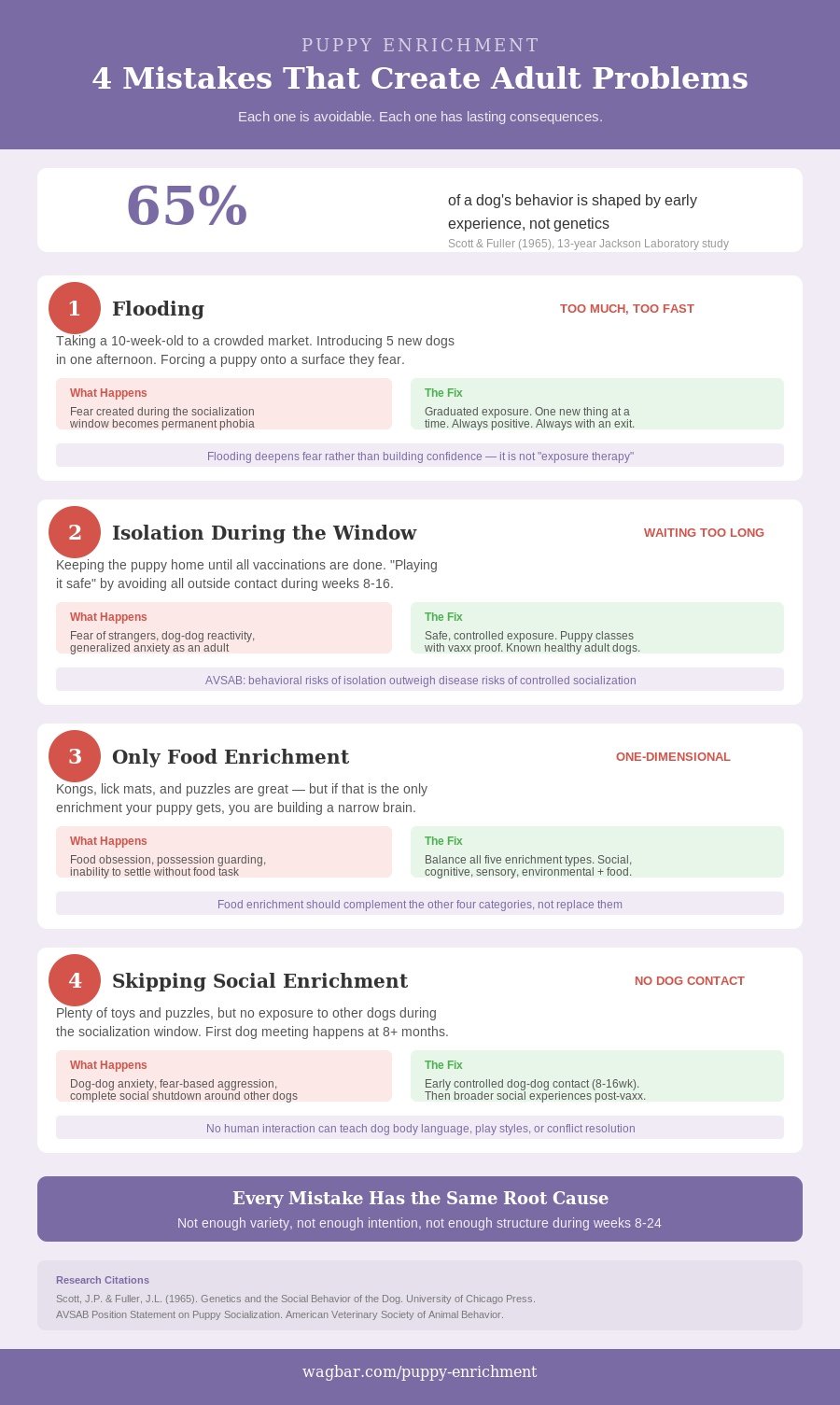
Four common enrichment mistakes during the puppy period produce behavioral problems that owners spend years trying to fix. Each one is avoidable.
Flooding. Too much, too fast, too young. Taking a 10-week-old puppy to a crowded farmer's market. Introducing them to five new dogs in one afternoon. Forcing them to walk on a surface they are afraid of. Flooding does not build confidence. It creates fear. And fear created during the socialization window is the hardest kind to undo. The fix is graduated exposure. One new experience at a time, always paired with something positive, always with an escape route.
Isolation during the socialization window. Keeping the puppy home until all vaccinations are complete sounds safe. It is not. The AVSAB explicitly states that the behavioral risks of isolation outweigh the disease risks of controlled socialization. Dogs isolated during weeks 8 to 16 are significantly more likely to develop fear of strangers, reactivity toward other dogs, and generalized anxiety as adults. The fix is safe, controlled exposure. Puppy classes with vaccination requirements. Known, healthy adult dogs. Carrying your puppy to public places before ground contact is safe.
Only using food enrichment. Kongs, lick mats, and puzzle feeders are excellent. But if food is the only enrichment your puppy receives, you are building a one-dimensional brain. Dogs who only experienced food enrichment as puppies often develop food obsession, possession guarding, or an inability to settle without a food-based task. The fix is balance. Social enrichment, cognitive challenges, sensory experiences, and environmental novelty need to run alongside food enrichment, not be replaced by it.
Skipping social enrichment. Some owners provide plenty of toys, puzzles, and solo activities but never expose their puppy to other dogs during the socialization window. By the time the dog meets other dogs as an adult, it has no framework for reading body language, initiating play, or de-escalating conflict. The result is dog-dog anxiety, fear-based aggression, or complete social shutdown. The fix is early, controlled social enrichment with known calm dogs during weeks 8 to 16, then broader social experiences after vaccination is complete.
FAQs
When can my puppy go to Wagbar?
After the final DHPP vaccination at 16 weeks plus a 7-day waiting period. That puts most puppies at 17 weeks (about 4 months) as the earliest safe date for off-leash social environments. Call your vet to confirm your puppy's specific timeline. Some puppies on accelerated vaccination schedules may be eligible slightly earlier.
Is it safe to socialize my puppy before all vaccinations are done?
Yes, with precautions. The AVSAB recommends beginning socialization after the first DHPP dose plus a 7-day wait. Safe options include puppy classes requiring vaccination proof, visits with known healthy vaccinated dogs, and carrying your puppy in public spaces. Avoid dog parks, pet store floors, and high-traffic dog areas until the 16-week vaccination is complete.
How much enrichment is too much for a puppy?
Watch your puppy's behavior. Signs of over-stimulation include biting more than usual, zoomies that will not stop, inability to settle, whining, and avoidance behavior. Puppies need 18 to 20 hours of sleep per day. If enrichment is cutting into rest, you are doing too much. One to two structured enrichment sessions per day plus normal household exposure is enough for most puppies under 16 weeks.
What if I adopted my puppy after 16 weeks?
The socialization window is not a cliff. It is a gradual slope. Enrichment after 16 weeks still matters enormously. It just requires more patience, more repetition, and more careful management of negative experiences. Counter-conditioning and desensitization replace the easy acceptance that younger puppies show. Start with the enrichment strategies from the 16 to 20 week period and scale up based on your dog's comfort level. And consider professional-level enrichment to accelerate the process.
Do different breeds need different enrichment?
The timeline applies across breeds, but intensity and type can vary. High-energy breeds may need more physical and cognitive enrichment earlier. Breeds prone to guarding behavior benefit from extra social enrichment during weeks 10 to 14. Toy breeds may need gentler introductions to larger dogs. The principle is the same for all breeds. Match the intensity to the individual puppy, not to a breed stereotype.
Their First 24 Weeks Write the Next 15 Years
Every frozen washcloth, every new surface, every calm dog your puppy meets, every puzzle they solve is building the brain your adult dog will live with. The socialization window closes. The enrichment window never does. But nothing you do at 2 years old will match the impact of what you do between 8 and 24 weeks.
Start now. Start today. And when your puppy hits 16 weeks and that final vaccination clears, bring them to Wagbar and let them experience what a fully enriched social environment feels like. Or explore what it means to build one yourself.