

The Wagbar Enrichment Experience: A Day in Your Dog's Brain
Top TLDR: A Wagbar visit is not just playtime. It is a structured sequence of enrichment phases that engage every part of your dog's brain, from olfactory processing at the gate to social cognition during play to memory consolidation during rest. This walkthrough follows a dog from arrival to departure and explains what their brain is actually doing at each stage. The quiet car ride home is not exhaustion. It is satiation. A brain that received everything it needed does not seek more stimulation. That is the difference between a tired dog and an enriched one.

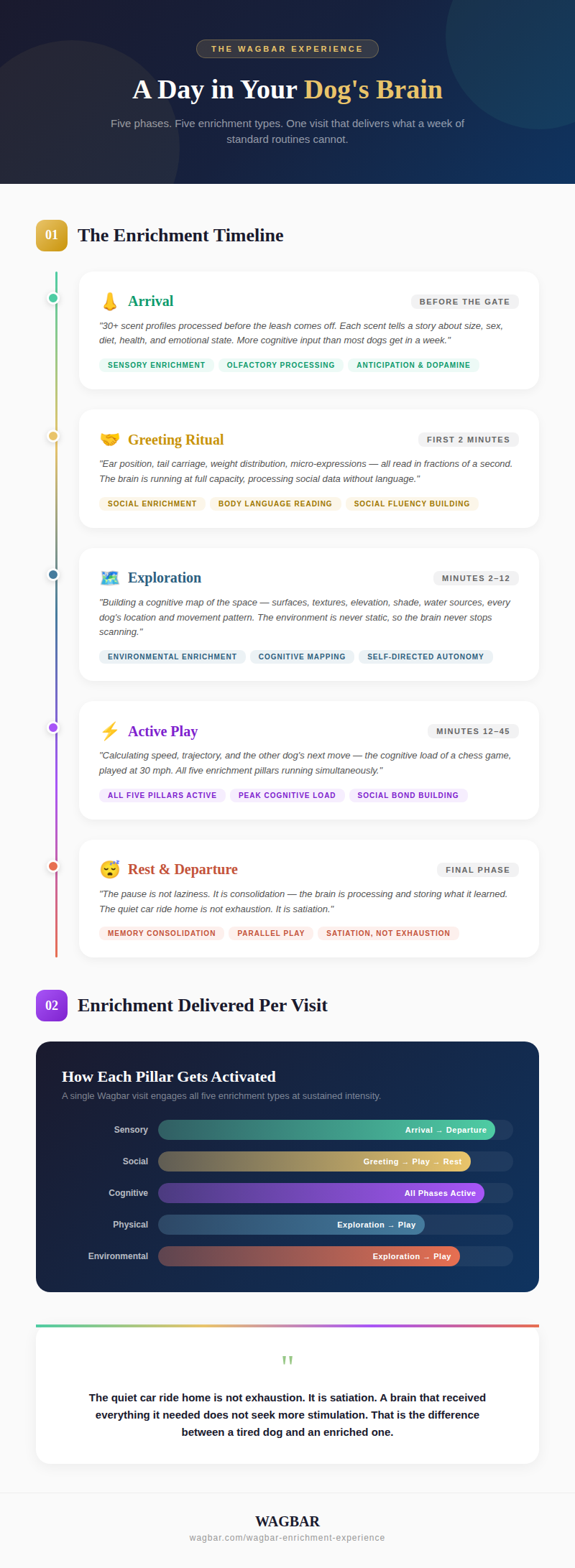
Arrival: The Parking Lot Is Already Working
The enrichment starts before you open the car door. Your dog knows this place. The sounds are different here. Voices, barking at a distance, the particular acoustics of an outdoor space with movement in it. Their ears rotate independently, triangulating sources, sorting familiar from novel. But the real processing starts with the nose.
Between the car and the front gate, your dog's olfactory system is already running at capacity. Every surface, every post, every patch of ground carries scent data deposited by the dogs that came before. Each scent profile tells a story about the dog that left it. Size. Sex. Diet. Reproductive status. Emotional state. Health. Your dog is reading all of it simultaneously, and they are reading it faster than you can scan a room.
Horowitz (2009) documented that the canine olfactory system can process scent information at a level of detail that has no human equivalent. A single sniff delivers more data points than a photograph delivers to your visual cortex. By the time your dog reaches the gate, they have already processed more novel cognitive input than most pet dogs encounter in a typical week at home.
This is sensory enrichment happening in real time. Not a manufactured puzzle. Not a scent kit purchased online. Real, layered, constantly updating olfactory data from a living social environment. The parking lot is not a waiting area. It is the first course.
The Greeting Ritual: Social Assessment at Full Speed
Entry at Wagbar is managed, not chaotic. Staff control the pace. Your dog does not get rushed through a gate into a crowd of unfamiliar animals. But even in a controlled introduction, the social processing that happens is extraordinary.
When your dog meets another dog for the first time, their brain is running a full-body assessment that happens in fractions of a second. Ear position communicates confidence or anxiety. Tail carriage signals arousal level. Weight distribution reveals whether the other dog is leaning forward (engaged, possibly assertive) or shifting back (cautious, gathering information). Micro-expressions around the eyes and mouth add layers of emotional data.
This is not instinct running on autopilot. This is active cognition. Your dog is reading, interpreting, and responding to social signals with a processing speed that rivals anything happening in the human brain during a first conversation. The difference is that dogs do it without language, relying entirely on body mechanics, scent, and spatial positioning.
The social enrichment value of this greeting phase is significant on its own. Dogs that only interact with the same household pets never get to practice this skill. Their social reading ability stagnates. Meeting new dogs in a supervised setting keeps that neural pathway active and developing, building what behaviorists call social fluency.
At Wagbar, the greeting happens under staff observation. If one dog shows stress signals during the introduction, staff adjust the pace. If a dog needs more space, they get it. The social assessment still happens at full cognitive speed, but it happens safely. The dog learns that new social encounters are manageable, not threatening.
The First Ten Minutes: Exploration and Environmental Scanning
Watch any dog in their first ten minutes at Wagbar and you will see a pattern. They do not immediately start playing. They move through the space with purpose, nose working constantly, stopping at certain spots, circling back to others, covering ground in a way that looks random but is actually systematic.
This is environmental enrichment at work. Your dog is building a cognitive map of the space. They are cataloging surfaces, textures, elevation changes, shaded areas versus sun-exposed areas, water sources, and the locations of every other dog currently present. They are also tracking movement patterns of those other dogs and identifying which ones are relaxed, which are active, and which are worth approaching.
The brain activity during this exploration phase is broad and sustained. Unlike a walk on the same neighborhood route, where the brain can switch to autopilot after the first block, a dynamic social environment keeps the scanning function engaged. New dogs arrive. Existing dogs change location. The scent landscape shifts as dogs interact and mark. The environment is never static, which means the brain never stops processing.
This exploration phase also functions as decompression. The dog is not being asked to perform or respond to commands. They are moving at their own pace, investigating what interests them, making their own choices about where to go and what to investigate. Autonomy is a component of enrichment that gets overlooked. A dog that spends its entire day responding to human direction benefits enormously from a period of self-directed exploration.
Active Play: Cognitive Load at 30 Miles Per Hour
The play phase is what most people picture when they think about a dog park visit. Running, chasing, wrestling, the full physical output. But the physical component is only half the story. The cognitive load during active social play is remarkable.
During a chase sequence, your dog is calculating speed, trajectory, acceleration, and the other dog's likely next move. They are reading body language at full sprint to determine whether the chase is still play or has shifted in tone. They are making split-second decisions about when to pursue, when to dodge, and when to reverse roles. The computational demand is comparable to what a chess player faces during a timed match, except your dog is processing it at 30 miles per hour while also managing their own physical coordination across uneven terrain.
Sommerville et al. (2017) analyzed the functional significance of play in domestic dogs and found that play serves multiple simultaneous purposes. It builds physical fitness, certainly, but it also develops social skills, tests boundaries, and strengthens social bonds between play partners. The cognitive benefits of play are not a side effect of the physical activity. They are the primary function.
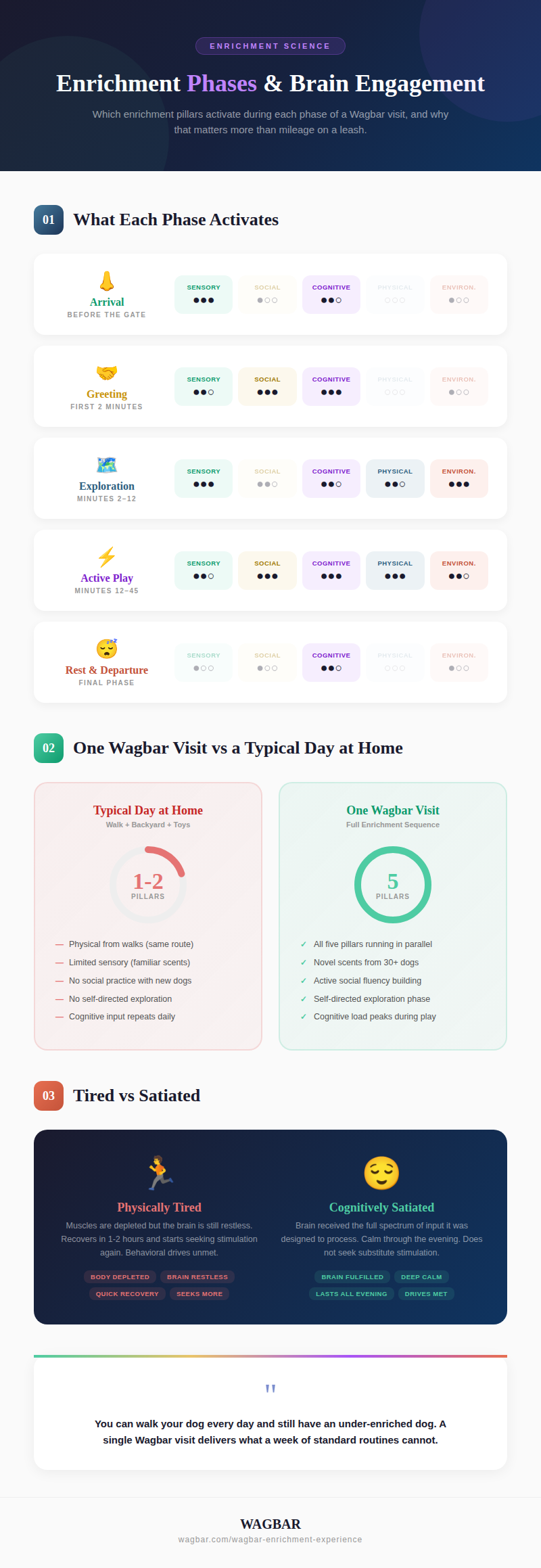
This is where the five pillars of dog enrichment converge in a single experience. Social enrichment through partner interaction. Cognitive enrichment through problem-solving and prediction. Physical enrichment through sustained movement. Sensory enrichment through continuous environmental input. Environmental enrichment through navigating a dynamic, shared space. No single at-home activity delivers all five simultaneously. A puzzle toy provides cognitive stimulation. A walk provides sensory input. A playdate with one familiar dog provides some social engagement. But a supervised off-leash social environment delivers all five pillars at once, running in parallel, for a sustained period.
Ottenheimer Carrier et al. (2013) studied cortisol patterns and social behavior in dogs at off-leash parks. Their findings confirmed that positive social play produces a distinct hormonal profile, one associated with healthy arousal and engagement rather than chronic stress. The quality of the social context determines whether the play produces beneficial or harmful physiological outcomes. Supervised play at Wagbar is designed to keep that context consistently positive.
Rest and Reset: The Brain Is Not Done
At some point during the visit, your dog will stop playing. They will find a spot, lie down, maybe watch the other dogs from a distance. Owners sometimes worry about this. They wonder if their dog is bored, or not feeling well, or not having fun.
The opposite is true. The pause is not laziness. It is consolidation.
After sustained cognitive and physical engagement, the brain needs time to process and store what it has learned. This is the same mechanism that makes sleep essential for human memory formation. The dog is not disengaging from the environment. They are integrating the social information they gathered, the spatial maps they built, the play strategies that worked and the ones that did not.
This rest period also involves what researchers call parallel play, a state where dogs are near each other, aware of each other, but not actively interacting. Parallel play is itself a social skill. It teaches dogs that proximity to other dogs does not always require engagement. Dogs that never learn parallel play often struggle with overarousal in social settings because they have only practiced the on-switch, never the off-switch.
The rest phase at Wagbar is possible because the environment is calm enough to rest in. Staff management keeps arousal levels from spiking to a point where no dog can settle. The space allows dogs to self-select quieter areas. This is part of the enrichment model at Wagbar that distinguishes it from unstructured environments. In a public dog park where nobody manages the energy level, the dogs that need rest cannot get it because the environment never calms down enough to allow it.
Departure: The Good Tired
The car ride home tells you everything. The dog that was vibrating with anticipation on the way in is now quiet. Eyes soft. Breathing slow. Maybe they fall asleep before you leave the parking lot.
This is not exhaustion. This is satiation. There is a meaningful difference.
An exhausted dog has been physically depleted. Their muscles are tired, but their brain may still be restless. A dog that ran laps in the backyard for an hour is physically tired but mentally understaffed. They will recover quickly and start looking for stimulation again within a few hours.
A satiated dog has been both physically and cognitively fulfilled. Their brain received the full spectrum of input it was designed to process. Novelty. Social complexity. Problem-solving under real conditions. Sensory depth. Autonomy. The quiet on the ride home is not a crashed system. It is a satisfied one.
This is what owners describe when they talk about the "Wagbar effect." The dog is calmer that evening. Less destructive. Less demanding of attention. Not because they are too tired to misbehave, but because the behavioral drives that fuel destruction and attention-seeking have been met. A dog that got what it needed does not go looking for substitutes.
Over weeks of regular visits, this effect compounds. Dogs develop better emotional regulation. They settle faster in new environments. Their baseline anxiety drops because they are not living in a state of chronic under-stimulation. The enrichment experience at Wagbar is not a treat or a luxury. It is maintenance for a brain that was built to do more than most pet dogs are ever allowed to do.
What This Means for Your Dog
You can walk your dog every day and still have an under-enriched dog. Walks provide exercise and some sensory input, but they do not provide social complexity, cognitive challenge at speed, self-directed exploration in a novel environment, or the chance to practice the full range of social skills that dogs are built to use.
A single Wagbar visit delivers what a week of standard routines cannot. Not because the visit is longer or more intense, but because it engages every system at once. The nose, the social brain, the problem-solving circuits, the body, the capacity for rest. All of it, in sequence, in a single session.
That is the enrichment experience. Not a park. Not a playdate. Not a toy. A complete neurological event that leaves your dog's brain genuinely satisfied.
Ready to see the difference? Check out what to expect on your first visit or explore membership options to make enrichment part of your dog's regular routine.
Bottom TLDR: A Wagbar visit follows a natural sequence of enrichment phases. Arrival floods the olfactory system with real social scent data. The greeting ritual runs a full-body social assessment at cognitive full speed. Exploration builds a dynamic mental map of the environment. Active play delivers all five enrichment pillars simultaneously, combining social, cognitive, physical, sensory, and environmental input at sustained intensity. Rest allows the brain to consolidate and store what it learned. And the quiet car ride home is not exhaustion. It is satiation. A brain that received everything it was designed to process does not look for more. That is the difference between a tired dog and an enriched one.
