

Sensory Enrichment for Dogs: What Most Owners Forget to Stimulate
Your dog experiences the world through senses that are wildly different from yours. Their nose processes information the way your eyes process a movie. Their ears pick up sounds you will never hear. Their paws read texture and temperature with every step.
And in most homes, every single one of those senses is running on empty.
Sensory enrichment is the most overlooked category in canine enrichment. Owners nail the walks, buy the toys, maybe toss in a puzzle feeder. But the sensory world their dog lives in stays flat, predictable, and boring. Same smells, same sounds, same surfaces, same view, same food texture, every single day.
That changes once you understand what your dog's senses are actually built to process and how far short most homes fall.

Smell: 300 Million Reasons This Comes First
Dogs have roughly 300 million olfactory receptors. Humans have about 6 million. The part of the brain dedicated to analyzing scent is proportionally 40 times larger in dogs. Smell is not just their strongest sense. It is their primary way of understanding the world.
Most homes offer almost zero olfactory variety. Same cleaning products, same furniture, same air freshener, same yard. Your dog's most powerful sense has nothing new to work with.
Smell Starter Kit
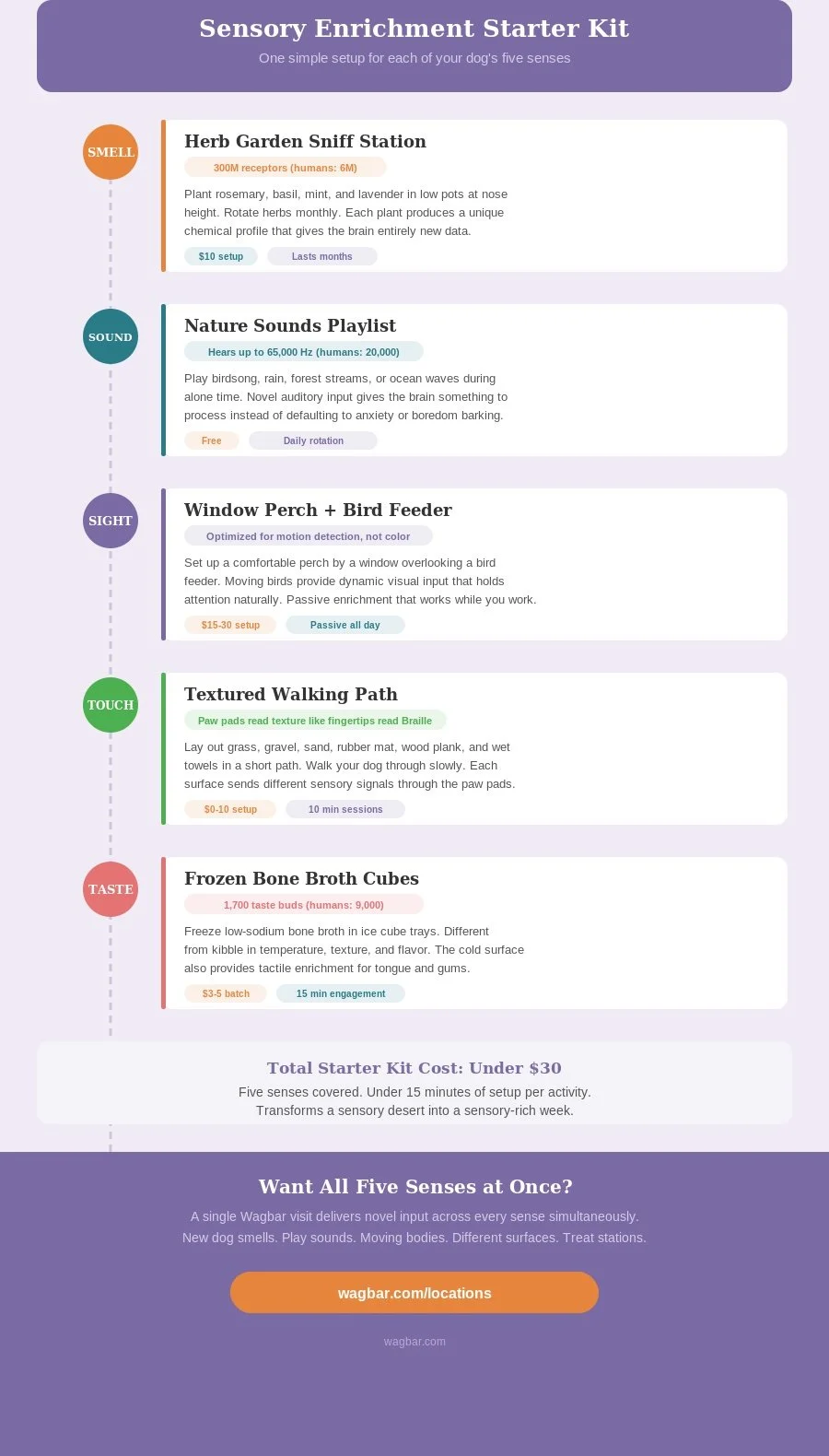
Herb garden sniff station. Plant rosemary, basil, mint, and lavender in a low planter or arrange pots at nose height. Rotate herbs monthly. Each plant produces a different chemical profile that gives the brain new data to process.
Scent trails. Drag a treat along a path through the yard, changing direction multiple times. Let your dog follow the trail to the reward. This is nose work in its simplest form and it occupies the brain more completely than any toy.
Novel scent rotation. Bring home new smells deliberately. A towel rubbed on a friend's dog. A pinecone from a different park. A sock worn during a hike somewhere new. Place these items where your dog can investigate at their own pace.
Sniff walks. Dedicate one walk per week entirely to sniffing. No destination. No pace. Your dog leads and you follow. Fifteen minutes of free sniffing produces more mental fatigue than thirty minutes of heel walking.
What Wagbar adds. Every visit introduces dozens of novel scent profiles from dogs your dog has never met. The environment carries layered olfactory information that changes daily. No home setup replicates this kind of scent complexity.
Sound: Your Dog Hears a World You Cannot
Dogs hear frequencies up to 65,000 Hz. Humans max out around 20,000 Hz. Your dog also hears sounds at four times the distance you can. They are constantly processing an auditory world that is richer, louder, and more detailed than anything you experience.
Most homes provide exactly two sound categories. Silence when you leave and TV noise when you are home. Neither one engages the auditory brain.
Sound Starter Kit
Nature sounds playlist. Play recordings of birdsong, rain, forest streams, or ocean waves during alone time. These are not background noise. They are novel auditory inputs that give the brain something to process instead of defaulting to anxiety or boredom barking.
Sound variety walks. Alternate between urban walks (traffic, voices, construction) and nature walks (birds, wind, water, rustling leaves). Each environment provides a completely different soundscape that the brain has to decode in real time.
Musical enrichment. Classical music at low volume has been shown to lower heart rate and cortisol in kenneled dogs. Reggae produces similar calming effects. Play different genres on different days so the auditory input stays novel.
Training with varied cues. Use a whistle, a clicker, verbal commands, and hand claps as different cues for different behaviors. The brain has to distinguish between sound types and assign meaning to each one. That is cognitive work layered on top of sensory input.
What Wagbar adds. The ambient sound profile at an off-leash facility is rich and constantly shifting. Dogs barking at different pitches, paws on different surfaces, staff voices, doors opening and closing. The auditory brain stays fully engaged because the soundscape is unpredictable.
Sight: The Forgotten Sense

Dogs see the world differently than humans. Their vision is optimized for motion detection and low-light conditions, not color detail. They see blues and yellows well but reds and greens look similar. What matters for sensory enrichment is not color variety. It is motion, novelty, and visual complexity.
Most dogs stare at the same four walls, the same yard, and the same walking route. The visual brain gets nothing new.
Sight Starter Kit
Window perch with bird feeder. Set up a comfortable perch by a window that overlooks a bird feeder. Moving birds provide dynamic visual input that holds a dog's attention naturally. This is passive visual enrichment that works while you are at work.
New walking routes weekly. Every unfamiliar route presents new visual information. Different buildings, different trees, different people, different dogs. The brain processes new visual data actively instead of running on autopilot through a memorized route.
Visual puzzle toys. Transparent puzzle feeders let the dog see the treat and figure out how to access it. The visual confirmation of the reward keeps motivation high while the brain works on the mechanical problem.
Outdoor time variation. Take your dog outside at different times of day. Dawn, midday, dusk, and after dark each present different light conditions, shadow patterns, and animal activity that create distinct visual experiences.
What Wagbar adds. A room full of moving dogs is the most visually stimulating environment your dog can experience. Every body is in motion. Every interaction creates new spatial patterns the visual brain has to track. Combined with the social problem solving happening simultaneously, the visual processing load is constant.
Touch: The Sense Under Their Paws
Dogs have sensory receptors across their entire body, with concentration in their paws, muzzle, and whiskers. Every surface they walk on, every texture they contact, and every temperature change provides tactile data. Paw pads read ground texture the way your fingertips read Braille.
Most pet dogs walk on two surfaces. Carpet inside and concrete outside. That is the tactile equivalent of eating the same meal every day for years.
Touch Starter Kit
Textured walking path. Create a short path using grass, gravel, sand, rubber mat, a wooden plank, and wet towels. Walk your dog through it slowly. Each surface sends different sensory signals through the paw pads to the brain. This is a simple DIY enrichment project that takes ten minutes to set up.
Water play. A shallow kiddie pool, a sprinkler, or even a wet towel on the ground. Water creates a completely different tactile experience. Temperature, pressure, and the sensation of wet fur all provide sensory input the brain rarely gets.
Massage and varied touch. Gentle massage along the spine, between the toes, around the ears. Vary the pressure and speed. This is not just bonding. Each touch pattern sends different nerve signals that keep the somatosensory cortex engaged.
Temperature variation. A cool tile floor in summer, a warm blanket in winter, frozen towels to lie on, heated beds. Temperature differences are sensory events that most owners never think about.
Terrain variety on walks. Grass, dirt, mud, sand, shallow streams, leaf piles, snow. Seek out different ground surfaces instead of sticking to sidewalks. Every new texture under the paws is fresh data for the brain.
What Wagbar adds. The facility offers multiple surface types, indoor and outdoor transitions, and weather variation that home environments rarely provide. Dogs walk on different flooring, interact with different textures, and experience temperature changes between zones. Every visit gives the tactile brain something new.
Taste: The Most Underused Sense
Dogs have about 1,700 taste buds compared to roughly 9,000 in humans. Their taste experience is less nuanced, but it still matters. The problem is that most dogs eat the same kibble, same flavor, same temperature, same texture at every meal for their entire life. That is sensory deprivation through repetition.
Taste Starter Kit
Frozen bone broth cubes. Freeze low-sodium bone broth in ice cube trays. Different from kibble in temperature, texture, and flavor. The cold surface also provides tactile enrichment for the tongue and gums.
Texture rotation. Alternate between dry kibble, wet food, freeze-dried raw, dehydrated food, and fresh toppers throughout the week. The mechanical experience of eating different textures engages the brain differently each time.
Safe fruit and vegetable variety. Blueberries, watermelon, carrots, cucumber, banana. Offer small amounts of dog-safe produce as treats. Each one delivers a unique flavor, texture, and moisture profile that the brain processes as novel input.
Lick mats with varied spreads. Peanut butter one day, plain yogurt the next, mashed banana, pumpkin puree. The licking motion is calming, and rotating flavors ensures the taste experience stays enriching instead of routine.
What Wagbar adds. The bar environment introduces new taste experiences through treats and water stations. But the bigger taste-adjacent benefit is the olfactory stimulation from other dogs that triggers salivation and taste receptor activation even without eating. The senses work together.
The Sensory Audit: What Your Home Actually Provides
Most owners are shocked when they do this exercise. Walk through every room your dog has access to and ask one question for each sense. What novel input does this room provide?
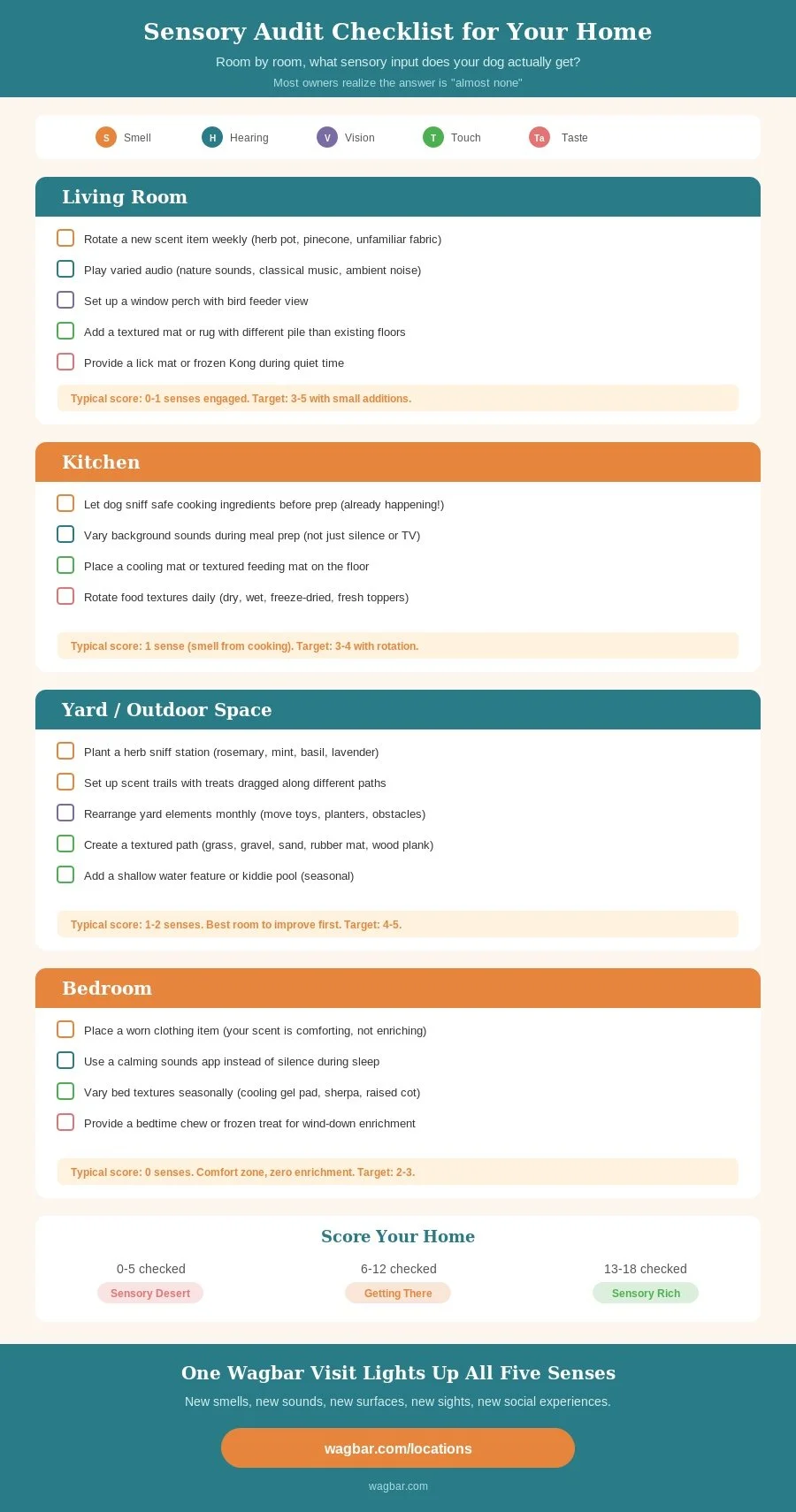
Living room. Smell. Same couch, same carpet, same air. Sound. TV or silence. Sight. Same furniture arrangement for months. Touch. Carpet or hardwood, nothing else. Taste. No food access. Score for most homes. Almost zero sensory variety.
Kitchen. Smell. Cooking smells are the one bright spot. Sound. Appliance noise your dog already ignores. Sight. Same layout. Touch. Tile floor, same temperature. Taste. Bowl of kibble, same as yesterday. Score. One sense partially engaged.
Yard. Smell. Better, but still the same yard with the same scent markers. Sound. Neighborhood noise that has become background. Sight. Same fence, same trees, same view. Touch. Same grass or dirt. Taste. Grass eating out of boredom. Score. Marginally better than indoors, but still repetitive.
Bedroom. Smell. Your scent, which is comforting but not novel. Sound. White noise machine or nothing. Sight. Dark for most of the day. Touch. Same bed surface. Taste. Nothing. Score. Comfort zone, zero enrichment.
The pattern is consistent. Most homes provide almost no sensory novelty. The dog's world is a sensory echo chamber where the same inputs repeat on a loop. Every room scores near zero on the variety scale.
This is why dogs who seem to "have everything" still show signs of under-enrichment. They have toys. They have walks. They have love. But their sensory world is flat.
Fixing the Gaps Without Overhauling Your Life
You do not need to renovate your house. You need to add small sensory events throughout the week.
Monday, bring home a new smell. A stick from a different trail, a towel from a friend's pet. Tuesday, play a nature sounds playlist during the afternoon. Wednesday, walk a new route. Thursday, set up a textured path in the hallway for five minutes. Friday, swap kibble for a different food texture at one meal. Saturday, fill a lick mat with a new spread. Sunday, visit a Wagbar location and let all five senses light up at once.
Each of these takes under five minutes. Combined, they transform a sensory desert into a sensory-rich week.
Why Multi-Sensory Environments Hit Different
Stimulating one sense at a time is good. Stimulating multiple senses simultaneously is exponentially better. The brain does not process senses in isolation. Smell, sound, sight, touch, and taste feed into the same neural networks simultaneously, and the combined processing load is far greater than the sum of individual inputs.
This is why a trip to a new park beats a puzzle toy at home. The park delivers novel input across all five senses at once. And it is why a visit to a multi-sensory enrichment environment produces a level of mental fatigue that hours of single-sense enrichment at home cannot match. New dog smells, barking and play sounds, visual chaos of moving bodies, different floor textures, and treat stations. Every sense is working at full capacity simultaneously.
Dogs who get regular multi-sensory experiences develop broader neural pathways, better emotional regulation, and a baseline calm that exercise alone never produces. The five pillars of enrichment all matter, but sensory enrichment is the foundation that makes every other type more effective.
FAQs
How do I know which sense my dog needs stimulated most?
Watch what your dog seeks out obsessively. A dog who sniffs everything on walks is craving olfactory input. A dog who reacts to every sound is either over-stimulated or under-stimulated auditorily. A dog who chews everything may be seeking tactile input through the mouth. The behavior points directly to the sensory gap.
Can sensory enrichment help with anxiety?
Yes. Anxiety often stems from sensory deprivation or sensory overload. Regular, controlled sensory enrichment teaches the brain to process stimulation without flooding. Dogs who get consistent nose work and varied environmental exposure show measurably lower cortisol levels over time.
Is it possible to over-stimulate a dog's senses?
Yes, and the signs are obvious. Whale eye, lip licking, yawning, trying to leave, shutting down. If your dog shows stress signals during sensory enrichment, reduce the intensity. Start with one new sensory input at a time and build gradually. Puppies and anxious dogs need especially gradual exposure.
Do senior dogs still benefit from sensory enrichment?
Absolutely. Senior dogs experience sensory decline in hearing and vision, which makes the remaining senses even more important to stimulate. Olfactory enrichment is especially valuable because smell is the last sense to deteriorate. Regular sensory stimulation also slows cognitive decline by keeping neural pathways active.
Your Dog Lives in a World You Cannot See, Hear, or Smell
Their senses are built for complexity that most homes never provide. Every new scent, sound, surface, sight, and flavor wakes up a part of the brain that has been idle.
Find your nearest Wagbar and give all five senses a full workout in a single visit. Or explore the franchise opportunity and build the kind of sensory-rich environment every dog deserves.