

Senior Dog Enrichment: The Last Years Should Be Rich, Not Just Comfortable
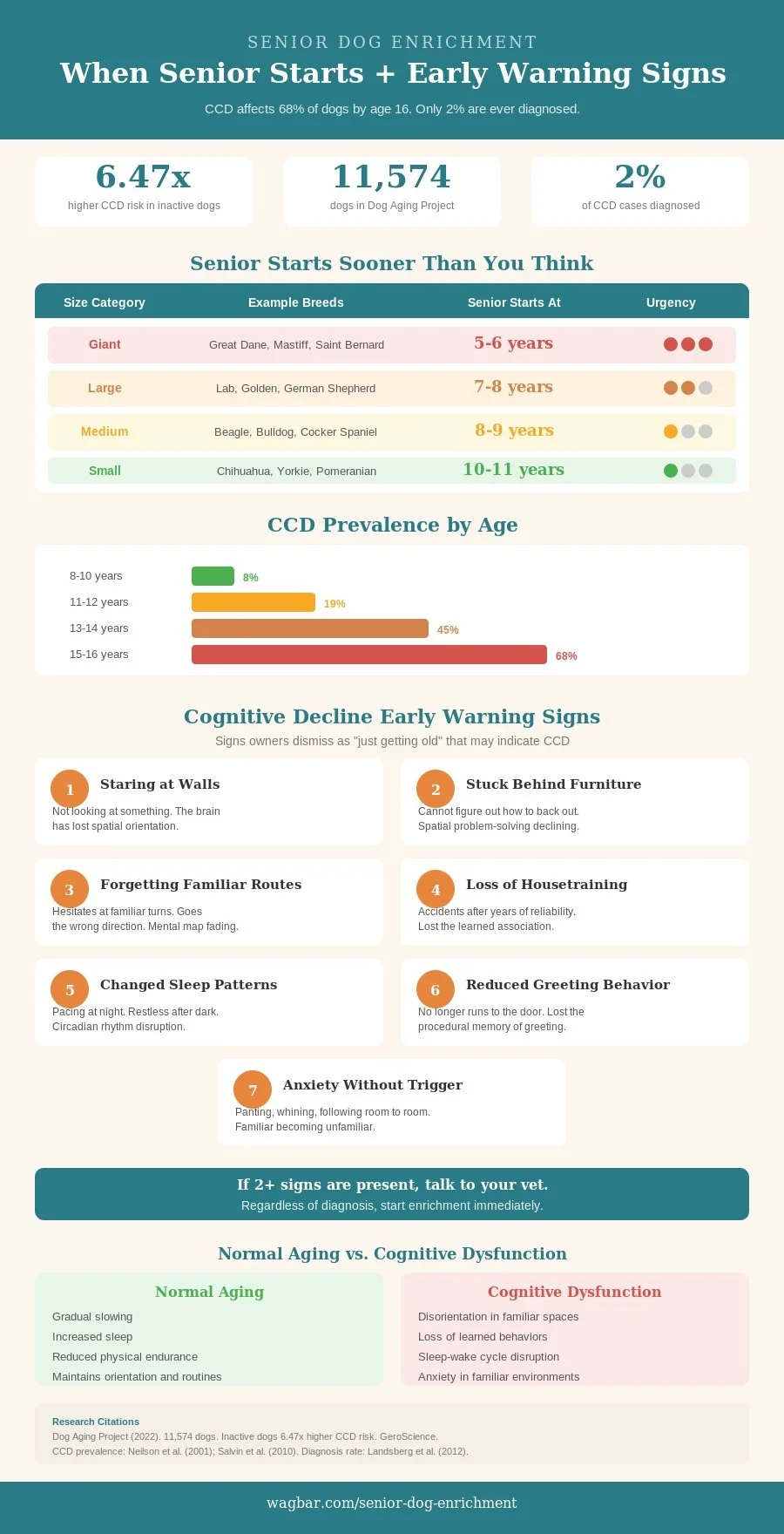
Top TLDR: Senior starts earlier than most owners realize. Giant breeds hit senior status at 5 to 6 years. Large breeds at 7 to 8. Small breeds do not get there until 10 to 11. Canine cognitive dysfunction (CCD) affects roughly 28% of dogs aged 11 to 12 and 68% by age 15 to 16, but only about 2% of affected dogs are ever formally diagnosed. The Dog Aging Project (11,574 dogs) found that inactive dogs were 6.47 times more likely to develop CCD than active dogs of the same age and health status. Enrichment during the senior years is not about keeping an old dog busy. It is neuroprotection. What follows covers when senior actually starts by breed size, the early cognitive decline signs owners miss, a joint-safe enrichment menu of 17 activities, modified social enrichment protocols, and why the last years of your dog's life should be the richest.
Your dog turned 8. They slowed down. They sleep more. They stopped chasing the ball. They are calmer on walks.
And you thought, finally. They are mellowing out. This is normal.
Some of it is. Some of it is their brain slowly losing function while you watch and call it aging.
The difference between a senior dog aging naturally and one whose brain is deteriorating from cognitive dysfunction is invisible at first. Both sleep more. Both move slower. Both seem calmer. But one is aging gracefully. The other is losing their mind, one neural connection at a time, while their owner assumes everything is fine.
Wagbar was built for dogs at every stage, including this one. A supervised, low-intensity enrichment environment where senior dogs can sniff, socialize at their own pace, and engage with a world that changes daily. But you need to understand when "senior" actually starts, what cognitive decline looks like before it becomes obvious, and why the right enrichment is the most powerful thing you can do for your aging dog's brain.

Senior Starts Sooner Than You Think
Most owners define "senior" by behavior. The dog slowed down, so they must be old. That is not how veterinary science defines it. Senior status is based on breed size, and the gap between the largest and smallest breeds is enormous.
Giant breeds (Great Dane, Mastiff, Saint Bernard, Irish Wolfhound) reach senior status at 5 to 6 years. A 6-year-old Great Dane is geriatrically equivalent to a human in their mid-60s.
Large breeds (Labrador, Golden Retriever, German Shepherd, Rottweiler) become senior at 7 to 8 years. That Golden Retriever you still think of as middle-aged is already in the window where cognitive changes begin.
Medium breeds (Beagle, Bulldog, Cocker Spaniel, Border Collie) enter senior territory at 8 to 9 years.
Small breeds (Chihuahua, Yorkshire Terrier, Pomeranian, Toy Poodle) do not hit senior until 10 to 11 years. Their longer lifespan means more total years, but CCD still catches up eventually.
The practical implication is this. If you own a large or giant breed dog and you have not started senior-specific enrichment by age 7, you are already behind. The cognitive reserve your dog builds during the early senior years determines how their brain handles the decline that is coming. And it is coming. The question is not whether. It is when, and how much reserve your dog has built up to meet it.
How the Aging Brain Changes

The canine brain begins losing volume around age 7 in most breeds. Neurons die. Synaptic connections thin out. Beta-amyloid plaques accumulate, the same protein deposits found in human Alzheimer's patients. Neurotransmitter production drops, particularly dopamine and serotonin, which affect mood, motivation, and learning.
None of this happens overnight. It starts years before any owner notices a behavioral change. By the time a dog is staring at walls or getting stuck behind furniture, the brain has already undergone significant structural deterioration.
The Dog Aging Project, one of the largest longitudinal studies of companion dogs, enrolled over 11,500 dogs and measured cognitive function against lifestyle factors. Among dogs of the same age, health status, breed type, and sterilization status, the odds of cognitive dysfunction were 6.47 times higher in dogs who were not active compared to those who were very active.
6.47 times higher. Nearly seven times the risk. And "activity" means both physical movement and cognitive engagement. Exercise alone is not enough. The brain needs problems to solve, novelty to process, and social complexity to navigate. That is enrichment.
Cognitive Decline Early Warning Signs
The biggest problem with canine cognitive dysfunction is not the disease itself. It is that owners do not recognize it until the damage is severe. CCD affects approximately 28% of dogs aged 11 to 12. By 15 to 16, that number reaches 68%. But only about 2% of affected dogs are ever formally diagnosed. The rest get labeled "old."
These are the signs that most owners dismiss as normal aging but that veterinary behaviorists recognize as early cognitive decline.
Staring at walls or into corners. Not looking at something. Just staring. The brain has lost spatial orientation or is experiencing processing interruptions that leave the dog mentally "stuck."
Getting stuck behind furniture. The dog walks behind a chair or into a corner and cannot figure out how to back out. Spatial problem-solving is one of the first cognitive skills to degrade.
Forgetting familiar routes. A dog who has walked the same path for years suddenly hesitates at turns or seems disoriented in their own neighborhood. The mental map is degrading.
Loss of housetraining. A reliably housetrained dog starts having accidents indoors. Not from a medical issue (rule that out first). The dog has lost the learned association between the urge and the door.
Changed sleep patterns. Pacing at night. Sleeping all day and restless after dark. The circadian rhythm disruption that characterizes CCD mirrors human dementia patients.
Reduced greeting behavior. The dog who used to run to the door when you came home now stays on the bed. They have not stopped caring. They have lost the procedural memory that connects your car to the behavior of greeting.
Increased anxiety without trigger. Panting, whining, following you room to room in a house they have lived in for years. The familiar is becoming unfamiliar inside their brain.
If two or more of these are present, talk to your vet. And regardless of diagnosis, start enrichment immediately. The research is unambiguous. Cognitive engagement slows the progression of decline at every stage.
Enrichment as Neuroprotection
Enrichment for a senior dog is not about fun. It is about function. Every puzzle feeder your senior dog works through, every new scent they process, every calm social interaction they navigate is building or maintaining neural pathways that CCD is trying to destroy.
A two-year longitudinal study on aging beagles found that dogs receiving behavioral enrichment combined with a brain-supportive diet maintained learning and memory significantly better than dogs receiving neither. The enriched dogs performed better on cognitive tasks at the end of the study than they had at the beginning. Their brains were not just declining slower. They were still building new capacity.
This aligns with the cognitive reserve model. A brain that regularly processes novel information builds redundant neural networks. When age-related atrophy destroys some pathways, the redundant ones take over. The decline still happens, but it takes longer to become visible because the brain has backup systems.
An adult dog who received consistent enrichment through ages 2 to 8 enters the senior years with substantially more cognitive reserve than one who was on autopilot. And a senior dog who begins enrichment at 9 or 10, even with no prior history, still benefits measurably. It is never too late. But earlier is always better.
The Joint-Safe Enrichment Menu
Senior enrichment has a constraint that younger dogs do not face. Joints. Arthritis affects the majority of senior dogs, and any enrichment that requires running, jumping, or rough physical play is off the table for most of them. That does not mean enrichment stops. It means enrichment gets smarter.
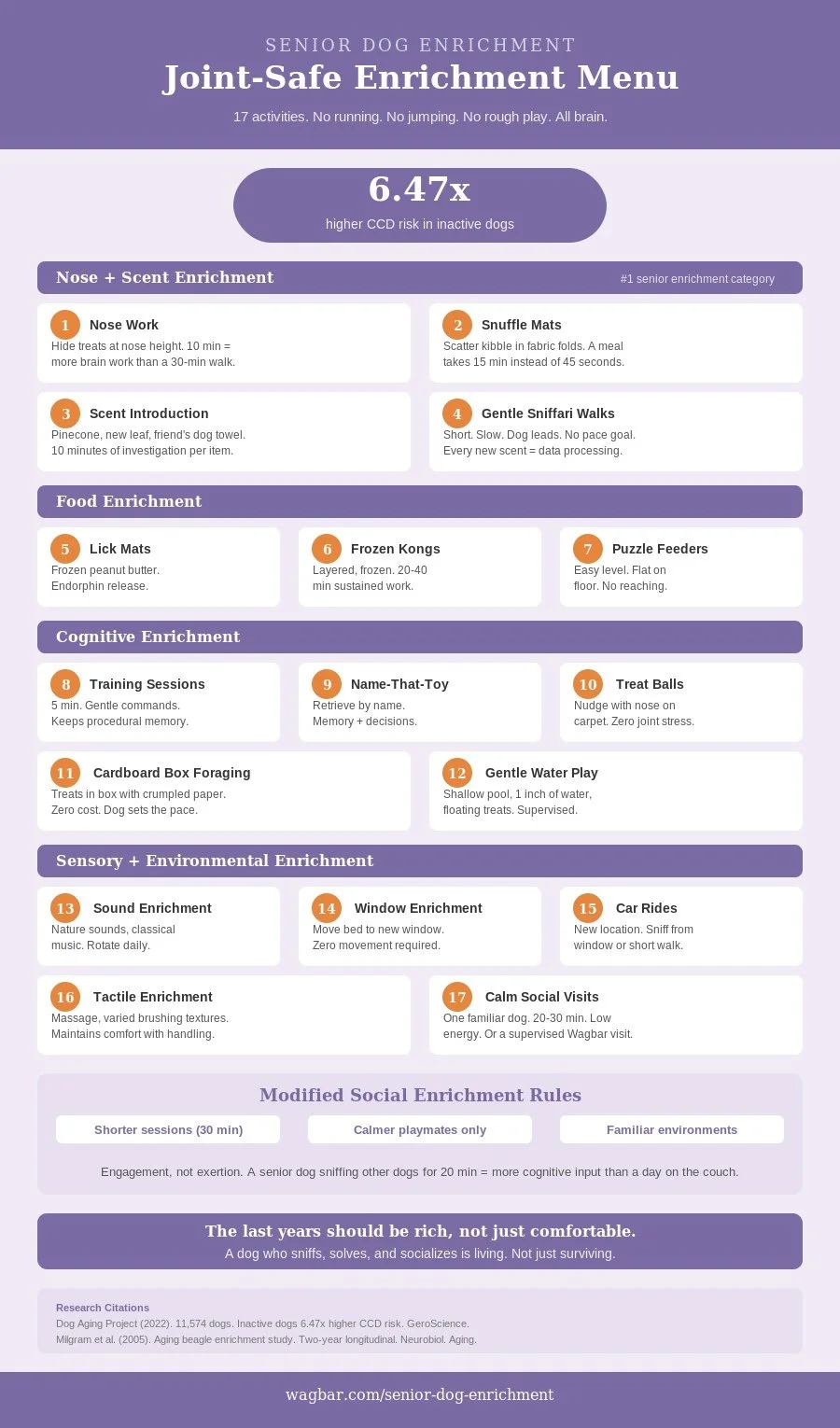
These 17 activities require no running, no jumping, and no rough play. Every one of them engages the brain.
Nose work. The single best enrichment for senior dogs. Hide treats around the house at nose height. No reaching, no jumping. The olfactory system stays sharp even as other cognitive functions decline. Ten minutes of nose work engages more brain volume than a 30-minute walk.
Lick mats. Spread peanut butter, yogurt, or pumpkin on a lick mat and freeze it. Repetitive licking releases endorphins. The texture variety provides sensory enrichment. No effort required beyond the tongue.
Snuffle mats. Scatter kibble through the fabric folds. Low physical demand, high cognitive demand. A meal that takes 15 minutes instead of 45 seconds.
Gentle sniffari walks. Short, slow walks where the dog leads and sniffs everything. No agenda, no distance goal, no pace. Ten minutes of sniffing is worth more to a senior brain than 30 minutes of structured leash walking. Every new scent is data the brain has to process.
Puzzle feeders on the ground. Easy-level puzzles placed flat on the floor. No reaching, no standing on hind legs. Slide-and-reveal puzzles, muffin tin with tennis balls over kibble, egg carton with treats inside.
Calm social visits. One familiar dog. Short duration. Low energy. A 20-minute visit from a known calm dog provides social enrichment that activates brain regions solo activities cannot reach. No dog parks. No chaotic group play.
Tactile enrichment. Massage. Brushing with different textures (soft bristle, rubber curry, grooming mitt). Gentle body handling that introduces varied tactile input. Many senior dogs become touch-sensitive as they age. Regular positive touch maintains comfort with handling.
Car rides to new locations. Drive to a new park, a new neighborhood, a quiet trail. Let the dog sniff from the car window or take a short walk in the new environment. The novelty of new scent profiles stimulates the brain without taxing the joints.
Frozen Kongs. Layer wet food, kibble, banana, and broth. Freeze overnight. Takes 20 to 40 minutes of sustained cognitive and oral engagement. Adjust difficulty for dogs with dental issues.
Hand feeding training sessions. Five minutes. Gentle commands. "Sit." "Shake." "Touch." The act of re-practicing keeps procedural memory pathways active.
Name-that-toy games. If your dog knows toy names, ask them to retrieve specific ones. If they do not, teach it. Memory, language processing, and decision-making with zero physical demand.
Slow-release treat balls. A treat ball that rolls on carpet. The dog nudges it with their nose and watches treats fall out. Problem-solving with zero joint stress.
Sound enrichment. Play nature sounds, classical music, or audiobooks at low volume. Rotate daily. Auditory novelty provides environmental enrichment without physical demand.
Scent introduction. Bring home a pinecone, a leaf from a new trail, a towel rubbed on a friend's dog. Place it on the floor. Novel scent processing is pure cognitive enrichment.
Cardboard box foraging. Place treats in a cardboard box with crumpled newspaper. The dog noses through the paper to find food. Zero cost, and the dog sets the pace.
Window enrichment. Move a bed near a window your dog does not usually access. Different view, different sounds, different scent flow. The brain processes new input without the dog moving a muscle.
Gentle water play. A shallow kiddie pool with an inch of water and floating treats. Supervised. The novel sensation plus the challenge of retrieving floating treats provides dual enrichment.
Modified Social Enrichment for Senior Dogs
Social enrichment does not stop because a dog is old. It changes shape. A senior dog who was social their entire life still needs interaction with other dogs. But the parameters shift.
Shorter sessions. Thirty minutes of calm social time beats two hours of overstimulation. Senior dogs fatigue faster and recover slower. Cognitive overload in an aging brain looks like confusion or anxiety, not exhaustion.
Calmer playmates. Pair senior dogs with dogs of similar energy. A calm adult, another senior, or a naturally mellow temperament. High-energy adolescent dogs are too much for most seniors.
Familiar environments. Novel environments are valuable but can trigger anxiety in dogs with early cognitive changes. Rotate between familiar spaces and mildly novel ones. If your dog shows disorientation in a new space, return to familiar ground.
Wagbar visits. A supervised environment where staff match your senior dog with appropriate companions and control intensity. The scent variety alone, different dogs every visit, provides sensory enrichment without requiring your dog to do anything except exist in the space and breathe.
The goal is engagement, not exertion. A senior dog who spends 20 minutes calmly sniffing other dogs at Wagbar has received more cognitive input than one who slept on the couch all day. Social information is among the most neurologically complex data a dog processes.
How Wagbar Accommodates Senior Dogs
This is not a dog park with a fence and a prayer. Wagbar is a staffed, supervised environment where intensity is calibrated to the individual dog.
Senior dogs at Wagbar benefit from environmental novelty (different dogs, different scents, different energy every visit) without being forced into high-energy play. The off-leash format lets them engage at their own pace. Sniff a new dog, then rest. Explore the space, then settle. The brain is processing even when the body is resting.
For owners considering the franchise opportunity, senior dog enrichment is a growing market reality. Dogs are living longer. Pet owners are spending more on quality of life for aging dogs. A facility that serves seniors alongside younger dogs is serving the demographic that needs enrichment most.
Wagbar's enrichment model is not a dog park, not a traditional daycare, and not a kennel. It is a membership-based, off-leash enrichment bar where every visit delivers multi-category stimulation. For a senior dog, one visit per week may provide more cognitive input than the rest of their week combined.
The Emotional Case for Keeping Your Senior Dog's Brain Alive
Your senior dog's last years are coming. You cannot stop that. But you can determine what those years look like.
A senior dog who sniffs, solves, and socializes is living. Not just surviving. Not just existing on a bed in the corner waiting for meals. Living. Processing. Engaging with a world that still has things to offer.
A senior dog who is under-enriched is a dog whose brain is powering down faster than it needs to. Every day without cognitive input is a day the neural pathways get weaker, the spatial memory gets foggier, the social recognition gets dimmer.
The science of enrichment is clear. Enriched senior dogs maintain cognitive function longer and retain quality of life deeper into old age. The enrichment does not have to be complicated. A nose work session. A frozen Kong. A gentle walk on a new route. Ten minutes of effort from you buys your dog months of sharper living.
The last years should be rich, not just comfortable. Your dog earned that.
FAQs
When should I start senior-specific enrichment?
Start when your dog hits breed-appropriate senior age. Giant breeds, 5 to 6 years. Large breeds, 7 to 8. Medium, 8 to 9. Small, 10 to 11. If your dog is already past those thresholds, start today. The brain retains plasticity throughout life, and even dogs showing mild cognitive changes benefit from structured enrichment.
Can enrichment reverse cognitive decline?
It cannot reverse structural brain changes already occurred. But it can slow progression significantly, compensate for lost function by strengthening alternative neural pathways, and maintain quality of life well beyond what an under-enriched dog experiences. The two-year beagle study showed enriched dogs actually improved on cognitive tests. The decline is not a cliff. It is a slope, and enrichment changes the angle.
Is my senior dog too old for Wagbar?
If your dog can walk, sniff, and tolerate the presence of other dogs without significant stress, they are not too old. Wagbar's supervised format means the experience is tailored to the individual dog. Senior dogs are not forced into high-energy play. They engage at their own pace in a space designed to provide enrichment across all five categories simultaneously.
How do I know if my dog has cognitive dysfunction or is just aging normally?
Normal aging produces gradual slowing, increased sleep, and reduced physical endurance. CCD produces disorientation, loss of learned behaviors, changes in social interactions, sleep-wake cycle disruption, and anxiety in familiar environments. If your dog stares at walls, gets stuck behind furniture, forgets housetraining, or stops recognizing familiar people, those are not normal aging. Talk to your vet and start enrichment immediately.
Their Best Days Do Not Have to Be Behind Them
A 10-year-old Lab with a frozen Kong, a weekly Wagbar visit, and a daily sniffari walk is a dog whose brain is fighting for itself. Every puzzle solved, every new scent processed, every calm interaction with another dog is a deposit in the cognitive reserve account that determines whether your dog spends their final years present or lost.
Start the enrichment. Keep the brain working. Or explore the franchise opportunity and build the space where every senior dog in your city gets what their brain needs most.
Bottom TLDR: Senior status starts at 5 to 6 years for giant breeds and 10 to 11 for small breeds. Most owners are late. CCD affects 28% of dogs by age 11 and 68% by age 16. Only 2% are diagnosed because owners accept decline as aging. The Dog Aging Project found inactive dogs are 6.47 times more likely to develop CCD. Early warning signs include wall-staring, getting stuck behind furniture, forgotten routes, lost housetraining, sleep changes, and reduced greeting. A joint-safe enrichment menu of 17 activities (nose work, lick mats, snuffari walks, puzzle feeders, tactile enrichment, calm social visits) provides neuroprotection without taxing arthritic joints. Social enrichment shifts to shorter sessions, calmer playmates, and familiar environments. Wagbar accommodates seniors with supervised, self-paced enrichment. Enrichment is not entertainment for old dogs. It is the strongest modifiable neuroprotector available.