
Adult Dog Enrichment: The Good Dog Trap and Why Enrichment Never Stops
Top TLDR: Most owners stop enriching their dogs once problem behaviors resolve. This is the Good Dog Trap. Well-behaved adult dogs are often the most cognitively under-stimulated dogs in the house. Canine cognitive dysfunction affects 28% of dogs by age 11 and 68% by age 15. Research from the Dog Aging Project (11,574 dogs) shows a strong negative association between lifelong physical and cognitive activity and age-related cognitive decline. Enrichment during adulthood is not optional. It is preventive care. This page covers the cognitive maintenance concept, a monthly self-assessment checklist, and a 4-week restart protocol for dogs who have been on autopilot.
Your dog is two years old. They stopped chewing furniture. They come when called. They walk on a loose leash. They sleep through the night. They are, by every conventional measure, a good dog.
So you stopped. You stopped rotating toys. You stopped introducing new challenges. You stopped varying walking routes. You stopped scheduling playdates. The puzzle feeder sits in a cabinet. The snuffle mat is under the couch. Breakfast goes in a bowl, dinner goes in a bowl, and the most cognitively demanding thing your dog does all day is decide which end of the couch to sleep on.
This is the Good Dog Trap. And your dog is in it.
What the Good Dog Trap Actually Is
The Good Dog Trap is what happens when owners mistake compliance for fulfillment. A well-behaved dog is not necessarily an enriched dog. It is often just a dog who has given up asking for stimulation in ways you find inconvenient.
Puppies get enrichment because they are destructive without it. Adolescent dogs get enrichment because they are unmanageable without it. Adult dogs get nothing because they stopped making their boredom your problem. They learned to cope. And coping looks a lot like being "good."
The dog who sleeps 16 hours a day is not relaxed. The dog who walks the same route without pulling is not content. The dog who has stopped playing with their toys is not mature. These are signs of cognitive disengagement, and they are the early stages of a brain that is slowly powering down.
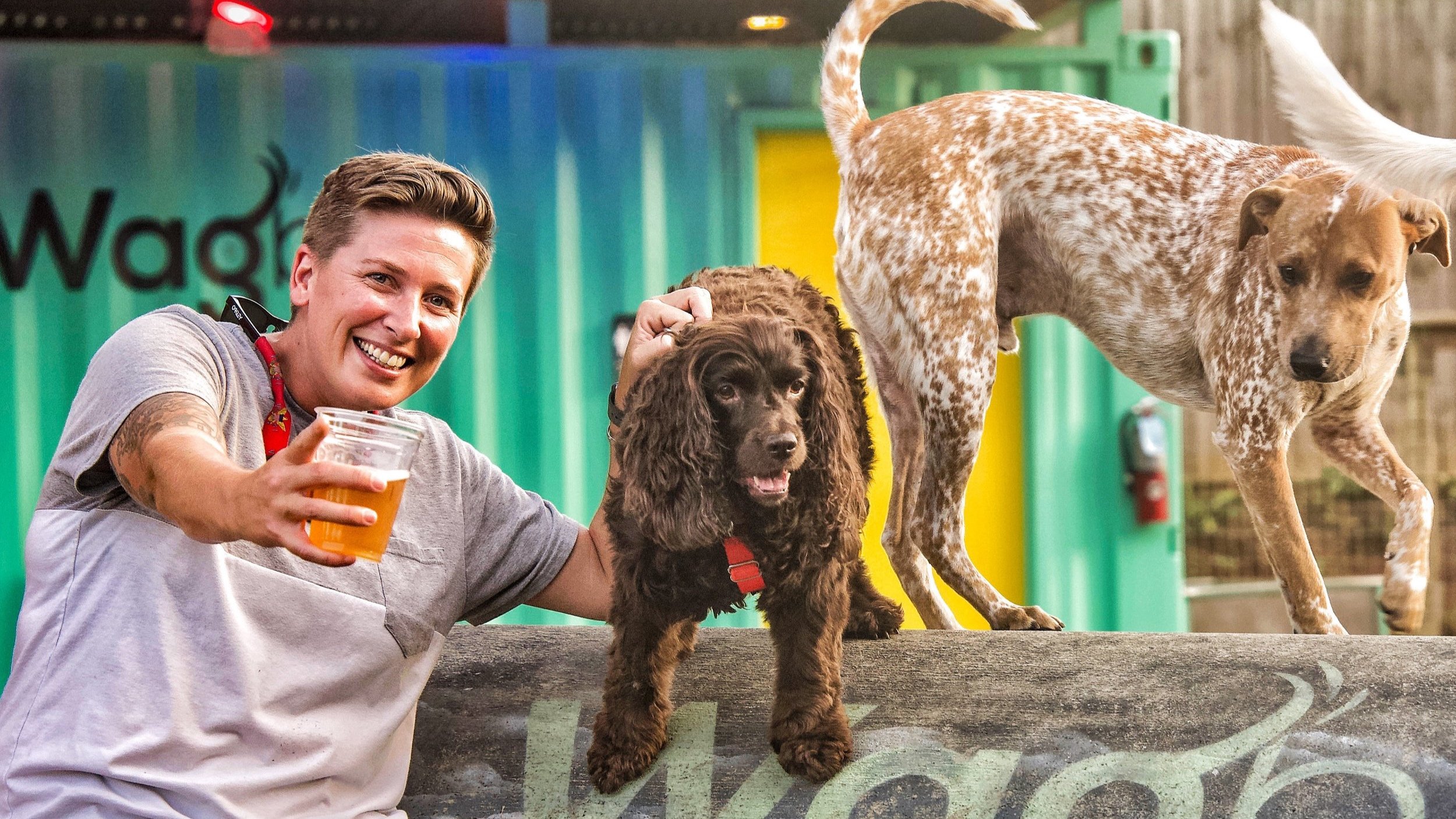
Wagbar exists in part because of this trap. A membership-based, off-leash environment where adult dogs get consistent social, cognitive, and environmental enrichment without requiring owners to build an enrichment program from scratch every week. But whether you visit Wagbar or not, every adult dog owner needs to understand that enrichment is not a puppy phase. It is lifelong brain maintenance.

The Science: Use It or Lose It
The Dog Aging Project, one of the largest longitudinal studies of companion dogs ever conducted, enrolled over 11,500 dogs and measured cognitive function against lifestyle factors. The findings are clear. Dogs with higher levels of physical and cognitive activity showed significantly better cognitive outcomes than inactive dogs, even after adjusting for age, breed, weight, and health conditions.
Chronic physical and cognitive inactivity was one of the strongest correlates of worse cognitive scores across the entire dataset. Less active dogs displayed significantly higher severity on validated cognitive dysfunction rating scales.
This mirrors what human neuroscience has established for decades. Cognitive reserve, the brain's ability to resist decline, is built through sustained mental engagement. Brains that process novel information, solve problems, and navigate social complexity throughout adulthood develop stronger, more redundant neural networks. When age-related decline begins, those networks have more backup capacity. The decline starts later and progresses slower.
Dogs work the same way. An adult dog who spends years 2 through 8 cognitively active enters the senior years with a measurably stronger brain than one who spent those years on autopilot. Enrichment during adulthood is not about keeping your dog entertained. It is about building the cognitive reserve that determines whether your dog develops canine cognitive dysfunction at 11 or at 15.
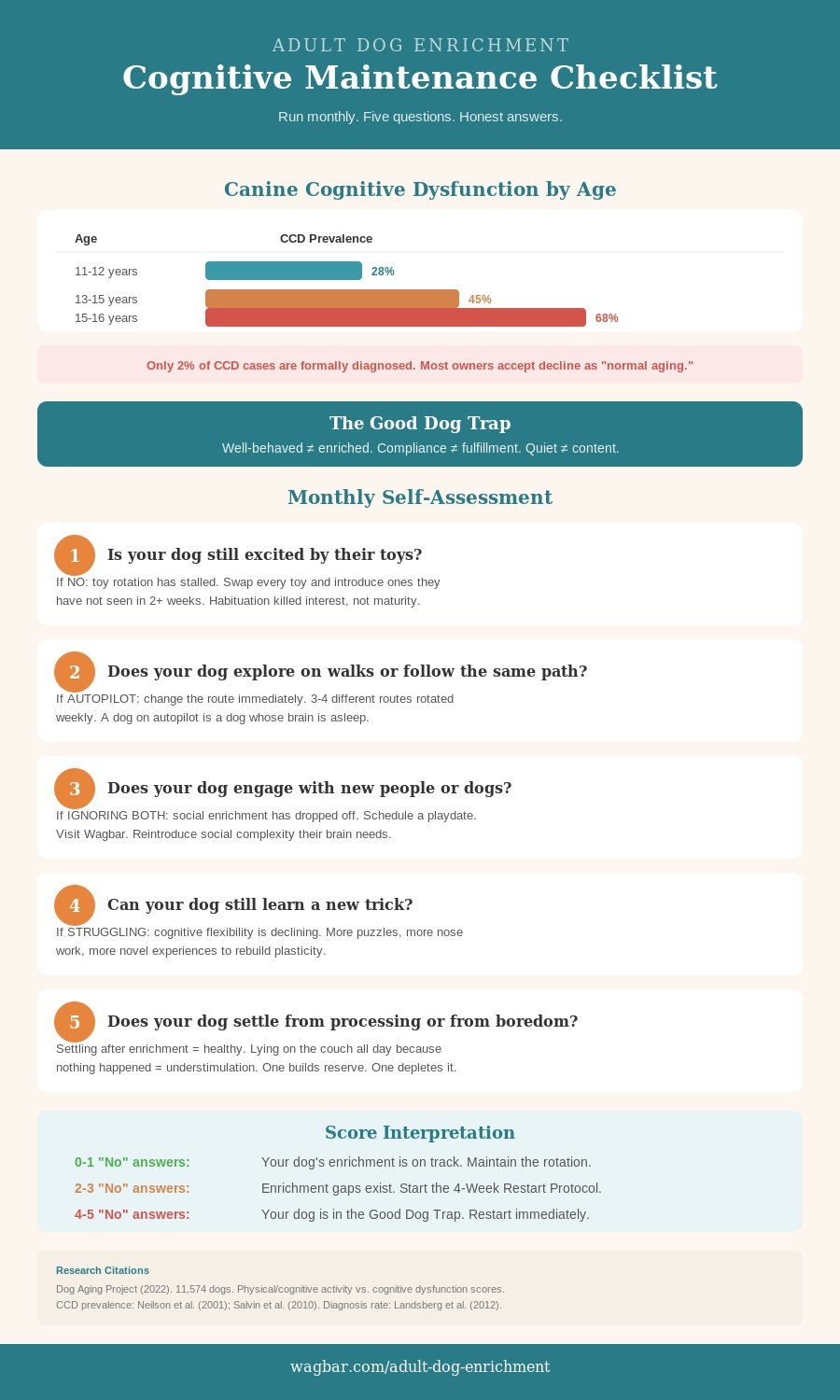
The prevalence numbers make this urgent. CCD affects approximately 28% of dogs aged 11 to 12 years. By age 15 to 16, that number jumps to 68%. Only about 2% of affected dogs are ever formally diagnosed because owners and vets tend to accept cognitive decline as normal aging. It does not have to be.
Signs of Adult Dog Boredom That Owners Miss

Problem behaviors in adult dogs are easy to identify. Boredom in adult dogs is not. It looks like calm. It looks like routine. It looks like the dog is fine.
Decreased toy interest. Your dog used to play with toys. Now they ignore them. Most owners assume the dog has outgrown toys. More likely, the dog has habituated to every toy in the house and none of them trigger cognitive engagement anymore.
Autopilot walks. Your dog walks the same route, sniffs the same spots, and shows no curiosity about new stimuli. The walk is physical movement with zero cognitive enrichment. The brain checked out of that route months ago.
Social disinterest. Your dog used to engage with other dogs and new people. Now they ignore both. This is not maturity. It is social under-stimulation. A dog who has had no social enrichment in months loses the motivation to engage.
Inability to learn new things. Your dog knows their commands but cannot seem to pick up a new trick. This is not a training problem. It is a plasticity problem. A brain that has not been challenged in a long time loses the flexibility to learn efficiently.
Excessive sleep. Adult dogs need 12 to 14 hours of sleep. More than that, combined with low energy during waking hours, often indicates a brain that is not getting enough stimulation to justify staying alert.
If three or more of those sound familiar, your dog is not being "good." Your dog is under-enriched. And the longer it continues, the harder the restart becomes.
The Cognitive Maintenance Checklist
Run this monthly. Five questions. Honest answers.
Is your dog still excited by any of their toys? If no, the toy rotation has stalled. Swap out every toy they have access to and introduce ones they have not seen in at least two weeks.
Does your dog explore on walks or follow the same path on autopilot? If autopilot, change the route immediately. Three to four different routes rotated throughout the week. A dog who explores is a dog whose brain is processing. A dog on autopilot is a dog whose brain is asleep.
Does your dog engage with new people or other dogs? If they ignore both, social enrichment has dropped off. Schedule a playdate. Visit Wagbar. Reintroduce the social complexity their brain needs.
Can your dog still learn a new trick or command? Test it. Teach "spin" or "touch" or "back up." If the dog struggles to learn something new, cognitive flexibility is declining. More puzzle feeders, more nose work, more novel experiences.
Does your dog settle from processing or from boredom? There is a difference. A dog who settles after a Wagbar visit, a sniffari walk, or a puzzle session is settling because the brain processed enough input. A dog who lies on the couch all day because nothing happened is settling from understimulation. One is healthy. The other is the Good Dog Trap.
The 4-Week Restart Protocol
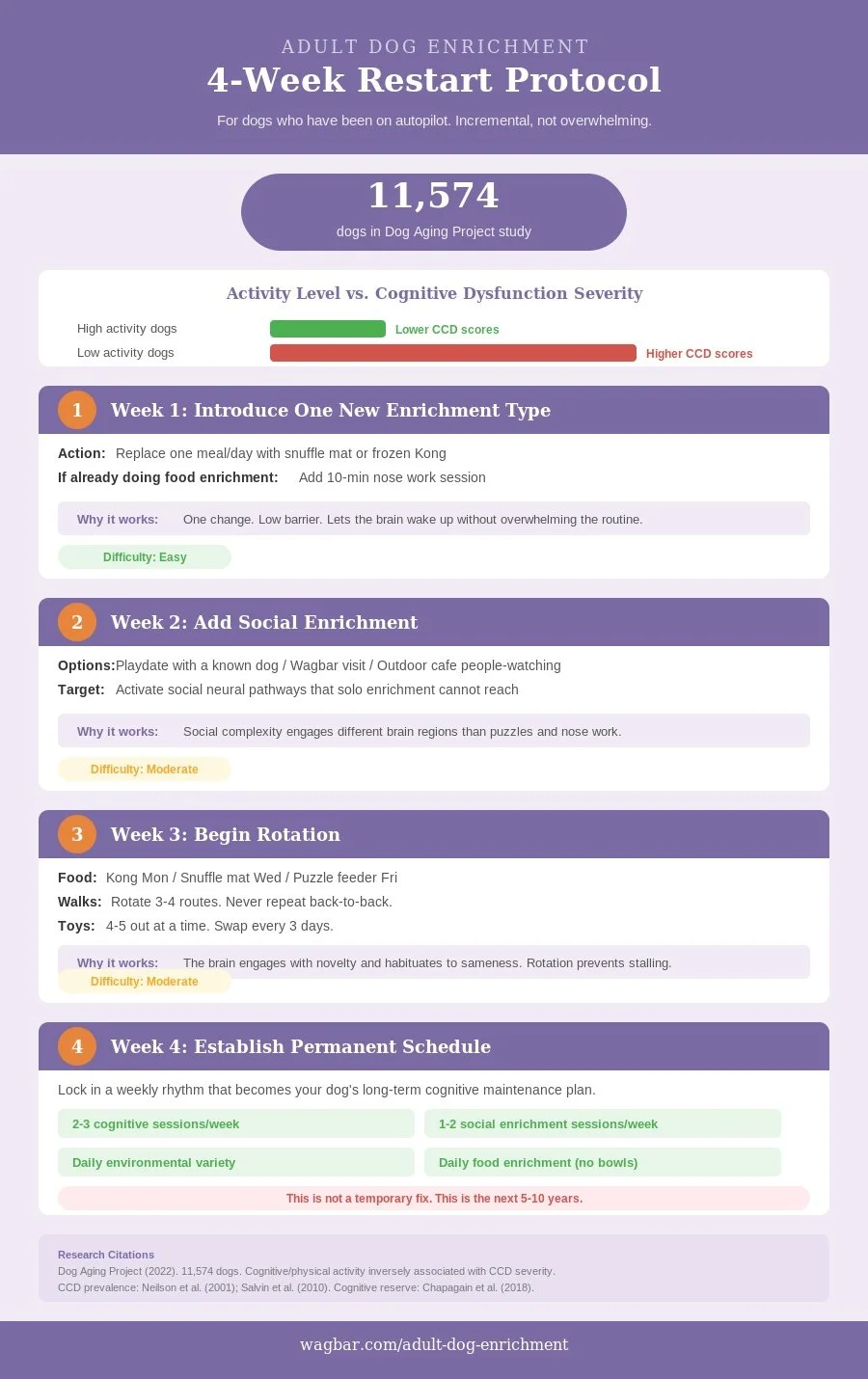
For dogs who have been on autopilot. This is not overwhelming. It is incremental.
Week 1. Introduce one new enrichment type. If your dog eats from a bowl, replace one meal per day with a snuffle mat or frozen Kong. If they already do food enrichment, add a 10-minute nose work session (hide treats around the house). One new thing. Let the brain wake up.
Week 2. Add social enrichment. Schedule a playdate with a known dog. Visit Wagbar for a supervised off-leash session. Take your dog to an outdoor cafe and let them watch people. Social stimulation activates different neural pathways than solo enrichment. Both matter.
Week 3. Begin rotation. Stop repeating the same enrichment daily. Rotate food enrichment tools (Kong Monday, snuffle mat Wednesday, puzzle feeder Friday). Rotate walking routes. Rotate toys. The brain engages with novelty and habituates to sameness. Rotation is the mechanism that keeps enrichment effective.
Week 4. Establish a permanent schedule. Lock in a weekly rhythm. Two to three cognitive sessions. One to two social enrichment sessions. Daily environmental variety. Daily food enrichment. This is not a temporary fix. This is your dog's cognitive maintenance plan for the next 5 to 10 years.
Why Wagbar Is the Easiest Fix for the Good Dog Trap
Home-based enrichment works. It also requires daily planning, constant rotation, and the kind of sustained effort that most owners start strong and then slowly abandon. That is how dogs end up back in the trap.
A regular Wagbar membership solves the hardest part of adult dog enrichment. The social complexity, the environmental novelty, the sensory enrichment of new dogs and new scents every visit. Your dog gets the five categories of enrichment simultaneously without you having to design, rotate, and manage the program yourself.
Think of it as your dog's weekly brain workout. You do not need to understand the science of enrichment to benefit from it. You just need to show up. The environment does the rest.
FAQs
How much enrichment does an adult dog actually need?
A minimum of one cognitive enrichment session daily (puzzle feeder, nose work, training game), social enrichment once or twice per week (playdate, Wagbar, dog class), and daily environmental variety (rotating walking routes, new objects in the home). Most adult dogs are getting none of these. Even partial implementation produces measurable behavioral improvement.
Does my dog really need enrichment if they seem happy?
A dog lying quietly on the couch may be content or may be under-stimulated. Run the cognitive maintenance checklist above. If your dog has stopped engaging with toys, ignores new people and dogs, and walks the same route on autopilot, they are not happy. They have adapted to low stimulation. That adaptation comes at a cost that shows up later as accelerated cognitive decline.
At what age should I worry about cognitive decline?
Cognitive dysfunction symptoms become clinically detectable in many dogs by age 8 to 10, though the underlying neural changes begin earlier. The Dog Aging Project data shows that lifelong cognitive and physical activity is the strongest modifiable protective factor. Starting enrichment at age 8 is better than never, but starting at age 2 and maintaining through adulthood builds the deepest cognitive reserve.
Is it too late to restart enrichment for my older adult dog?
No. The brain retains plasticity throughout life, though it decreases with age. A senior dog who begins enrichment at age 10 will still benefit. The restart protocol above works for dogs of any age. Adjust intensity downward for older dogs (shorter sessions, gentler puzzles) but maintain frequency and variety.
Your Dog's Brain Does Not Retire
Good behavior is not the finish line. It is the point where most owners accidentally stop investing in the thing that matters most. Your dog's brain does not stop needing input at age 2. It does not coast on autopilot for a decade without consequences. Every month of cognitive engagement during adulthood adds to the reserve that determines your dog's quality of life in the senior years.
Start the checklist. Run the restart. Get to Wagbar. Or explore the franchise opportunity and build the space where every adult dog in your city gets what their brain has been quietly asking for.
Bottom TLDR: The Good Dog Trap is when owners stop enriching adult dogs because problem behaviors have resolved. Well-behaved adult dogs are often the most cognitively under-stimulated. The Dog Aging Project (11,500+ dogs) shows strong correlation between lifelong cognitive/physical activity and delayed cognitive decline. CCD affects 28% of dogs by age 11 and 68% by age 15, but only 2% are diagnosed. A monthly cognitive maintenance checklist catches early disengagement. A 4-week restart protocol (new enrichment type, add social, begin rotation, establish permanent schedule) gets dogs off autopilot. Regular Wagbar visits provide multi-category enrichment without requiring owners to manage the program daily.