
Food-Based Enrichment for Dogs: Ditch the Bowl and Turn Every Meal into Brain Work
Your dog eats two meals a day. Each one lasts about 30 seconds. That is 60 seconds of total food interaction in a 24-hour period. The other 23 hours and 59 minutes, the brain has nothing food-related to work on.
In the wild, food acquisition takes hours. Tracking, foraging, problem solving, chewing through barriers, competing with other animals for access. The entire process engages the brain from start to finish. Your dog's ancestors worked for every calorie. Your dog inhales a bowl of kibble before you can put your shoes on.
That 30-second meal is the single biggest wasted enrichment opportunity in your house. The food is already there. The motivation is already there. You are just delivering it in the most brain-dead way possible.
Ditch the bowl. Turn every meal into cognitive work. The behavior changes start within days.

The Five Categories of Food Enrichment
Food enrichment is not one thing. It is a spectrum of activities that all use food as the motivator but engage the brain in completely different ways.
Scatter Feeding
The simplest upgrade. Take the entire meal and toss it across the floor, the yard, or a room. The dog uses their nose to locate every piece. A 30-second bowl meal becomes a 15-minute foraging session.
Scatter in grass for maximum difficulty. The visual cue disappears and the dog must rely entirely on scent. This is beginner-level food enrichment that works for every dog from puppies to seniors.
Stuffable Toys (Kongs, Toppls, West Paw Tuxes)
The workhorse of food enrichment. Stuff the toy with layered ingredients, freeze it, and hand it to your dog. The brain has to figure out how to extract food from a container using tongue, teeth, and jaw manipulation. Strategy changes constantly based on what is working. Frozen versions extend engagement from 5 minutes to 30 or more.
Puzzle Feeders
Puzzle toys require the dog to perform specific mechanical actions to release food. Slide a panel, flip a lid, spin a disc, lift a compartment. Each puzzle presents a different problem. The brain has to figure out the mechanism, execute it, and then apply that learning to new puzzles.
Rotate puzzles weekly. A puzzle your dog has mastered is no longer enrichment. It is just a slow feeder with extra steps.
Lick Mats
Spread soft food across a textured lick mat surface. The dog licks methodically to extract food from the grooves and ridges. The repetitive licking motion activates the parasympathetic nervous system, producing a calming effect that makes lick mats ideal for anxious dogs, thunderstorm anxiety, vet visits, and wind-down time.
Freeze the lick mat for extended engagement. A frozen peanut butter lick mat keeps most dogs occupied for 15 to 25 minutes.
Snuffle Mats
Fabric mats with deep folds where kibble or small treats are hidden. The dog roots through the fabric with their nose, combining olfactory work with food acquisition. Snuffle mats are excellent for dogs who eat too fast and need to slow down, and for rainy day enrichment when outdoor options are limited.
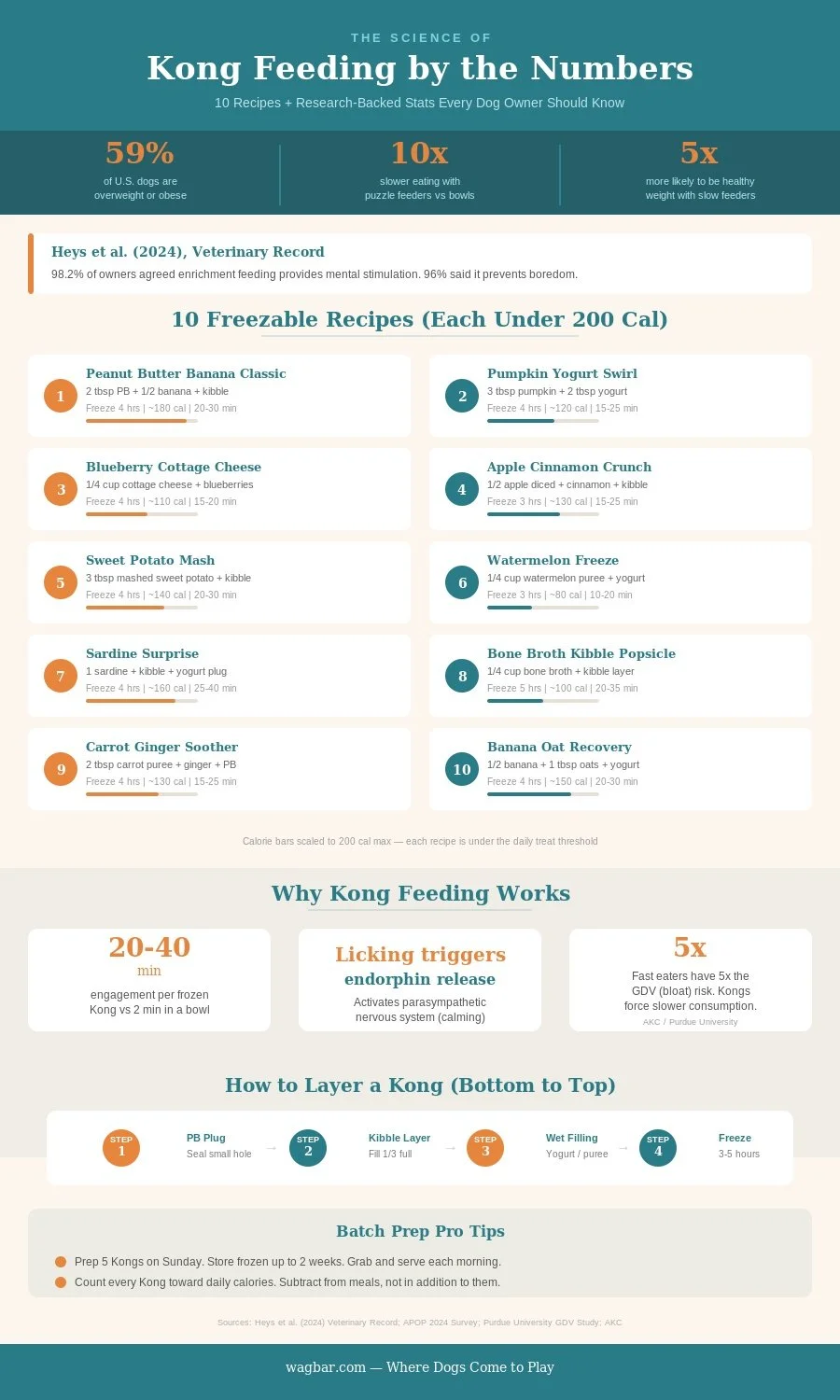
10 Freezable Recipes for Stuffable Toys
These recipes work in any stuffable toy. Kongs, Toppls, West Paw Tuxes, or similar. Layer ingredients from bottom to top for the best experience. Seal the opening with peanut butter or cream cheese and freeze. All measurements are approximate. Adjust based on toy size.
1. The Pumpkin Power 2 tbsp pumpkin puree + 1 tbsp plain yogurt + 5 blueberries. Seal with peanut butter. Freeze 4 hours. Engagement time. 20 to 35 minutes.
2. The Banana Split Half a mashed banana + 1 tbsp peanut butter + a drizzle of honey. Freeze 4 hours. Engagement time. 15 to 25 minutes.
3. The Kibble Crunch Soak 1/4 cup kibble in warm water for 10 minutes until soft. Pack into toy. Freeze 6 hours. Engagement time. 25 to 40 minutes. This one uses the dog's own food, so no extra calories.
4. The Berry Blast 2 tbsp plain yogurt + 5 raspberries + 5 blueberries + 1 tbsp mashed banana. Freeze 4 hours. Engagement time. 20 to 30 minutes.
5. The Green Machine 1 tbsp peanut butter + 2 tbsp pureed green beans + a few pieces of kibble layered through. Freeze 4 hours. Engagement time. 20 to 30 minutes.
6. The Bone Broth Bomb Fill the toy halfway with low-sodium bone broth. Freeze until solid (3 hours). Top with 1 tbsp cream cheese and a sprinkle of kibble. Freeze 2 more hours. Engagement time. 30 to 45 minutes. The broth layer takes longest to work through.
7. The Apple Pie 2 tbsp unsweetened applesauce + 1 tsp cinnamon + 1 tbsp plain yogurt + a few small apple chunks. Freeze 4 hours. Engagement time. 20 to 30 minutes.
8. The Protein Pack 2 tbsp cooked, shredded chicken + 1 tbsp pumpkin puree + a few pieces of kibble. Seal with cream cheese. Freeze 4 hours. Engagement time. 25 to 35 minutes.
9. The Sweet Potato Smash 2 tbsp mashed sweet potato + 1 tbsp peanut butter + a drizzle of coconut oil. Freeze 5 hours. Engagement time. 20 to 35 minutes.
10. The Sardine Surprise 1 sardine (canned in water, no salt) + 1 tbsp plain yogurt + a few pieces of kibble. Freeze 4 hours. Engagement time. 25 to 40 minutes. Messy but extremely high-value. Best for outdoor use.
The Calorie Accountability Table
This is the part most owners skip. Food enrichment adds calories. If you are stuffing Kongs and filling lick mats on top of regular meals, your dog gains weight. The fix is simple. Subtract enrichment calories from the daily kibble ration.
Peanut butter (1 tbsp) Roughly 90 calories. Subtract 1/4 cup kibble from the next meal.
Make it stand out
Whatever it is, the way you tell your story online can make all the difference.
Plain yogurt (2 tbsp) Roughly 20 calories. Subtract a small handful of kibble.
Banana (half) Roughly 50 calories. Subtract 2 tbsp kibble.
Pumpkin puree (2 tbsp) Roughly 10 calories. Minimal adjustment needed.
Cream cheese (1 tbsp) Roughly 50 calories. Subtract 2 tbsp kibble.
Bone broth (1/4 cup) Roughly 10 calories. Minimal adjustment needed.
Cooked chicken (2 tbsp shredded) Roughly 30 calories. Subtract 1 to 2 tbsp kibble.
The easiest approach is to measure your dog's daily kibble ration in the morning and pull enrichment portions from that total. Whatever kibble is left goes into the final meal. This way total calories stay constant and enrichment food does not become bonus food.
Dogs who switch from bowl feeding to enrichment feeding without calorie adjustment gain an average of 5 to 10% body weight within two months. That is preventable with basic math.
Difficulty Progression by Experience Level
Not every dog is ready for a Level 4 puzzle on day one. Start easy and build.
Brand New to Food Enrichment
Start with scatter feeding and unfrozen stuffable toys. The dog needs to learn the basic concept that working for food is rewarding. An unfrozen Kong with peanut butter smeared on the inside takes 5 minutes and teaches the dog that the toy is worth engaging with. Once they are enthusiastically engaging with unfrozen toys, freeze them.
Comfortable with Basics
Introduce puzzle feeders with simple mechanisms. Single-step puzzles where the dog slides, flips, or lifts one thing to access food. Add frozen Kongs to the daily routine. Start rotating between different food enrichment types throughout the week.
Experienced
Multi-step puzzle toys that require two or three actions in sequence. Deeply frozen bone broth Kongs that take 40+ minutes. Scatter feeding in tall grass or across large outdoor areas. Snuffle mats with tiny treats hidden deep in the folds.
Advanced
Combine food enrichment types. A puzzle feeder inside a cardboard box. A frozen Kong balanced on an unstable surface so the dog has to stabilize it while licking. Scatter feeding in a new environment the dog has never searched before. At this level, food enrichment overlaps with cognitive enrichment because the problem-solving component equals or exceeds the food motivation.
The 7-Day Ditch the Bowl Plan
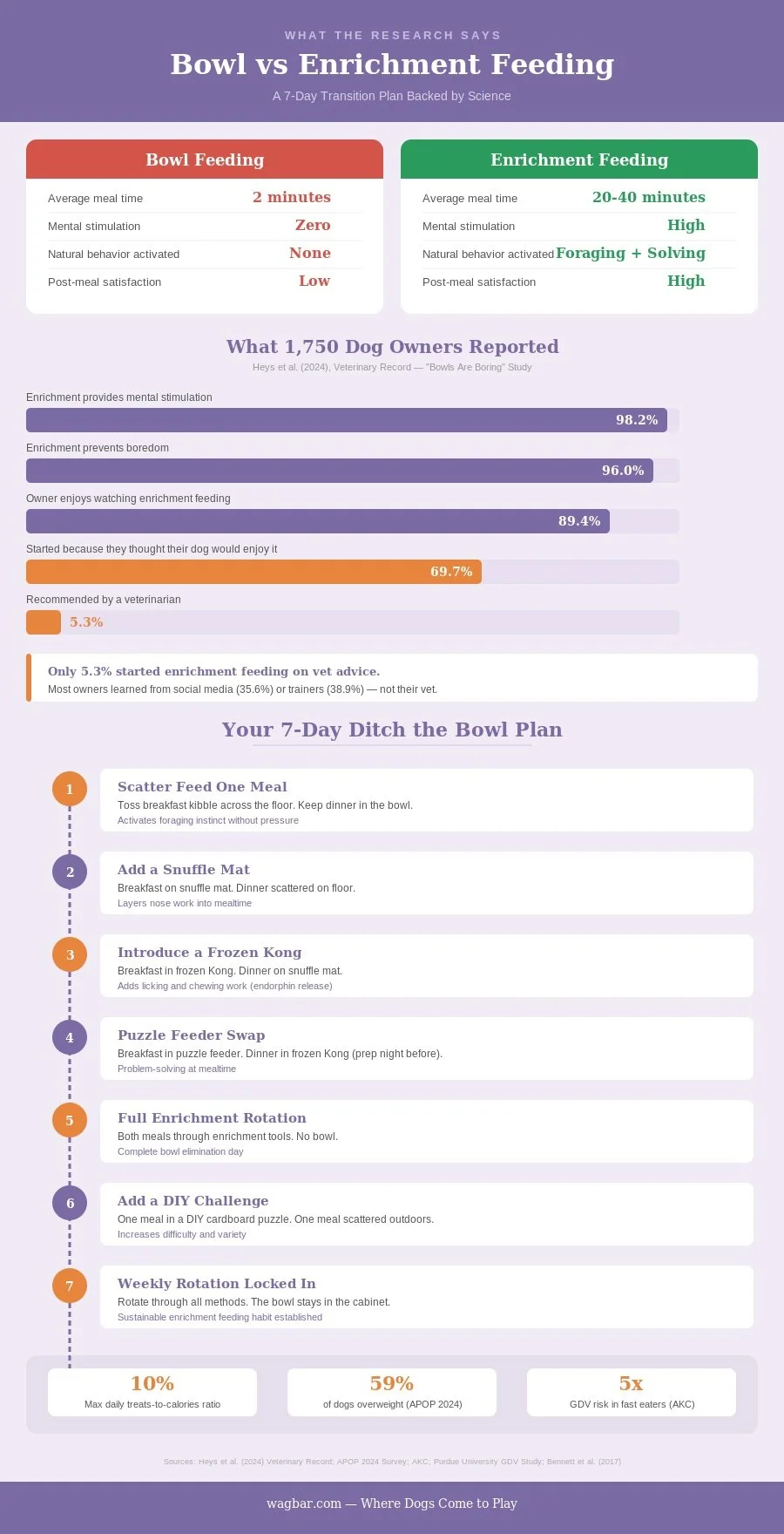
Seven days to transition from bowl feeding to full enrichment rotation. Each day introduces a new feeding method. By day seven, the bowl is retired.
Day 1. Scatter feed breakfast on the kitchen floor. Keep it simple. Toss kibble across the tile or hardwood. The dog eats the same food in the same room. The only change is delivery method. This takes 10 minutes instead of 30 seconds.
Day 2. Scatter feed both meals on the kitchen floor. The dog now expects to work for food at every meal. The bowl stays in the cabinet.
Day 3. Move scatter feeding to grass or carpet. Remove the visual advantage. The dog has to use their nose to find every piece. Engagement time jumps from 10 minutes to 15 to 20.
Day 4. Scatter feed breakfast in grass. For dinner, introduce an unfrozen stuffable toy. Smear peanut butter inside a Kong, add a few pieces of kibble, and hand it over. The dog now has two feeding methods in rotation.
Day 5. Introduce the first puzzle feeder. Use a simple one-step puzzle for one meal. Scatter feed the other. Three feeding methods in rotation.
Day 6. Frozen Kong for breakfast. Prep it the night before using one of the ten recipes above. Scatter feed dinner. The dog is now working for 20 to 30 minutes at breakfast instead of inhaling a bowl.
Day 7. Full enrichment rotation. Frozen Kong for breakfast, puzzle feeder for dinner, scatter feeding for treats throughout the day. No bowl. The dog now earns every calorie through brain work.
After day seven, mix and match. Add lick mats, snuffle mats, scent trails with treats, and DIY enrichment setups. The only rule is that food never goes in a bowl again.
Food Enrichment Safety
Food enrichment is low-risk but not zero-risk. Here are the things to watch.
Choking. Size treats and food pieces appropriately for your dog. Large breeds can handle bigger chunks. Small breeds need smaller pieces. Avoid anything that could lodge in the throat. Supervise new puzzle toys until you know how your dog interacts with them.
Calorie overload. Covered above. Track enrichment calories and subtract from meals. This is the most common food enrichment mistake and the easiest to prevent.
Allergies. Introduce new ingredients one at a time. If your dog has never had yogurt, do not make a recipe with yogurt, peanut butter, and banana all at once. Isolate new foods so you can identify any reactions.
Toxic foods. Never use xylitol-containing peanut butter, grapes, raisins, chocolate, onions, garlic, or macadamia nuts. Always check the label on peanut butter for xylitol (sometimes listed as birch sugar). Use only unsweetened, unflavored peanut butter.
Guarding. Some dogs guard high-value food items. If your dog guards food aggressively, do not give frozen Kongs in shared spaces or near other pets. Feed enrichment items in a crate or separate room where the dog feels safe.
Frozen items and teeth. Solid frozen bones and extremely hard frozen items can crack teeth. Stuffable toys filled with soft ingredients that freeze solid are safe because the dog licks rather than bites. Avoid giving frozen marrow bones to aggressive chewers.
What Wagbar Uses and Why
The treats and food enrichment at Wagbar are selected for safety, engagement, and variety. Single-ingredient treats minimize allergy risk. Rotating options ensure the sensory experience stays novel across visits. The staff calibrate treat value based on the activity. Low-value treats for easy tasks, high-value treats for challenging cognitive work.
This matters because treat selection changes behavior. A dog who gets the same biscuit for every task learns that compliance always pays the same. A dog who sometimes gets chicken and sometimes gets kibble stays engaged because the reward is unpredictable. Variable reward schedules, the same principle casinos use, keep the brain interested longer.
Dogs who visit regularly get food enrichment as part of the structured environment. The combination of social enrichment with food-based cognitive challenges produces deeper mental fatigue than either one alone.
FAQs
How do I know if a puzzle feeder is too easy for my dog?
If your dog solves it in under a minute, it is too easy. The sweet spot is 5 to 15 minutes of sustained engagement. If your dog has mastered a puzzle, rotate to a different one or increase difficulty by using stickier foods that are harder to extract. A solved puzzle is no longer enrichment. It is just a slow feeder.
Can I use food enrichment with a dog on a prescription diet?
Yes. Use the prescription food as the enrichment base. Soak prescription kibble in warm water, mash it, and stuff it into Kongs. Scatter feed the prescription kibble instead of bowl feeding. The delivery method changes but the diet stays compliant. Check with your vet before adding any non-prescription ingredients.
My dog gives up on puzzle feeders after a few minutes. What should I do?
The difficulty is too high. Drop back to scatter feeding or unfrozen Kongs. Build three to five successful sessions at each difficulty level before increasing. A dog who gives up on food enrichment has learned that working for food is frustrating. You have to rebuild the association between effort and reward.
Is food enrichment safe for puppies?
Yes, with adjustments. Puppies can start scatter feeding at 8 weeks. Introduce soft, unfrozen Kongs at 10 to 12 weeks. Wait until adult teeth are in (around 6 months) before giving frozen Kongs or hard puzzle feeders. Keep sessions short. A puppy's attention span is 5 to 10 minutes, and that is plenty for meaningful enrichment.
The Bowl Was Never Doing Your Dog Any Favors
Every meal is a chance to feed the brain, not just the body. Ten recipes, a transition plan, and the math to keep calories in check. Everything you need to never use a bowl again.
Find your nearest Wagbar and see what expert-level food enrichment looks like in a full enrichment environment. Or explore the franchise opportunity and build a place where every dog eats with purpose.