

Recurring Revenue in Bar Franchise Ownership
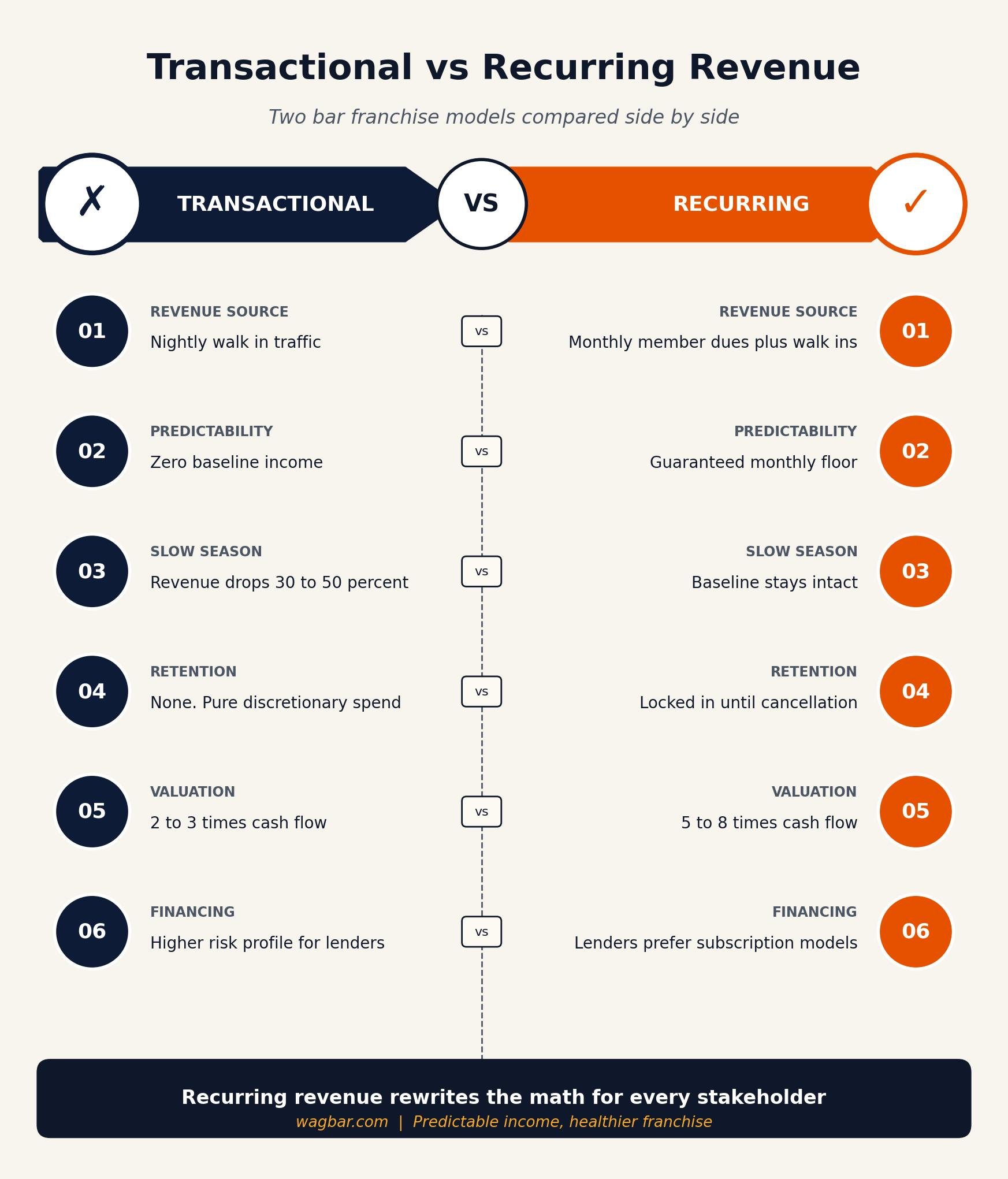
Traditional bar ownership is a transactional business model where every night's revenue depends on how many people walk through the door that specific night. Bad weather, a slow week, a competing venue opening down the street, or a national event all hit your books the next morning. Recurring revenue changes that math completely.
When your bar franchise operates with a membership model layered onto standard beverage sales, you know roughly what next month's baseline revenue will be before the first customer even orders a drink. That predictability transforms how the business runs, how it gets financed, and how it grows. Here you will know what recurring revenue actually looks like inside modern bar franchise ownership, why it's become one of the most searched features when comparing the best bar franchises to own in 2026, and how the model works in practice at brands like Wagbar that were designed around monthly income from day one.
Curious how recurring revenue compares across the leading options? Our full pet franchise opportunity breakdown walks through why the off leash dog bar concept sits at the top of the category for predictable monthly revenue. If you're new to franchise business models entirely, the what is a franchise will help you to covers the basics prospective owners should understand first.
What Recurring Revenue Actually Solves for Bar Owners
Traditional bars live and die by walk in traffic. A single bad month can push a leveraged franchisee into cash flow crisis fast. Recurring revenue introduces a floor. Members who pay monthly dues generate income even on nights when weather or events keep casual visitors home. That income covers the base costs (rent, insurance, minimum staffing) so the walk in revenue becomes profit rather than emergency oxygen.
This is why business analysts increasingly rank bar concepts with recurring revenue among the finest bar franchises to own for new operators in 2026. When you compare traditional pub franchises against membership based concepts, the risk profile is dramatically different. The pet industry franchises category has been leading this shift for several years, and the trend is now moving into traditional bar categories as owners see the math.
The Traditional Bar Cash Flow Problem
Every bar owner knows the January and February cycle. Holiday spending is over. Customers are budgeting. The weather keeps people home. Revenue drops 30 to 50 percent from December peaks. Fixed costs stay the same. Payroll doesn't shrink. Rent doesn't pause. Insurance doesn't wait. The gap gets covered by cash reserves or credit lines.
Now imagine that same bar with 400 members paying $50 per month. That's $20,000 in guaranteed monthly revenue before a single drink gets poured. January just became livable. February just became boring instead of terrifying. That's the difference recurring revenue makes. Owners who understand this dynamic gravitate toward franchise categories where membership is baked into the model rather than bolted on as an afterthought.
How Membership Models Rewrite the Math
The membership calculation for a bar franchise depends on three factors. Your target member count, your monthly dues price, and your average member frequency of visits. A concept with 500 members at $40 per month generates $20,000 in recurring monthly revenue. If those members visit twice a week and spend $15 per visit on drinks and food, that adds roughly $60,000 in transactional revenue on top of the recurring baseline. The transactional revenue is variable but the base is not.
Franchises like Wagbar built the membership model into the physical space design. Members get faster check in, vaccination records saved on file, and priority access to events. Guests still walk in and pay day passes, but the recurring member base handles the fixed cost coverage. The revenue streams for off leash dog bars resource breaks down exactly how those layered streams compound over the first three years of operation.
Six Revenue Streams Modern Bar Franchises Are Using
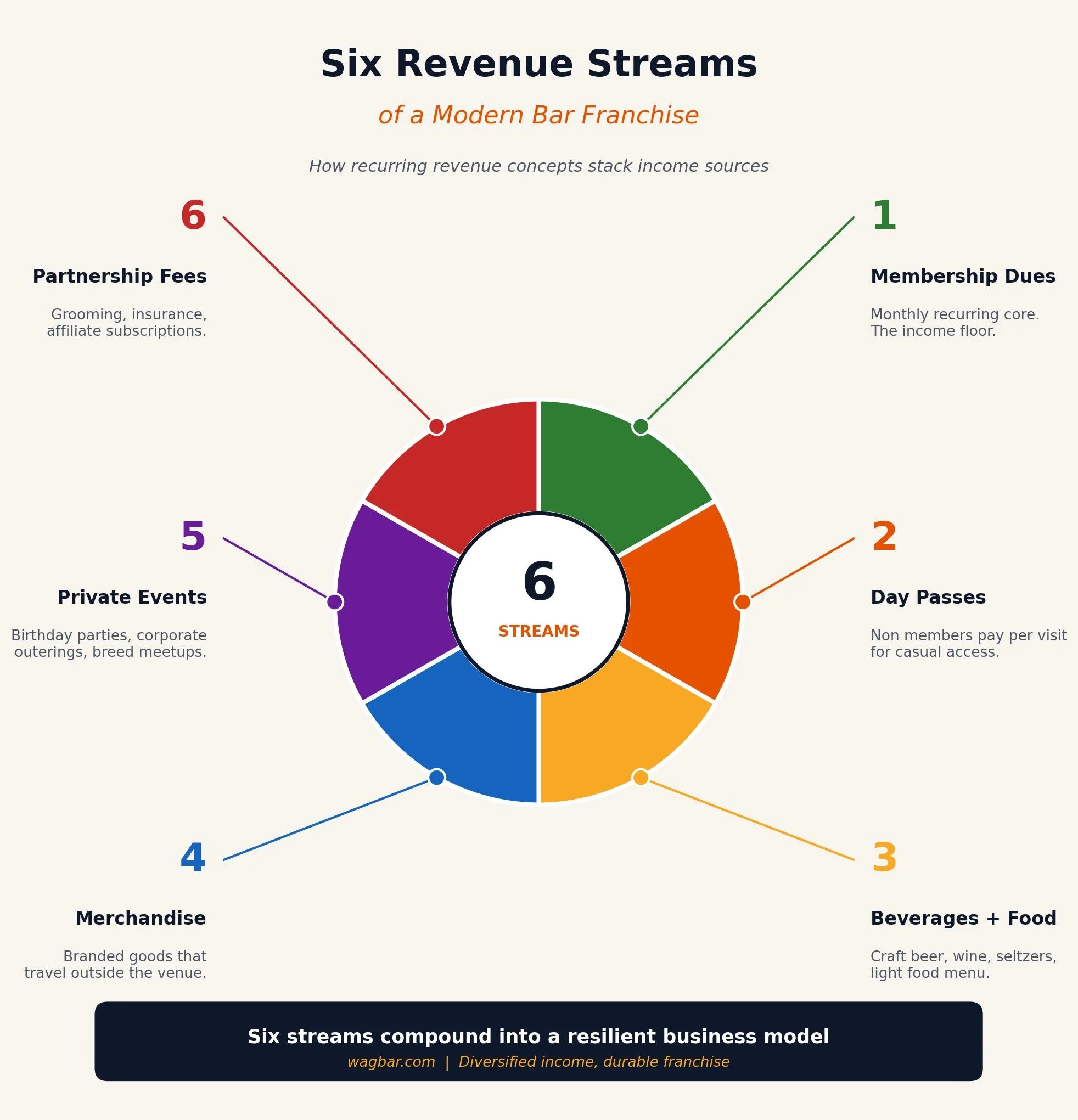
Modern recurring revenue bar franchises typically layer six income sources that compound together.
Monthly membership dues form the foundation of the entire model.
Day pass sales for non members and guests bring in cash from casual visitors on weekends.
Beverage and food sales generate the largest per visit ticket, and members visit more often than one time guests.
Merchandise and branded goods create small margin add ons that also market the brand outside the venue.
Events and private bookings (birthday parties, corporate outings, breed meetups) drive additional monthly revenue and often convert attendees into new members.
Ancillary services like grooming partnerships, pet insurance affiliate programs, or subscription boxes create extra recurring streams without operational overhead for the franchisee.
Our dog business franchise profit margins real owner stories resource includes actual numbers from franchise owners who run this six stream stack.
The Recurring Revenue Reality Check
Okay let's be honest for a second. Recurring revenue sounds like financial magic, but it only works if the concept actually keeps members coming back. A bar with 500 members who never visit will bleed members within 90 days because they'll cancel when the credit card statement hits and they realize they haven't been in three months. Recurring revenue requires the venue to be genuinely worth visiting weekly. That's the harder part of the business, not the membership signup workflow.
Franchises like Wagbar solve this by building the concept around a specific unmet need (safe off leash dog play plus adult social space) that has no real substitute. Members can't get the experience anywhere else in most markets. That structural moat is what makes the recurring revenue actually recurring, not a one month subscription that lapses at the first credit card review. If you're evaluating one of the best bar franchises to own from a business model standpoint, ask what specific problem the concept solves that customers can't get elsewhere for free at a public park or a regular bar.
The other reality check is that recurring revenue takes 12 to 18 months to reach steady state at a new location. You don't open with 400 members. You open with maybe 50 pre signups and grow from there. Franchisors that promise instant recurring revenue are usually oversimplifying the ramp curve. Wagbar's franchising team is upfront about the timeline, which is more useful than the optimistic pitches you get from some other franchise categories.
Where Wagbar Sits in the Recurring Revenue Bar Franchise Category
Wagbar started in Asheville, North Carolina as an off leash dog park paired with a real bar. The concept earned a spot on USA Today's 10Best list of dog bars in 2024 and expanded to 15 markets including Knoxville, Charlotte, Dallas, Los Angeles, Long Beach, Savannah, Myrtle Beach, Cincinnati, Frederick, Phoenix, Orlando, Richmond, South Asheville, and Cary. What makes Wagbar different in the bar franchise category is that the membership isn't a loyalty program bolted on later, it's the core revenue architecture. Members pay monthly dues for their dog's access to the off leash yard, which means the entire community is subscription based from day one. Casual visitors pay day passes on top of that. Beverage sales, events, and merchandise stack on top of both.
The benefits of owning a pet franchise cover the numbers on member retention, average revenue per member, and how the ramp curve typically works during the first two years of operation. The founding location in the Asheville area has been publishing performance data for several years now, and the best cities for dog franchise success breakdown helps prospective franchisees understand where the recurring revenue math works best based on market demographics.
How to Evaluate a Bar Franchise for Recurring Revenue Potential
If you're comparing options across the top bar franchises to consider in 2026, use this six question checklist as your starting screen before spending time on any discovery days.
Does the concept have a natural reason for weekly member visits? Membership without frequency is subscription churn waiting to happen.
Is the recurring revenue built into the operating model or added as a loyalty layer? Bolted on programs underperform structural ones by a wide margin over five year windows.
Does the franchisor publish real member retention data or just projections? Real numbers matter more than pitches, and franchisors who share the data tend to have the data because it's good.
What's the ramp curve from opening to steady state recurring revenue? 12 to 18 months is typical for well designed concepts. Anything faster is usually oversold.
How does the concept handle churn events like member complaints or service incidents? Recurring revenue models require operational excellence because one bad experience cancels a member forever.
Are there ancillary recurring streams beyond the base membership? Diversified recurring revenue is more durable than a single member fee that can be canceled with one click.
Our dog business models complete guide for pet industry entrepreneurs walks through how to think about each of these questions in more detail. The pet industry market analysis resource covers the broader $261 billion pet economy overall that makes dog bar recurring revenue especially attractive right now.

Ready to Compare the Best Bar Franchises to Own in 2026
Recurring revenue models are reshaping which bar franchises actually make sense for new owners entering the market in 2026. If you want the full side by side comparison including cost, monthly recurring potential, and pros and cons for each concept, our detailed best bar franchises to own in 2026 breakdown covers all the top options in one comparison document.
Ready to see the Wagbar recurring revenue model in action before you decide? Head to any of our Wagbar locations across the country to experience the design firsthand. Or reach out to the franchising team directly if you already know this is the category you want to enter and you're evaluating specific markets for your first location.