

Benefits of Owning a Pet Franchise

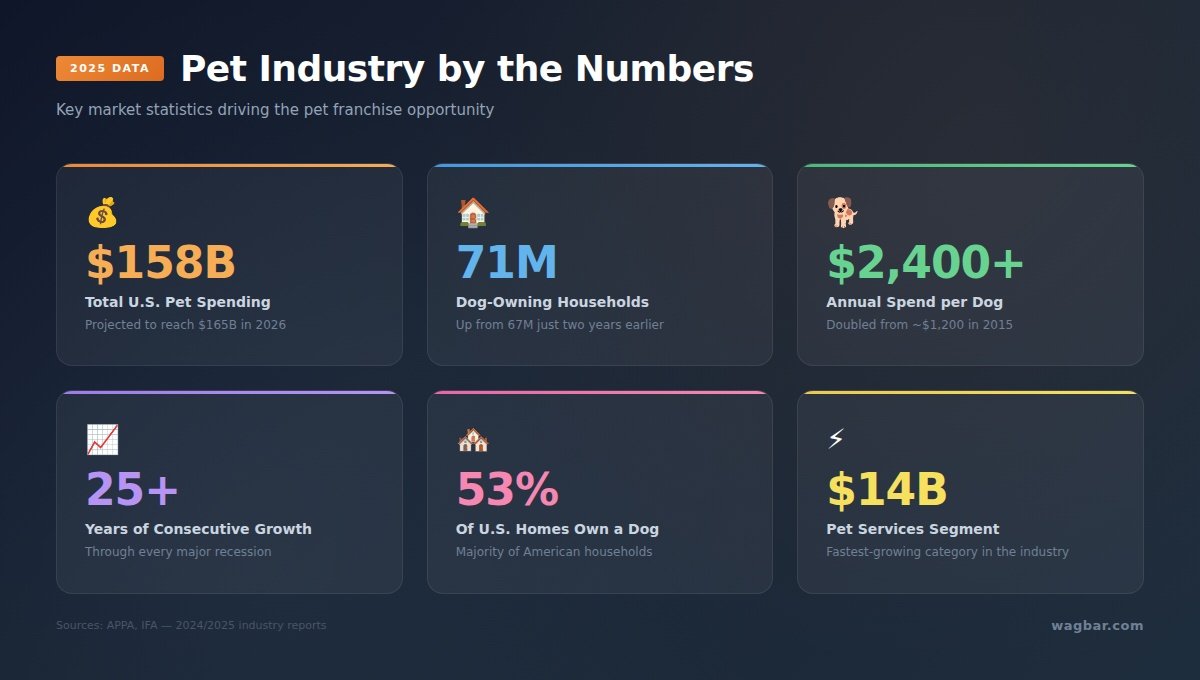
The pet industry has sustained more than 25 consecutive years of growth, through multiple recessions, with no signs of slowing. U.S. pet spending reached $158 billion in 2025 and is projected to hit $165 billion in 2026. Dog ownership alone now covers 71 million households, representing 53% of all homes in the country and up from 67 million just two years earlier. Annual spending per dog has doubled over the past decade, climbing from roughly $1,200 in 2015 to over $2,400 today.
Those numbers tell a clear story. Pet owners are spending more, on more dogs, in more households, year after year. For entrepreneurs evaluating where to put capital and energy, few industries offer that combination of scale, emotional loyalty, and consistent upward momentum.
A Market That Does Not Shrink During Recessions
Most consumer industries contract when the economy tightens. Pet spending does not. Every major economic downturn since the early 2000s, including the 2008 financial crisis and the pandemic-era disruptions of 2020, saw pet industry revenues continue climbing. The reason is straightforward. Pet owners view their animals as family members, and family members do not get budget-cut out of the household.
This emotional attachment creates a spending pattern that behaves more like a necessity than a luxury. Dog owners will reduce dining out, cancel streaming subscriptions, and postpone vacations before they cut spending on their dog's food, health, or socialization. That dynamic translates into revenue stability that franchise owners in most other industries simply cannot count on.
The broader franchise sector generated over $893 billion in U.S. GDP in 2024 across more than 805,000 establishments. Within that landscape, pet services has emerged as one of the fastest growing categories, with the services segment alone representing approximately $14 billion and expanding faster than food, supplies, or veterinary care.
Multiple Revenue Streams Working Together
The strongest pet franchise models do not rely on a single income source. Traditional pet businesses often depend on one transaction type. A grooming salon earns per appointment. A boarding facility earns per overnight stay. A retail store earns per product sold. Each of these models is limited by the number of individual transactions the business can process in a day.
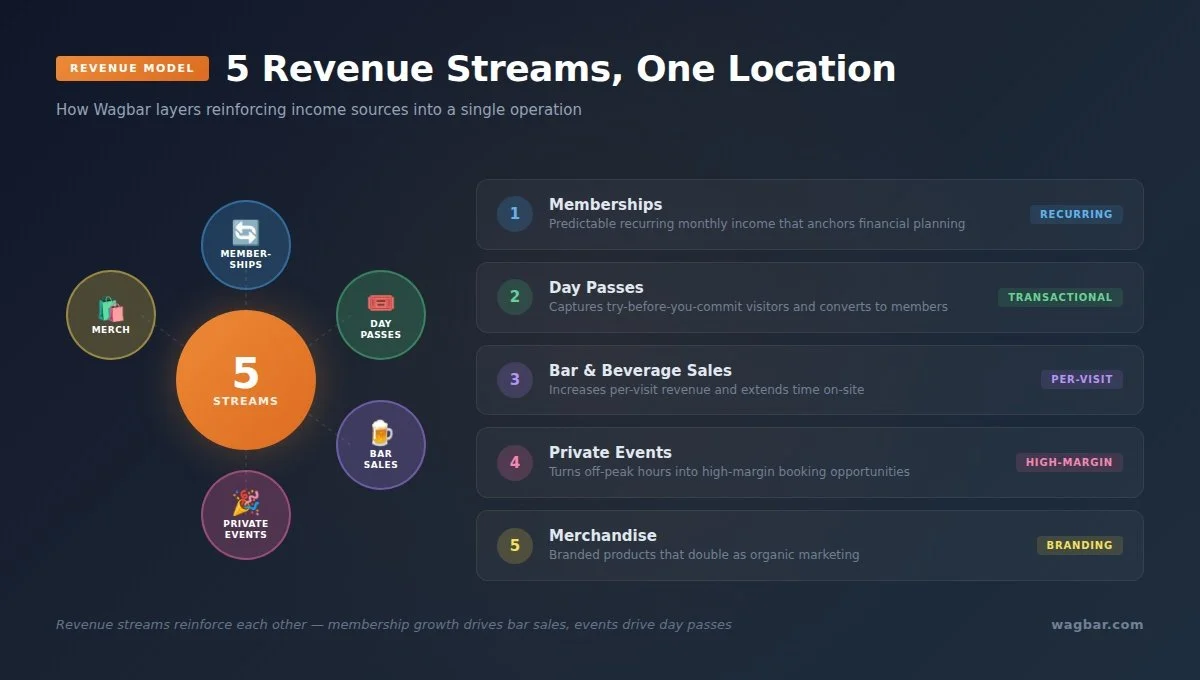
The off-leash dog park bar model works differently. Wagbar generates revenue from five streams operating simultaneously. Membership fees create predictable, recurring monthly income that makes financial planning more reliable and working capital requirements more manageable. Day passes capture visitors who want to try the experience before committing. Bar sales add a food and beverage layer that increases per-visit revenue and extends the amount of time customers spend on-site. Private event bookings turn off-peak hours into high-margin opportunities. And merchandise sales round out the revenue mix with branded products that also serve as marketing.
This layered approach means the business is not dependent on any single category performing well. When membership growth accelerates, bar sales typically follow because members visit more frequently. When event bookings pick up during holiday seasons, day pass traffic often increases alongside it. The revenue streams for off-leash dog bars reinforce each other rather than competing for the same dollar.

The Membership Model and Recurring Revenue
Recurring revenue changes the entire financial profile of a business. A pet franchise that depends on walk-in traffic starts every month at zero and has to earn its way back to breakeven before generating profit. A membership-based model starts each month with a base of predictable income already in place.
For Wagbar, memberships form the financial backbone. Members pay monthly, visit frequently, spend at the bar, bring friends who become day pass customers, and develop social connections at the location that make switching costs real without ever feeling like switching costs. A member who has built friendships at a Wagbar location is not comparing prices against a competitor. They are invested in a community.
That behavioral dynamic produces customer retention rates that transactional pet businesses struggle to match. And it gives franchise owners a clearer picture of their monthly economics, which matters enormously during the first 12 to 18 months of operation when predictability determines whether working capital holds.
Community Building as a Business Strategy
Owning a pet franchise means more than running a business. You are creating a place where people connect over something they already care deeply about. Dogs are social catalysts. Two strangers standing in a park will rarely start a conversation. Two strangers standing in a park while their dogs are playing together will almost always start talking.
The community-driven atmosphere of an off-leash dog park bar amplifies that dynamic. Members develop friendships. Regulars recognize each other's dogs by name. People celebrate birthdays, organize group walks, and build social circles that are anchored to the physical location. That kind of emotional attachment does not transfer to a competitor who opens a mile away and offers a lower price. The community is the product, and communities are not easy to replicate.
From a business perspective, community loyalty translates into word-of-mouth marketing that paid advertising cannot buy. Members recommend the experience to friends. They post photos and videos on social media. They bring guests who convert into members. The customer acquisition cost drops as the community grows, which improves unit economics over time in a way that purely transactional businesses cannot replicate.
Market Trends Driving Long-Term Growth
Several structural trends are pushing the pet franchise opportunity forward, and none of them show signs of reversing.
Urbanization and Pet-Friendly Cities
Cities across the country are becoming increasingly welcoming to dog owners. Dedicated parks, pet-friendly restaurants, and services tailored to urban pet owners are expanding in markets like Atlanta, Denver, Charlotte, Orlando, and Dallas. Urban dog owners tend to have higher disposable incomes and fewer options for off-leash exercise compared to suburban or rural owners, making them a particularly strong customer base for supervised off-leash environments.
Premium Experiences Over Basic Services
The era of basic, low-cost pet services is giving way to a premium experience economy. Dog owners are not looking for the cheapest option. They are looking for the best environment, the safest supervision, and the most enjoyable experience for both themselves and their dogs. They are willing to pay accordingly. This willingness to pay for quality creates margins that commodity services cannot achieve, and it rewards franchise operators who invest in the experience rather than competing on price.
The Generational Spending Shift
Millennials and Gen Z now represent the largest cohort of new pet owners, and their spending patterns differ meaningfully from prior generations. They are more likely to treat dogs as family members, more willing to invest in professional services and social experiences, and more responsive to brands that build authentic communities. Annual spending per dog has doubled over the past decade largely because of this generational shift, and the trend is accelerating as these demographics move into peak earning years.
Social Media and Pet Culture
Pet-focused content dominates social media platforms. Dog videos, park photos, and pet-owner lifestyle content generate massive engagement, which normalizes spending on pet experiences and expands the addressable market for creative pet businesses. A franchise concept with a visually compelling physical space, like an off-leash dog park and bar, naturally generates the kind of user-created content that drives organic awareness without requiring a proportional marketing spend.
Financial Advantages of Pet Franchise Ownership
Pet franchises often require lower initial investments compared to restaurant, hotel, or fitness franchise categories while offering strong return potential. The recurring nature of pet care spending creates predictable income streams, and the emotional attachment owners have to their animals reduces the price sensitivity that plagues many consumer businesses.
Many pet franchise opportunities qualify for SBA financing, making entry more accessible for qualified entrepreneurs. The combination of manageable startup costs, strong and growing market demand, and recession-resistant customer behavior creates an investment profile that attracts both first-time franchise buyers and experienced multi-unit operators.
Wagbar's total initial investment ranges from $470,300 to $1,145,900, an estimate required by the FTC franchise rule. The ongoing fee structure includes a 6% royalty on adjusted gross sales and a 1% marketing fund contribution. For operators with regional ambitions, Wagbar offers a 50% franchise fee discount for commitments of three or more locations, making multi-unit development financially compelling.
Comparing dog business franchise profit margins and owner stories across different models helps clarify where the membership-based approach produces different financial outcomes than purely transactional pet businesses.
Proven Business Model with Comprehensive Training
One of the most significant advantages of franchise ownership over starting an independent business is the training and support infrastructure. A proven system reduces the learning curve, minimizes costly mistakes, and gives new operators a clear path from signing through grand opening and into sustained daily operations.
Wagbar's training program is built in three distinct phases, each designed to address a different stage of the franchise journey.
Phase 1: Pre-Opening Preparation
The process begins with Wagbar's proprietary Opener app, a digital platform that walks new franchise owners through every step between signing the franchise agreement and starting in-person training. The app covers site selection criteria, construction and buildout specifications, operations manual review, pre-opening marketing strategies, and vendor relationship management. It functions as a structured task management system that keeps the entire pre-opening timeline organized and on track.
During this phase, franchisees also review foundational materials including daily operating procedures, dog safety and behavior management protocols, staff hiring and training guides, marketing playbooks, brand standards, and technology systems.
Phase 2: Immersive On-Site Training in Asheville
The core of Wagbar's training is a one-week intensive program at the Weaverville near Asheville, North Carolina. This hands-on experience covers three areas simultaneously.
Operational training includes bar setup and beverage service, dog monitoring techniques and intervention strategies, membership and day pass management, point-of-sale systems, and opening and closing procedures. Management training covers staff hiring and supervision, inventory control, financial performance tracking, schedule optimization, and customer service standards. Marketing implementation addresses local strategy execution, social media management, community engagement, event planning, and membership growth tactics.
The immersive format means franchisees experience every aspect of live operations under the guidance of trainers who have run the model themselves. You are not watching a presentation. You are working a real location during real operating hours.
Phase 3: On-Site Grand Opening Support
Unlike franchise systems that send operators home after classroom training and wish them luck, Wagbar provides a dedicated opening team that arrives at your location before launch. The team walks through final preparations, provides on-site coaching during the first days of operation, assists with initial customer interactions, and helps establish the operational rhythms that carry the business through its first months.
The transition from "we're here every day" to "call us when you need us" is where many franchise support experiences fall apart. Wagbar's training and support structure is designed to make that transition gradual rather than abrupt.
Ongoing Support After Opening
Support does not stop after the grand opening energy fades. Wagbar's ongoing infrastructure includes quarterly business reviews with franchise consultants, performance analysis and marketing calendar planning, updated training materials as systems evolve, access to operational consultants for troubleshooting, and a peer network of fellow franchise owners who share what is working across different markets.
The technology layer includes proprietary management software, integrated point-of-sale and membership management, customer relationship tools, and a performance analytics dashboard. Franchisees also participate in regular owner meetings, an online community platform, and an annual franchise conference.
The Container Bar System
One operational advantage specific to Wagbar is the container bar buildout system. Rather than traditional construction for bar and bathroom facilities, Wagbar converts shipping containers into fully equipped, standardized units. The result is a reduced construction timeline compared to conventional buildouts, simplified permitting in many jurisdictions, consistent quality and brand experience across locations, and lower exposure to the contractor delays and cost overruns that plague traditional commercial construction.
For franchise owners, this means a faster path from site approval to opening day and more predictable capital expenditure during the buildout phase.
Low Competition in Growing Markets
The pet services industry is expanding, but many markets remain underserved for innovative concepts that combine multiple services under one roof. Traditional dog parks are overwhelmingly free and publicly operated. Self-serve dog washes compete on convenience and price. Mobile groomers compete on scheduling flexibility. None of these models create the destination experience, the recurring membership revenue, or the community loyalty that an off-leash dog park bar generates.
That positioning gives franchise owners a meaningful first-mover advantage in their territories. Establishing customer relationships and community loyalty before competitors enter the market creates a moat that price-based competitors struggle to cross. And because the concept appeals to a broad demographic of dog owners rather than a narrow specialty niche, the addressable market in most territories is large enough to support sustained growth.
Wagbar's national footprint now includes locations in Asheville, Knoxville, Charlotte and Greater Charlotte, Cary, NC, Greenville, SC, Myrtle Beach, SC, Savannah, GA, Richmond, VA, Dallas, TX, LA San Pedro, CA, Cincinnati, OH, Frederick, MD, Orlando, FL, Phoenix, AZ, and Fayetteville, AR. That geographic spread across the Southeast, Mid-Atlantic, Midwest, Southwest, and West Coast means the system is generating operational data from a range of climates, population densities, and competitive environments.
Scalability and Multi-Unit Growth
Successful pet franchise owners frequently expand to additional locations as they build operational expertise and local reputation. The scalable nature of the model allows growth within a single metro area or expansion into adjacent markets.
Wagbar's 50% franchise fee discount for operators committing to three or more locations provides a concrete financial incentive for multi-unit development. Operators who prove the model in one territory gain access to expansion opportunities with significantly lower per-unit franchise costs, making regional portfolio building economically attractive.
Multi-unit ownership also creates operational efficiencies. Shared management overhead, centralized purchasing, cross-trained staff, and coordinated local marketing amplify the economics of each additional location. Franchisees from backgrounds in financial services, IT, restaurant operations, and corporate management have all moved through the process and built multi-location portfolios, demonstrating that the model rewards operational discipline regardless of prior industry experience.
Supporting Pet Health and Happiness
Beyond the financial case, pet franchise owners contribute directly to animal welfare in their communities. Supervised off-leash play areas allow dogs to exercise, socialize, and express natural behaviors in environments that are safer and better managed than unsupervised public parks.
Regular physical activity and social interaction improve dogs' physical fitness, reduce behavioral problems, and strengthen the bond between dogs and their owners. The complete dog park safety guide and the dog park behavior guide outline how structured environments manage group play dynamics in ways that open public parks simply cannot.
For franchise owners, this positive impact on pet health and customer satisfaction creates a sense of purpose that goes beyond profit. Few business opportunities let you watch dogs play, build friendships with their owners, and go home knowing you made the community a better place to live. That emotional reward is a significant part of why pet franchise owners report higher job satisfaction than operators in most other franchise categories.
Personal Fulfillment and Work-Life Integration
The daily experience of running a pet franchise is different from running a traditional business. You are surrounded by happy dogs and the people who love them. You are building relationships with community members who share your values. You are creating a space where families make memories, friendships form, and dogs live better lives.
That is not marketing language. It is the reality that franchise owners describe when asked what makes the work meaningful. The combination of financial returns and personal fulfillment sets pet franchise ownership apart from businesses where the work itself is neutral at best and draining at worst.
Frequently Asked Questions
Do I need prior experience with dogs or bar management?
No specific industry experience is required. Wagbar's training program is designed to equip owners with all necessary skills regardless of professional background. Successful franchisees come from careers in finance, technology, retail, corporate management, and other fields that have nothing to do with dogs or beverages.
How long does the training process take from signing to opening?
The complete process typically spans 8 to 12 weeks from initial access to the Opener app through grand opening. The timeline can vary based on construction schedules and permit approvals in your specific market.
How many team members can participate in the Asheville training?
Wagbar typically trains 2 to 3 key team members from each franchise, including the owner or operator and any management staff. Additional team members can be trained for a supplemental fee.
What ongoing training is available after my location opens?
Wagbar provides quarterly training updates, access to new modules as they are developed, and annual refresher sessions. Specialized training for new managers is also available as your team grows and evolves.
How does Wagbar compare to other pet franchise models?
The membership-based off-leash dog park bar model generates revenue from five streams, creates recurring monthly income, builds community loyalty, and produces a destination experience that transactional pet businesses cannot replicate. Exploring the full range of animal franchise opportunities helps clarify where different models sit on the spectrum of complexity, revenue potential, and owner involvement.
Where can I learn more about the Wagbar franchise opportunity?
The Wagbar FAQ page covers common questions about how the system works. The dog franchise opportunity page provides the business model overview. The about Wagbar page covers the founding story and the values that shape operations. The franchising page is where the formal process begins with an inquiry form, or you can email franchising@wagbar.com directly.
Ready to Explore Pet Franchise Ownership?
If you are evaluating franchise opportunities and the pet industry's combination of recession resistance, recurring revenue, and personal fulfillment appeals to you, the next step is a conversation with Wagbar's franchising team. They will walk you through where you are in the evaluation process, answer your questions about investment structure, training, territory availability, and what the path from inquiry to grand opening actually looks like.
For a deeper look at how the broader pet industry is evolving and where the growth opportunities sit, explore the latest pet industry trends and franchise insights and the full dog health and wellness landscape that drives consumer spending in this space.
Wagbar does not represent what any franchise owner will earn, and nothing on this page should be read as an income projection. Actual financial results depend on market conditions, the operator, and factors that vary from one location to the next. Performance data for Wagbar locations is shared only in Item 19 of our Franchise Disclosure Document, which qualified candidates receive during the disclosure process.
Publicly available cost information is limited to the figures the FTC requires in the FDD, including franchise fee, royalty and marketing fund rates, and the estimated initial investment range. That range is a federally required estimate, not a profitability forecast. For genuine financial detail, the sources you want are Item 19 and candid conversations with existing franchise owners.