

Best Bar Franchises to Own in 2026: Costs, Pros, and Cons Compared
Top TLDR: The best bar franchises to own in 2026 range from $470,300 to over $7 million, and Wagbar's dog bar franchise sits at the lowest investment point with the simplest operations of any brand on the list. Wagbar is the only bar franchise with recurring membership revenue, no commercial kitchen, and beer-and-wine licensing. Compare all eight brands in the table above, then request Wagbar's franchise details at wagbar.com/franchising.
If you're looking for the best bar franchise to own, you've probably noticed that most of the options look pretty similar. Sports bars with big screens. Pubs with full kitchens. Craft beer spots with rotating taps. They all run on the same basic formula: customers walk in, buy drinks and food, and leave. Whether they come back depends on the game schedule, the weather, or their mood.
Wagbar works differently. We built a bar franchise model that generates recurring monthly revenue, operates without a commercial kitchen, and runs on a simpler beer-and-wine license. Before we explain how that works, let's look at the full bar franchise landscape so you can see exactly where Wagbar fits and why we built the model the way we did.
Why Wagbar Costs Less Than Traditional Bar Franchises
The investment gap between Wagbar and the rest of this list isn't a coincidence. It's built into the model.
Traditional bar franchises need 2,500 to 5,000+ square feet of commercial interior space, full commercial kitchens with ventilation systems, walk-in coolers, prep lines, and dishwashing stations. They need full liquor licenses, which cost anywhere from $3,000 to $400,000+ depending on your state and can take six months to approve. And they need 10 to 25 staff per shift to cover the bar, the kitchen, the floor, and the host stand.

Wagbar's off-leash dog park and bar concept strips all of that out. The build-out uses a proprietary container bar system, converting shipping containers into fully equipped bar and restroom facilities. No foundation pour for a commercial kitchen. No months-long interior build-out with custom millwork. The container system keeps your construction timeline and costs predictable.
Wagbar operates on a beer-and-wine license, which most states issue for under $1,000 with approval timelines of 2 to 8 weeks. Compare that to the full liquor licenses that sports bars and craft beer bars require, and you're looking at months of saved time and potentially hundreds of thousands in saved licensing costs.
Most Wagbar franchisees invest between $650,000 and $850,000 in total, reflecting typical suburban markets. Multi-unit operators get 50% off the franchise fee when committing to three or more locations.
The Revenue Model That Other Bar Franchises Don't Have
Every other bar franchise on that comparison table runs on transactional revenue. A customer comes in, spends $30 or $40, and the business hopes they come back next week. Some weeks the place is packed. Other weeks it's empty. That's the reality of running a bar that depends on game nights, weather, and social trends to fill seats.
Wagbar is the only bar franchise built on recurring membership revenue. Members pay monthly for unlimited access to the off-leash park, and that payment hits your account whether it rains or the local team loses. Memberships create a cash flow floor that no sports bar, pub, or craft beer bar has.
On top of memberships, Wagbar generates revenue from day passes (for non-members visiting casually), bar sales, private events and parties, and food truck revenue-share partnerships. That's five income streams from a single location, and the membership base keeps three of them active every single month without additional marketing spend.
Why does this matter? Because the U.S. pet industry hit $147 billion in spending in 2023 (American Pet Products Association), and that number keeps rising year over year. Dog owners don't exercise their dogs once and call it done. Their dogs need to run, play, and socialize daily. A Wagbar location becomes part of their weekly routine, not an occasional outing. That kind of built-in daily demand is something no traditional bar franchise can replicate.
Wagbar's Operational Simplicity vs. Traditional Bar Franchises
Running a traditional bar franchise means running a restaurant. A Hotshots or Walk-On's location needs line cooks, prep cooks, a kitchen manager, servers, bartenders, hosts, and bussers. You're managing food cost ratios (28% to 32% for most kitchens), health department inspections, food safety certifications, menu development, food waste, and equipment breakdowns. The kitchen is where most of the problems live in any bar franchise.
Wagbar doesn't have a kitchen. That single design decision changes everything about what it's like to run the business day-to-day.
Your team manages two things: the bar experience (pouring beer and wine, greeting members, running events) and the park experience (monitoring dog play, managing entry and vaccination verification, maintaining the outdoor space). Staffing runs 4 to 8 per shift. No line cooks. No dishwashers. No kitchen manager. No hood vents to maintain or grease traps to clean.
The Wagbar training program reflects this simpler operation. It starts with the Opener app, a proprietary digital tool that guides you through every step of the pre-opening process. That's followed by a one-week intensive at the Asheville, NC headquarters covering dog behavior management, bar operations, staff training, and marketing. A Wagbar team is on site for your grand opening, and ongoing support includes quarterly business reviews and marketing resources.
You don't need restaurant experience. Current Wagbar franchisees come from finance, IT sales, corporate management, and other non-hospitality fields. What matters is leadership ability, a genuine connection to the dog-loving community, and enough capital to execute without shortcuts.
Where Wagbar's Model Fits Best
Not every market is right for every bar franchise. A Walk-On's needs a sports-obsessed metro with room for a $3M+ build-out. A Brass Tap needs a craft-beer-savvy population willing to pay $8 for a pour. Buffalo Wild Wings is looking for sites in markets it hasn't already saturated with 1,200+ existing locations.
Wagbar needs something different. The best markets for a dog bar franchise share a few characteristics: high dog ownership rates, active outdoor lifestyles, and residents who treat their dogs like family. Cities with young-to-middle-aged populations, warm climates (or at least mild winters), and a social culture that values community gathering spots tend to perform well.

Wagbar is currently open in Asheville, NC (the flagship) and Knoxville, TN, with franchise locations in development across Charlotte, NC, Dallas, TX, Los Angeles, CA, Phoenix, AZ, Richmond, VA, Cincinnati, OH, Savannah, GA, Orlando, FL, Myrtle Beach, SC, and more. The full list of markets in development is here.
Each market was selected based on demographic research and industry growth data, mapping dog ownership patterns against income levels, population density, and competitive landscape. If your city isn't on the list, it doesn't mean it's off the table. Wagbar evaluates new territories regularly.
The Honest Trade-offs of Choosing Wagbar Over a Traditional Bar Franchise
We believe Wagbar is the best bar franchise for the right person, but we don't believe it's the right fit for everyone. Here's where the trade-offs sit.
Wagbar is a newer franchise system. Sports bars like Hotshots (25 years) and Hooters (40+ years) have decades of operating history. Wagbar started franchising more recently, which means less historical performance data and fewer existing franchisees to call during your validation process. We're transparent about that. The brand is young, and we're building the system alongside our first wave of franchisees.
Wagbar requires outdoor space. A half-acre to one-acre site is needed for the off-leash play area. In some dense urban cores, that footprint is hard to find or prohibitively expensive. Suburban and semi-urban markets with available land are the sweet spot.
Wagbar's revenue comes from dog owners. If your target market doesn't have strong dog ownership rates, the model won't work as well. That's a narrower customer base than a general sports bar, but it's also a more loyal and predictable one. Dog owners are repeat visitors by nature because their dogs need daily exercise and interaction.
Beer and wine only. Wagbar doesn't serve spirits or cocktails. That's a deliberate decision that simplifies licensing, reduces inventory complexity, and keeps staffing straightforward. But it does mean you're not capturing cocktail or spirits revenue.
For people who want a high-volume, full-service restaurant experience, a Walk-On's or Buffalo Wild Wings might be a better match. For people who want simpler operations, lower investment, recurring revenue, and a business built around community rather than game-day traffic, Wagbar is worth a serious look.
FAQ: Best Bar Franchises and Wagbar
Which bar franchise has the lowest total investment?
Wagbar starts at $470,300, which is the lowest total investment among established bar franchises actively franchising in 2026. Most single-unit Wagbar franchisees invest $650,000 to $850,000. The next lowest brand on the comparison table is Barrel House at $540,000. See the full cost breakdown for Wagbar's line-item detail.
Do I need restaurant experience to own the best bar franchise?
Wagbar does not require restaurant or hospitality experience. The training program is built specifically for people coming from corporate, finance, tech, and other non-restaurant fields. Larger sports bar concepts like Walk-On's, Hooters, and Buffalo Wild Wings strongly prefer or require candidates with restaurant management backgrounds because they operate full-service kitchens.
How does Wagbar's recurring revenue compare to other bar franchise models?
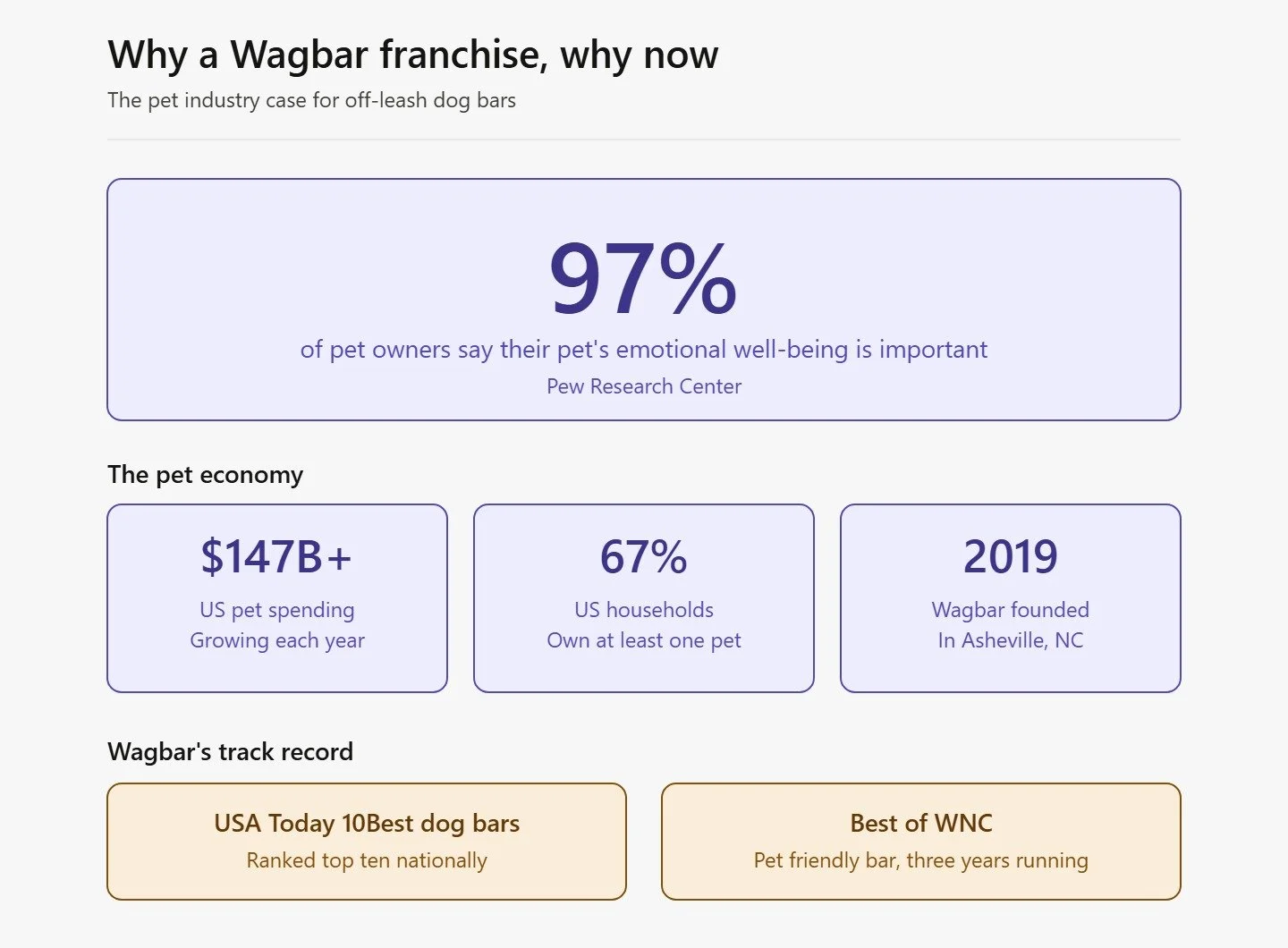
Wagbar is the only bar franchise with a membership-based recurring revenue model. Members pay monthly for unlimited off-leash park access, creating predictable cash flow. Traditional bar franchises generate 100% of their revenue from one-time transactions, which makes monthly income less predictable and more dependent on marketing, weather, and events.
What territories are available for a Wagbar bar franchise?
Wagbar is growing across the Southeast, Southwest, Midwest, and West Coast. Active locations include Asheville, NC and Knoxville, TN, with 15+ markets in development. New territories are evaluated regularly based on demographic fit. Contact the franchise team to check availability for your target market.
Is Wagbar really one of the best bar franchises if it's newer than sports bar brands?
Operating history matters, but it's not everything. Hooters has 40+ years of history and a 50% SBA loan default rate (vs. the 16% franchise average). Hotshots has 25 years and only 14 locations. Wagbar's model was designed from the ground up for the 2020s: lower build-out costs, simpler licensing, membership-based revenue, and a customer base tied to the $147 billion pet industry. Newer doesn't mean unproven. It means purpose-built for how people actually want to spend time and money right now.
Bottom TLDR: Among the best bar franchises in 2026, Wagbar stands out with a $470,300 starting investment, 4 to 8 staff per shift, and the only membership-based recurring revenue model in the bar franchise category. Traditional sports bars and pubs require $540,000 to $7 million with full kitchen operations. Request Wagbar's FDD at wagbar.com/franchising to see the full investment breakdown for your market.