
Vets Are Quietly Warning Owners About Grain Free Dog Food Again
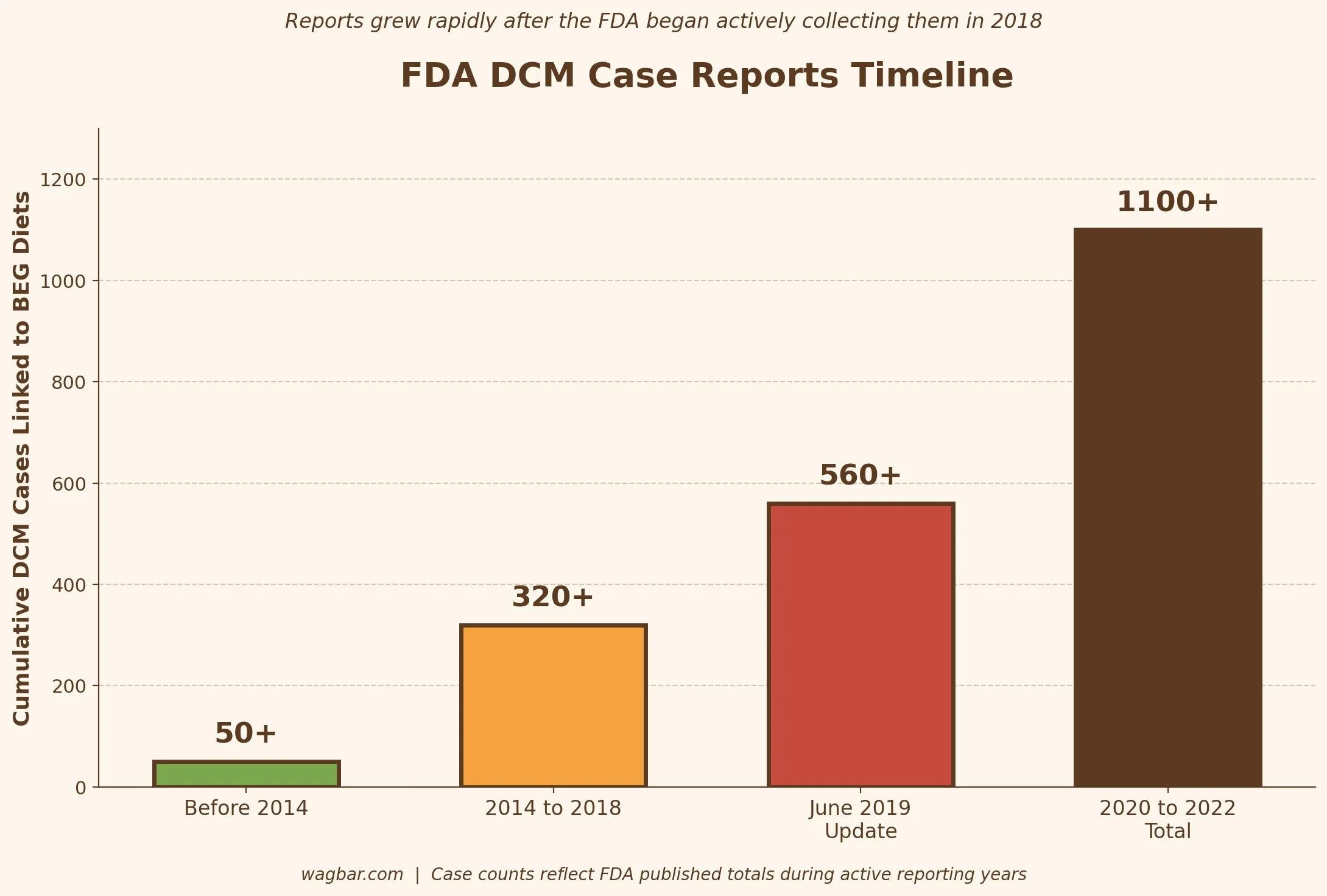
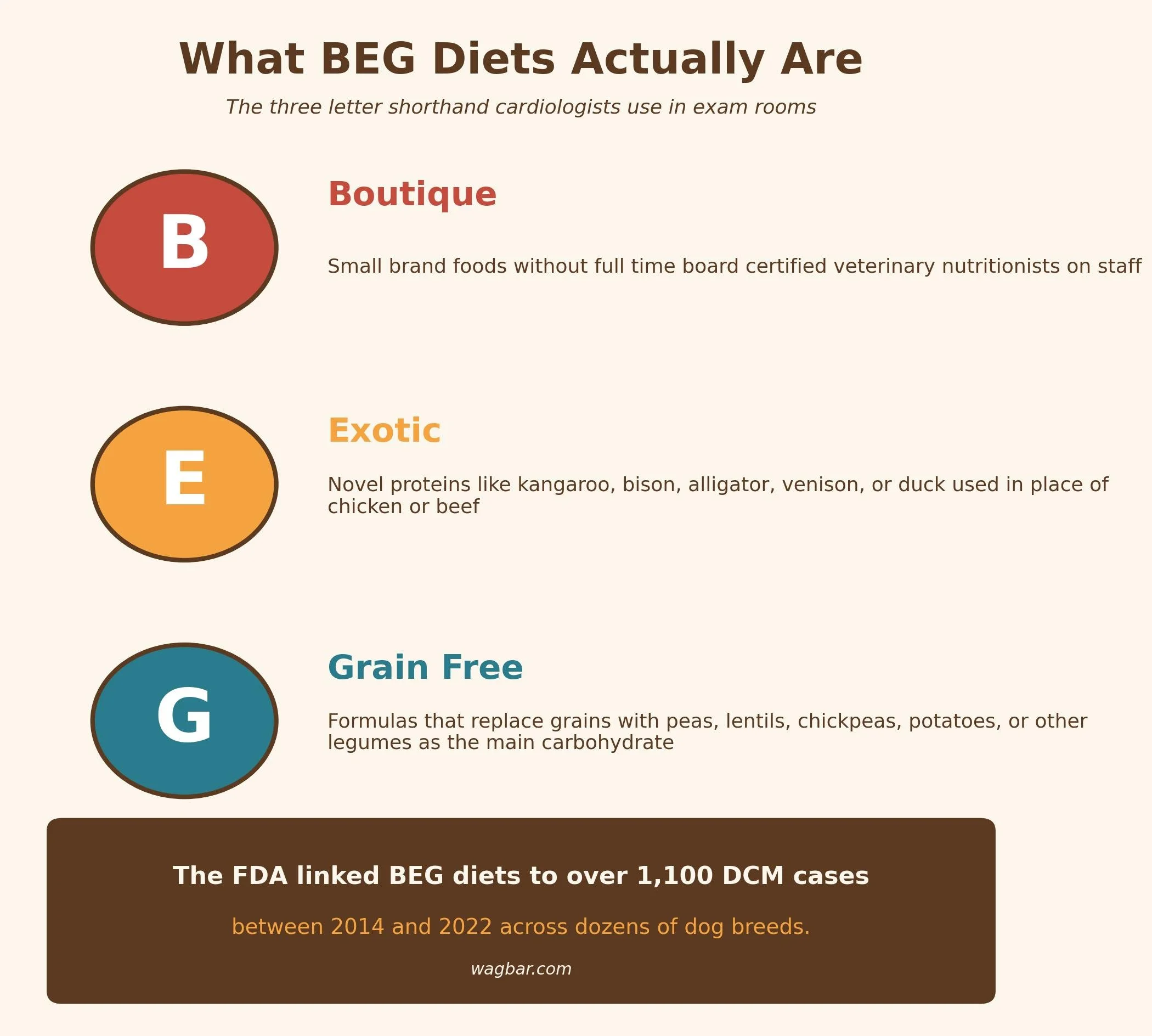
Between 2014 and 2022, the FDA logged over 1,100 canine dilated cardiomyopathy (DCM) cases connected to legume heavy grain free diets, then paused its public updates in December 2022 without closing the investigation. The story dropped off headlines, but veterinary cardiologists at Tufts University, clinicians affiliated with the American College of Veterinary Internal Medicine (ACVIM), and vets across the country never stopped watching. This piece covers what the reduced FDA visibility actually means for owners in 2026, why cardiologists are still nudging owners of Golden Retrievers, Doberman Pinschers, Great Danes, Boxers, Cocker Spaniels, and Miniature Schnauzers toward grain inclusive foods, how legume protein displaces the sulfur amino acids that build taurine, what a WSAVA compliant food label looks like on the shelf, and the three questions to ask at your next annual visit. If you skipped the food aisle debate two years ago and just kept buying the bag you always buy, this is your catch up read.
Prefer to talk this out with other dog owners in real life instead of doom scrolling forums at midnight? Our Wagbar locations host casual member conversations about exactly this kind of thing, and the Play and Unwind side of the community turns food talk into something that happens naturally between rounds of fetch. Peer reviewed but with beers.

The Story That Left the Headlines
The FDA published its last public DCM update in December 2022, then went quiet. That silence was not a resolution. University based cardiology programs at Tufts, University of California Davis, and Cornell kept collecting cases and publishing findings. Papers in the Journal of the American Veterinary Medical Association (JAVMA), the Journal of Veterinary Cardiology, and Veterinary Sciences continued documenting the pattern through 2023, 2024, and 2025. Cardiologists talk about it openly at ACVIM Forum conferences every summer, but the mainstream pet media coverage never came back.
Meanwhile, boutique grain free brands adjusted their recipes quietly. Some reduced legume content, others added supplemental taurine and methionine, and a few reformulated entirely without announcement. Hundreds of grain free bags still sit on shelves at big box pet stores with peas, lentils, and chickpeas in the top five ingredients. Your dog health and wellness reading list should include a periodic check on what's actually in your dog's bowl.
Why Legumes Became the Problem
When kibble makers stripped grains out to catch the gluten free wave from human food, they needed something to replace those carbohydrates. Legumes filled the gap because they're cheap, they push the crude protein number higher on the label, and they hold together well during extrusion cooking. But legume protein is fundamentally different from animal protein. It contains fewer sulfur amino acids like cysteine and methionine, which the canine body uses to synthesize taurine. Even in breeds that manufacture their own taurine (unlike cats, who cannot), legume heavy diets appear to lower whole blood taurine over months and years.
Cocker Spaniels were the canary in the coal mine. Vets at UC Davis identified a taurine deficient DCM pattern in Cocker Spaniels as early as the 1990s that reversed with taurine supplementation. When the same reversible pattern started showing up in Goldens, Labs, and other breeds on grain free diets in 2018, the connection clicked for veterinary cardiology. For a wider read on nutrition and lifestyle for city dogs specifically, our urban dog living page connects those dots.
The Silent Symptom Problem
Here's what makes DCM so frustrating for owners. Dogs don't show clinical signs until the disease is already advanced. The left ventricle can stretch, the walls can thin, and the ejection fraction can drop 20 to 25 percentage points before you notice anything at home. By the time you catch the cough at night, exercise intolerance, syncope (fainting), or ascites (abdominal fluid buildup), the myocardium has been remodeling for months or years. This is exactly why cardiologists push echocardiogram screening in dogs who "seem fine" externally.
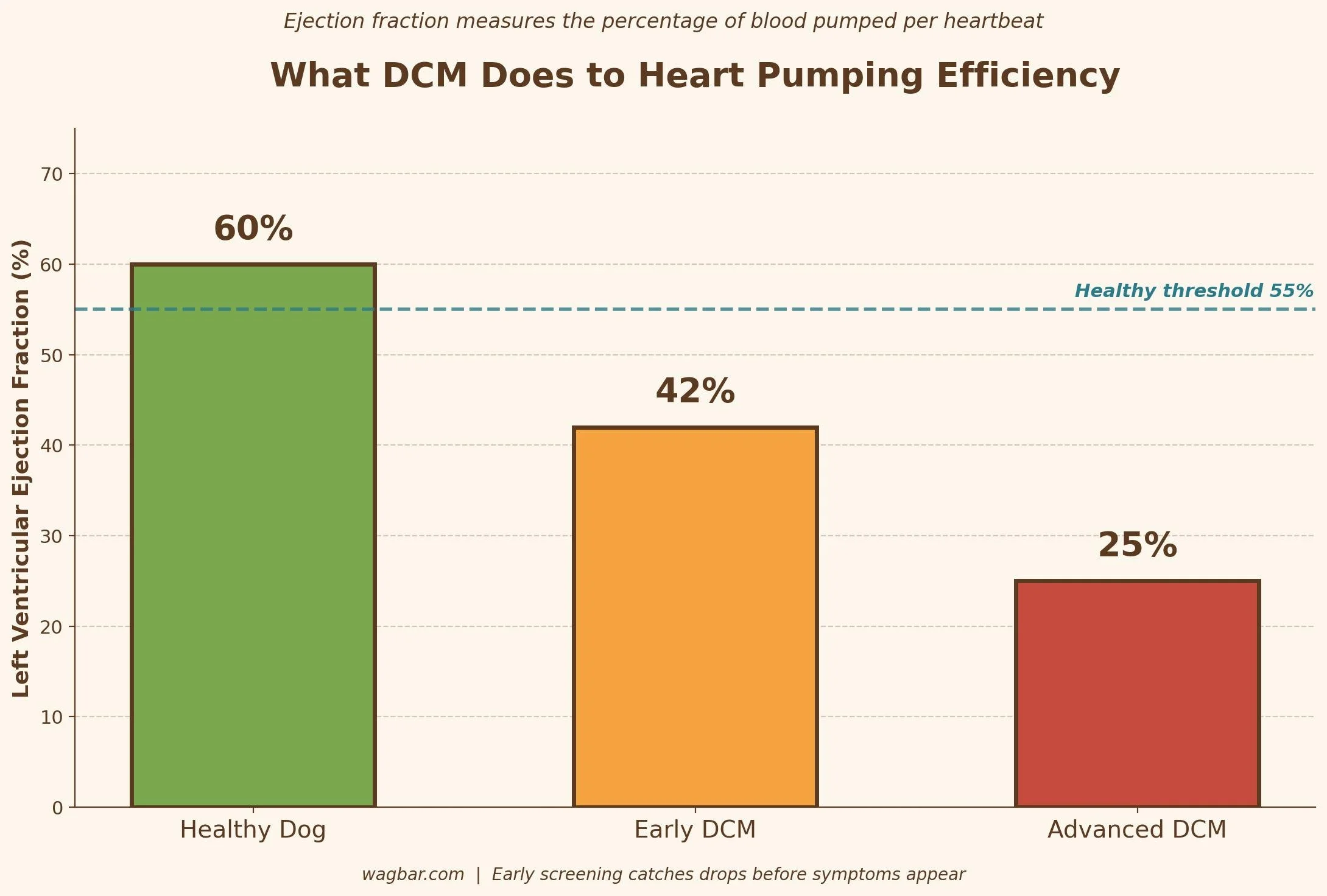
An echocardiogram measures the left ventricular internal diameter, fractional shortening, and ejection fraction directly. Pair that with an NT proBNP blood test, which detects cardiac stretch and stress, and vets get a picture of whether the heart is quietly compensating. Screening a Doberman or Boxer annually catches DCM years before symptoms, and the same protocol makes sense right now for Goldens on legume heavy diets. Owners familiar with our off leash training checklist already understand the value of catching physical issues early rather than late.
Breeds Currently Under Cardiac Watch
Golden Retrievers had a very low DCM rate before 2014. That changed sharply during the grain free popularity peak. Doberman Pinschers, Boxers, and Great Danes already carried known genetic DCM predispositions, but their reported case counts still climbed in FDA data during that period. Cocker Spaniels reappeared as a taurine deficient DCM breed after decades of quiet. Miniature Schnauzers, Whippets, English Bulldogs, and even Labrador Retrievers showed up more often than expected. Some breeds not typically associated with cardiac disease at all, like Shih Tzus and Bichon Frises, appeared in scattered case reports.
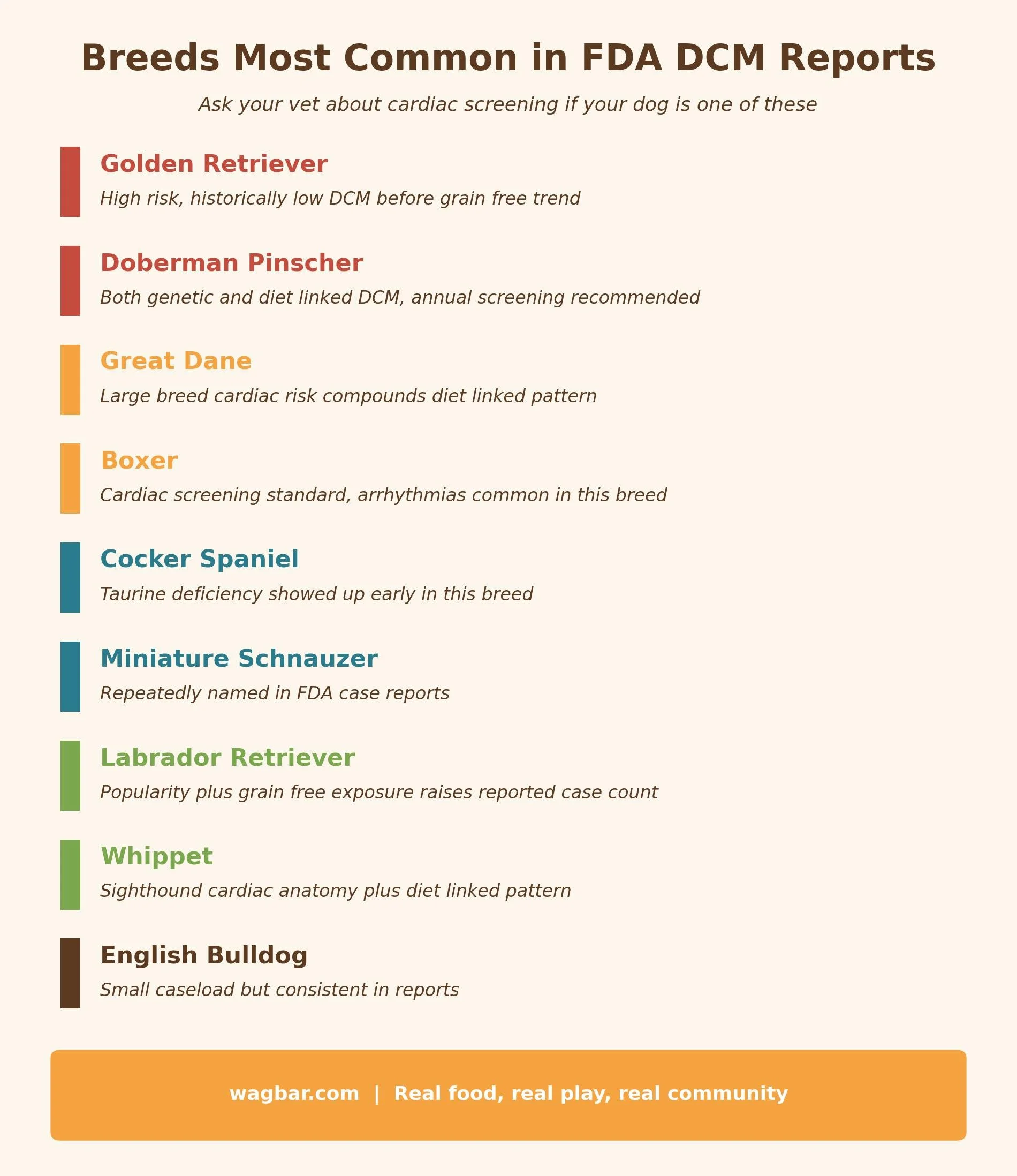
If your dog has any of these breeds in their background and you feed a grain free bag, this is where the conversation with your vet needs to happen at the next visit. Owners of Goldens can cross reference our Golden Retriever breed guide for other health markers worth watching. Households running two or more dogs on separate feeding plans can lean on the multi dog household breed compatibility page for how to manage split feeding stations without either dog stealing from the other bowl.
The Boutique Trap and the Beige Bag Comeback
Boutique brands built a marketing story that grain free was premium, ancestral, and "clean." That story sold enormously well from 2014 through 2019. It also skipped one detail. Board certified veterinary nutritionists were rarely involved in developing these foods. The FDA specifically flagged 16 brands with the highest DCM case counts, including Acana, Zignature, Taste of the Wild, 4Health, Earthborn Holistic, Blue Buffalo, and Merrick. Some of these brands have since reformulated. Others haven't. The bags look nearly identical on the shelf regardless of what changed inside.
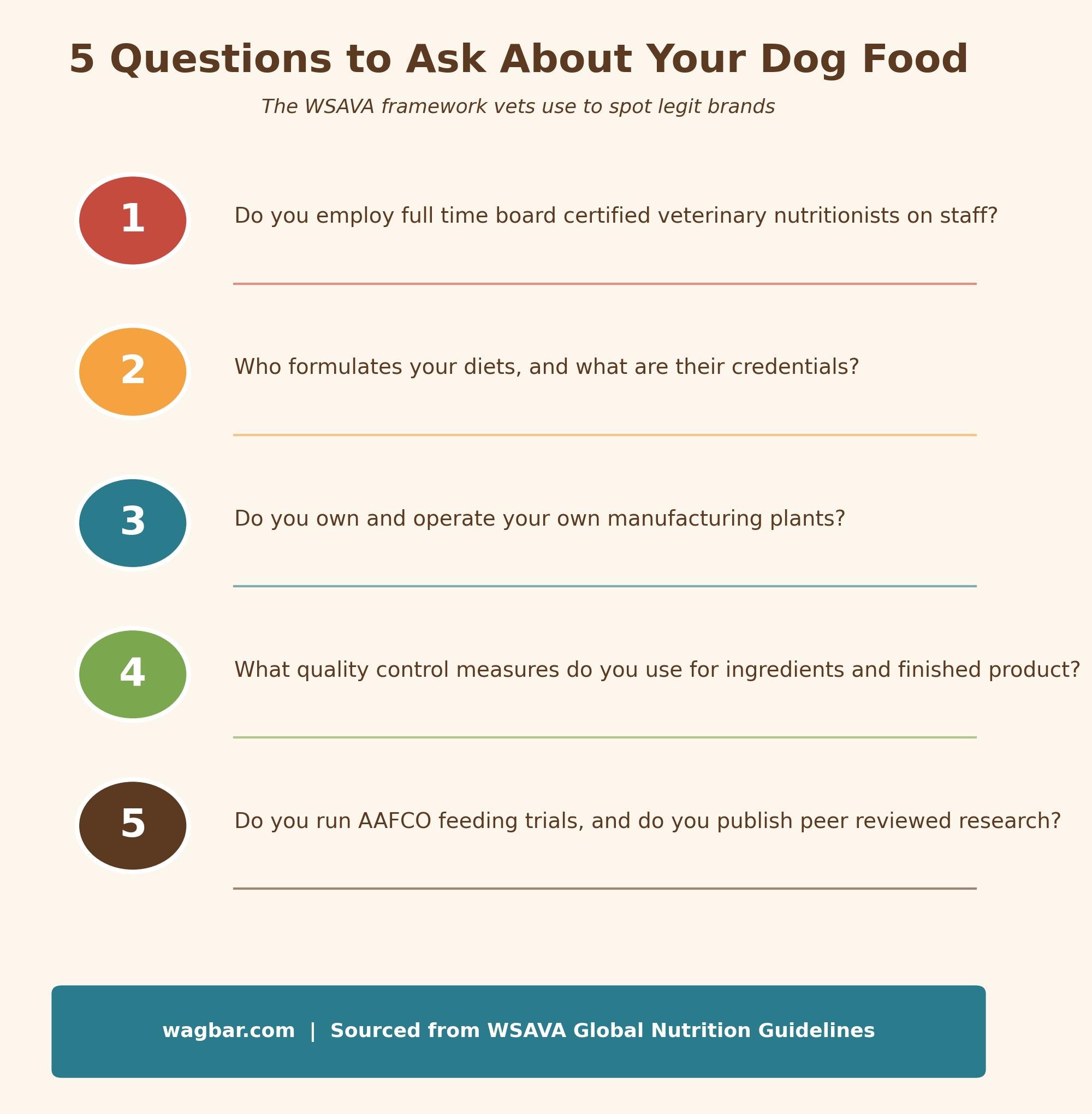
Meanwhile, the boring beige bags from Purina Pro Plan, Royal Canin, Hill's Science Diet, and Iams kept doing what they always did. Employing full time PhD veterinary nutritionists on staff. Running AAFCO feeding trials. Publishing peer reviewed research in cardiology and nutrition journals. Owning their manufacturing plants end to end. WSAVA (World Small Animal Veterinary Association) has a nutrition guidelines document that lists exactly what to ask. If a brand can't answer the WSAVA questions, that's your answer.
What Gen Z Dog Parents Are Missing
Okay, the marketing worked really well on us. If you're in your 20s or 30s and got your first dog during the pandemic, you probably picked out food based on the packaging vibe. Clean design, sans serif fonts, moody mountain photography, ingredient lists in lowercase san serif. That was a whole aesthetic in 2020 to 2022 pet marketing. And honestly, some of those bags are still probably fine for adult dogs of low risk breeds. But if you have a Golden or a Dobie and you bought that food because it "felt right" at Petco, ask your vet whether to switch. Cardiac silence is not a personality trait, it's a warning.
The other piece aging weirdly is the "biologically appropriate" and "ancestral diet" language on some of those bags. Dogs are not wolves. Their AMY2B gene copy numbers, which control amylase production, are dramatically higher than wolves. Domestic dogs evolved to digest starches alongside humans over 15,000 years of coexistence. The "wolf ancestor" branding is scientifically flat wrong. Feeding your Chihuahua like a wolf is not respecting their nature, it's ignoring 15,000 years of evolution. It's like insisting humans should only eat what cavemen ate while ignoring that we invented agriculture 10,000 years ago.
If you already threw the bag out and switched, no notes, you're ahead of the curve. If you're still on a legume heavy bag and your dog seems fine, please still book the cardiac screening. Silent DCM doesn't care how your dog seems. It cares what the echocardiogram shows. Your dog can't advocate for their own heart. That's your job now.
What Cardiologists Are Currently Recommending
The consensus from veterinary cardiology has settled into a few practical points. Feed a food that meets WSAVA standards, developed by a board certified veterinary nutritionist, from a manufacturer that owns its plants and publishes research. If your dog is on a legume heavy grain free diet and has any of the at risk breeds in their background, ask for a whole blood taurine level test and consider a baseline echocardiogram. If diet linked DCM is caught early, switching foods and supplementing taurine when indicated can reverse the ventricular changes on follow up imaging over 3 to 6 months.
That third point is the wild one. Dilated cardiomyopathy in humans is generally not reversible once diagnosed. In dogs on legume heavy diets, when caught early, hearts have been documented remodeling back toward normal size and function after diet correction. That is one of the more surprising findings in small animal cardiology in the past decade. It's also why the current warnings still matter. The disease can be caught and stopped, but only if owners actually get the message.
Wagbar's Role in the Bigger Nutrition Picture
Wagbar started in Asheville, North Carolina as an off leash dog park paired with a real bar, and it has grown into a national brand with locations open or in development across Knoxville, Richmond, Charlotte, South Asheville, Dallas, Los Angeles, Long Beach, Savannah, Myrtle Beach, Cincinnati, Frederick, Phoenix, Orlando, and Cary. The Asheville location earned a spot on USA Today's 10Best list of dog bars in 2024 and was voted Best Pet Friendly Bar in Western North Carolina multiple years running by Mountain Xpress readers. What matters for the grain free conversation is that Wagbar's community sees this play out live. Members compare notes on which bags their vets flagged, which cardiologists they trust, and which grain inclusive brands their dogs actually enjoy. That kind of peer knowledge, traded across a picnic table with a beer while dogs play, is how nutrition trends get vetted in real households across the country.
Talking to Your Vet Without Getting Defensive
Most owners get uncomfortable when their vet brings up food. The instinct is to defend the choice. Don't. Your vet isn't judging your love for your dog. They're pointing at data from cardiology journals. Come in prepared. Bring the current bag or a photo of the ingredient list. Ask three specific questions. Does my dog's breed profile suggest cardiac screening? Do you recommend a whole blood taurine level test? If I switch foods, what brands do you personally trust for my dog's life stage and body condition?
Cardiac screening runs roughly $400 to $700 for a basic echocardiogram in most metro areas, sometimes less at teaching hospitals like the University of Tennessee College of Veterinary Medicine in Knoxville, Cornell University, or NC State College of Veterinary Medicine in Raleigh. Pet insurance often reimburses cardiac diagnostics under illness or specialist referral coverage. Our page on pet insurance monthly premium breaks down which policies actually cover this kind of screening in practice.
Frequently Asked Questions
Did the FDA close the DCM investigation?
No. The FDA paused public updates in December 2022 but confirmed the investigation remains open. Independent research at Tufts, UC Davis, Cornell, and other veterinary schools continues collecting cases and publishing findings in peer reviewed journals.
Are big brands like Purina and Hill's actually better than boutique brands?
For most dogs, yes, based on the WSAVA compliance framework. Major manufacturers employ full time board certified veterinary nutritionists, own their manufacturing plants, run AAFCO feeding trials, and publish peer reviewed research. Many boutique brands do not meet these standards, though some smaller companies do.
What percentage of dogs on grain free diets develop DCM?
The FDA data does not give a clean percentage because it relied on voluntary reporting. Not every case gets reported to the agency, and many dogs on grain free diets never develop DCM. What the reports show is a case pattern in breeds that historically had low DCM rates, which points at diet as a contributor rather than a certainty.
Can I feed a limited ingredient diet without falling into the BEG trap?
Yes, if the limited ingredient food is from a WSAVA compliant maker. Prescription diets like Hill's Prescription Diet z/d and Royal Canin Hydrolyzed Protein meet limited ingredient needs while being properly balanced for cardiac safety.
Should I get a second opinion if my vet dismisses my grain free concern?
Yes. If your vet isn't current on the cardiology research, request a referral to a veterinary cardiologist or a board certified veterinary nutritionist. Cardiologists across North America have adopted screening protocols and can walk you through what to test and interpret.
Are freeze dried or air dried foods safer than grain free kibble?
Not automatically. Freeze dried and air dried foods can still be legume heavy or produced by boutique makers without proper formulation oversight. Check the ingredient list and the manufacturer's WSAVA compliance regardless of the processing method.
Is home cooking safer than boutique grain free food?
Home cooking without a veterinary nutritionist's recipe is often nutritionally incomplete on calcium, zinc, iodine, choline, and other micronutrients. If you want to home cook, work with a board certified nutritionist through the American College of Veterinary Nutrition (ACVN) directory or use a service like BalanceIT.com to build a balanced recipe.
Does anxiety or reactivity connect to diet linked DCM?
Not directly, but a dog with cardiac fatigue from early DCM can show behavior changes like reluctance to play, snappiness, or withdrawal that get misread as behavioral problems. Our reactive dog training resource covers the behavior side while your vet handles the medical side.
What if my dog is a mixed breed with an unknown background?
If your dog has physical traits suggesting Golden Retriever, Doberman, Boxer, Great Dane, or Cocker Spaniel heritage, treat them as at risk. DNA tests from Embark or Wisdom Panel can identify breed makeup and help your vet decide whether cardiac screening makes sense.
Where This Leaves Owners in 2026
The grain free trend was a marketing success and a nutritional gray zone at the same time. Some dogs handled those diets without any issue. Others didn't. Cardiologists can't tell which is which without an echocardiogram, and the FDA stopped making public noise so most owners never got the memo. If your dog is a Golden, a Dobie, a Boxer, a Great Dane, a Cocker Spaniel, or has one of those breeds in the background, and you're feeding legume heavy grain free food, book the cardiac screening. Bring your bag to your vet. Ask the direct questions.

Still figuring out your next move? Our FAQ page tackles the questions most owners send us about diet, membership, and what a normal day at the park actually looks like. Curious about bringing this model to your neighborhood or want to chat with a real person about it? Reach out through Wagbar franchising and someone from the team will walk you through the whole thing without any pressure.