
Every Pet Food Label Hides Something and This Is How Nutritionists Read It

Pet food labels are legally required regulatory documents, not marketing copy, and yet they're written in a way that hides critical information behind formatting quirks, ingredient splitting tactics, and vague terminology approved by the Association of American Feed Control Officials (AAFCO). Board certified veterinary nutritionists at institutions like Tufts Cummings School of Veterinary Medicine know exactly what to look for when they flip a bag over, and most of what they check gets skipped by regular owners in three seconds flat. This piece walks through the six mandatory sections every US pet food label must contain, how ingredient splitting inflates the apparent meat content of a bag, what the AAFCO Nutritional Adequacy Statement actually promises versus what it only implies, how to identify a food that meets the WSAVA Global Nutrition Guidelines, and how to spot the calorie content line most owners never even see. Read the whole thing and you'll flip a bag the way a cardiologist reads an echocardiogram, hunting for what's missing rather than what's advertised.
Curious how a community built around dog wellness actually approaches this stuff day to day? Take a peek at our about the Wagbar story page for how the whole thing started, or browse the FAQ for the questions members send us about food, membership, and daily park life. Zero judgment if you've been feeding the wrong bag. Everyone starts somewhere.
The 6 Mandatory Sections Every US Pet Food Label Must Have
Under federal law and state feed control statutes, every dog food label sold in the United States must contain six specific elements. Product Identity (brand and product name), Net Weight Statement, Guaranteed Analysis Panel, Ingredient Statement, Nutritional Adequacy Statement (also called the AAFCO statement), Feeding Directions, Calorie Content Statement, and Manufacturer's Contact Information. These requirements are enforced state by state through the FDA's Center for Veterinary Medicine using AAFCO Model Regulations as the reference framework.
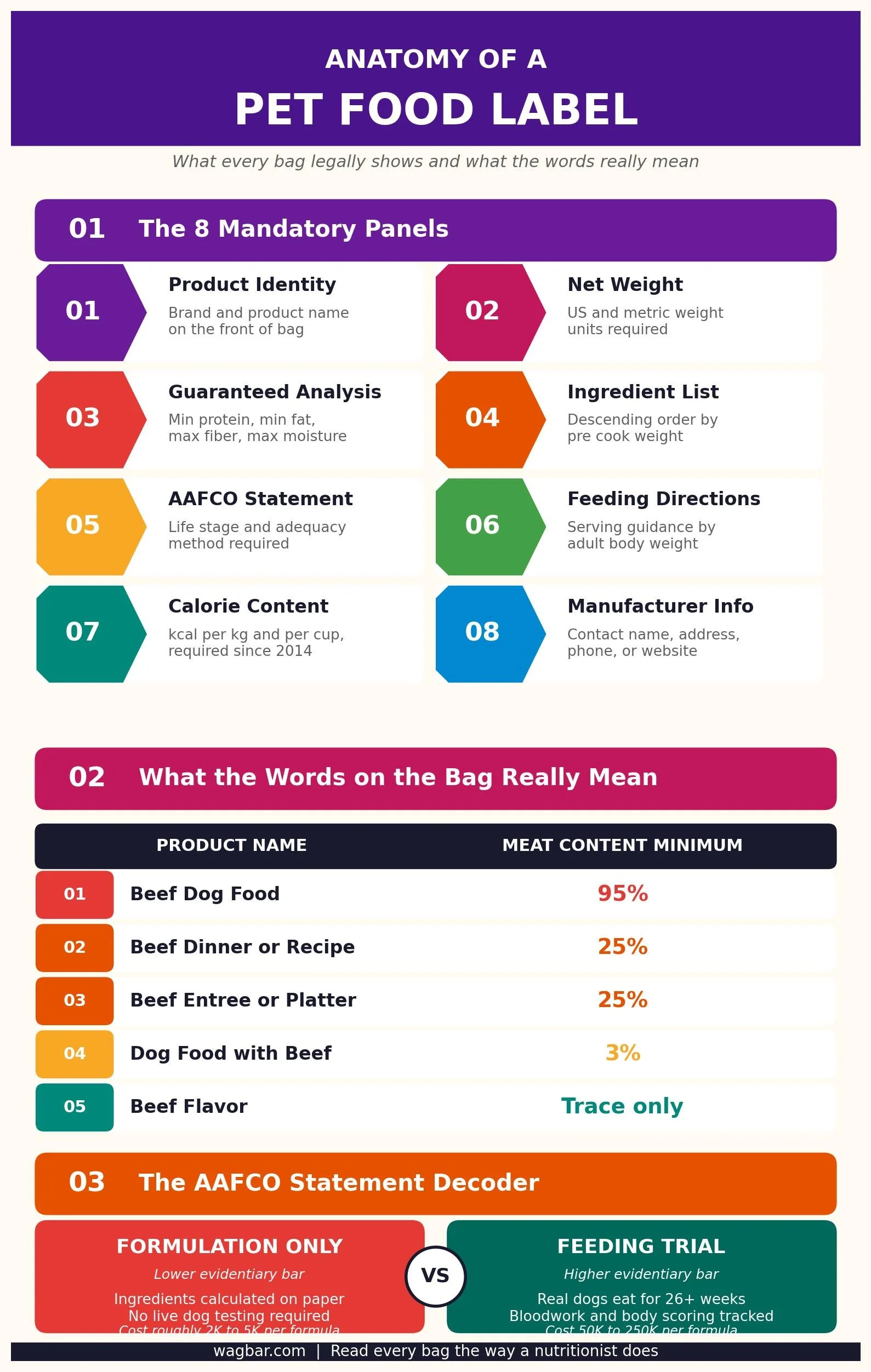
Caption: Every US pet food label is legally required to contain these panels. Missing any one signals a compliance issue worth flagging.
Regulatory research on these requirements is publicly available through AAFCO consumer resources and cross referenced in peer reviewed veterinary nutrition literature indexed on Google Scholar.
What Guaranteed Analysis Actually Guarantees
The Guaranteed Analysis panel is required to list only four numbers. Minimum crude protein percentage, minimum crude fat percentage, maximum crude fiber percentage, and maximum moisture percentage. That's it. No maximum protein, no minimum fat, no source or quality description, and no digestibility data. A food advertising "26% protein minimum" could contain 40% protein sourced partly from pea protein isolate or wheat gluten and still comply completely with the regulation.
According to research summarized by Tufts Petfoodology, the guaranteed analysis is a lower bound, not a description of the food's actual composition. Board certified nutritionists convert these numbers to a dry matter basis when comparing foods, because a 10% moisture kibble and a 78% moisture canned food cannot be compared as printed. The dry matter formula divides the nutrient percentage by (100 minus moisture percentage) and multiplies by 100. Your vet can walk you through this in five minutes at any annual visit.
Ingredient Splitting Is the Oldest Trick on the Bag
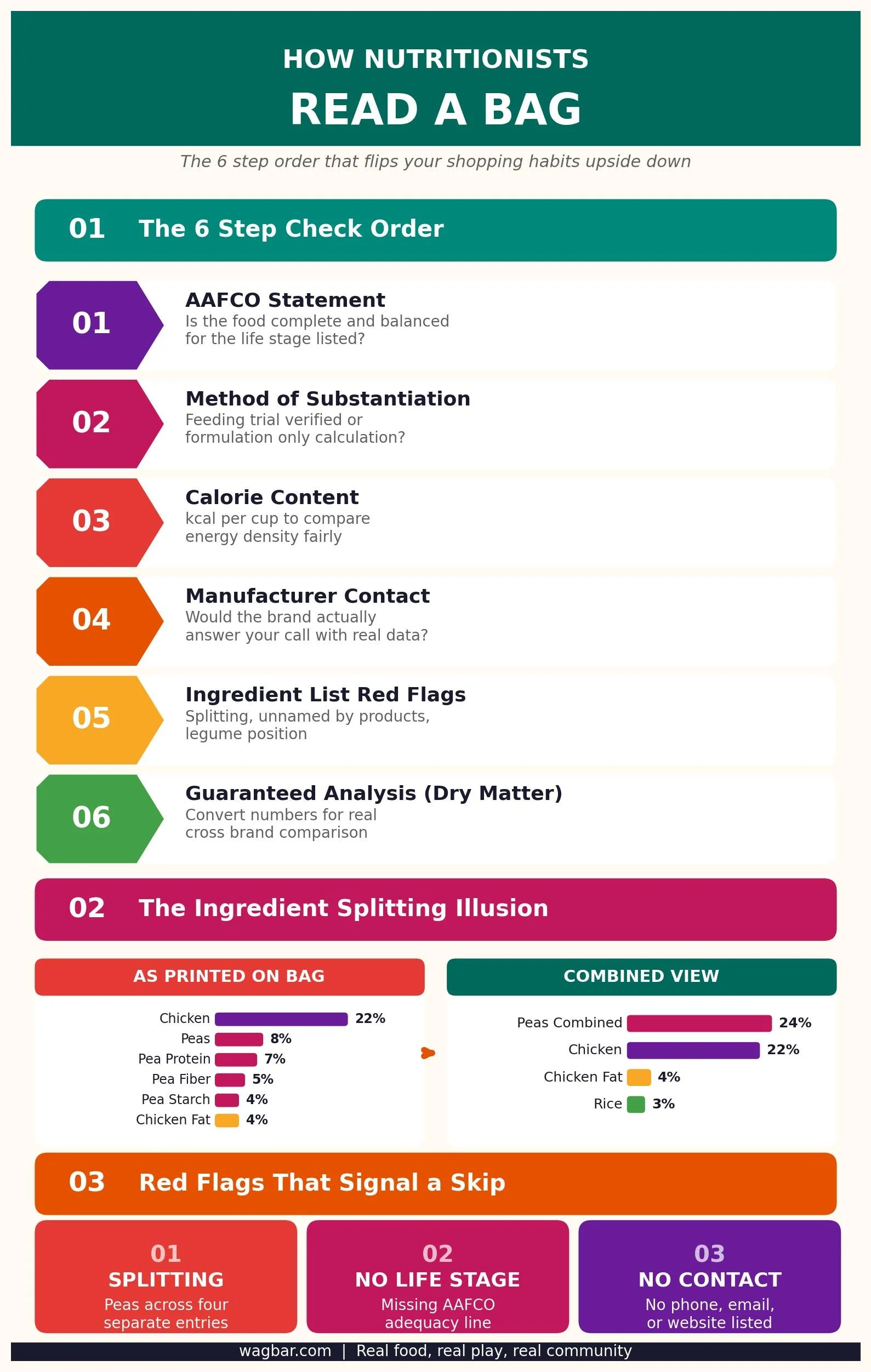
Pet food ingredients on a US label must be listed in descending order by weight before cooking. Manufacturers exploit this rule by splitting a single ingredient into multiple named forms so no single legume or grain sits at the top. If you see peas, pea protein, pea fiber, and pea starch listed as four separate ingredients across the top ten slots, that's ingredient splitting. Combined, those four peas would probably outweigh the named meat sitting at position one.
Caption: When you combine the split ingredients back together, the true carbohydrate story of the bag becomes visible. This is what nutritionists mentally calculate as they read.
This practice is legal under AAFCO rules but repeatedly criticized by board certified veterinary nutritionists who point out that ingredient splitting obscures the actual protein and carbohydrate profile. Kaplan and colleagues published research in PLOS ONE (2018) documenting ingredient splitting patterns across grain free formulas that were later linked to dilated cardiomyopathy cases in Golden Retrievers (Google Scholar reference). Freeman et al. published a companion analysis in the Journal of the American Veterinary Medical Association (JAVMA) that same year covering diet associated DCM patterns more broadly (Google Scholar reference).
The AAFCO Statement That Everyone Skips
Every complete and balanced dog food carries an AAFCO Nutritional Adequacy Statement, usually buried in the smallest print on the bag. It reads one of two ways. Either the food is "formulated to meet the nutritional levels established by the AAFCO Dog Food Nutrient Profiles" for a specific life stage (adult maintenance, growth and reproduction, or all life stages) OR "animal feeding tests using AAFCO procedures substantiate that this product provides complete and balanced nutrition" for that life stage.
Caption: A feeding trial statement means real dogs actually ate this food under supervised protocols. A formulation only statement means the ingredients look right on paper. The difference is significant.
The feeding trial version is dramatically stronger. Formulation only means the ingredients added up to AAFCO minimums on a spreadsheet. Feeding trial means real dogs ate the food for at least 26 weeks under supervised protocols with monitored bloodwork, body condition scoring, and reproductive outcomes when applicable. Most boutique brands use the cheaper formulation only statement because feeding trials cost tens of thousands of dollars per formula. Research indexed on PubMed covers the methodological differences in depth.
Marketing Words That Have Actual Regulatory Meaning
Some words on pet food labels carry legal definitions. Others carry none at all. "Beef Dog Food" must be at least 95% beef excluding water added for processing. "Beef Dinner," "Beef Entree," or "Beef Recipe" only needs 25% beef. "Dog Food with Beef" only needs 3% beef. "Beef Flavor" needs beef to be detectable in taste tests, which can be as little as trace amounts. These naming rules are codified in the AAFCO Official Publication and enforced through state feed control officials.
Caption: The exact same protein claim can mean 95 percent or trace amounts depending on the wording. This is why nutritionists read the product name carefully before anything else.
Terms like "natural," "premium," "gourmet," and "holistic" have no regulatory definition in pet food at all. They mean whatever the marketing team decided they meant. "Organic" is the exception because it falls under USDA National Organic Program rules and can be verified through the USDA Organic INTEGRITY Database for any certified brand.
Feed Grade vs Human Grade vs Feed Ingredient Grade
Most pet food ingredients are "feed grade," which means they meet animal feed standards but not human food standards. "Human grade" is a stricter AAFCO defined term that requires every ingredient to be edible for people at every step of the supply chain and the manufacturing facility to hold human food licensing. Only a small number of pet food brands actually meet the full human grade standard, and they must document it if audited by state feed control officials.
Feed ingredient grades vary by ingredient. Meat meals, for example, come in several tier levels depending on the animal source, rendering temperature, and quality control at the processing plant. Boutique brands sometimes claim "human grade" without meeting the full AAFCO defined requirement, and enforcement is inconsistent across states. Academic reviews of this regulatory gap are available through Google Scholar.
The Calorie Content Line You Probably Missed
Since 2014, AAFCO has required every complete and balanced pet food to include a Calorie Content Statement measured in kilocalories per kilogram (kcal/kg) and usually also expressed per cup or per can. Most owners never look at this line. It's how you calculate the right feeding amount for your dog's ideal body weight, and it's where you spot calorie dense boutique foods that drive slow weight gain over years without any warning.
A typical adult maintenance kibble runs 350 to 450 kcal per cup. Some grain free legume heavy formulas hit 500 kcal per cup or higher. Feed the same visual scoop and your dog gains weight steadily. The WSAVA Body Condition Score chart is the nine point scale nutritionists use to track this over time.
What Nobody Told You About Pet Food Marketing
Okay so the way pet food marketing works is basically fashion marketing with dog photos. Every year there's a new "clean" trend. Grain free was the athleisure era of pet food. Now it's raw, freeze dried, and "biologically appropriate." The bag design changes, the tagline changes, but the AAFCO panel on the back stays boring. That's the panel nutritionists actually care about. The front of the bag is basically vibes with a golden retriever on it.
Also worth knowing, the influencer economy for pet food is enormous. Some of the "vet recommended" claims you see on TikTok and Instagram are paid partnerships from brands that don't employ full time board certified veterinary nutritionists. Real ACVN diplomates are pretty rare. There are only around 100 board certified veterinary nutritionists in the entire United States according to the American College of Veterinary Nutrition. If you're taking food advice from a lifestyle account with 200k followers, ask yourself who's actually formulating what they recommend. Odds are it's a marketing team, not a PhD nutritionist.
The good news is reading labels is a learnable skill. Once you understand what the six panels mean and what to check first, you can walk into any pet store and identify a solid bag in about 30 seconds. Your future dog thanks you for the effort. It's giving informed consumer energy.
What Nutritionists Actually Check First
Board certified veterinary nutritionists have a specific checking order that flips the typical owner habit on its head. First, they read the AAFCO Nutritional Adequacy Statement to confirm the food is complete and balanced for the intended life stage. Second, they note whether the statement is formulation based or feeding trial verified. Third, they check the calorie content per cup to compare energy density across candidates. Fourth, they scan the manufacturer contact info, because they will actually pick up the phone and ask questions. Fifth, they look at the ingredient list for red flags like ingredient splitting or unnamed by products. Sixth, they convert the guaranteed analysis to a dry matter basis for real comparison.
According to Tufts Petfoodology resources, most owners look at the ingredient list first, which is the most manipulable section of any bag because of splitting practices. Reading in the order nutritionists use stops the marketing story from anchoring your read.
Where Wagbar Fits Into the Label Conversation
Wagbar started in Asheville, North Carolina as an off leash dog park paired with a real bar, and has grown into a national brand with locations open or in development across Knoxville, Richmond, Charlotte, South Asheville, Dallas, Los Angeles, Long Beach, Savannah, Myrtle Beach, Cincinnati, Frederick, Phoenix, Orlando, and Cary. The Asheville location earned a spot on USA Today's 10Best list of dog bars in 2024 and was voted Best Pet Friendly Bar in Western North Carolina multiple years running by Mountain Xpress readers. What matters for the label conversation is that Wagbar's community sees the ripple effects when owners upgrade their food after learning to read a bag properly. The parks fill with dogs whose coats got shinier, whose weight got right, whose energy leveled out, and whose social behavior settled because their humans figured out that the guaranteed analysis on their old bag wasn't guaranteeing much of anything.

How to Read a Bag in 30 Seconds
The next time you're at a big box pet store, pull a bag off the shelf and flip it over first. Don't look at the front. Find the AAFCO Nutritional Adequacy Statement and read it word for word. Note whether it says formulation or feeding trial. Check the calorie count per cup. Skim the ingredient list looking for splitting patterns like multiple pea derivatives or lentil variants. Find the manufacturer's phone number and website. If any of these are missing or printed in text harder to read than a prescription warning label, that tells you a lot about how much the brand actually respects your ability to make an informed decision.
You don't need to be a nutritionist to spot the tells. You just need to know where they hide. Save this piece and reference it next time you shop. Better yet, take the six point check to your vet at the next annual visit and ask them to walk through your current bag section by section. That is a 15 minute conversation that has changed real health outcomes for real dogs across the country. If your dog needs more physical outlets alongside a better diet, our off leash training checklist covers how to get them ready for real park time.
Frequently Asked Questions
How do I convert guaranteed analysis to dry matter basis?
Take the nutrient percentage and divide it by (100 minus the moisture percentage), then multiply by 100. For a kibble with 26% protein and 10% moisture, dry matter protein equals (26 divided by 90) times 100, which comes out to 28.9% on a dry matter basis. This lets you compare dry kibble and wet canned food fairly.
Does AAFCO test or approve pet foods directly?
No. AAFCO is a nonprofit that publishes model regulations and nutrient profiles. Individual states adopt AAFCO standards and their state feed control officials enforce them. The FDA also has federal authority through the Center for Veterinary Medicine, but state officials handle most day to day enforcement.
What does "for intermittent or supplemental feeding only" mean on a label?
It means the food is not complete and balanced for daily feeding. It's designed as a topper, a treat, or a nutritional supplement, not a full diet. If you see this statement, do not use the food as your dog's main meal.
Are ingredient splitting practices actually illegal?
No, but they are considered misleading by many veterinary nutritionists. AAFCO rules allow separate listing of chemically distinct ingredient forms (pea protein isolate versus whole peas versus pea fiber count as separate ingredients under current rules). Advocacy groups have pushed for reform, but enforcement remains unchanged as of 2026.
How do I find a board certified veterinary nutritionist?
The American College of Veterinary Nutrition publishes a directory of diplomates. There are roughly 100 board certified veterinary nutritionists practicing in the United States, some in academic settings, some in private consulting, and some employed by major pet food manufacturers.
Is a food's price a reliable quality signal?
No. Some of the highest priced boutique foods have thinner nutritional documentation than mid priced foods from major manufacturers with in house PhD nutritionists. Price reflects marketing, packaging, and ingredient sourcing, not automatic nutritional superiority.
What if my dog has been eating a food that fails the label check for years?
If your dog is currently healthy, don't panic. Book a wellness visit with your vet, review the current food, and plan a slow transition over 10 days if a change is warranted. Sudden food changes can cause GI upset. Bloodwork can identify any deficiencies that might already be developing.
Where can I read the actual AAFCO nutrient profiles?
The full AAFCO Official Publication is available for purchase through AAFCO's official site, and summary tables are published free on Tufts Petfoodology and other academic veterinary nutrition resources.
Does the same label logic apply to cat food?
Yes, with different nutrient profiles. Cats are obligate carnivores and require higher protein minimums, dietary taurine, and specific amino acids like arachidonic acid that dogs can synthesize. The label reading order stays the same. AAFCO statement, feeding trial or formulation, calories, contact info, ingredients, guaranteed analysis.
Where This Goes From Here
Reading a label properly is one part of the whole dog wellness picture. The other part is what happens after the food does its job. Bring your well fed pup to the Play and Unwind side of the community and see what a park full of thriving dogs looks like when their owners have actually done their homework. Or check out our Wagbar location list to find a park near you and swap notes with owners who've been through their own label reading education.