
Free Feeding Is Slowly Making Your Adult Dog Sick and Owners Don't See It

Free feeding, the practice of leaving a full bowl of kibble out all day for your adult dog to graze from, feels like the easiest and most natural feeding method. Your dog eats when hungry, you don't have to schedule anything, and the bowl gets refilled when it looks low. In reality, free feeding creates a slow drip of health problems that most owners don't catch until years into the pattern. Weight gain sneaks up. Appetite changes get missed. Kibble oxidizes in the bowl. Behavior around food deteriorates.
According to the Association for Pet Obesity Prevention, roughly 6 in 10 adult dogs in the United States are now overweight or obese, and free feeding is one of the most common feeding patterns in those households. This piece explains why board certified veterinary nutritionists recommend scheduled meals instead, what specific health issues free feeding accelerates in adult dogs, and how to switch your pup to a proper feeding routine without triggering a meltdown at home.
Reading this while your dog is napping under a table full of drink glasses? Head to Play and Unwind for what a properly fed adult dog looks like at a Wagbar location, or browse our FAQ for the feeding and health questions members send us most often.
The Damage Adds Up Before Symptoms Appear
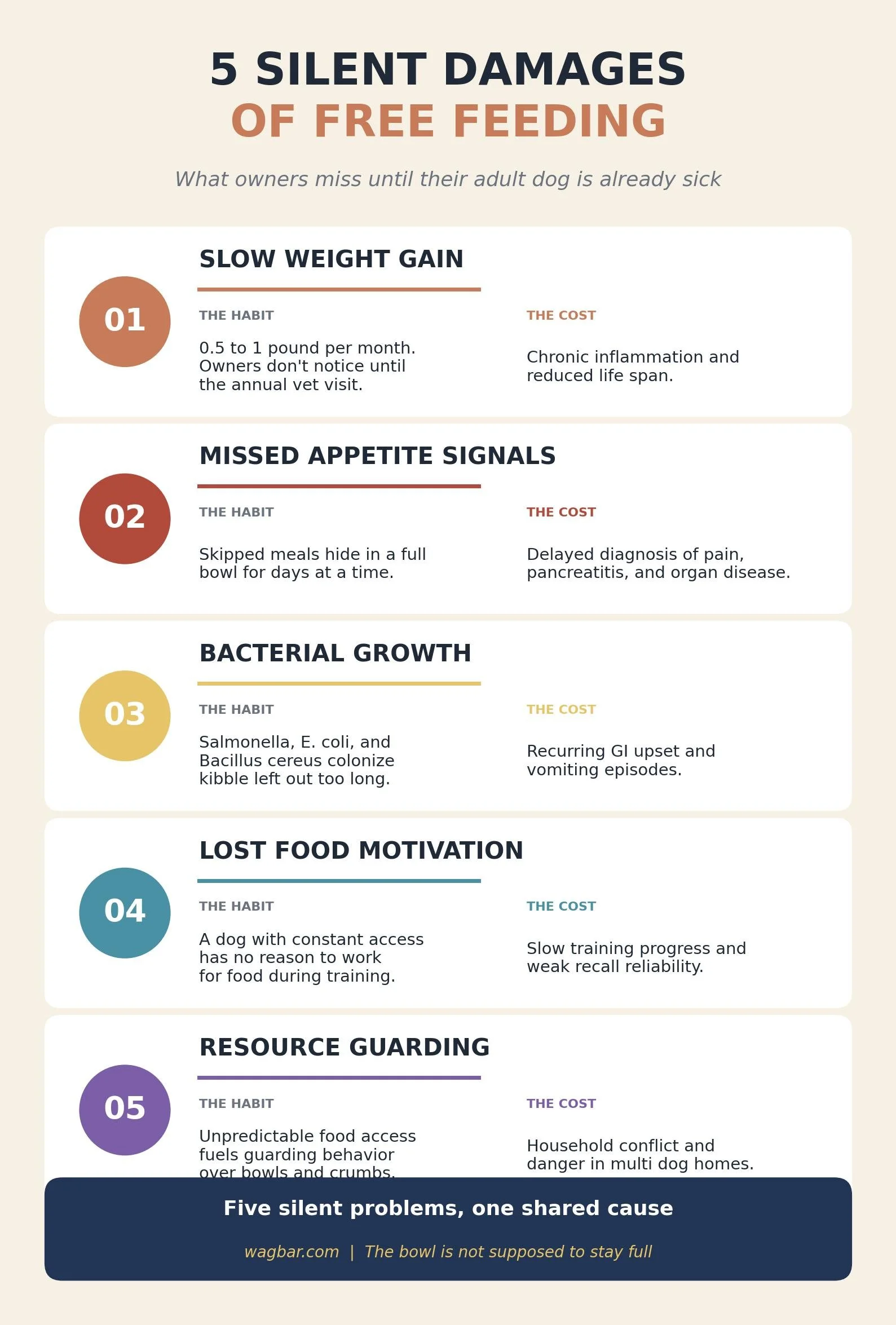
Free feeding damages dogs in ways that don't show up on the couch. The bowl looks fine, the dog is eating something, the owner has no visible reason to worry. Meanwhile several problems are quietly stacking up in the background.
Small amounts of daily overeating accumulate over months. A 40 pound adult dog needs roughly 900 to 1100 kcal per day for maintenance. Free fed dogs commonly consume 15 to 25 percent more than this because kibble is calorie dense and easy to graze between naps.
Fat cells expand and start driving low grade chronic inflammation that impacts joint cartilage, insulin sensitivity, and cardiac function over time. Research published in the Journal of Veterinary Internal Medicine and the Journal of the American Veterinary Medical Association documents this inflammatory cascade in dogs across multiple peer reviewed studies.
Appetite becomes background noise. When food is always available, tracking daily food intake is impossible. Skipped meals, which are one of the earliest warning signs of pain, nausea, dental disease, or organ dysfunction, become invisible to the owner.
How Free Feeding Became the American Default
Free feeding wasn't always common. In the 1970s and earlier, most dogs ate scheduled meals because dog food was expensive and food storage in kitchens was more manual. As kibble prices dropped and self dispensing storage bins became popular in the 1990s, free feeding spread rapidly because it was convenient for owners with variable work schedules. The pet food industry pushed the idea because higher food volume in the bowl means faster refills and higher food sales per household. That's a market incentive, not a nutritional recommendation. Tufts Petfoodology, run by Dr. Lisa Freeman and colleagues at Tufts Cummings School of Veterinary Medicine, has published critical reviews of the free feeding trend and its downstream health effects for years.
Why the Weight Gain Is So Sneaky
Weight gain from free feeding creeps in at maybe half a pound to a full pound per month. Owners see their dog every day, so the visual change is invisible. Then at the annual vet visit, the scale shows the dog is now 8 to 12 pounds heavier than optimal, and the vet gently mentions a body condition score of 6 or 7 out of 9 on the WSAVA Body Condition Score chart.
Even a mildly overweight dog carries measurable health consequences. Studies published in the Journal of the American Veterinary Medical Association (JAVMA) and other veterinary journals have documented that dogs kept at ideal body condition live roughly 1.5 to 2 years longer than their overweight counterparts, and they have a fraction of the arthritis, Type 2 diabetes mellitus, and cardiac disease incidence. The famous Purina Life Span Study tracked Labrador Retrievers for 14 years and confirmed this effect through peer reviewed publications in JAVMA. Full study documentation is available through the PubMed database for anyone who wants to read the primary literature directly.
Breeds most susceptible to obesity from free feeding include Labrador Retrievers (with a documented POMC gene variant affecting satiety signaling), Beagles, Dachshunds, Cocker Spaniels, Cavalier King Charles Spaniels, Basset Hounds, Rottweilers, Pugs, and English Bulldogs. If you own any of these breeds, scheduled meals matter even more.
The Missed Appetite Signal
The most underrated risk of free feeding is the diagnostic blind spot it creates. A healthy dog eats their meals consistently. When a scheduled feeder skips a meal, the owner knows within hours. When a free feeder skips a meal, the owner might not notice for a day or two because the bowl still has food in it. The dog just isn't touching it.
Skipped meals are the earliest sign of many serious conditions including dental abscesses, pancreatitis, gastric dilatation volvulus (bloat), hepatic lipidosis, canine parvovirus in unvaccinated dogs, hyperthyroidism, kidney disease, and various cancers. When you catch appetite change early, treatment options are broader and outcomes are better. When you catch it late because free feeding masked the change, the disease has often progressed. Our dog health and wellness resource covers other markers worth monitoring alongside appetite.
What's Actually Growing in the Bowl
Kibble left out for 24 hours or more is not the same food you scooped originally. Fats oxidize. Aromatics evaporate. Bacteria colonize the surface, especially if the bowl gets any moisture from a dog's mouth or the air is humid. The most common contaminants documented in veterinary studies are Salmonella spp., E. coli, and Bacillus cereus.
The American Veterinary Medical Association publishes food handling guidance for pet owners that includes cleaning bowls daily with hot soapy water and never leaving kibble in a bowl for more than 24 hours. Free feeding violates both principles by default. The kibble sits, the bowl doesn't get washed until it's empty, and the layer at the bottom becomes a microbe party.
Owners of adult dogs with recurring GI issues (occasional vomiting, loose stool, or gas) often see improvement just from switching to scheduled meals with fresh servings and daily bowl cleaning. This is not a hypothetical benefit, it's a common clinical finding reported by general practice vets nationwide.
The Behavior Bill That Comes Later
Free feeding creates behavior problems that show up months and years later. Trainers rely on food as a primary reinforcer. A dog that always has access to food has no meaningful reason to work for it during training sessions. If you've ever tried to teach a free fed dog a new command and wondered why they seem uninterested, this is why.
Some dogs develop resource guarding over the bowl itself, or over crumbs and dropped food, precisely because food is always around but never predictable in that unusual way. Scheduled feeding creates the predictability that reduces guarding behavior in most dogs.
Multi dog households especially struggle. When multiple dogs share a household and food is always out, dominance dynamics get messy fast. Faster eating, resource guarding, and fights over the bowl become more common. Our multi dog household breed compatibility resource covers how scheduled feeding stabilizes pack dynamics and gives each dog their own predictable meal.
The Real Talk Nobody in the Neighborhood Wants to Have
Okay let's be honest for a second. Most dog owners already know free feeding isn't ideal. They just don't want to change because scheduled feeding requires being home twice a day at consistent times, and that's inconvenient. Fair. But if you have a dog who's slowly getting heavier every year and you keep telling yourself it's just aging, it's probably the food access. Aging alone doesn't add 12 pounds to a 50 pound dog in five years. The bowl does.
The other honest truth is that free feeding is often a boredom management strategy owners don't realize they're using. If your dog is anxious or bored and their coping mechanism is grazing, you're feeding a behavior loop that gets worse over time. Mental enrichment through walks, off leash play, and social time with other dogs replaces the grazing habit. Our urban dog exercise resource covers workouts that redirect anxious grazers into actual movement outlets.
Third thing worth saying, if your vet has been gently mentioning body condition at the last two annual visits and you've been dismissing it, book a follow up. Ask for a taurine level test, a thyroid panel, and a real body condition assessment on the nine point scale. Sometimes the free feeding conversation gets easier when you have actual bloodwork numbers backing it up. You're not being lectured. You're being told your dog is at risk.
What Board Certified Nutritionists Recommend Instead
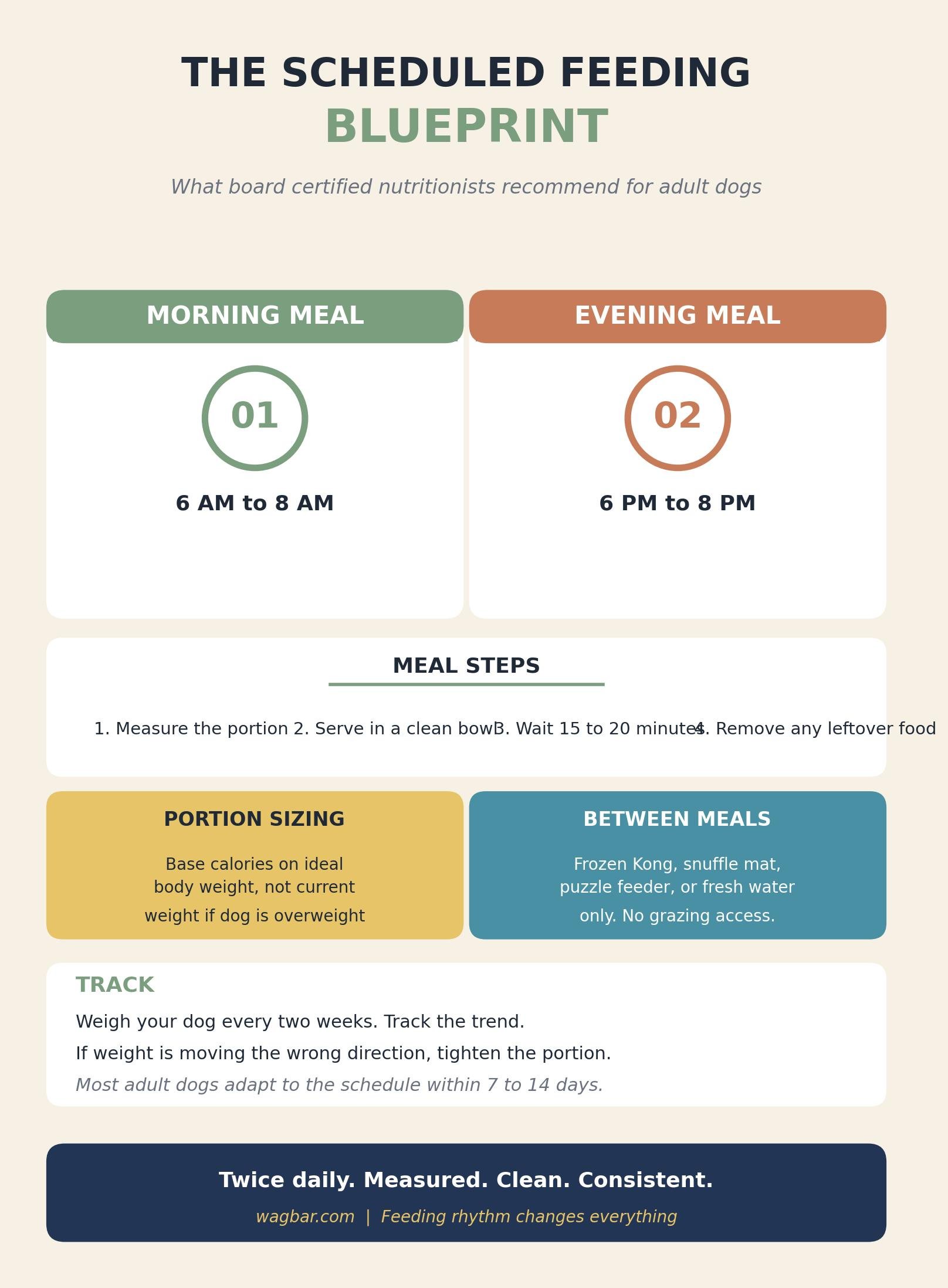
The consensus from board certified veterinary nutritionists is clear. Scheduled meals twice daily for adult dogs. Measure the food. Match the volume to your dog's calorie needs based on ideal body weight, not current weight if your dog is overweight. Serve, wait 15 to 20 minutes, then pick up any uneaten food and store it back in the sealed bag. Repeat 8 to 12 hours later.
Puppies under 6 months eat more often (3 to 4 times daily) as they grow. Adult dogs settle into a 2 meal rhythm. Senior dogs with slower metabolism sometimes benefit from smaller meals 3 times daily. Working dogs, sporting dogs, and pregnant dogs have different calorie needs but still eat scheduled meals rather than free feeding. The American College of Veterinary Nutrition diplomate directory lists board certified nutritionists nationwide for personalized consultations.
Where Wagbar Fits Into the Feeding Conversation
Wagbar started in Asheville, North Carolina as an off leash dog park paired with a real bar, and it has grown into a national brand with locations across Knoxville, Charlotte, Dallas, Los Angeles, Long Beach, Savannah, Myrtle Beach, Cincinnati, Frederick, Phoenix, Orlando, Richmond, South Asheville, and Cary. The Asheville flagship earned a spot on USA Today's 10Best list of dog bars in 2024. Members who visit regularly notice that dogs on scheduled feeding routines play better, socialize better, and have more predictable energy compared with free fed dogs who arrive either over full or under fueled. Scheduled feeding creates the metabolic rhythm that makes off leash play safer and more enjoyable, which is exactly what our locations are built for. Dog bartenders on shift also notice this pattern in the yard, since well fed dogs tend to interact more calmly than dogs pulled from a random grazing schedule.
How to Switch Without a Meltdown at Home
Transition slowly. Start by picking up the bowl for 2 hour blocks during the day so your dog gets used to food being unavailable at certain times. Extend those blocks over a week until you're at two scheduled meals with defined 15 to 20 minute eating windows.
Measure calories using the guaranteed analysis on the bag combined with your dog's ideal body weight. Most dog food bags publish suggested feeding amounts, but these are typically 15 to 20 percent higher than actual maintenance needs. If your dog is currently overweight, feed based on ideal body weight rather than current weight to trigger gradual healthy weight loss over 4 to 6 months.
Add mental enrichment during the between meal hours. A frozen Kong with a small portion of daily calories inside, a snuffle mat with dry kibble, or a puzzle feeder replaces the grazing habit with an appropriate outlet. Physical exercise also matters. Owners of reactive or anxious dogs can start with our reactive dog training resource for calmer walks and better social time at the park.
Weigh your dog every two weeks during the transition. Track the trend. If weight is moving the wrong direction, tighten the portions further. If your dog seems hungry between meals for the first week, that's normal and usually resolves as the body adapts to the new metabolic schedule.
Frequently Asked Questions
Is free feeding ever okay for adult dogs?
Only in narrow circumstances. Puppies under 12 weeks, pregnant or nursing females, and some very underweight dogs recovering from illness may benefit from more frequent access to food under veterinary guidance. Healthy adult dogs should be on scheduled meals twice daily.
How long does it take to switch from free feeding to scheduled meals?
Most adult dogs adapt within 7 to 14 days. Some anxious or food obsessed dogs may take 3 to 4 weeks to settle into the new rhythm. Consistency matters more than speed. Once the schedule is set, don't break it for the first month.
Will my dog starve if they don't finish a meal?
No. A healthy adult dog can safely skip an occasional meal without harm. If they consistently refuse meals, that's a signal to see the vet, which is exactly why scheduled feeding matters for early diagnosis of underlying issues.
What if I work long hours and can't feed at consistent times?
Automatic feeders on timers work well for many households. Set two timed portions matching your dog's calorie needs. The feeder dispenses at set times so the schedule stays consistent even when you're not home. Just clean the feeder weekly to avoid bacterial buildup in the reservoir.
Should I switch to fresh food while switching feeding schedules?
Doing both changes at once can overwhelm a dog's digestive system. Start with scheduled meals on the current food for 2 to 3 weeks. Then transition food type over another 10 days if desired. This gives you time to identify which change caused any digestive shift.
How much should I feed exactly?
Contact your vet for a specific calorie target based on your dog's ideal body weight, age, activity level, and neuter status. General ranges from bag labels are only starting points. Real portion sizes require personalized calculation.
What breeds struggle most with free feeding?
Labrador Retrievers top the list because they carry a documented POMC gene variant affecting satiety signaling. Beagles, Golden Retrievers, Basset Hounds, Cocker Spaniels, Cavalier King Charles Spaniels, Dachshunds, Pugs, and English Bulldogs also struggle with self regulation when food is always available.
Does scheduled feeding cause food anxiety or resource guarding?
The opposite. Scheduled feeding creates predictability, which reduces most food anxiety over time. Resource guarding often improves when dogs learn that meals happen at consistent times every day. Severe existing guarding may need professional behavior support alongside the schedule change.
Do senior dogs need different feeding schedules?
Senior dogs (7 plus years for most breeds, earlier for giant breeds like Great Danes and Bernese Mountain Dogs) sometimes benefit from smaller meals 3 times daily due to slower metabolism and reduced digestive efficiency. Talk to your vet about the right split for your senior.
Can I combine kibble and fresh food while on a schedule?
Yes, many households do this. Serve kibble for one meal and fresh food for the other, or split each meal 50/50. Just count both toward the daily calorie total so your dog doesn't gain weight from the addition.
The Longer Life You're Giving Up
Owners who free feed rarely realize they're trading their dog's health for daily convenience. The trade goes like this. You save yourself 10 minutes twice a day of measuring and serving, and your dog gets 1 to 2 fewer years of life plus more diseases in the years they do have. When you frame it that way, scheduled feeding stops being a chore and starts being basic care.
Ready to see what proper feeding looks like in a real community of dog owners? Head to any of our Wagbar locations and watch how well fed dogs play, socialize, and settle. A Wagbar membership makes regular visits easy and gives your dog the metabolic rhythm they deserve.

Interested in bringing the community model to your own city? Our franchising team can walk you through what a location looks like from initial call to opening day, including how the community approach to dog wellness impacts member retention and business economics.