

Year One Through Year Five at a Pet Business Franchise: A Realistic Operating Timeline
Top TLDR: A pet business franchise operating timeline spans five distinct phases: pre-opening setup, early customer acquisition, operational stabilization, break-even recovery, and long-term growth or exit decisions. Most franchisees reach operational profitability somewhere in Year 2 or 3, depending on membership momentum and market fit. If you are evaluating this path, understanding what each year actually requires will help you plan financing, staffing, and personal commitment before you sign anything.
Pet franchise ownership tends to look a certain way in the brochure: happy dogs, smiling owners, a thriving community, a business you genuinely love running. That picture is not wrong. But it skips the part where you are coordinating permits, building your first membership base from scratch, and trying to figure out why your Saturday numbers differ so much from Tuesday.
This guide walks through what Year One through Year Five at a pet business franchise actually looks like. Not the highlight reel. The real operating rhythm, where the pressure points fall, and what the decisions at each stage tend to look like for franchisees in the off-leash dog bar space.
Whether you are deep in due diligence on the Wagbar franchise opportunity or still comparing franchise models, this timeline gives you a grounded picture of what you are stepping into.
Year 1, First Half: Pre-Opening and the Weeks Before Launch
The months before your doors open are among the most demanding of your entire ownership experience. You are not generating revenue yet, but you are making decisions that will shape how your business performs for years.

Site selection and lease negotiation happen early and set constraints on everything that follows. The physical footprint of an off-leash dog bar matters enormously. You need enough outdoor space for safe off-leash play, adequate parking, and a layout that keeps dogs separated from street traffic. Wagbar's training and support program includes site selection guidance, which matters because first-time operators often underestimate how much the wrong location costs in year-over-year performance.
The Opener app and pre-opening checklist become your operational bible before you have staff to delegate to. Wagbar's proprietary pre-opening platform walks franchisees through each phase of setup, from build-out milestones to vendor coordination to vaccination requirement enforcement. This structured approach replaces the months of guesswork that independent operators face.
Staff hiring and initial training typically begins six to eight weeks before opening. For an off-leash dog bar, your team needs competency in both hospitality and basic canine behavior awareness. They need to recognize stress signals, manage group play dynamics, and enforce the vaccination requirements that keep the environment safe. Hiring people who only know bar work, or only love dogs, leaves gaps.
Soft marketing and pre-launch community building determine how strong your Day One attendance looks. Social media presence, local dog owner outreach, breed group connections, and neighborhood partnerships all build the audience that shows up at your grand opening. Franchisees who treat marketing as an afterthought typically see a slower first-quarter ramp than those who spend real effort on it during pre-opening.
Budget reality check: The initial investment range for a Wagbar franchise runs from $470,300 to $1,145,900, with a $50,000 franchise fee included in that figure. These are not soft estimates. Variance within the range depends heavily on build-out complexity, local permitting timelines, real estate costs, and equipment.
Year 1, Grand Opening Through Q1: Running Hot and Finding Your Baseline
Grand opening week at an off-leash dog bar tends to draw a strong initial crowd. Dog owners in most markets are curious, they want community, and a new venue with a genuine off-leash play area generates word-of-mouth quickly. The challenge is converting that curiosity into memberships and repeat visits before the novelty fades.
The first 90 days establish your operational baseline. You are running the systems you built in pre-opening against actual volume for the first time. Some things will work exactly as designed. Others will need adjustment. How quickly you identify what needs changing and act on it shapes whether your second quarter looks better or worse than your first.
Membership conversion rate is the single most important early metric. Day passes are fine revenue, but memberships represent predictable, recurring income that stabilizes your monthly cash flow. An off-leash dog bar that converts a strong percentage of early visitors into annual or monthly members is building financial stability that a day-pass-only model cannot replicate. Tracking this number from week one, and experimenting with what drives conversion, should be a primary focus.
Staff consistency is harder to maintain than it looked during training. The first quarter often exposes scheduling gaps, coverage issues on busy weekends, and the challenge of keeping customer-facing team members aligned on dog safety protocols when volume spikes. Franchisees who invest in clear opening and closing checklists, and who communicate expectations early, tend to have better retention through this period.
Community feedback loops matter more than social media metrics. In your first few months, the conversations happening between dog owners at your location are more valuable data than your follower count. Listen for what is working, what feels frustrating about the experience, and what visitors wish existed. Early-stage franchisees who stay close to their community during this phase tend to make better operational adjustments than those running purely from dashboards.
For a deeper look at how off-leash dog bars generate revenue across memberships, day passes, and beverage sales, that resource walks through each stream in detail.
Year 1, Second Half: Building a Customer Base and Asking the Profitability Question
By months seven through twelve, the initial excitement has settled. Your regulars know you. Your operational rhythms are more predictable. And you are probably asking the question every first-year franchise owner asks: when does this start feeling like it is working financially?
The honest answer is that most pet franchise owners are not at cash flow positive at the end of Year 1. This is not a failure condition. It is the expected shape of the curve for a business with significant upfront capital requirements, a recurring revenue model that takes time to build, and the operational costs of maintaining a safe, staffed venue. What you should see by the end of Year 1 is a membership base that is growing, revenue that is trending upward quarter over quarter, and a clearer picture of your break-even target.
Membership growth follows a pattern that rewards consistency over campaigns. The franchisees who build the strongest membership bases tend to run regular community events, maintain visible owner presence in the park, and respond quickly when members have concerns. Single promotions can spike sign-ups, but sustained relationship-building compounds over time in a way that one-time tactics cannot replicate.
Seasonal patterns become visible in Year 1. An outdoor off-leash dog bar will see weather-driven variation in traffic. Understanding your local seasonal curve, and planning programming and staffing around it, is a Year 1 learning that pays off substantially in Year 2 planning.
Your Year 1 financial picture also tells you how your financing is performing. If you used SBA financing, a 401(k) rollover, or another structured approach to fund your investment, Year 1 is when the actual debt service requirements intersect with real revenue. Reviewing your franchise's profit margin data and owner experiences alongside your own numbers gives you context for what to expect going forward.
Year 2: Membership Growth, Staff Stability, and Refining What Works
Year 2 tends to feel meaningfully different from Year 1. The learning curve flattens. Your team knows the operation. Your members trust you. You are no longer guessing at what your busiest days look like or which programming drives attendance. You are making decisions from actual data.
Membership numbers reaching critical mass changes the business's character. When you have enough active members, your venue feels alive on a normal Tuesday afternoon without requiring a special event to drive attendance. That density creates social proof for prospective members and makes the space more compelling for day-pass visitors to convert. Growing to that threshold is a primary Year 2 goal.
Staff stabilization improves everything downstream. High turnover in Year 1 is expensive and operationally disruptive. By Year 2, many franchisees have identified their core team, built in appropriate compensation structures, and reduced the constant cycle of hiring and retraining. A stable team performs the dog safety monitoring and customer service functions more reliably than a perpetually rotating one.
Operational refinements become smaller and more targeted. In Year 1 you might change your check-in process, redesign your membership tiers, or reconfigure your outdoor layout after watching how dogs actually use the space. In Year 2, the changes tend to be more incremental. You are tuning rather than rebuilding.
Year 2 marketing shifts from awareness to retention. You are no longer trying to explain the concept to your market. Most dog owners in your area have at least heard of you. The work now is keeping current members engaged, converting lapsed members back, and generating referrals from your most satisfied community. The benefits of owning a pet franchise with an established brand become more tangible in this phase, because brand recognition starts doing marketing work that pure paid advertising cannot.
Royalty and marketing fund obligations become routine budget line items. Wagbar's royalty structure is 6% of adjusted gross sales, with an additional 1% contribution to the marketing fund. In Year 2, these obligations are no longer surprises. They are built into your financial model, and managing toward a strong gross revenue number is the primary lever you have for improving your net position.
Year 3: Break-Even Territory and Investment Recovery
Year 3 is when the financial picture often starts matching what franchisees hoped for when they signed. This is not guaranteed, and it is not automatic. It depends on how effectively you built your membership base in Years 1 and 2, whether you found and held the right location, and whether your local market has the dog owner density and discretionary spending characteristics that support the model.
Break-even at the operating level, meaning revenues covering operating expenses plus debt service, typically arrives somewhere in the Year 2 to Year 3 window for well-performing locations. What that does not mean is that your initial investment capital has been recovered. Full return on the capital invested at opening takes significantly longer and varies based on how you structured your financing and what your actual investment total was.
Year 3 is also when your market position clarifies. You know who your member base is, what keeps them engaged, and what would pull them toward alternatives. You have a realistic sense of the ceiling your current location can reach. You know whether the local market has room to grow or whether you are at near-maximum penetration with your current footprint.
Retention strategies matter more in Year 3 than acquisition. Acquiring a new member costs meaningfully more than retaining an existing one. The members who joined in your first year and are still active in Year 3 are your most valuable customers, both financially and socially. They bring friends, they refer neighbors, and they set the tone for how your space feels to newcomers. Protecting that segment of your member base deserves real operational attention.

Reinvestment decisions begin in earnest. Some Year 3 franchisees take the first meaningful cash flow positive periods and immediately reinvest in facilities improvements, programming expansion, or marketing reach. Others prioritize building reserves before making growth investments. Neither is wrong, but having a clear perspective on what your goals are beyond break-even shapes which choice fits your situation.
Understanding the full business model framework for pet industry operators helps contextualize where an off-leash dog bar sits relative to other pet business models and what the long-term financial profile looks like.
Year 4: Scaling Decisions, Equity Building, and Steady-State Operations
Year 4 franchisees typically face one of three paths: they pursue a second unit, they focus on building equity in their existing location, or they settle into a sustainable steady-state operation that generates consistent returns without significant growth investment. Each is a legitimate choice, and the right answer depends heavily on personal goals and financial position.
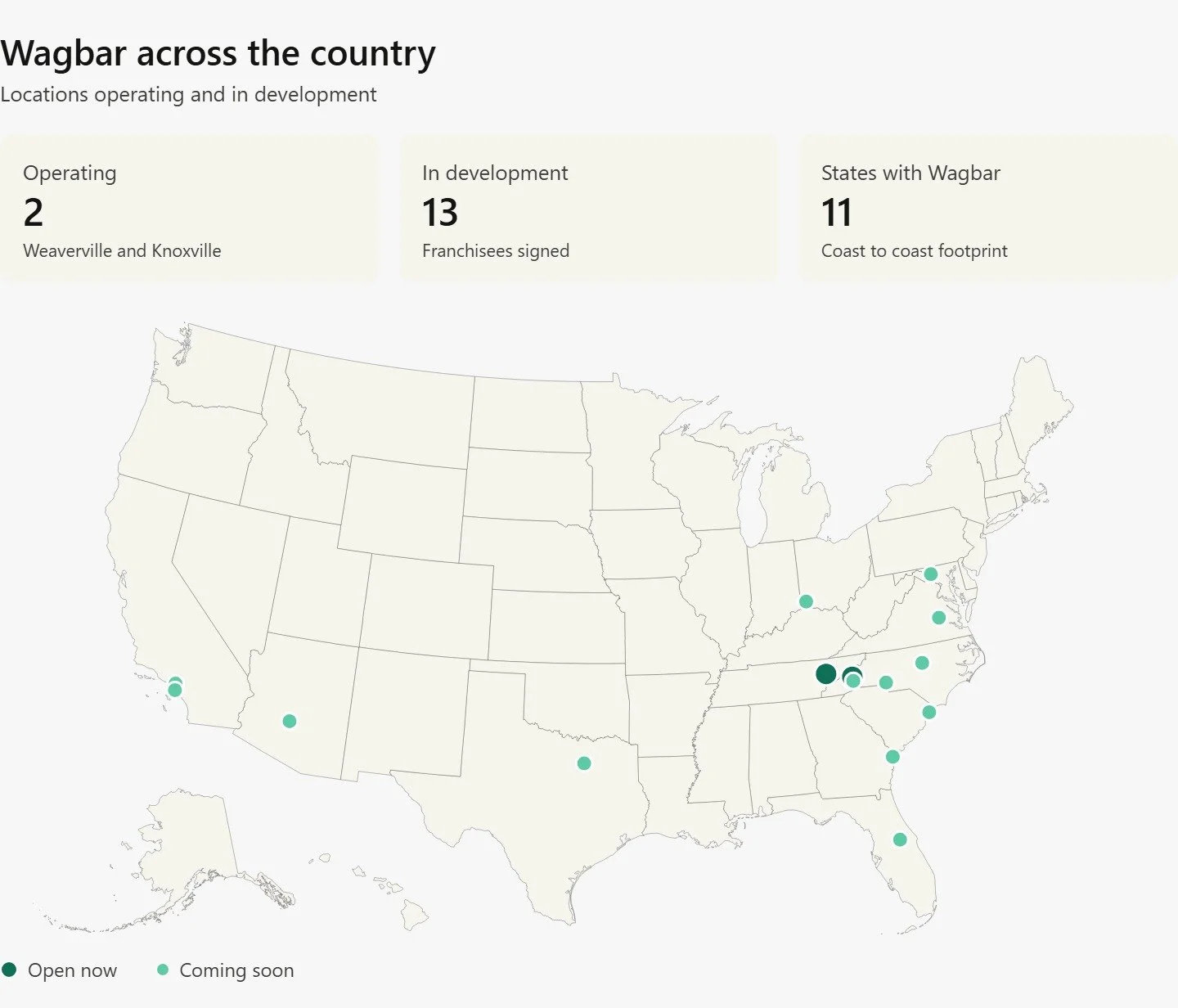
The multi-unit path becomes available and often attractive. Wagbar offers a 50% discount on the franchise fee when franchisees commit to opening three or more units. For an owner who has proven out the model in their first location and has the operational capacity to handle additional management layers, this can substantially improve unit economics on the second and third locations. Opening a second unit before the first is fully stable is a risk. Opening one after you have built strong systems, a capable team, and healthy margins is a different calculation.
Equity building in an existing location takes multiple forms. Your membership base has value. Your lease terms, brand reputation in the local market, and the physical build-out you have invested in all contribute to what the business would be worth if you chose to sell. Year 4 is not too early to think about how you are building that value, even if you have no immediate intention to exit.
Staffing structure often shifts in Year 4. Many franchisees hire a manager or general manager role to handle day-to-day operations by this stage. This frees the owner to focus on strategy, community relationships, and growth decisions rather than opening and closing shifts. Making this transition successfully requires the systems and documentation you built in earlier years to actually transfer to someone else.
Financial benchmarking becomes more valuable. By Year 4, you have enough data to compare your performance quarter over quarter, year over year, and against whatever benchmarks your franchisor makes available to the system. Identifying where you outperform your own historical numbers and where gaps persist gives you a grounded basis for Year 5 planning.
For anyone still evaluating the path to ownership and wanting to understand what the experience of owning a pet franchise involves from the inside, that resource is worth reading before you get to Year 4 planning.
Year 5: Exit Consideration, Valuation, and the Long Game
Year 5 is a natural checkpoint. The business has a real operating history. There is a track record to evaluate. And the question of what comes next, whether that is continued ownership, a second unit, a sale, or something else, becomes more concrete with five years of data behind it.
Business valuation becomes a real conversation. Service businesses with recurring membership revenue are valued differently than single-transaction businesses. The stability and predictability of your membership base, combined with your revenue trend over five years, form the core of any valuation discussion. A growing location with strong retention metrics and a well-established community position will command a different multiple than a plateau location with high member churn.
Exit readiness requires preparation that starts well before Year 5. Clean financials, documented operating procedures, a stable management team, and a membership base that is not dependent on the owner's personal presence are all factors that make a business more transferable and more valuable to a prospective buyer. Franchisees who think about eventual exit even in early years tend to build businesses that are systematically stronger.
The long-term hold path is also legitimate. Not every franchisee wants to sell. A well-run off-leash dog bar with a strong local following generates consistent returns and provides the community value that drew many franchisees to the concept in the first place. Year 5 planning might simply be about optimizing operations for sustained performance rather than exit.
Growth beyond single-unit changes the calculus significantly. Franchisees who opened a second unit in Year 4 are in a different position at Year 5 than single-unit operators. They have more complexity, more team to manage, and more capital at work, but also a larger equity position and more options for how the next five years unfold.
The pet industry market analysis resource provides broader context on where the category is heading, which matters for long-term holders and sellers alike, since market trajectory affects both operational opportunity and exit timing.
What the Timeline Looks Like in Summary
Most franchisees in the off-leash dog bar space follow a curve that looks roughly like this: heavy capital deployment and no revenue in pre-opening, growing revenue with high operational intensity in Year 1, membership momentum and staffing stabilization in Year 2, break-even territory in Year 3, equity building and scaling decisions in Year 4, and long-game positioning in Year 5.
The inflection points are real. So are the hard quarters in Year 1 when you are building a membership base from nothing and watching your debt service tick up. Franchisees who spent time during due diligence reviewing what to look for when investing in an off-leash dog bar franchise tend to enter Year 1 with more realistic expectations. Understanding where those pressure points fall, and preparing for them financially and emotionally, separates franchisees who stay clear-eyed through the hard parts from those who feel blindsided by them.
Frequently Asked Questions
How long does it typically take to open a Wagbar franchise after signing?
Pre-opening timelines vary based on site availability, local permitting requirements, and build-out complexity. Most franchisees are in active pre-opening operations for four to eight months before their grand opening, though this can extend in markets with slower permitting processes or significant construction requirements. Wagbar's Opener app and structured pre-opening support are designed to keep this timeline as predictable as possible.
What does the franchise fee cover, and is it included in the total investment range?
The $50,000 franchise fee covers licensing, access to the Wagbar system, training, and launch support. It is included within the $470,300 to $1,145,900 total estimated initial investment range. The variance in that total reflects differences in real estate markets, build-out scope, local permitting costs, and working capital requirements.
This information is not intended as an offer to sell, or the solicitation of an offer to buy, a franchise. It is for information purposes only. An offer is made only by Franchise Disclosure Document (FDD).
When do most pet franchise owners reach operational profitability?
There is no universal answer, but franchisees in experience-based pet business models with strong membership components typically reach operating profitability, meaning revenues covering operating costs and debt service, somewhere between Month 18 and Month 36. This depends heavily on location, membership growth rate, and initial investment level.
How important is prior business experience for a first-year franchisee?
Business or hospitality experience accelerates the learning curve, particularly around team management, financial tracking, and vendor relationships. Wagbar's training program is designed to be accessible to franchisees without industry-specific backgrounds, covering dog behavior management, bar operations, and customer service. Prior experience helps but is not a prerequisite.
What is the royalty structure and when does it kick in?
Wagbar charges a 6% royalty on adjusted gross sales, plus a 1% contribution to the brand marketing fund. These obligations begin once the location is operating. There is no revenue threshold below which royalties are deferred. Factor ongoing royalty payments into your financial model from Day 1 of operations.
What are the most common reasons first-year franchisees struggle?
Under-capitalization is the most common structural issue. Franchisees who entered with minimal working capital reserves often face cash flow pressure during the months before membership revenue reaches a stable level. Staffing instability, poor site selection, and insufficient pre-launch marketing are also frequent contributors to difficult first years.
How does the multi-unit discount work?
When a franchisee commits to opening three or more Wagbar locations, the franchise fee on units two and beyond is discounted by 50%. This discount applies at signing, not retroactively. It is designed to incentivize franchisees who have demonstrated success in their first location to scale the model in their market.
What does a realistic Year 5 exit look like for a pet franchise owner?
A well-performing single-unit franchise with stable recurring membership revenue, clean financial records, and documented operating systems is a marketable asset. Buyers in this category include other franchisees looking to add units, owner-operators looking to enter the franchise system with an established location, and investors seeking recurring revenue businesses. The franchise disclosure document process provides the prospective buyer with the same level of disclosure you received when you were evaluating the opportunity.
Bottom TLDR: The pet business franchise operating timeline from Year One through Year Five is a progression from capital deployment and customer acquisition through operational stability, break-even recovery, and long-term equity building. Most franchisees reach cash flow positive territory in Years 2 to 3, with full investment recovery taking longer depending on financing structure. Before committing, review the FDD carefully and plan your working capital reserves for at least 18 months of pre-profitability operations.