

Franchise Discovery Day: What to Expect and How to Prepare

Top TLDR: A franchise discovery day checklist for dog franchise buyers helps you cover the business model, training structure, territorial rights, safety protocols, and leadership culture in a single visit without forgetting critical questions under the pressure of the day. Organize your checklist by category and build it from questions raised during your FDD review and franchisee calls. To begin the Wagbar discovery process, submit an inquiry at wagbar.com/franchising.
At some point during the franchise evaluation process, reading stops being enough. You've gone through the Franchise Disclosure Document. You've spoken with existing franchisees. You've run financial projections with your accountant and reviewed the franchise agreement with an attorney. The research phase has given you a strong foundation, but documents can only take you so far. Discovery day is where the brand stops being a collection of pages and becomes a room full of real people running a real business.
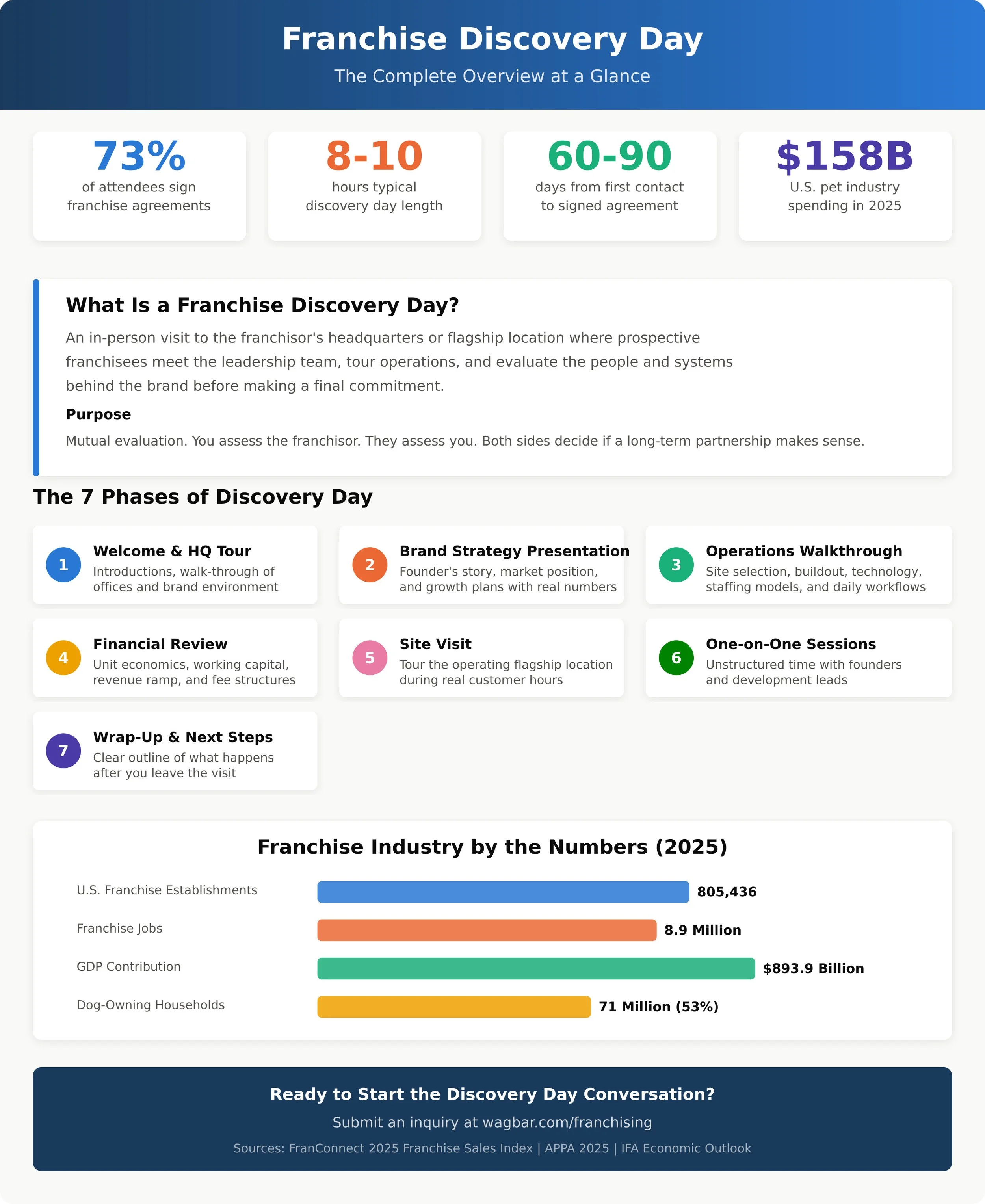
A franchise discovery day is the structured, in-person visit to the franchisor's headquarters or our location where prospective franchisees meet the founding team, tour operations, observe customer interactions, and ask the questions that couldn't be fully answered through documents and phone calls alone. It is one of the final steps before signing a franchise agreement, and for most buyers, it is the step that either confirms everything they've learned or raises concerns they hadn't anticipated.
The Pet Industry
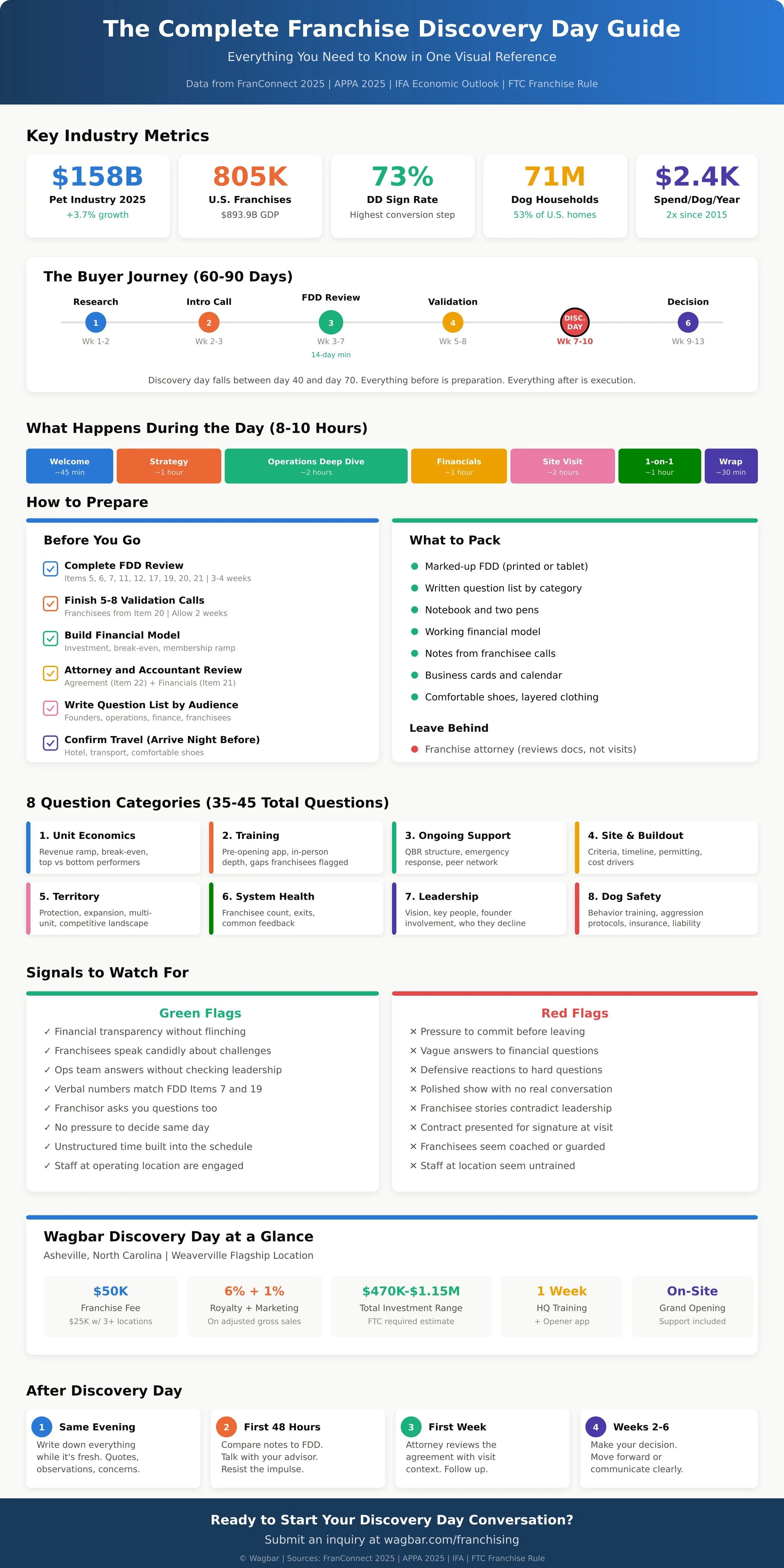
The franchise industry generated $893.9 billion in U.S. GDP in 2024 across more than 805,000 franchise establishments. Over 3,000 different franchise brands compete for qualified operators. Within that landscape, the pet services category has emerged as one of the fastest growing segments, with total U.S. pet industry spending reaching $158 billion in 2025 and projected to hit $165 billion in 2026. The off-leash dog park bar concept sits at the intersection of pet services, food and beverage, and membership-based recurring revenue, a model that makes the discovery day evaluation especially important because the operational complexity demands a franchisor who has thought through every detail.
This guide consolidates everything a prospective franchise buyer needs to know about the discovery day process. It covers what the day actually looks like from start to finish, how to prepare in the weeks and days leading up to your visit, what to bring and what to leave behind, the specific questions worth asking across every department, the red flags that should slow you down, and the steps that follow after you leave.
Wagbar-specific context is woven throughout because the Asheville is where Wagbar's discovery experience takes place, but the framework applies to evaluating any franchise system. If you're still in the earlier stages of exploring what franchise ownership looks like, the complete guide to franchise validation and the guide on what to look for when investing in an off-leash dog bar franchise cover the full picture before you get to this point.
Why Discovery Day Exists and Why It Matters More Than Most Buyers Realize
Discovery day is not a sales presentation. It is a mutual evaluation where two parties who have been circling each other through documents and phone calls finally sit across the table and assess whether a long-term business partnership makes sense.
The franchisor is evaluating you just as seriously as you are evaluating them. They want to see how you handle information, how you ask questions, whether you've done the preparation work that signals a serious operator versus a casual browser. The best discovery days feel like an extended, candid conversation rather than a rehearsed pitch. The concerning ones feel like a production designed to create excitement rather than clarity.
The data supports how critical this step is. According to franchise development research, 73% of discovery day attendees go on to sign franchise agreements. That conversion rate makes discovery day the single most effective touchpoint in the entire franchise sales process, far exceeding the 1.5% overall lead-to-agreement conversion rate that the broader franchise industry averages. Those numbers tell you something important about the buyers who get to this stage. By the time you're sitting in a franchisor's conference room or walking their location, both sides have already done significant filtering. You're not browsing anymore. You're deciding.
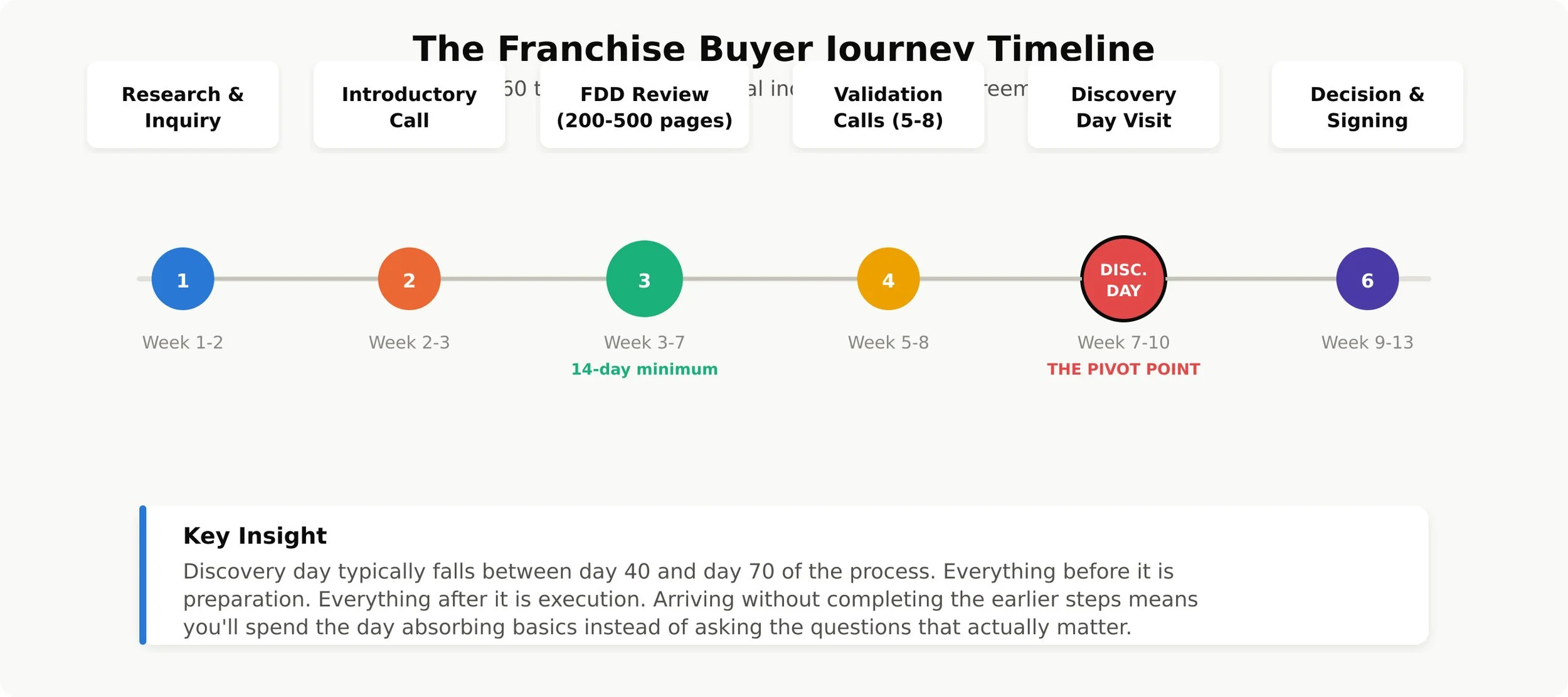
The franchise buying process typically runs 60 to 90 days from initial contact to signed agreement, and discovery day usually falls somewhere between day 40 and day 70 of that timeline. Everything before it is preparation. Everything after it is execution. The visit itself is the pivot point.
Where Discovery Day Falls in the Franchise Buying Process
Understanding where discovery day sits within the broader evaluation sequence matters because arriving too early wastes everyone's time, and arriving too late means you've already made emotional commitments that cloud your judgment.
The ideal sequence looks like this. You begin with initial research and inquiry, reading about the brand, understanding the industry, and submitting a franchise inquiry to start the formal process. The franchisor then schedules an introductory call to assess mutual interest and discuss your background, financial qualifications, and target market. If both sides want to continue, you receive the Franchise Disclosure Document, which federal law requires the franchisor to provide at least 14 days before you sign anything or pay any money. That 14-day period is a legal floor, not a target. Most franchise attorneys recommend spending three to four weeks on a thorough FDD review, and complex transactions may warrant even longer.
During or after your FDD review, you begin franchisee validation calls. This means reaching out to existing franchise owners listed in Item 20 of the FDD and asking them detailed questions about their experience. Validation alone often takes two weeks when done properly because scheduling calls with busy business owners takes time, and you need at least five to eight conversations to see patterns rather than individual perspectives.
Only after the FDD review and validation calls are substantially complete should you schedule your discovery day visit. Arriving with that foundation makes the conversations during the visit dramatically more productive. You're not hearing about the franchise fee for the first time. You're asking why three different franchisees mentioned the same operational challenge and how the leadership team is addressing it. That kind of question signals preparation, and prepared questions produce honest, substantive answers.
For Wagbar, the discovery process begins with the inquiry form on the franchising page. The team walks through where you are in the process and confirms whether you're ready for the in-person visit or whether a few more conversations make sense first. There's no pressure to accelerate past steps that aren't complete yet because the relationship that starts at discovery day lasts for the life of the franchise agreement.
What Actually Happens During a Franchise Discovery Day
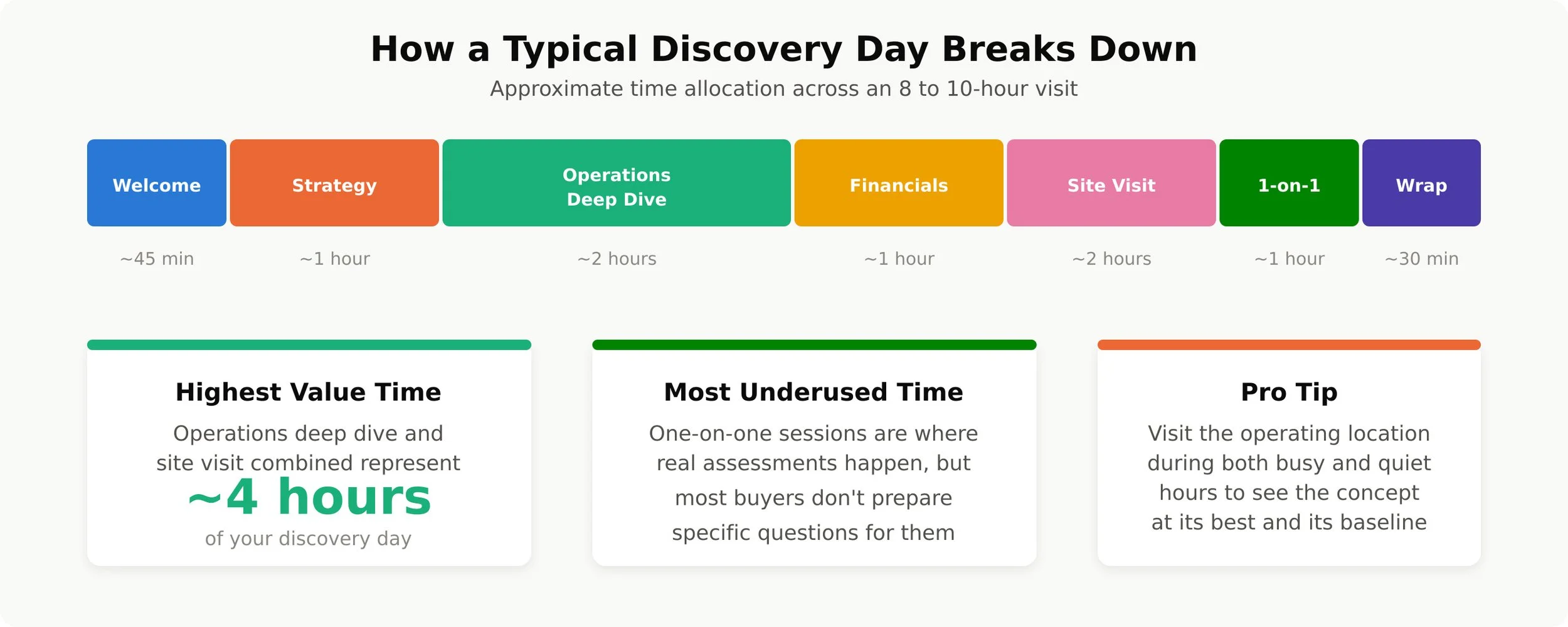
Most franchise discovery days run 8 to 10 hours and follow a predictable rhythm. The specifics vary by brand, but the structure typically includes several distinct phases that build on each other throughout the day.
The Opening Meeting with Leadership
The day usually begins with introductions and a sit-down with the founding team or senior executives. This is where the company's story, values, and strategic vision get presented directly by the people who built the system.
For Wagbar, that means hearing from Kendal Kulp, the founder and CEO who conceived the concept after a frustrating experience at a traditional dog park in 2015, and co-founder Kajur Kulp, whose background in creative design and project management shaped how Wagbar was actually built. Hearing the origin story in person from the people who lived it creates a fundamentally different understanding than reading it on a website. You can watch how they talk about the early days, how they describe the problems they solved, and how they respond when you ask about the problems they haven't solved yet.
Pay attention to the dynamic between the founders and the rest of the leadership team during this phase. A leadership group that defers all questions to one person looks different from one where multiple team members answer with confidence and specificity in their respective areas.
The Headquarters and Location Tour
For franchisors with corporate offices separate from operating locations, the tour may start at headquarters and move to a nearby unit. For concepts where the founders still run an active flagship, the tour often centers entirely on that operating location.
Wagbar's discovery experience centers in Asheville, NC. This is where the off-leash dog park and bar concept originally launched, and it's where you'll see every aspect of the operation running in a real, active market. You can observe how staff manages the off-leash environment, how the bar runs alongside dog park operations, how members interact with the space and with each other, and how the physical layout actually functions throughout the day.
Visiting during operating hours is particularly valuable. Seeing the location with dogs and members present gives you a fundamentally different perspective than walking an empty space. You can watch how staff handles a boisterous new dog entering the play area. You can see whether members look relaxed and comfortable or whether there's tension in the environment. You can observe the bar operations running in parallel with the dog park and assess whether the two functions complement each other or create friction.
Operations Deep Dives
The middle portion of the day is usually the most substantive. This is where the operations team walks through the specific systems, processes, and infrastructure that support franchisees from pre-opening through ongoing operation.
Expect to spend significant time on site selection criteria, understanding exactly what physical and demographic characteristics the franchisor looks for in a location. For dog park bar concepts, this includes outdoor space requirements, zoning considerations, proximity to residential density, parking adequacy, and visibility from main roads.
The buildout process is another major topic. Wagbar's container bar solution, which converts shipping containers into fully equipped bars and bathrooms, represents a distinctive approach to reducing construction complexity and timeline. Understanding how that solution interacts with local permitting, zoning, and site-specific constraints in your target market is something worth pressing on during the visit rather than discovering after you've signed.
Technology infrastructure, membership management systems, and staffing models typically get their own segments in the operations walkthrough. For a membership-based concept, the technology that handles sign-ups, check-ins, billing, and member communications is the operational backbone. Understanding what's proprietary, what's third-party, and where the integration points are matters more than most buyers initially realize.
The Financial Review Session
The financial team or franchise development lead walks through the unit economics, working capital requirements, and what existing franchisees are seeing in terms of revenue ramp and performance. Federal franchise rules limit what franchisors can share outside of Item 19 of the FDD (Financial Performance Representations), but you can ask clarifying questions about anything that's already in the written document.
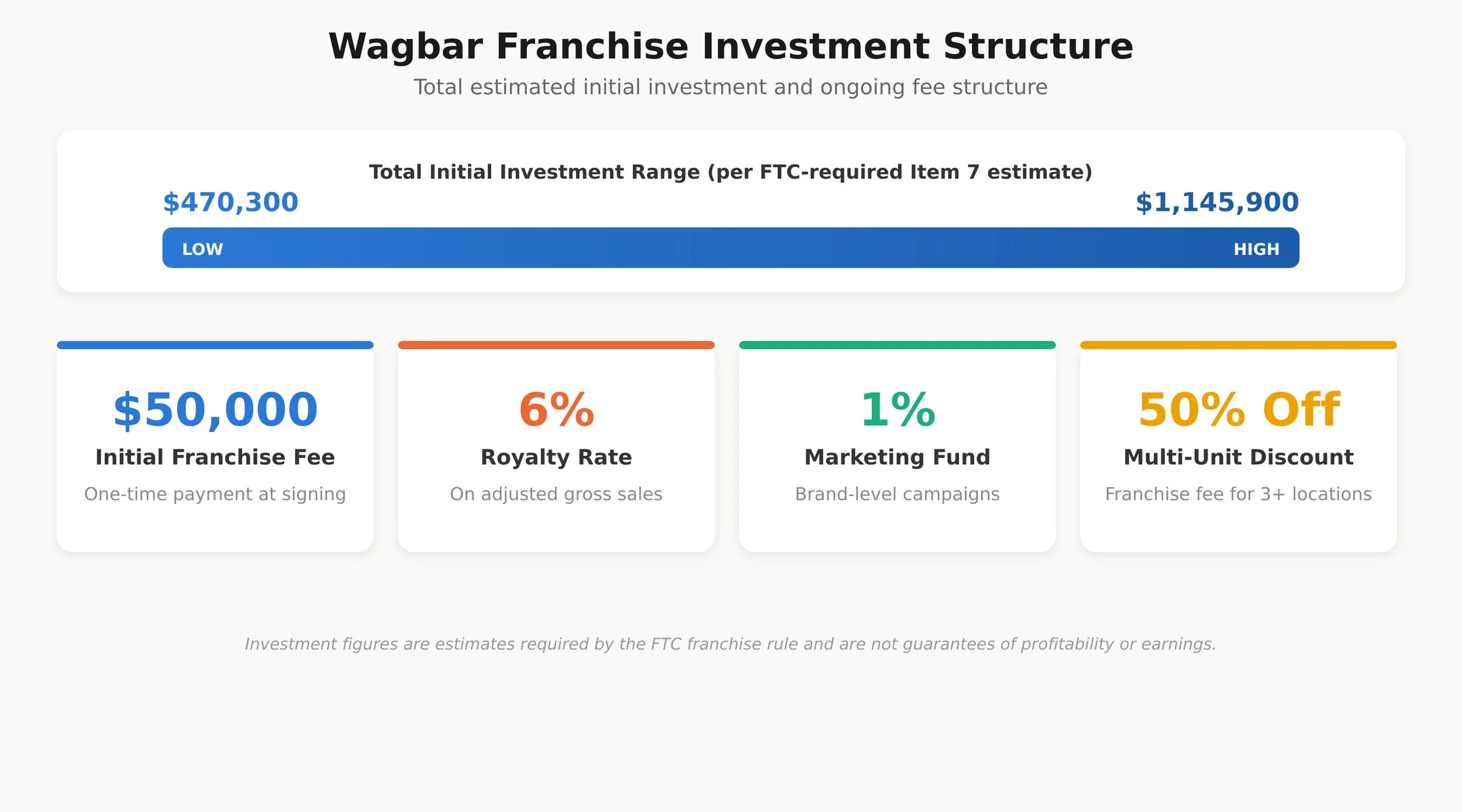
For Wagbar, this discussion covers the franchise economics in detail. The total initial investment for a Wagbar location ranges from $470,300 to $1,145,900, which is an estimate required by the FTC franchise rule and not a guarantee of profitability or earnings. The ongoing fee structure includes a 6% royalty on adjusted gross sales and a 1% marketing fund contribution. Wagbar also offers a 50% franchise fee discount for operators who commit to three or more locations, making the multi-unit development model financially interesting for buyers with regional ambitions.
The financial conversation during discovery day is most productive when you arrive with a working financial model for your target market. If you already know your estimated total investment range, your assumptions about membership ramp-up, and what break-even looks like under conservative projections, you can pressure-test those specific numbers rather than absorbing financial information for the first time.
Training and Franchisee Support Overview
Expect a detailed walkthrough of the training and support structure from day one through grand opening and beyond. This section typically covers what happens between signing the franchise agreement and opening the doors, what the training curriculum includes, how long it lasts, and what ongoing support looks like after the grand opening excitement fades into daily operations.
Wagbar's support structure has several distinct phases. The proprietary "Opener" app guides franchisees through pre-opening setup, functioning as a task management system that keeps the entire pre-opening process organized and on track. The one-week in-person training program takes place at Wagbar headquarters, combining classroom instruction with hands-on experience. The franchisor then provides on-site support during grand opening, helping the new franchisee navigate the most operationally intense period of the business launch.
Ask specific questions about what happens after the grand opening support ends. The transition from "we're here every day" to "call us when you need us" is where many franchisee support experiences start to diverge from what was described during the sales process. Understanding the quarterly business review structure, the field visit schedule, the response time for urgent operational questions, and the peer network among franchisees gives you a realistic picture of what the ongoing relationship actually looks like.
One-on-One Sessions and Unstructured Time
Toward the end of the day, most franchise systems build in unstructured time for individual conversations with the franchise development lead, sometimes the CEO, and occasionally a senior operations leader. This is the most valuable time of the entire visit because it's where the carefully structured presentation gives way to real, unscripted dialogue.
Use this time for the questions that didn't have a natural home earlier in the day. The questions you were hesitant to ask in a group setting. The specific market or site concept you want to walk through directly with the team and hear their honest read on. The concern that surfaced from a franchisee conversation that you want to raise face-to-face with the person who can actually address it.
Wrap-Up and Next Steps
The day closes with a clear outline of what comes next. If you decide to move forward, this is when you'll typically receive the territory agreement, signing timeline, and any remaining materials. If you decide not to move forward, this is when you should say so directly. Franchisors prefer a clean no over an indefinite maybe, and a respectful, honest decision not to proceed is far better for both parties than weeks of avoided phone calls.
How to Prepare in the Weeks Before Discovery Day
The quality of your discovery day experience is almost entirely determined by the preparation you do before you arrive. Showing up as an informed, prepared buyer transforms every conversation from a general overview into a specific, actionable exchange.
Complete Your FDD Review First
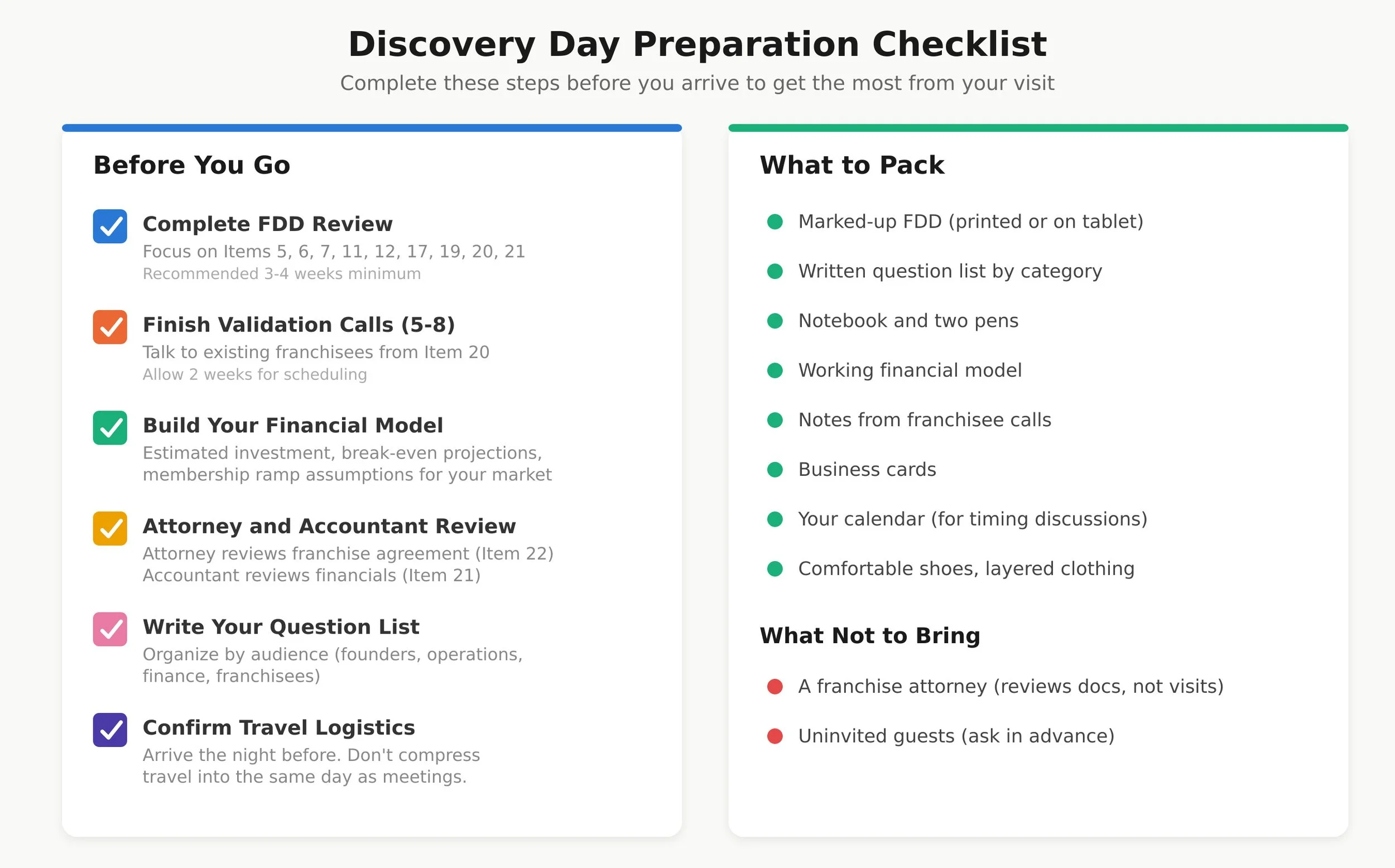
The Franchise Disclosure Document should be in your hands and thoroughly reviewed, ideally with a franchise attorney, before you attend a discovery day. The document typically runs 200 to 500 pages including exhibits, and a thorough review takes three to four weeks at minimum.
Focus your re-read in the week before the visit on the items that generate the most discovery day questions. Item 5 covers initial fees. Item 6 covers other fees including royalties, marketing contributions, and technology charges. Item 7 covers estimated initial investment. Item 11 covers the franchisor's obligations to you. Item 12 covers your territory rights. Item 17 covers renewal, termination, and transfer. Item 19 covers financial performance representations. Item 20 lists current and former franchisees you can contact. Item 21 contains the franchisor's own financial statements.
Read those items with a pen in hand, writing down every question that surfaces. Bring that list with you. Most of those questions will get answered during the day's formal presentations. The ones that don't become your one-on-one session material.
Complete Your Franchisee Validation Calls
Talking to existing franchise owners before discovery day is not optional if you want to get real value from the visit. Franchisee conversations give you specific observations to explore with the corporate team. If three different owners mentioned the same operational challenge, you can ask leadership directly how they're addressing it. If two franchisees praised the same support team member, you can meet that person during the visit. If someone's revenue ramp was slower than they expected, you can ask the financial team what factors they've identified in locations that ramp more slowly.
Plan for at least five to eight franchisee conversations before your discovery day. The 20 questions to ask franchisees approach gives each call structure, but the most valuable information usually comes from the follow-up questions that aren't on any list. Listen for patterns across multiple conversations rather than placing too much weight on any single owner's experience.
Wagbar's franchisee network includes operators from diverse professional backgrounds. AJ Sanborn in Richmond, Dianna in Phoenix, Jennifer in Los Angeles, Liz and Shelby in Knoxville, Brandi and Denise in Charlotte, and Matt and Taylor in Myrtle Beach all moved through the discovery process before signing. Their backgrounds span financial services, IT sales, restaurant operations, and corporate roles, which means the perspectives you'll hear represent a range of pre-franchise career experiences.
Run Your Financial Numbers
Arrive with a working financial model for your target market. Know your estimated total investment range, your assumptions about membership ramp-up, and what break-even looks like under conservative projections. Discovery day conversations about the business model are dramatically more useful when you have specific numbers to pressure-test rather than hearing about the economics for the first time.
Your accountant should have already looked at Item 21 of the FDD (the franchisor's own financial statements) and flagged anything worth discussing. Your franchise attorney should have reviewed the franchise agreement in Item 22 and identified the provisions you need to negotiate or clarify in person.
Write Out Your Questions in Advance
You'll be processing enormous amounts of information quickly during the visit. A written list ensures you don't leave without asking something important. Organize your questions by who you want to ask each one of. Some questions are best directed at the founders, others at the operations team, and others at the franchise development lead. Having that structure in advance keeps you focused even when the day's pace makes it hard to think clearly.
Know What You're Evaluating in the Leadership Team
Discovery day is partly about assessing whether these are people you want to be in a long-term business relationship with. That evaluation is easier if you've thought in advance about what matters to you. Transparency. Responsiveness. Strategic thinking. How they handle hard questions. Whether they get defensive when pressed on challenges or whether they lean in with candid, specific answers. The ongoing franchisor-franchisee relationship will reflect the dynamics you observe during the visit, so watch carefully.
What to Bring to Discovery Day
A well-packed bag eliminates friction and keeps your focus on the conversations rather than on what you forgot.
Bring your marked-up copy of the FDD, either printed with tabs or loaded on a tablet with your annotations. Bring your written question list organized by audience. Bring a notebook and two pens because you'll forget half the day if you don't take notes during it, and pens run out at inconvenient moments. Bring business cards if you have them because franchisors trade them at the start. Bring your calendar because territory and timing conversations sometimes lead to "when could you sign?" questions, and knowing your real availability matters. Bring comfortable shoes and layered clothing because headquarters meeting rooms tend to run cold while site visits, especially for outdoor concepts like Wagbar, keep you on your feet in the elements.
A laptop or tablet is useful only if you actually need it for accessing your FDD notes or financial model. The day works better without screens creating barriers between you and the people you're talking to.
If your spouse, business partner, or potential co-investor will share decision-making or ownership of the business, they should attend. Two sets of ears catch more than one, and the franchisor will want to meet anyone who will be part of the ownership structure. Most franchisors welcome the additional perspective. Some prefer to structure the day around a single prospect, so ask in advance to confirm.
What not to bring includes a franchise attorney. Attorneys review documents and contracts, not discovery days. Bringing one to the visit signals adversarial framing before either side has agreed to terms, and it changes the tone of every conversation in the room in ways that rarely benefit the buyer.
The Questions Worth Asking During Your Visit
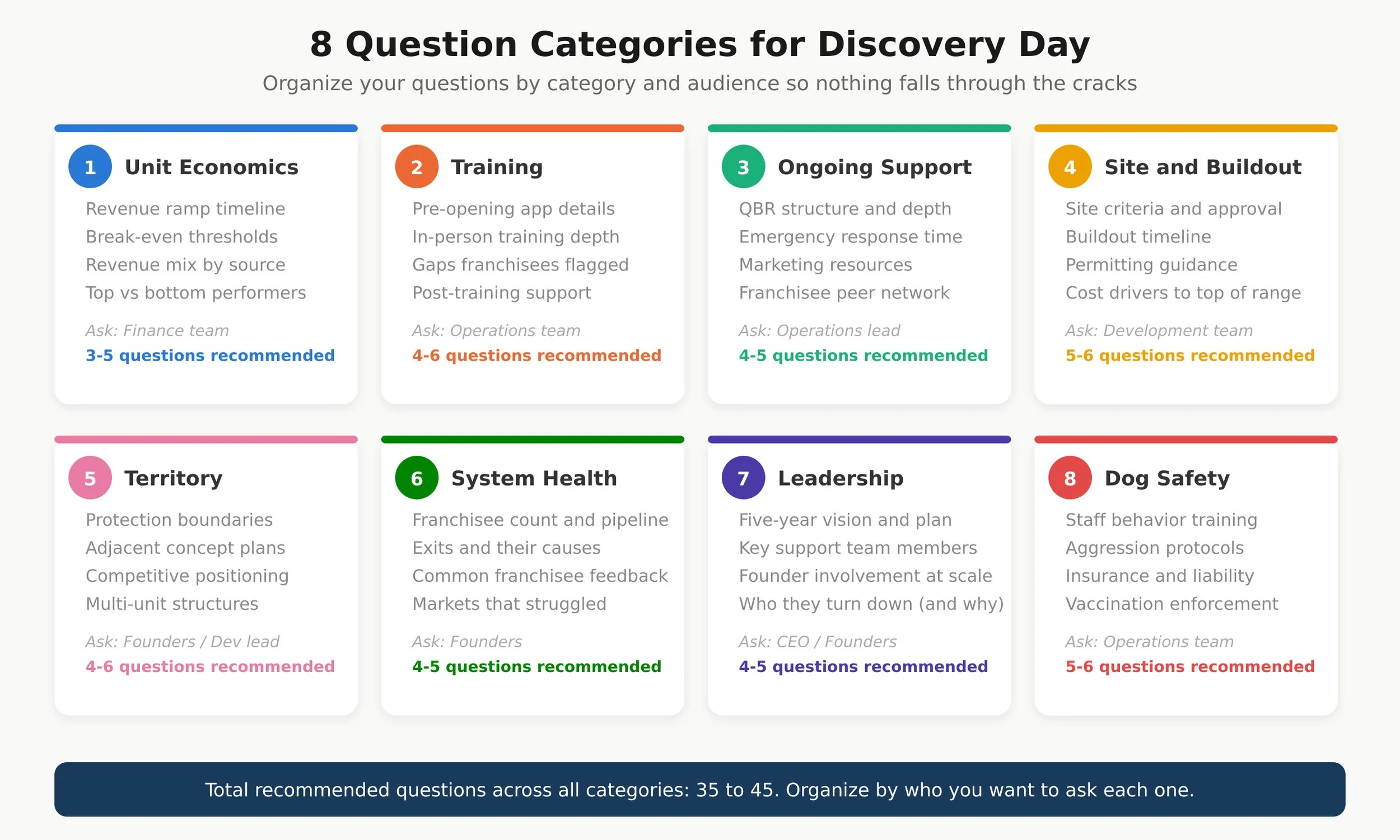
The franchisors who run good discovery days expect hard questions. The questions that make them pause, think, and give you a real answer rather than a rehearsed one are the questions that produce the most valuable information. Organize your question list by category so you can work through each area systematically rather than jumping between topics.
Questions About the Business Model and Unit Economics
Understanding how the concept generates revenue and what drives the difference between strong performers and struggling ones is foundational to your evaluation.
Ask what a realistic membership ramp looks like in a new market during the first 12 months and what the range has been across existing locations. Ask what membership volume a location needs to reach operational break-even. Ask what percentage of revenue typically comes from memberships versus day passes versus bar sales versus events, and how that mix has shifted as locations have matured. Ask about the most common reasons a location underperforms during its first year.
For a concept like Wagbar, where memberships form the recurring revenue backbone, the ramp timeline is especially important. A location that takes six months to build sustainable membership volume has very different working capital requirements than one that gets there in three months. The revenue streams for off-leash dog bars page explains how the different income sources layer together, which helps you frame sharper questions when you're in the room.
Questions About Training and Pre-Opening Support
Every franchisor describes their training program in positive terms during the sales process. Discovery day is where you push past the description and into the practical reality.
Ask for a detailed walkthrough of the Opener app, including what it covers and what it expects from you between signing and starting in-person training. Ask what the one-week training schedule looks like and how much of it is hands-on versus classroom. Ask what the most common things are that franchisees say they weren't fully prepared for after training ends. Ask how the training program has changed based on feedback from early franchisees. Ask what happens if you encounter a situation during the first few months that training didn't cover.
Questions About Ongoing Operational Support
The post-opening relationship is where many franchise experiences diverge from expectations. These questions probe the reality of that ongoing support.
Ask what a quarterly business review actually covers, who runs it, and how actionable the outcomes tend to be. Ask what happens when a franchisee has a major operational problem at 8 PM on a Saturday. Ask what marketing resources are available and how much control you have over local marketing versus brand-level campaigns. Ask what the franchisee network looks like in terms of peer-to-peer communication and whether operators in different markets actively share what's working. Ask what resources exist for staffing, particularly around finding and training people who understand dog behavior.
For a broader view of what the benefits of owning a pet franchise look like in practice, that page covers the support structure components that continue after opening.
Questions About Site Selection and Buildout
For a dog franchise concept, the physical location isn't just a real estate question. The site needs to support outdoor off-leash play, bar service, customer parking, and enough foot traffic to generate the membership volume the model requires.
Ask what the minimum and ideal site criteria are in terms of square footage, outdoor space, zoning requirements, and accessibility. Ask how involved the franchisor's team is in site selection and at what point final approval happens. Ask about the typical buildout timeline from site approval to opening day and the most common complications that cause delays. Ask how the estimated initial investment range in Item 7 of the FDD gets influenced by site variables and what specifically drives costs toward the top of the range.
Wagbar's container bar solution is worth a dedicated conversation. Understanding the timeline, the permitting implications in your specific market, the cost savings compared to traditional construction, and the limitations of the container approach gives you practical information that directly affects your opening timeline and capital requirements.
Questions About Territory and Competitive Positioning
Territorial rights and competitive dynamics are two of the most consequential topics in any franchise evaluation, and they're areas where document language and operational reality sometimes diverge.
Ask how your protected territory is defined and what the exact conditions are under which that protection could change. Ask whether the franchisor has plans to develop adjacent concepts or formats that could operate within your territory. Ask how the franchisor is thinking about competitor concepts entering the off-leash dog bar space as the market matures. Ask about the territory approval process and what market criteria a territory needs to meet for approval.
Wagbar's multi-unit discount of 50% off the franchise fee for operators committing to three or more locations makes regional development financially interesting. Discovery day is the right time to understand exactly how multi-unit territory structures work, including what happens if one location in a multi-unit commitment underperforms.
Questions About Franchisee Satisfaction and System Health
These questions look at the franchise system from a portfolio perspective. The answers either confirm or complicate what you heard from franchisees during your earlier validation calls.
Ask what the current franchisee count is and how many locations are in various stages of development. Ask whether any franchisees have exited the system and what the circumstances were. Ask what the most common feedback from franchisees is about what the system could improve. Ask how the leadership team decides when to make changes to the operating model based on franchisee experience. Ask if there are markets where the concept has struggled to gain traction and what was learned from those situations.
How leadership handles these questions tells you as much as the content of their answers. A founding team that speaks candidly about what hasn't worked and gets specific about what they changed because of it demonstrates the kind of operational self-awareness that produces better long-term support. Vague or defensive responses to the same questions are worth noting. The dog business franchise profit margins and owner stories page provides useful context on what financial performance looks like across different types of dog franchise models.
Questions About Leadership Vision and Culture
Discovery day gives you access to the people behind the brand in a way that no document can replicate. These questions assess the long-term direction and the quality of the partnership you'd be entering.
Ask what the long-term vision for the system looks like and where the leadership team wants to be in five years in terms of location count and geographic reach. Ask who the key people on the support team are that you'd work with after signing and what their backgrounds are. Ask how the founders plan to stay involved in day-to-day franchisee support as the system scales. Ask what their philosophy is on the franchisor-franchisee relationship when there's a disagreement about direction. Ask what kind of franchisee they turn down and why.
That last question is particularly revealing. A franchisor who can articulate clearly what makes someone a poor fit for their system has usually thought carefully about what makes someone a good one. Broad, permissive answers suggest the qualification bar may be lower than you'd want in a system you're joining.
Questions Specific to Dog Franchise Operations and Safety
This category distinguishes a dog franchise discovery day from a general franchise evaluation. The operational complexity of managing dogs safely alongside bar service creates questions that don't exist in most other franchise categories.
Ask how staff are trained in dog behavior assessment and how that training is maintained over time. Ask what the protocol is when an aggressive dog situation develops and how it has been handled in existing locations. Ask what vaccination and membership requirements are in place and how they're enforced. Ask about the insurance requirements for franchisees and what coverage the brand carries at the system level. Ask what liability exposure the system has encountered and how it's managed. Ask about the protocol when a dog injures another dog or a person.
Wagbar's safety model is built on clear protocols covering vaccination requirements, behavioral standards, staff supervision ratios, and zero-tolerance policies for aggressive behavior. Understanding exactly how those protocols are operationalized, trained, and enforced across locations is important for running the business well and for understanding your liability position as an owner. The complete dog park safety guide and the dog park behavior guide provide useful background on the operational complexity involved in managing off-leash group dynamics.
How to Use Your Question List During the Visit
Print your question list or load it on your phone, and check off items as they're covered organically during the presentation before asking about what hasn't come up. Some franchisors will address many of these points unprompted, which is itself a positive signal about their transparency and thoroughness.
When you do ask, ask one question at a time and give the answer room to develop before following up. The most valuable information often comes in what gets added after the initial response, not in the initial response itself. The pauses after a direct question are where real candor lives.
Take notes during the day, not just at the end of it. Memory of specific details degrades quickly after a full day of information, and notes taken in the moment are significantly more reliable for the debrief you'll do afterward with your spouse, partner, or advisor.
What to Observe While You're There
Beyond the formal conversations and presentations, a discovery day gives you access to environmental and interpersonal information that no document provides. Train your attention on the things happening around the structured agenda.
Watch the Staff
For a dog franchise, staff quality is the operation. Watch how team members interact with dogs and with members. Are they attentive and engaged, or are they going through motions? Do they seem genuinely comfortable managing the off-leash environment, or does it look like controlled chaos? Can they answer questions about individual dogs with specificity, or do they seem disconnected from the daily operation?
The Wagbar model depends on staff who are well-trained in dog behavior, calm under pressure, and capable of maintaining a welcoming environment for both the dogs and the humans. Visiting during operating hours gives you a direct view of whether that standard is being maintained at the extreme level, which is the best the system is going to look.
Notice How Questions Get Answered
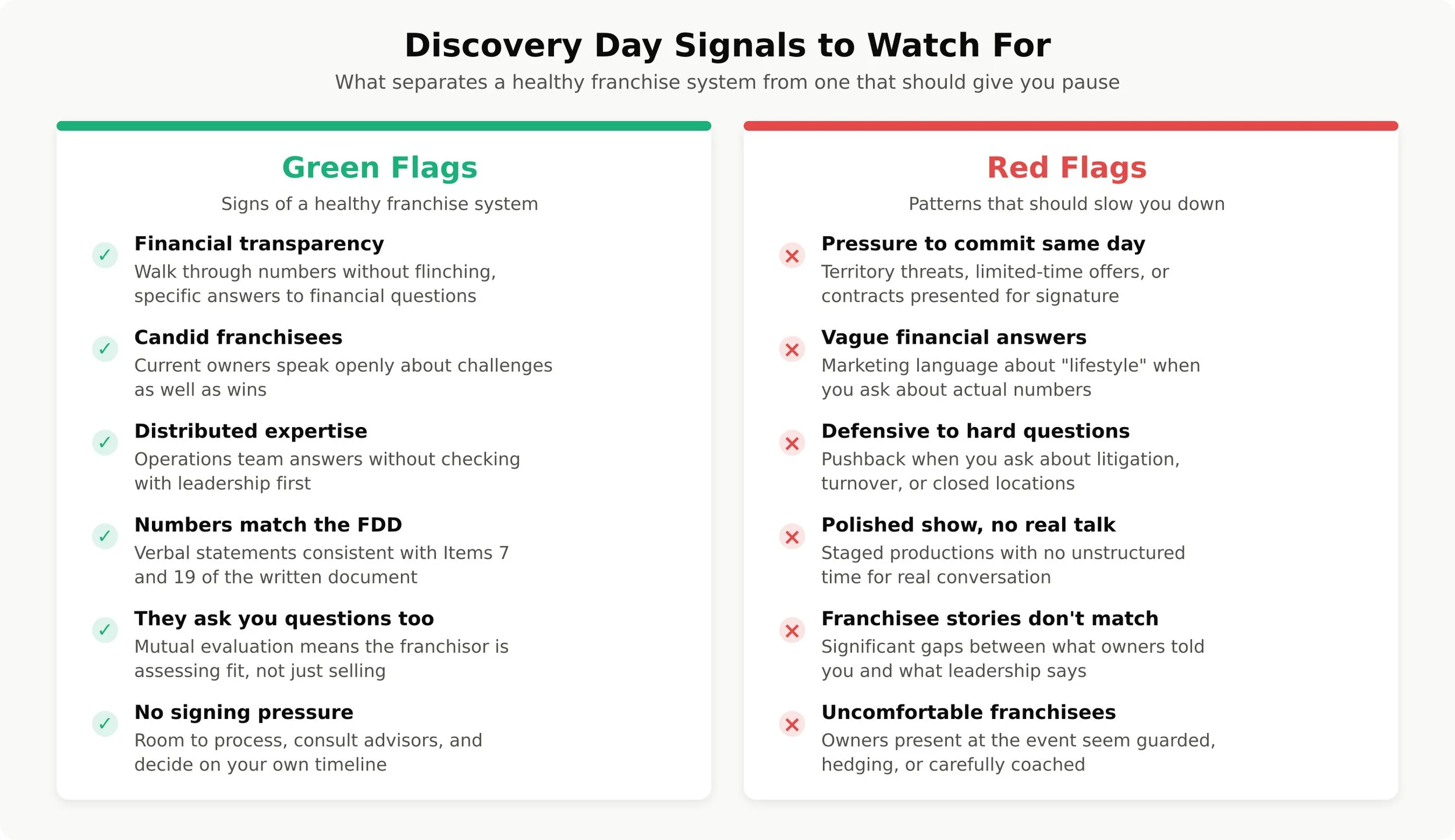
Direct, substantive answers to difficult questions are a strong positive signal. The franchisor has heard these questions before, has honest answers, and is willing to share them because they're confident the answers hold up to scrutiny.
Deflection, subject changes, or reliance on marketing language when you ask about specific challenges, financial realities, or operational difficulties is worth noting. Not every instance of redirection is a red flag, but patterns of avoidance across multiple topics signal a culture where candid communication isn't prioritized.
Pay Attention to How Challenges Get Discussed
Every franchise system has operational difficulties. How leadership talks about those difficulties is a reliable indicator of the culture you'd be joining. Solutions-focused teams describe what went wrong, what they learned, and what they changed. Defensive teams minimize problems, blame external factors, or pivot quickly to something positive. The first response style correlates with franchise systems that improve over time. The second style correlates with systems where the same problems persist for years.
Observe the Physical Environment
How clean is the park? How are dogs being monitored? Does the bar area run smoothly alongside the dog park operations? Are members relaxed and clearly comfortable? Is the equipment well-maintained? Does the physical space feel intentionally designed or thrown together?
The location you see on discovery day is the standard the franchisor is showing you at its best. Whatever you observe is the ceiling, not the floor. Every detail matters because those details reveal the operational standards you'll be expected to maintain in your own location, and they reveal whether those standards are achievable or aspirational.
Watch for Disconnects
Compare what you're seeing with what franchisees told you during validation calls. Compare what the operations team says with what the founders said earlier in the day. Compare the presentation slides with the physical reality of the location tour. Consistency builds confidence. Disconnects deserve follow-up questions, and significant gaps deserve serious pause.
Red Flags That Should Slow You Down
Not every discovery day leaves a prospective buyer more confident. Some visits raise concerns that are worth taking seriously, and learning to recognize these patterns can save you from a decision that looks very different 18 months after signing.
Pressure to Decide Before You Leave
Legitimate franchise systems do not need to manufacture urgency. If you're being told that you need to commit before you leave, or that the territory will be taken by another buyer if you don't decide today, slow down immediately. Real territory decisions don't move that fast, and pressure tactics at the discovery day stage predict how the relationship will feel for the next decade.
The most well-run franchise development teams understand that discovery day is an information event, not a closing event. A franchisor who wants a healthy, long-lasting partnership gives you room to process, consult your advisors, and make a decision on a timeline that reflects the size of the commitment.
Vague Answers to Financial Questions
Discovery day is an appropriate place to ask specific questions about franchisee financial performance, unit economics, and the assumptions behind the financial model. A leadership team that consistently deflects those questions or redirects to qualitative language about community, lifestyle, and passion rather than addressing the business realities should prompt serious follow-up.
Federal law limits what franchisors can share outside of Item 19 of the FDD, and responsible franchisors operate carefully within those boundaries. But there is a wide space between legally cautious and deliberately vague, and most experienced franchise development professionals know how to be helpful within the regulatory framework.
Defensive Responses to Hard Questions
The best franchise systems welcome hard questions because they have honest answers and because they know that a buyer who asks hard questions is a buyer who has done real work. Defensive reactions to questions about litigation history, franchisee turnover, closed locations, or financial challenges usually indicate that there's something the franchisor doesn't want to discuss directly. That reluctance is itself important information.
Polished Production Instead of Real Conversation
Discovery days that feel like carefully staged productions rather than genuine two-way conversations often reflect a culture where control is valued more than candor. If the agenda leaves no room for unstructured time, if the Q&A sessions feel scripted, or if every answer sounds like it came from a marketing document, the experience is telling you something about what the ongoing franchisee relationship will look like.
Inconsistency Between What Franchisees Said and What the Team Says
Small differences between franchisee perspectives and corporate messaging are normal. Every party sees the business from their own vantage point. But significant gaps between what current owners told you in your validation calls and what leadership says during the discovery day deserve direct attention. If franchisees described a support challenge as persistent and serious while the leadership team dismisses it as minor and resolved, that disconnect is worth pressing on openly. How they respond to the challenge tells you more than the original inconsistency did.
Franchisee Tension That Surfaces During the Visit
If you interact with a franchisee during the discovery day, whether at lunch, during a tour, or in a separate session, and they seem less than enthusiastic, guarded in their language, or carefully hedging their responses, pay close attention. Follow up with that person directly afterward if you can. Franchisees who are present at a corporate-organized event and still seem uncomfortable are sending a signal that the structured environment hasn't fully suppressed.
What Wagbar's Discovery Day Specifically Covers
Wagbar's discovery day takes place in Asheville, North Carolina, where Kendal and Kajur Kulp founded the concept. The day is structured to give you direct access to both founders, the operations team, and the working Weaverville location.
The experience typically includes founder time with Kendal Kulp (CEO) and Kajur Kulp (Co-founder), who built the original location themselves during the earliest months of the pandemic. You'll walk through the Asheville during real customer hours, including the off-leash play area, the bar setup, and the container-based buildout system that has become one of Wagbar's key construction advantages.
The operations review covers the Opener app that guides pre-opening tasks, the one-week intensive training program, and the on-site grand opening support. The financial walkthrough covers the full investment range, the royalty and marketing fund structure, and the multi-unit discount. Territory discussions focus on the specific market you're considering, including how Wagbar evaluates which cities fit the concept best.
You'll also experience the Asheville food scene, which is part of how the market works. Visiting on a busy weekend afternoon shows you the real operation with members and dogs filling the space. Visiting on a quiet weekday morning shows you the buildout details and maintenance routines without distractions. Most serious buyers see both during a two-day visit.
Wagbar's franchisee network now spans a growing national footprint. Current and upcoming locations include Asheville , Knoxville, TN, Charlotte, NC and Greater Charlotte, Cary, NC, Greenville, SC, Myrtle Beach, SC, Savannah, GA, Richmond, VA, Dallas, TX, LA San Pedro, CA, Cincinnati, OH, Frederick, MD, Orlando, FL, Phoenix, AZ, and Fayetteville, AR. That geographic spread across the Southeast, Mid-Atlantic, Midwest, Southwest, and West Coast means the system is generating operational data from a range of climates, population densities, and competitive landscapes, all of which makes the discovery day conversation richer and more data-driven.
Current operators moved through the same discovery process before signing, and their experiences during that process informed how Wagbar evolved its approach. Meeting the operations team members who will support you after signing, walking the location where the concept was proven, and sitting with the founders who built it is a qualitatively different experience from any phone call or document review.
What Happens After Discovery Day
A discovery day is not a point of no return. It's a checkpoint. What you do in the 48 hours to two weeks after the visit is just as important as what happened during it.
The Same Evening
Write down everything that happened while it's fresh, including specific quotes, observations about the team dynamics, things you noticed during the location tour, and any concerns you didn't fully address during the visit. Memory of specific details degrades quickly after a full day of dense information, and notes taken the same evening are significantly more reliable than trying to reconstruct the day a week later.
The First 48 Hours
Give yourself at least a day before making any decisions. Compare your notes to what the FDD says and flag any inconsistencies for follow-up. Talk through the experience with your spouse, business partner, or trusted advisor while the details are still vivid. Resist the impulse to send an enthusiastic "I'm in" email before you've processed everything.
The First Week
Have your franchise attorney review the franchise agreement against your discovery day notes. Post-visit legal review with specific context from the visit is more productive than abstract document analysis. If Item 19 of the FDD didn't include financial performance representations, or if the ones included left questions unanswered, now is the right time to request any additional information the franchisor is willing to share.
Schedule any remaining validation calls. If discovery day raised new questions about a specific operational area, call a franchisee who operates in a similar market to yours and ask about their experience with that specific issue.
Making the Decision
After discovery day, most franchise systems expect movement toward either a signed agreement or a mutual decision not to proceed. Most buyers take two to six weeks after the visit to reach a final decision, and that timeline is normal and expected.
If you decide to move forward, the typical sequence involves finalizing territory selection based on what you discussed during the visit, completing attorney review of the franchise agreement with any negotiated items addressed, paying the initial franchise fee at signing, beginning the real estate search with the franchisor's support, and entering onboarding through the training schedule and pre-opening systems.
If you decide not to move forward, communicate that directly and respectfully within a few days. Most franchisors appreciate clear feedback over indefinite silence. Walking away after recognizing a poor fit is a far better outcome than signing and regretting it later, and the way you handle a respectful decline often leaves the door open if circumstances change in the future.
How Wagbar Compares to Other Pet Franchise Models
Not all pet franchises ask the same questions during discovery day because not all pet franchises operate the same way. Understanding where Wagbar sits relative to other franchise models in the pet space helps you evaluate what you're actually looking at when you visit.
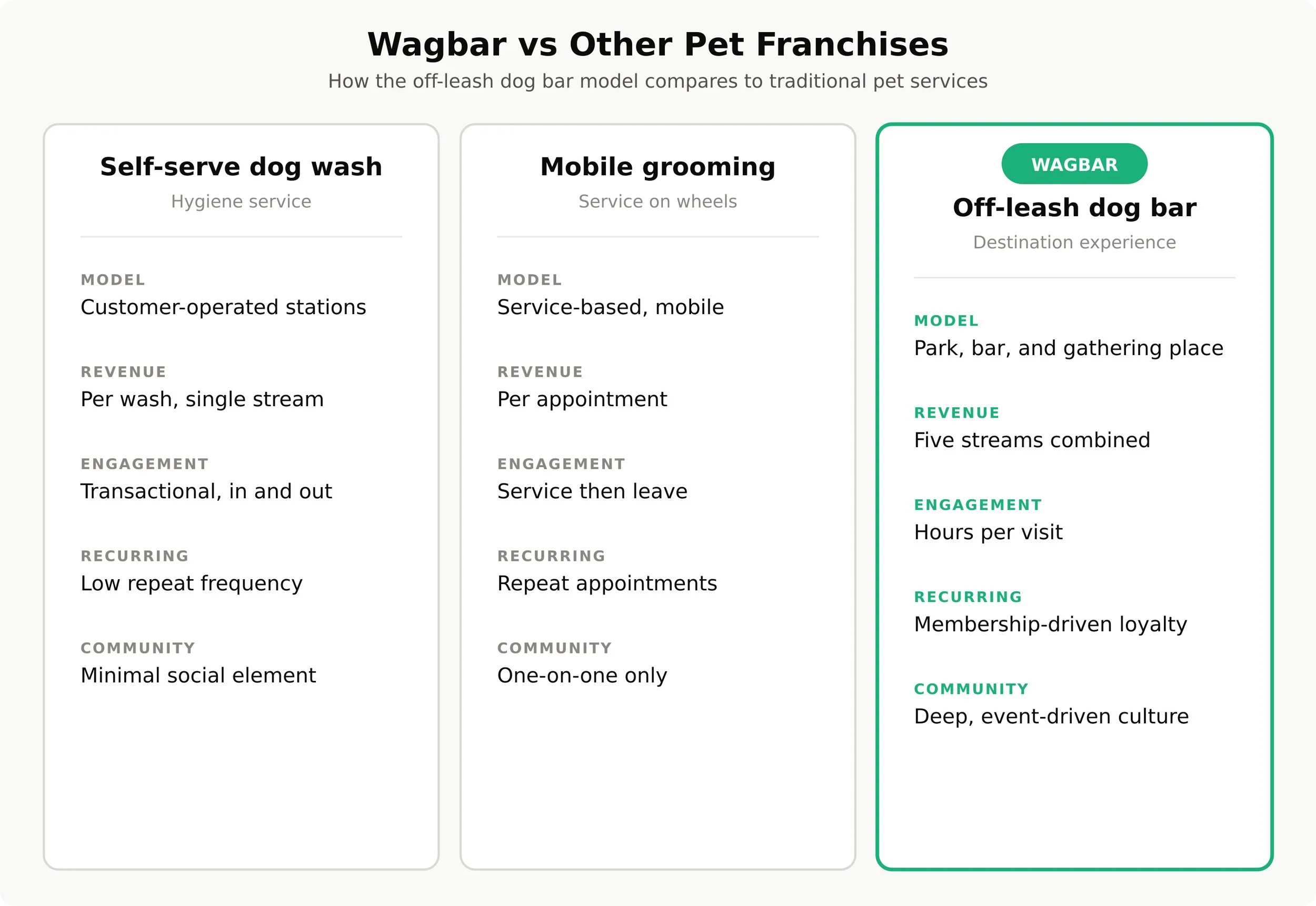
A self-serve dog wash franchise runs on a simple, transactional model. Customers come in, use the wash station, pay per visit, and leave. The revenue stream is singular, the customer relationship is brief, and there is minimal community or social element built into the experience. The repeat frequency tends to be low because most dog owners wash their dogs once every few weeks at best, and there is little reason for a customer to choose one self-serve wash location over another beyond convenience.
A mobile grooming franchise adds a service layer but operates on a fundamentally similar per-appointment basis. The groomer arrives, performs the service, and moves to the next appointment. There is no gathering place, no social environment, and no membership structure creating predictable recurring revenue. The relationship is one-on-one between the groomer and the pet owner, and the business scales primarily by adding more vans and more groomers rather than by deepening the relationship with each customer.
Wagbar's off-leash dog bar model works differently across every dimension that matters for franchise evaluation. The concept combines a dog park, a bar, and a community gathering place into a single destination experience. Revenue comes from five streams working together rather than one stream working alone. Customers spend hours per visit rather than minutes. The membership model creates loyalty-driven recurring revenue that makes financial projections more predictable and working capital requirements more manageable. And the community and event-driven culture means members develop social connections that make switching costs real without ever feeling like switching costs.
During your discovery day, pay attention to how the leadership team talks about this positioning. A franchisor who understands why their model is different can articulate the operational implications of that difference, not just the marketing advantages. The questions you ask about revenue mix, membership ramp, and customer retention take on a different character when you understand that you're evaluating a destination business rather than a service business. The benefits of owning a pet franchise page covers how these structural differences translate into the day-to-day ownership experience.
The Pet Industry Context That Makes This Moment Worth Understanding
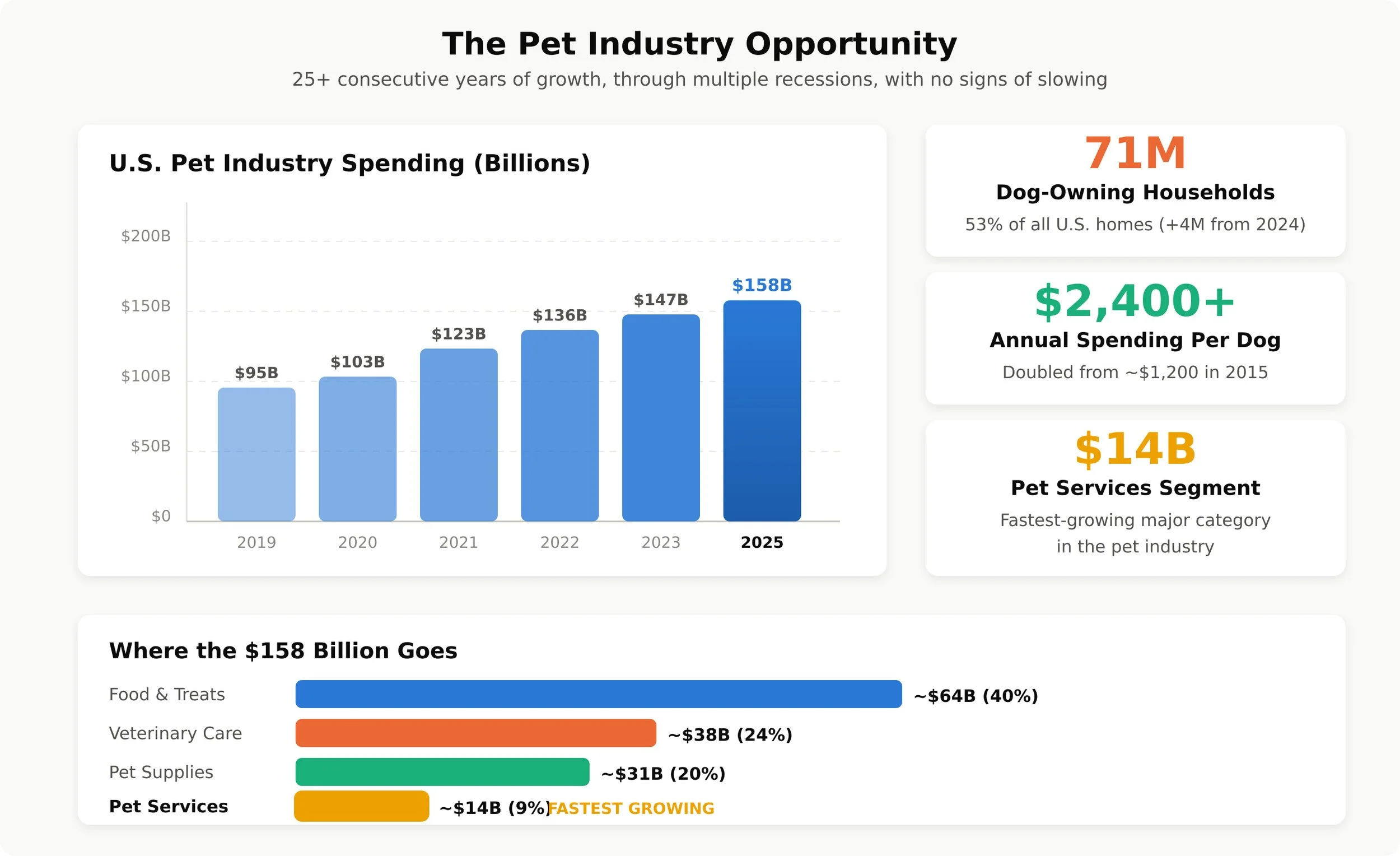
The franchise discovery day you attend doesn't happen in a vacuum. It happens within a pet industry that has sustained more than 25 consecutive years of growth, through multiple recessions, and shows no signs of decelerating.
U.S. pet industry spending reached $158 billion in 2025, growing 3.7% over the prior year, with projections pointing toward $165 billion in 2026. Dog ownership specifically has reached 53% of U.S. households, representing 71 million homes, up from 51% in 2024. That's roughly four million additional dog-owning households added in a single year.
The pet services segment, which includes grooming, boarding, daycare, training, and concepts like off-leash dog park bars, represents approximately $14 billion of the total pet market and is the fastest growing major category within the industry. Annual spending per dog has doubled over the past decade, rising from approximately $1,200 in 2015 to over $2,400 in 2025, driven largely by millennials and Gen Z owners who treat their pets as family members and invest accordingly in professional services and premium experiences.
Within this market, the off-leash dog park bar concept occupies a unique position at the intersection of pet services, food and beverage, and membership-based recurring revenue. Traditional dog parks, of which 89% are free to access, don't capture any of the spending that pet owners increasingly want to make on premium experiences for their dogs. The membership model converts that willingness into predictable, recurring revenue while creating a community environment that traditional dog parks can't replicate.
The franchise model for pet services has also matured significantly. The broader franchise industry saw lead-to-agreement conversion rates roughly double from 0.76% in 2023 to 1.50% in 2025, indicating that both franchisors and buyers are getting more sophisticated about identifying good matches earlier in the process. Referrals from existing franchisees convert at nearly 19% compared to less than 1% for internet leads, which underscores why the franchisee validation calls you complete before discovery day are so important to the overall process.
Frequently Asked Questions
When in the franchise evaluation process should I schedule a discovery day?
Discovery day works best toward the end of the validation process, after you've reviewed the FDD, spoken with at least five to eight existing franchisees, completed a preliminary financial model for your target market, and had your franchise attorney review the key provisions of the franchise agreement. Arriving with that preparation makes the visit significantly more productive because every conversation starts at a higher level of specificity and substance.
Is attending a discovery day mandatory before signing a franchise agreement?
For most franchise systems, yes. Discovery day is part of the franchisor's qualification process and signals serious mutual interest. Some franchisors will sell to qualified buyers without an in-person visit, especially for multi-unit deals where the buyer has prior franchise experience, but for first-time franchisees an in-person discovery day is typically expected. Contact the Wagbar team through the franchising page for specifics on their current process.
Can I bring my spouse, business partner, or potential investor?
Yes, and if that person will share decision-making or ownership of the business, their attendance is strongly recommended. Two sets of ears catch more than one, and the franchisor will want to meet anyone who will be part of the ownership structure. Most franchisors welcome the additional perspective. Ask in advance to confirm whether the day's format accommodates additional guests.
What should I bring with me?
A marked-up copy of the FDD with your annotations is the most important item. Bring your organized question list, a notebook and pens for notes, your financial model if you have one, your calendar for timing conversations, business cards if applicable, and comfortable shoes with layered clothing appropriate for both indoor meetings and outdoor site visits.
How long does a franchise discovery day typically last?
Most discovery days run 8 to 10 hours in a single day. Some franchise systems spread the content across two days, especially for candidates considering multi-unit development or for concepts where the operating location warrants extended observation during different time periods. Plan to arrive the night before and leave the day after to avoid compressing travel into the same day as meetings.
How much does attending discovery day cost me out of pocket?

The franchisor typically covers meals during the visit and provides materials and on-site transportation. You cover airfare, lodging, and travel time. Expect $500 to $2,500 in out-of-pocket costs depending on where you're flying from and how many nights you stay. The investment signals seriousness to the franchisor, and trying to cut corners on the trip usually means cutting corners on the experience.
Do I sign anything at discovery day?
Usually no. Most franchisors structure discovery day as a pre-signing event because both sides benefit from time to process and reflect after the meetings. The franchise agreement, territory agreement, and initial franchise fee typically come two to six weeks after the visit. Remember that the FTC requires a 14-day waiting period after receiving the FDD before you can sign or pay anything, and most franchise attorneys recommend treating that as a minimum, not a deadline.
What if I leave discovery day still unsure?
That happens often and is a completely normal outcome. The right response is to schedule additional validation calls in the week after the visit, discuss any new information with your accountant and attorney, and write down the specific questions still on your mind. Sometimes a second visit or a follow-up conversation with the founders helps clarify things. Sometimes the uncertainty itself is the answer, and that's a valid conclusion too.
Can I visit Wagbar before a formal discovery day?
Yes. The Weaverville is open to the public and gives you a real-world look at the concept without any formal commitment or obligation. Many prospects visit on their own first, experience the off-leash environment as a customer, and then come back for the structured discovery day later with much better context for their questions.
What if discovery day doesn't go well?
You are under no obligation to continue. Tell the franchisor honestly that you're not moving forward and share the reason if you're comfortable doing so. Most franchisors appreciate the feedback, and walking away after recognizing a poor fit is a far better outcome than proceeding with doubts and regretting it later.
Can I attend discovery days at multiple franchise brands?
Yes, and many active buyers do exactly this. Comparing two or three discovery days head-to-head is one of the most effective ways to evaluate franchise brands at the same depth. Be transparent with each franchisor that you're evaluating multiple options. Most expect and respect this approach.
What's the single most useful part of a franchise discovery day?
For most buyers, the one-on-one time with the founders and the operating location tour are the two highest-value elements. Both give you texture and nuance that documents and phone calls simply cannot convey. The formal presentations cover important content, but the unstructured time is where real assessments get made and genuine rapport either develops or doesn't.
Where can I learn more about Wagbar's franchise structure before visiting?
You just nee to visit the Wagbar FAQ page that will answer to you all questions and doubts you have. Similarly the dog franchise opportunity page provides the business model overview. The about Wagbar page covers the founding story, the Kulp family's background, and the values that shape operations. Visit the franchising page if you are willing to start a franchise business.
Ready to Start the Discovery Day Conversation?
If you've completed your FDD review and franchisee validation calls, you're ready to talk to Wagbar's team about scheduling a visit. You can start by emailing franchising@wagbar.com or filling out the form on the Wagbar franchising page. The team will walk through where you are in the process and confirm whether you're ready for the in-person visit or whether a few more conversations make sense first.
The trip to Asheville is worth the time. Wagbar's team built the brand on relationships that start with a real conversation, not a sales pitch. Discovery day is the beginning of that conversation, and the most prepared buyers leave with the clearest answers.
Bottom TLDR: Franchise discovery day is the in-person visit where serious buyers meet the franchisor's leadership team, tour the operating location, and make a clear-eyed assessment of whether the people and systems behind the brand justify a long-term business partnership. Prepare by completing your FDD review, finishing at least five to eight franchisee validation calls, building a financial model for your target market, and arriving with organized written questions across every category from unit economics to dog-specific safety operations. Wagbar's discovery experience centers on the original in Asheville, North Carolina, where the off-leash dog park bar concept launched and where you'll see every element of the operation running in its original market.
