

The Cost of Opening a Bar Franchise Across US Regions
Opening a bar franchise involves a wide range of estimated initial investment figures depending on which region of the country you build in. Real estate lease rates in Los Angeles run far higher than those in Knoxville. Contractor rates in Manhattan cost meaningfully more than similar work in Charlotte. Even franchise fees themselves sometimes shift based on territory value. This page walks through what a first time franchisee should actually expect on the cost side in each major US region, why the same concept lands at very different total investment figures depending on zip code, and how to think about the cost side of your decision when the numbers are anything but flat across the country.
Wagbar does not make any representation about the income, sales, profits, or earnings a franchise owner can expect. Information about the financial performance of Wagbar locations appears only in Item 19 of our Franchise Disclosure Document, which qualified candidates receive during the formal disclosure process. This page focuses only on the cost inputs from Item 7 and the franchise fee and royalty rates from Items 5 and 6.

If you're scoping which market to open in, the Wagbar locations page shows where existing franchisees have built so far. When it comes to weighing the cost side across different bar concepts, our franchise comparison walks through initial investment and structural pros and cons for each concept.
The Real Cost Range Nobody Publishes Upfront
Franchise Disclosure Documents publish estimated initial investment ranges in Item 7, but the ranges are wide enough to be almost meaningless without regional context. A typical bar franchise FDD might list $500,000 to $1.5 million as the initial investment. That's a million dollar spread. Which end you actually hit depends almost entirely on where you open. Location drives cost more than any other single variable in the equation.
The International Franchise Association publishes annual benchmarks on franchise costs by industry, and bar concepts consistently show the widest regional cost variation of any category. Anyone looking at different franchise options needs to weight the cost projections against local market realities rather than the national average number.
Why Location Multiplies Every Cost Line Item
Four cost inputs scale directly with geography. Real estate lease rates vary from around $15 per square foot per year in tertiary markets to around $150 per square foot in premium urban zones. Construction and buildout costs per square foot swing from around $80 in the Midwest to around $250 in coastal cities. Labor costs for opening staff differ by state minimum wage and skilled trade rates. Insurance and permitting fees fluctuate based on state and municipal rules.
Even the franchise fee itself sometimes flexes for territory attractiveness. A market like Austin or Denver may command a higher fee than a smaller metro. The pet franchise opportunity page covers how territory sizing typically works in the dog bar category.
The Northeast Cost Reality
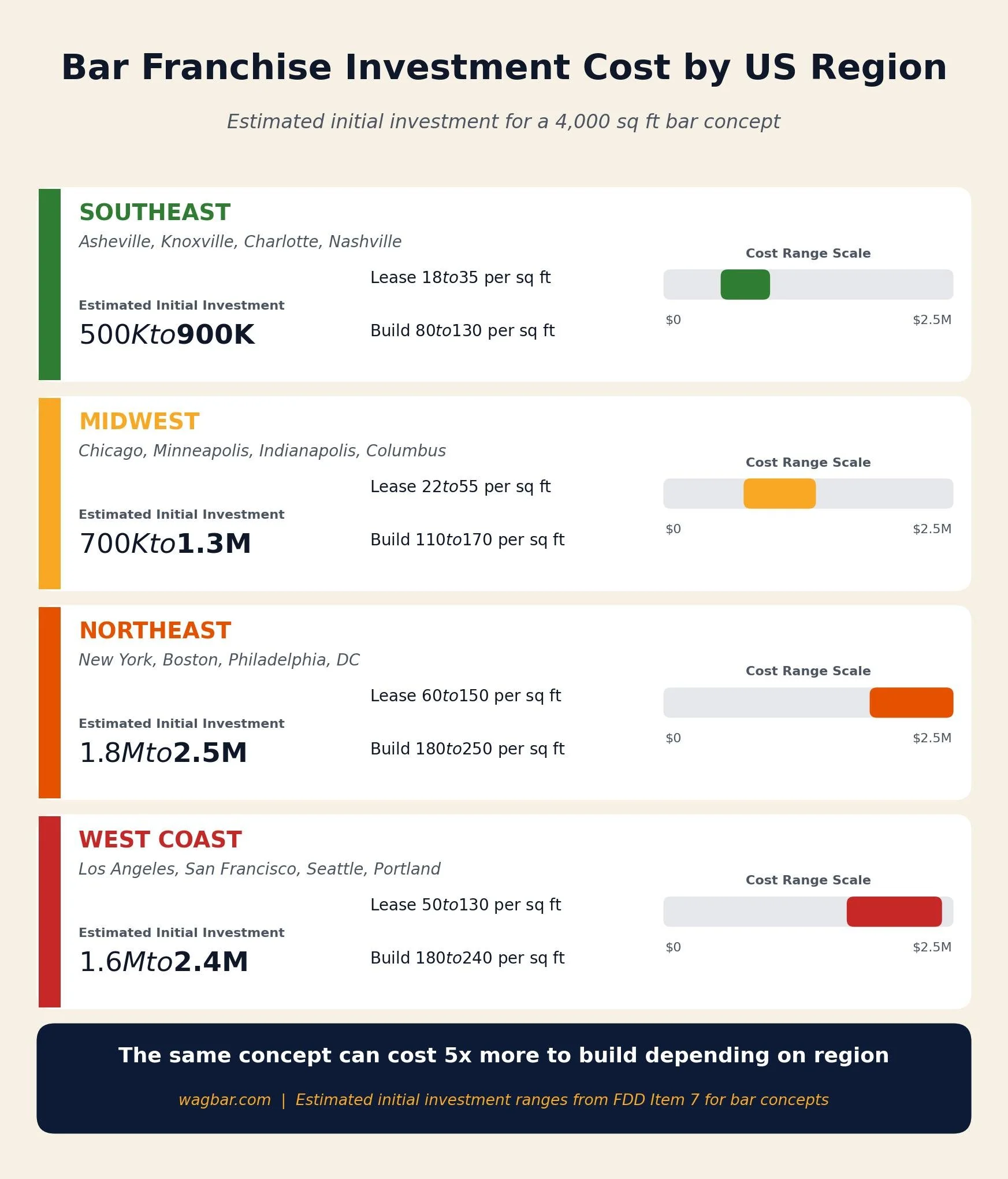
New York City, Boston, Philadelphia, and Washington DC sit at the high end of the cost spectrum. Lease rates in these cities run roughly $60 to $150 per square foot per year for retail space with outdoor patio potential. Construction costs run roughly $180 to $250 per square foot due to union labor requirements and premium materials expectations. A 4,000 square foot bar franchise in the Northeast can carry an estimated initial investment of $1.8 to $2.5 million before opening.
Any question about whether that investment level makes sense for the Northeast belongs in a conversation with current franchisees during validation and in the Item 19 disclosures during your discovery period. Cost and performance are different questions, and the cost side is what this page covers.
The Southeast Cost Profile
Asheville, Knoxville, Charlotte, Raleigh, Nashville, Atlanta, and Savannah sit at the other end of the cost curve. Lease rates run roughly $18 to $35 per square foot per year for equivalent space. Construction costs are roughly $80 to $130 per square foot with non union skilled trades and lower material prices. Total estimated initial investment for the same 4,000 square foot concept lands at $500,000 to $900,000.
The Southeast has been where much of the dog park bar category has grown initially, largely because the cost basis is lighter and the outdoor season is long. Our best cities for dog franchise success resource covers which Southeast markets have the strongest demographic and outdoor factors for the concept.
The Midwest Cost Profile
Chicago, Minneapolis, Indianapolis, Columbus, Milwaukee, and Kansas City sit in the middle of the cost spectrum. Lease rates range from roughly $22 to $55 per square foot per year depending on how urban the specific submarket is. Construction costs are roughly $110 to $170 per square foot with mixed union and non union labor markets. Total estimated initial investment for a bar franchise lands at $700,000 to $1.3 million.
The Midwest also has a densely established franchise operator community, so first time franchisees can find experienced operators to talk to before signing anything. Validation calls with current owners in the region are one of the most useful parts of any franchise discovery process.
The West Coast Cost Reality
Los Angeles, San Francisco, Seattle, Portland, San Diego, and San Jose sit at the top of the cost curve alongside the Northeast. Lease rates land in the $50 to $130 per square foot range. Construction costs run $180 to $240 per square foot with California and Washington state prevailing wage laws driving up labor. Total estimated initial investment lands at $1.6 to $2.4 million for the same concept.
California specifically adds regulatory cost through California Environmental Quality Act review for certain permits, liquor license fees that run higher than most states, and workers compensation insurance rates at the top of the national scale. First time franchisees in California often work with a franchise attorney familiar with state specific compliance issues before they sign the area development agreement.
The Real Talk on Regional Cost Decisions
Okay let's be honest, most first time franchisees pick where to open based on where they already live, not where the cost math works best. That's how you end up with someone opening a bar franchise in San Francisco and being surprised the buildout ate 40 percent of their liquidity before opening day. If you have the flexibility to pick your market, actually look at regional cost data before you sign an area development agreement.
The other real thing is that the franchisor sales pitch usually focuses on best case markets. Ask specifically to talk to franchisees in your target region during validation. Real conversations with real owners in your region beat any polished national deck. Those conversations are also the right place to ask any question about performance, since the only verified performance data the franchisor shares publicly lives in Item 19 of the FDD.
And if you're in your 20s or 30s and considering a franchise as your first business, the Southeast and Midwest markets give you the most forgiving cost structure for a first attempt. The coastal metros carry a much higher burn rate before opening, which is not a factor to underestimate for a first time operator.
How Wagbar Prices Across Markets
Wagbar started in Asheville, North Carolina and has grown into 15 markets covering both low cost and high cost regions. The franchise fee stays consistent at $50,000 across all territories. Total estimated initial investment ranges from roughly $470,300 to $1,145,900 as published in our Item 7 disclosures, which reflects real cost differences between construction and lease markets rather than any bump in what the franchisor charges. The ongoing royalty is 6 percent of adjusted gross sales with a 1 percent brand marketing fund, both disclosed in Item 6.
The Wagbar franchising team is willing to walk qualified candidates through the disclosure documents and set up validation conversations with current owners during discovery. Any question about what a location can do financially belongs in those validation conversations and in Item 19, not on a website.
The Cost Buckets Most Franchisees Underestimate
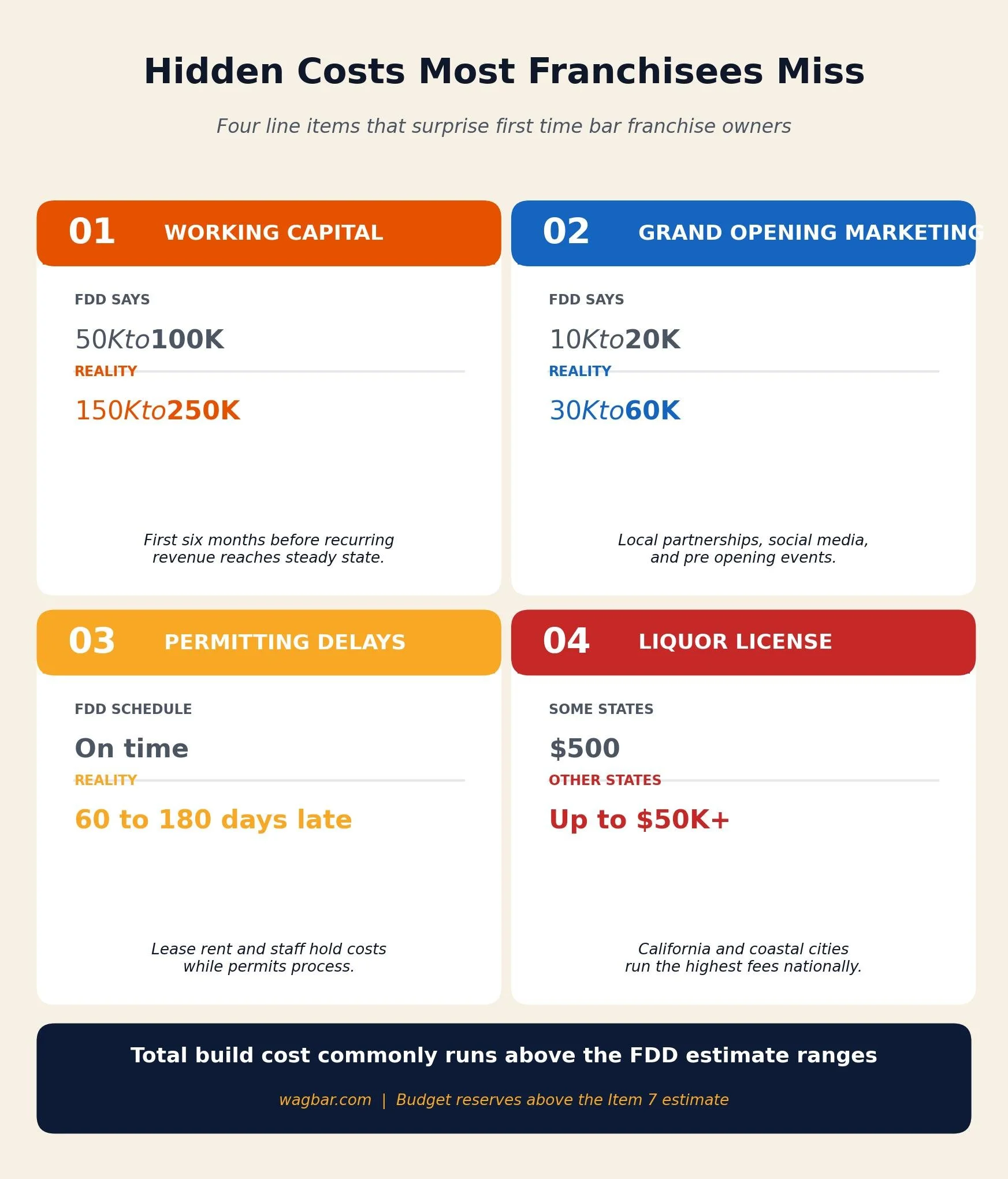
Beyond real estate and construction, four cost buckets consistently surprise first time franchisees regardless of region.
Working capital reserves. Most FDDs disclose an estimated working capital line in Item 7, and franchise attorneys generally recommend building a reserve on top of the FDD estimate for the first several months of operation before a location reaches a steady state.
Grand opening marketing. FDDs disclose an estimated grand opening marketing figure, and actual spend for a strong local opening often runs higher than the FDD estimate once local partnerships, social media, and pre opening events are added.
Permitting delays. Every region except a handful of business friendly southeastern cities has permit approval timelines that add 60 to 180 days beyond the projected buildout schedule. Every additional month adds lease rent and staff hold costs.
Insurance and licensing. Liquor licenses cost $500 in Wisconsin and $50,000 or more in California. This single line item can shift the total budget by tens of thousands of dollars depending on state.
The Small Business Administration publishes helpful working capital guidance for first time business owners, and their loan programs are worth understanding early in the discovery process.
What to Do Before You Sign Anything
The best move for anyone weighing bar franchise costs across regions is to build a real spreadsheet with local numbers rather than trusting the national FDD averages. Get actual lease quotes from a commercial broker in your target city. Get real construction bids from two or three local contractors. Get state specific liquor license fees. Get real workers comp rates for your state. Every one of those numbers moves the total investment materially.
Once those local cost inputs are on paper, our full comparison of different bar concepts becomes a more useful tool for weighing which cost profile fits your target market. If you want to visit an existing Wagbar in your region before running your local numbers, Wagbar locations lists all 15 markets. And if you're ready for market specific guidance on the disclosure process, the franchising team can walk you through the FDD and set up validation conversations with current owners.

Wagbar does not make any representation about the income, sales, profits, or earnings a franchise owner can expect. The financial performance of Wagbar locations appears only in Item 19 of the FDD, which qualified candidates receive during the formal disclosure process.