

Running a Dog Park Bar: The Operational Playbook for Owners
Top TLDR: Running a dog park bar requires managing a licensed bar and a supervised off-leash animal facility simultaneously, with neither side able to take a back seat on any given shift. The hardest operational challenges are behavioral incidents in the park, hiring for a supervision role that doesn't exist in any other industry, and sustaining revenue through slower seasons. Wagbar's franchise training program is specifically built to prepare new operators for this dual-business reality before opening day.
Most people who look seriously at opening a dog park bar have been to one as a customer. They've sat on the patio, watched their dog run with a pack of new friends, ordered a second beer, and thought: "This is the business I want to run."
That experience is real. The joy it produces is genuine. But what you see as a customer is the finished product. What happens before you get there, while you're there, and after you leave is a different picture entirely.

Running a dog park bar is genuinely rewarding work. It's also operationally more complex than a traditional bar or a standalone dog park because it's both of those things simultaneously, with the failure modes of each category available at any given moment. A glass breaks behind the bar while a scuffle breaks out in the park. A food truck doesn't show up. A member's vaccination records have lapsed and they're standing at the gate with a dog that's already excited.
This page walks through what that day-to-day reality actually looks like, where the hard problems live, and how experienced operators handle them. If you're evaluating dog park bar ownership as a business decision, this is the operational picture you need to understand before you sign anything.
The Dual-Business Challenge: You're Not Running One Business, You're Running Two
This is the thing that catches new operators off guard more than anything else.
A traditional bar is a hospitality business. You're managing inventory, staff, a liquor license, customer experience, and cash flow. That's a well-documented set of challenges with plenty of industry precedent, support resources, and experienced hires available.
A traditional dog park is a facilities and animal services business. You're managing fencing, sanitation, dog behavior, vaccination compliance, liability, and a code of conduct that actually gets enforced. That's a different skill set with different staffing needs, different risks, and different regulatory considerations depending on your municipality.
A dog park bar is both. At the same moment, on the same afternoon, with the same staff.
The two sides of the business are not separable in the way an owner might hope. You cannot put less attention on the park because the bar is busy. You cannot reduce bar staffing because the park is crowded. The businesses are physically integrated and the customer experience of both depends on each running well simultaneously.
What this means practically is that every decision you make as an operator carries dual considerations. Scheduling decisions affect park supervision coverage and bar coverage. Pricing decisions affect membership volume and walk-in bar traffic. Event programming drives both gate revenue and beverage sales. Marketing serves both the dog owner looking for off-leash access and the social drinker looking for somewhere interesting to spend a Saturday afternoon.
Operators who thrive in this model are people who genuinely enjoy the hospitality side and genuinely care about dogs. That's not a marketing line. If you're indifferent to animal behavior and only excited about the bar, you'll underinvest in park management and the business will feel it. If you love dogs but find the bar operation uncomfortable, you'll underinvest in the hospitality experience and the revenue will reflect that too.
A Typical Day: What Open-to-Close Looks Like
No two days at a dog park bar are identical, but the operational rhythm is consistent. Here's what a typical service day looks like from the owner's or manager's perspective.
Before the Gates Open
The first hour before opening is maintenance and preparation. Staff inspect the fenced play area for anything that wasn't there yesterday: standing water in low spots after rain, a loose fence panel, debris carried in by wind, anything left behind from the previous close. Waste stations are restocked. Water stations are refreshed and checked.
The bar area gets its standard pre-service prep: inventory check, line cleaning if it's a scheduled day, taps confirmed, coolers at temperature, POS system up. If there's a food truck scheduled, their arrival time and setup location are confirmed.
Vaccination records for members are accessible in the system. Day-pass entry will require verification at the gate. Staff assignments for the day are confirmed: who is on park duty, who is working the bar, who is handling gate entry and membership check-in.
Opening and the Gate Check
When the gates open, the entry protocol activates. Every dog entering needs to be screened, either as an active member whose records are already verified or as a day-pass visitor presenting current documentation for Rabies, Bordetella, and Distemper. Dogs must be at least six months old and spayed or neutered.
This process is not optional and it cannot be rushed. It exists because off-leash group play only works when every dog in the space has been health-screened. Operators who get sloppy about entry verification eventually have problems that could have been prevented. Members who have been through the system handle this part of the check-in process efficiently. First-time visitors take a few minutes, especially if their documentation isn't organized.
The first wave of guests sets the social temperature for the day. Experienced park staff read the incoming group quickly. A mix of familiar regulars and well-socialized dogs creates an easy afternoon. A large number of new dogs arriving simultaneously takes more management attention.
During Service Hours
Once the park is open and the bar is running, the operational flow divides into parallel streams that run simultaneously for the rest of the service day.
In the park, at least one trained staff member is active, watching, and moving. Park supervision is not a static post. An effective park staff member is reading the group dynamics continuously, not watching from a single corner. They're looking for body language that signals tension before it becomes a problem, dogs that are getting overwhelmed or pushed too hard, pairs or groups that need space from each other, and owners who aren't paying adequate attention.
The Wagbar code of conduct requires owners to keep eyes on their dogs and physically intervene if their dog isn't playing well. Park staff enforce this, not by being confrontational, but by being present enough that owners stay engaged and know that staff are watching too. When a dog needs to be separated or an owner needs to be redirected, staff handle it immediately. The zero-tolerance policy for aggressive behavior exists because hesitation in those moments makes everything worse.
At the bar, service runs as it would at any well-run outdoor bar, with the added dimension that the customer base includes people actively watching their dogs in the park. Sightlines matter. A covered patio with clear views into the play area isn't just an amenity, it's operationally important. Customers stay longer when they can watch their dogs from where they're sitting. Longer dwell time means more beverage orders.
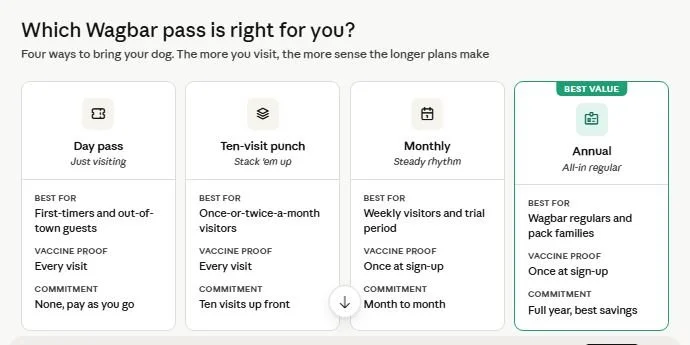
The bar also handles membership sign-ups and renewals during service hours, takes private event inquiries, and manages food truck coordination when applicable. At Wagbar, membership options include daily passes, 10-visit punch passes, monthly recurring memberships, and annual memberships. Converting a first-time day-pass visitor to a monthly member during their first visit is one of the highest-value interactions a bar staff member can create.
Waste management runs continuously throughout service. This is one of the less glamorous truths about running a dog park: the volume of waste from a busy afternoon requires constant attention. Waste stations are placed throughout the park, owners are required to clean up after their dogs, and staff handle the maintenance on an ongoing basis throughout the day. This doesn't stop when the bar gets busy.
Events, Programming, and Peaks
Wagbar locations run regular programming: trivia nights, live music, breed-specific meetups, holiday events, dog adoption days, and themed weekends. Events create traffic spikes that the operation needs to absorb. A trivia Tuesday that draws 40 people requires adequate bar staffing for that volume. A smush-face breed meetup that brings in a large group of bulldogs, pugs, and their owners requires additional park supervision because breed-specific gatherings can generate different social dynamics than mixed-group days.
Event programming is not just entertainment. It's a retention and acquisition tool. Members who come to trivia on Tuesday and the park on Saturday are dramatically more valuable than members who only show up occasionally. Events are how you make the business a habit rather than an occasional outing.
Close-Down
End-of-day operations include a full waste sweep of the play area, water station draining and cleaning, equipment checks, bar inventory counts, and a close-out process for the POS. Any behavioral incidents from the day are documented. Membership lapse notifications are flagged for follow-up. Fencing and gate hardware are inspected.
The physical close-down of a dog park bar takes longer than closing a standard bar because there are two environments to secure and clean, not one.
The Three Hardest Operational Problems
Every type of business has its specific hard problems. These are the three that dog park bar operators deal with most consistently and that cause the most operational stress when not managed proactively.
Problem One: Behavioral Incidents in the Park
The dog park is a controlled social environment, not a controlled one. Dogs can read each other's body language with remarkable speed, social tensions can escalate faster than humans expect, and even well-socialized dogs have bad days. No amount of screening and supervision eliminates all incidents. The goal is to reduce their frequency and respond effectively when they happen.
The failure mode here is either not seeing a problem developing before it escalates, or hesitating once it's visible. Experienced operators train their park staff specifically in dog behavior reading, not just park rule enforcement. There's a meaningful difference between staff who know the rules and staff who can read what a group of dogs is communicating before anything physical happens.
Wagbar's Asheville-based training program covers dog behavior management alongside bar operations for exactly this reason. You cannot separate the two skills in this business. When something does happen in the park, the response protocol needs to be clear, fast, and consistent. Owners are notified, the situation is documented, and the code of conduct determines what follows. Dogs that exhibit repeated aggressive behavior lose their membership. There is no middle ground on this because the safety of the whole community depends on consistent enforcement.
The other piece of this problem is the human side. Dog owners sometimes disagree with staff assessments of their dog's behavior. They take it personally. Handling those conversations well requires park staff who are confident in what they observed, calm in how they communicate, and backed by management that will support their judgment.
Problem Two: Hiring for a Role That Doesn't Exist Anywhere Else
Park supervision at a dog park bar is not a role with an established hiring market. A dog trainer brings the animal behavior skills but often has no bar or hospitality experience. A bar industry hire brings the hospitality skills but knows nothing about reading canine body language. Dog daycare workers have relevant experience with group dog management but may not be accustomed to a public-facing social venue where the humans are as important as the dogs.
What you're looking for is someone who genuinely loves dogs, reads them well from experience, handles the physical demands of an active outdoor job, is comfortable being the authority in the park, and can also be personable and professional with customers. That person exists. They're just not responding to a standard job posting.
Successful operators hire differently for this role. They recruit from dog training communities, dog daycare networks, dog rescue volunteers, and people who do agility or other dog sports. They look for people who are already spending their free time around dogs in group settings. They also lean toward internal development: hire someone with the right personality and dog sense, then train them on everything else.
Wagbar's one-week Asheville training covers dog behavior management as a core curriculum component alongside bar operations. That structure reflects reality: you need both, and most hires will have gaps in one or the other.
The staffing challenge also runs across the full business. Bar staff need to be genuinely comfortable around dogs, including large dogs running at them or jumping up with muddy paws. Not every hospitality hire is a fit for that environment. You find out quickly which ones are.
Problem Three: Revenue Through the Slow Season
This is the one that surprises operators who project revenue on peak-day assumptions. A Thursday in February is not a Saturday in June. If your business model only works during warm-weather weekends, it doesn't work.
The slow season problem is more manageable than it appears, but it requires intentional planning rather than hoping traffic holds up. Several mechanisms help:
Membership revenue runs in the slow season too. Active monthly and annual members continue paying regardless of how often they visit. A strong membership base is the closest thing to a revenue floor that a dog park bar has. This is one of the most important reasons to prioritize membership conversion over day passes: members stay members through January.
Indoor and covered infrastructure matters. Wagbar's bar areas include covered patios with fans for summer and heaters for the winter months, with some locations partially enclosing their patios seasonally. A customer who has a comfortable place to sit with a warm drink while their dog runs on a 45-degree afternoon is a customer who still comes in February.
Programming creates pull when the weather doesn't. Trivia Tuesday at Wagbar's flagship in Asheville runs year-round. The framing is explicit: "We continue to do trivia as long as you show up. We have heaters and hot drinks." That's not passive. That's an operator actively managing the slow period with a reason to show up.
Revenue projections need to account for variance. Operators who build their financial models on peak-week revenue and then get surprised by a quiet January aren't planning, they're guessing. Realistic projections assume a seasonal curve: typically 60–70% of peak-season revenue in slower months, with event-driven spikes in fall and spring. Building that curve into your break-even analysis from the start is the difference between a business that plans well and one that panics in its first winter.
Staffing Structure: What the Team Actually Looks Like
A dog park bar doesn't have a universal staffing template because locations vary in size, hours, and traffic patterns. But the functional requirements are consistent.
Every shift needs coverage for two simultaneous functions: bar service and park supervision. Neither can be unstaffed during operating hours. That sets a minimum shift size regardless of how slow the day is, which is one reason labor costs as a percentage of revenue stay elevated compared to a single-concept hospitality business.
The park supervisor is the active presence in the play area. This role requires continuous engagement, not periodic check-ins. They're watching body language, managing interactions, enforcing the code of conduct with owners, handling waste station maintenance, and being the first responder if something goes wrong in the park. On busy days, this role may require two people.
The bar staff handle beverage service, membership sign-ups and check-ins, point-of-sale, and the customer-facing hospitality experience. On high-volume days or event shifts, bar staffing scales up. On slow weekday afternoons, one person may cover the bar while doubling as gate check-in.
The gate/entry role can be a separate position on busy days or absorbed by bar staff on quieter ones. The entry check for vaccination records and pass validation is a process that slows down if it's not handled by someone with no competing responsibilities during peak arrival windows.
Owner involvement varies considerably. Some Wagbar franchisees are owner-operators who are physically present most days and take on the park supervisor or manager role themselves. Others build a management layer that allows them to step back from day-to-day operations over time. Wagbar's training equips franchisees to operate either way, but most operators who thrive in the early going are deeply present in the business during its first year.
The Wagbar training program is structured to make franchisees competent in every function of the business before they open, including staff training. You cannot effectively manage staff in roles you don't understand. The one-week immersive training in Asheville exists to make that competency real, not theoretical.
Seasonal Operations: Planning the Full Year
A dog park bar is genuinely a year-round business, but it's not a flat one. Understanding the seasonal rhythm in advance is what separates operators who manage it well from those who get caught by it.
Spring and early summer are the highest-traffic period for most outdoor dog park bars. Weather is good, people are motivated to get outside, and new members are acquired at the highest rate of the year. This is also the period where operational stress is highest: peak volume, simultaneous training of seasonal staff, and the rush of activity that can reveal gaps in your systems.
Late summer carries heat management considerations. Dogs can overheat in crowded play environments during high-temperature days. Water stations become more critical. Some operators adjust hours or limit admission on extreme heat days to protect animal welfare. This is a judgment call that requires policies in place before the situation arises.
Fall is a strong secondary season. Mild temperatures, holiday programming, and community events create good traffic without the intensity of peak summer. Breed-specific meetups and themed events perform particularly well in fall.
Winter is the test. Operators who have built a strong membership base, programmed consistently, and invested in weather-resilient infrastructure hold their revenue better than those who haven't. The key insight from Wagbar's Asheville flagship, which has run through western North Carolina winters, is that members keep coming if you give them a reason to and a comfortable environment to do it in. Heaters work. Mulled wine and hot drinks work. Trivia works. Passive approaches to winter traffic do not.
Planning the full year means building your staffing schedule, programming calendar, maintenance schedule, and revenue projections across all four seasons before the first one hits. Operators who plan reactively spend the slow season stressed and underprepared.
The Metrics That Matter Most
Every business has its relevant KPIs. A dog park bar's most important metrics reflect the dual nature of the operation and the membership-based revenue model.
Active membership count. This is the bedrock metric. It tells you the size of your recurring revenue base and your habitual customer community. Growth in active memberships is the most reliable leading indicator of business health. Declining memberships need to be understood immediately: is it churn from the community, a service quality issue, or a pricing problem?
Membership retention rate. How many members who paid last month are paying this month? Retention matters more than acquisition once your membership base is established. Acquiring a new member costs marketing dollars and staff time at entry. Retaining an existing one is essentially free. Operators who focus exclusively on new membership growth while ignoring churn end up running hard to stay in place.
Average revenue per visit. This combines dog park pass or membership revenue with beverage and any other spend per customer visit. Understanding what a typical visit generates per person tells you where your pricing is calibrated and where there's room to improve. Long dwell time is an asset here: a customer who stays two hours and orders three drinks generates a very different average than one who stays 45 minutes and orders one.
Daily and weekly traffic counts. Not just volume, but patterns. Which days are reliably slow? Which time windows are the peak arrival windows? Understanding your traffic curve lets you schedule labor more precisely and time programming more effectively.
Incident rate in the park. Track behavioral incidents, escalations, and any situations requiring medical attention. A rising incident rate over time can signal a screening problem, a supervision problem, or a membership mix issue. A zero-incident count over many months may indicate underreporting rather than a perfect environment.
Event attendance and event revenue. Which events drive traffic? Which ones underperform? Programming should be data-driven. Events that consistently draw 50+ people and generate strong beverage sales should be repeated and promoted. Events that draw 8 people cost more than they return and should be replaced.
Revenue by stream. Break down how much is coming from dog park passes and memberships, how much from bar sales, and how much from private events. A healthy split suggests both sides of the business are functioning. Heavy reliance on one stream creates vulnerability: if the bar isn't working, the whole business feels it.
What Wagbar's Franchise System Solves for New Operators
Building all of this from scratch, without precedent, is one of the hardest paths an operator could take. The dual-business model requires operational knowledge that spans two distinct industries and the intersection where they meet. There isn't a manual for this that exists in the broader hospitality or pet services world.
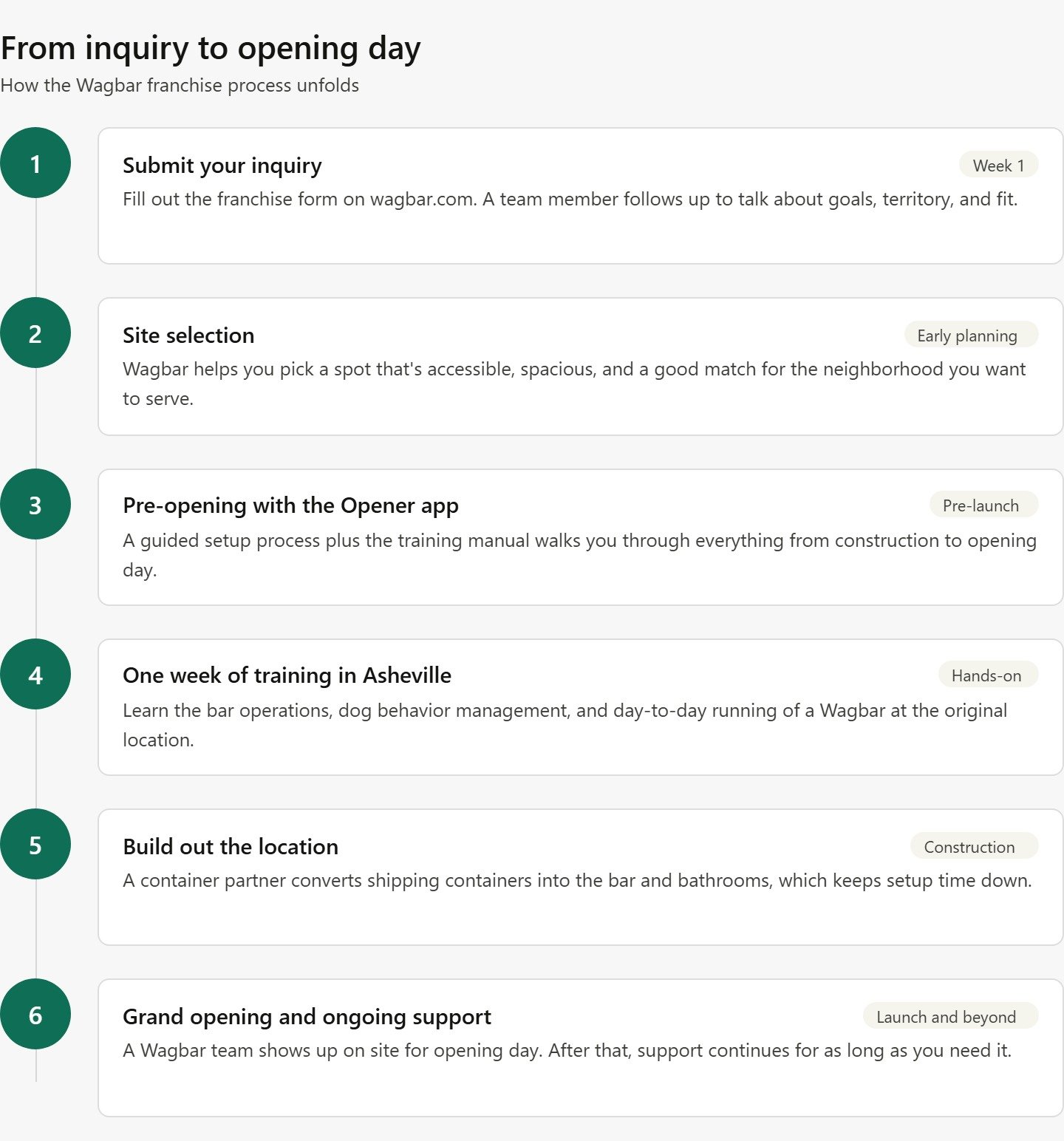
Wagbar's franchise system was developed specifically to address that gap. The "Opener" app walks new franchisees through site selection, construction, and setup before they ever arrive in Asheville for in-person training. The one-week immersive program in Asheville covers every functional area: dog behavior management, bar operations, staff training, marketing, and the code of conduct enforcement that keeps the community working. A Wagbar team is on-site for the grand opening and available for support on an ongoing basis after that.
The franchise training and support structure exists because Wagbar has already run this business through every season, every operational problem, and every staffing challenge described in this page. That institutional knowledge transfers through the franchise system. New operators don't have to discover through expensive experience that the park needs a clear behavioral incident protocol or that winter programming is what keeps members engaged in January.
If you're considering opening a dog park bar and building these systems independently, everything in this guide represents what you'd need to figure out on your own. If you're considering a Wagbar franchise, it represents what the training prepares you for before you open.
The benefits of owning a pet franchise include more than brand recognition and marketing support. The operational framework that makes a dog park bar run is the most valuable thing a franchise system can transfer to a new owner.
Frequently Asked Questions
How many staff members does a dog park bar need per shift?
At minimum, every shift requires coverage for two simultaneous functions: active park supervision and bar service. That means at minimum two people on any service shift. High-volume periods and events require additional coverage. The gate entry check-in function can be absorbed by existing staff on slow days or handled by a dedicated person during busy opening hours. Specific staffing levels scale with location size, hours, and traffic patterns.
Do I need experience in dog training to run a dog park bar?
You don't need formal dog training credentials, but you need to understand dog behavior well enough to manage the park and train staff who will supervise it. Wagbar's one-week immersive training in Asheville covers dog behavior management as a core component. Franchisees who have little dog behavior background before training come out significantly more equipped than when they arrived.
What happens when a dog is aggressive in the park?
Wagbar operates a zero-tolerance policy for aggressive behavior. Staff intervene immediately, the situation is documented, and the owner is notified. Dogs with repeated aggressive behavior lose their membership. Having this policy written, communicated, and enforced consistently is more important than the specific response in any individual incident. Staff need to know the protocol and have management support to execute it without hesitation.
How do you manage the park and the bar at the same time?
With defined roles and a staffing model that doesn't allow either function to go unattended. Park supervision and bar service are treated as parallel, non-negotiable responsibilities. When volume increases, staffing scales to maintain both. The physical layout of the venue matters too: the bar area needs sightlines into the park so staff are never completely disconnected from what's happening in the play area.
What does the slow season look like operationally?
Slower in traffic but not closed. Membership revenue continues from active members regardless of visit frequency. Programming runs year-round to maintain reasons to come in. Covered, heated bar infrastructure keeps the environment comfortable for guests and their dogs on cold days. Labor schedules adjust to reflect lower expected volume. Financial projections should model the slow season realistically from day one rather than treating it as an exception.
What are the biggest mistakes new dog park bar operators make?
The three most consistent ones are underestimating the staffing complexity of the dual-business model, projecting revenue based on peak days rather than a realistic annual curve, and being inconsistent about park code enforcement because it feels confrontational. Each of these is preventable with planning and the right operational framework in place before opening.
What support does Wagbar provide to franchisees after opening?
Beyond the pre-opening training and grand opening support, Wagbar provides ongoing operational support, marketing assistance, regular updates on best practices, and access to the franchisee community network. Quarterly business reviews help operators identify where performance can improve. The support structure doesn't end at opening day.
Summary
Running a dog park bar means managing two businesses simultaneously from the moment you open each day: a licensed hospitality operation and a supervised off-leash animal facility. The daily rhythms, staffing challenges, behavioral management requirements, and seasonal revenue patterns are all distinct from either a traditional bar or a standalone dog park. Operators who thrive understand both sides of the business, plan for the full year including the slow season, and enforce their standards consistently. Wagbar's franchise system was built to transfer the operational knowledge required to run this business well before new owners open their doors. If you want to see what a Wagbar location looks like from the customer side, find a location near you. If you're ready to understand the franchise opportunity in detail, start at the franchising page.
Bottom TLDR: Running a dog park bar is operationally more complex than either a bar or a dog park alone, requiring parallel management of hospitality service, active park supervision, vaccination compliance, behavioral incident protocols, and year-round revenue planning. The metrics that matter most are active membership count, retention rate, and revenue by stream. Prospective owners should review the Wagbar franchise training and support structure at wagbar.com/franchising to understand how the operational systems are transferred before a location opens.