

Pet Industry Experience Economy: Where the Spending Is Shifting

Top TLDR: The pet industry experience economy is the fast-growing share of pet spending flowing into experiences like dog-friendly venues, memberships, and social outings rather than traditional products. U.S. households now put a meaningful portion of their roughly $147 billion pet budget into services and experiences. Operators who want to capture this shift should build recurring-revenue membership models around shared dog and human experiences.
Key Takeaways
The pet industry experience economy captures pet dollars flowing out of aisles and into venues, memberships, and services.
Total U.S. pet spending crossed $147 billion, with services and non-food categories growing faster than food.
97% of pet owners treat their pet's emotional well-being as a top priority, per Pew Research.
Recurring membership revenue is replacing one-time retail transactions at pet-focused venues.
Action step: study which pet spending categories are growing in your market before you commit capital to a pet concept.
For decades, the U.S. pet market meant kibble, squeaky toys, vet bills, and the occasional plush bed. That picture is aging fast. Today, a growing share of pet spending flows into dog-friendly bars, off-leash park memberships, group socialization classes, training cohorts, pet-inclusive travel, and wellness visits that look more like health club sessions than old-school grooming appointments. The industry term for this is the experience economy. The interesting question is where the money is actually moving and what that means for operators and investors.
What Is the Pet Industry Experience Economy
The experience economy is a concept coined by Pine and Gilmore in 1998 to describe a broader consumer shift from buying goods to buying memorable experiences. Applied to pets, it means owners are less interested in just owning stuff for their dog and more interested in doing things with their dog that generate shared social moments.

You can see it in the rise of dog-friendly patios, pet-inclusive hotels, group hiking clubs, breed meetups, and off-leash venues where the dog runs and the human socializes. These aren't products you take home. They're experiences you show up for, often on a recurring basis. The pet industry market analysis page lays out the full $261 billion global pet economy and traces which segments are accelerating.
The Spending Shift from Products to Experiences
American households spent over $103 billion on pets in 2020, a number that has climbed to roughly $147 billion in more recent U.S. figures. Inside that total, the mix matters as much as the headline. Pet food still leads, but services and non-food categories are growing faster than basic supplies in many recent annual reports.
The pet industry growth trends page breaks down the shift in detail. Services, boarding, training, socialization, and experience venues have compounded at higher rates than food and supplies over the past several years. That's the real signal. Owners aren't buying less for their pets. They're reallocating dollars that used to go toward a new squeaky toy into a monthly membership at a venue their dog actually visits.
Why Pet Owners Are Paying for Experiences Over Products
Three forces are pushing the shift. First is pet humanization. A Pew Research Center survey found that 97% of pet owners treat their pet's emotional well-being as a top priority. Owners who see their dog as a family member are willing to pay for the dog's social life the same way they'd pay for a kid's soccer league.
Second is time pressure. Urban and suburban owners want high-quality time with their dog but don't have hours to fill every weekend. A venue that combines off-leash play for the dog with an adult social setting for the human solves two problems in one trip. The pet spending demographics page covers how Millennial and Gen Z owners are reshaping the buyer profile.
Third is loneliness and post-pandemic social repair. Venues that create low-friction ways to meet other adults with similar lifestyles are pulling foot traffic from traditional bars and coffee shops. The dog becomes the social lubricant.
Categories Gaining Share Inside the Pet Industry Experience Economy
The fastest-growing slices of the pet industry experience economy fall into a handful of categories:
Off-leash dog bars and parks with bar service
Pet-inclusive travel and boarding-plus-experience concepts
Group training cohorts and socialization classes
Dog-friendly events including breed meetups, adoption nights, and holiday themed gatherings
Wellness and rehab venues that blur the line between grooming and spa
Subscription-based enrichment boxes with experiential elements
The common thread is recurrence. These categories reward operators who build programs customers come back to weekly or monthly, not one-off purchases. Wagbar's off-leash dog bar concept sits squarely in the highest-growth slice because it combines repeat social visits with a bar revenue engine.
Membership Models Are Eating the Old Retail Model
Retail pet stores are being squeezed on two sides. Chewy and Amazon have taken share on price and convenience for commodity goods. Meanwhile, experience-driven venues have pulled customers away from in-store browsing by giving them something to do instead of something to buy.
Memberships are the engine of the experience economy. A monthly or annual pass at a dog-focused venue locks in recurring revenue, smooths seasonality, and creates a loyalty loop that one-time purchases can't match. Operators running this model benefit from more predictable cash flow than traditional retailers who rely on transaction volume. The revenue streams for off-leash dog bars page breaks down how memberships, day passes, bar sales, food truck partnerships, and private events stack into a diversified P&L.
Off-Leash Dog Bars as the Leading Example
Off-leash dog bars are the cleanest case study of the pet industry experience economy at work. Nothing about the product is physical. A member pays to access a safe outdoor yard where their dog runs with other dogs, while they grab a seat at the bar, meet neighbors, and watch a sunset. Most visits drive a second purchase on drinks or food from a rotating food truck.

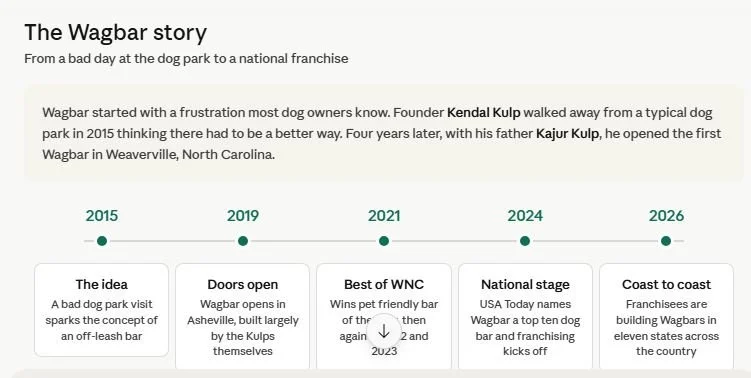
The category barely existed a decade ago. Today, independent and franchised operators are growing in mid-sized cities across the country. Wagbar, founded in 2019 in Weaverville, North Carolina, has been featured on USA Today's 10Best Dog Bars list and is expanding nationally with franchisees in Knoxville, Richmond, Phoenix, Charlotte, Los Angeles, and more. The concept works because it compounds the experience economy's three drivers: humanization, time compression, and social connection.
What This Means for Pet Franchise Investors
For prospective franchise investors, the shift toward experiences reshapes the evaluation checklist. The old pet franchise playbook was heavy on retail: pick a busy shopping center, stock the right brands, compete on margin. The new playbook is about recurring engagement.
Key questions to run against any pet franchise opportunity:
Does the concept create a reason to come back at least weekly?
Is recurring membership revenue a meaningful share of the P&L?
Does the venue solve a human social need alongside a pet care need?
Are on-site experiences cross-sellable into bar, food, and event revenue?
Does the brand have a defensible community position in its market?
Concepts that check most of these boxes are better positioned for the experience economy than those leaning on retail traffic. The pet franchise overview covers how Wagbar's model maps to each of these criteria.
Demographics Driving the Experience Economy Shift
The demographic profile behind the experience economy matters for where to open and who to target. Millennials and Gen Z lead pet ownership growth and skew heavily toward experiences over things. They are also the primary buyers of craft beverages, fitness memberships, and shared-space venues. The overlap with dog ownership is nearly total.
Income distribution follows. Households with income above the U.S. median account for a disproportionate share of experience spending. Cities with strong outdoor culture, craft beverage scenes, and dog-forward neighborhoods over-index on every metric that matters. The benefits of owning a pet franchise resource includes additional market sizing by age cohort and income bracket.
How Wagbar Is Positioned for the Experience Economy
Wagbar's model was built for the experience economy before the term was common in pet industry reports. The core design decisions reflect that:
Dogs enter on memberships, annual passes, 10-visit punch passes, or day passes, making recurring revenue the primary revenue engine
Humans 18 and over enter for free, which lowers the barrier to bringing friends and expands the social footprint
Dogs must have current Rabies, Bordetella, and Distemper vaccinations, be at least 6 months old, and be spayed or neutered, which protects the quality of the experience
Rotating local food trucks at each location keep the menu fresh and deepen the local partnership angle
Weekly events including trivia, live music, breed meetups, and holiday themed gatherings give members a reason to return on specific nights
Each design choice compounds the others. Free human entry increases group size. Vaccination requirements keep the yard safe so dogs come back. Events drive Tuesday and Wednesday traffic that would otherwise be slow nights. It's a tightly integrated experience economy business plan, not a retail store with a dog park attached.
Investment Context for Pet Experience Venues
For investors looking at the experience economy through a franchise lens, Wagbar's current investment ranges give a reference point for a venue-based concept in this category:
Initial franchise fee: $50,000
Estimated initial investment range: $470,300 to $1,145,900
Royalty: 6% of adjusted gross sales
Marketing fund contribution: 1% of adjusted gross sales
Multi-unit discount: 50% off the franchise fee at three or more units
The top end of the investment range pays for sites with more acreage, higher construction costs, or premium urban locations. The low end reflects secondary markets where land is cheaper and build timelines are shorter. The emerging opportunities resource compares these figures to other pet industry categories so prospective investors can benchmark.
Frequently Asked Questions
What exactly is the pet industry experience economy?
The pet industry experience economy is the share of pet spending that goes into services, memberships, and shared venues rather than physical products. It includes off-leash dog bars, group training, pet-inclusive travel, wellness venues, and recurring community events. It's growing faster than product categories in most recent industry reports.
How big is the pet industry experience economy right now?
U.S. pet spending totals roughly $147 billion across all categories. Inside that total, services, non-food goods, and experience-based categories are compounding at faster annual growth rates than traditional pet food. Accurate slice-specific figures vary by source, but the trend is consistent across the major pet industry research reports.
Why are pet owners choosing experiences over products?
Pet humanization is the biggest driver. 97% of owners treat their pet's emotional well-being as a top priority, per a Pew Research survey. Add in time pressure, post-pandemic social rebuilding, and Millennial and Gen Z preferences for shared moments over material goods, and you have a structural shift that favors venue-based operators.
Which pet experience categories are growing fastest?
Off-leash dog bars, pet-friendly event venues, group training cohorts, pet-inclusive travel, and wellness-oriented grooming are the fastest-growing slices. Recurring membership models are the common design element across the leading categories.
How does Wagbar fit into the pet industry experience economy?
Wagbar's off-leash dog park and bar concept is built on recurring memberships, rotating food truck partnerships, weekly events, and free human entry. The model captures the three drivers of the experience economy (humanization, time efficiency, and social connection) and turns them into a repeatable venue-based business.
What should investors look for in a pet experience business?
Focus on recurring revenue share, weekly visit frequency, community fit, and cross-sell into food and beverage. Concepts built on one-time transactions face the same headwinds as traditional pet retail. Concepts built on repeat visits and membership loyalty are better aligned with where pet spending is heading. The Wagbar franchising page covers how these criteria apply to the Wagbar model.
Bottom TLDR
The pet industry experience economy is reshaping where U.S. pet dollars go, pulling spending out of retail aisles and into memberships, venues, and shared social experiences. Off-leash dog bars are the clearest example of the shift at work. Investors and operators who want upside in the next decade should prioritize recurring-revenue models that solve both pet and human social needs at once.