

Pet Franchise Royalty Structures Compared: What 6% Really Costs You
Top TLDR: Pet franchise royalty structures typically range from 4% to 10% of gross sales depending on the category, with most pet service franchises sitting between 6% and 9%. Understanding pet franchise royalty structures before you sign means evaluating what you actually receive in return, not just what you pay. For Wagbar, the 6% royalty funds training infrastructure, operational support, and marketing systems that would cost significantly more to build independently.
When you're evaluating a pet franchise investment, the royalty percentage is usually one of the first numbers you'll see. It's also one of the most misunderstood.
Six percent sounds like a specific, meaningful number. But 6% of what? Compared to what alternatives? In exchange for what services? Those questions matter a lot more than the percentage itself, and most franchise comparison guides skip straight past them.
This breakdown covers how pet franchise royalty structures work, what typical ranges look like across different pet business categories, how to calculate the actual annual dollar cost of a royalty at different revenue levels, and what Wagbar's 6% specifically includes, so you can make a genuinely informed comparison before committing to any pet franchise investment. For broader context on the revenue model that royalties apply to, the dog park bar revenue streams guide explains what the 6% is calculated on in practice.
What a Franchise Royalty Actually Is
A royalty is an ongoing fee paid by a franchisee to the franchisor, typically calculated as a percentage of gross or adjusted gross sales. It's paid for the ongoing right to operate under the franchisor's brand, use their systems, receive their support, and benefit from their marketing.
This is distinct from the initial franchise fee, which is a one-time payment made at signing. The royalty is the recurring cost of being in the system, month after month, for the life of the franchise agreement.

Some franchises charge a flat monthly royalty (a fixed dollar amount regardless of revenue). Others charge a percentage of revenue. Most use a percentage model because it scales with the business, meaning the franchisor and franchisee share in both the upside and the downside.
The percentage model has an important implication: as your revenue grows, your royalty dollar amount grows with it. A location generating $500,000 per year at 6% pays $30,000 in royalties annually. A location at $900,000 pays $54,000. Understanding this math before you open is fundamental to building an accurate financial model. The complete guide to what a franchise is covers the full structure of franchise agreements for anyone working through the terminology for the first time.
Pet Franchise Royalty Ranges by Category
Royalty rates across the pet industry vary considerably by business type. Here's where different pet franchise categories generally fall, based on industry-typical structures:
Pet grooming franchises typically charge royalties between 6% and 9% of gross sales. Grooming systems with strong brand recognition and customer acquisition infrastructure tend to sit at the higher end of this range.
Dog training franchises generally run 7% to 10%, reflecting the premium pricing in training and the significant investment franchisors make in developing and maintaining proprietary training methodologies.
Pet boarding and daycare franchises commonly sit in the 6% to 8% range. These models carry higher startup costs and more complex operational requirements, and franchisors price their ongoing support accordingly.
Off-leash dog park bar franchises, including Wagbar, operate at 6% of adjusted gross sales. The adjusted gross sales basis (rather than total gross) means certain revenue categories may be excluded from the royalty calculation, which is specified in the Franchise Disclosure Document.
Most pet franchise categories also charge a separate marketing or advertising fund contribution on top of the base royalty, typically ranging from 1% to 3%. Understanding the full range of animal franchise opportunities helps put these structures in the right context before evaluating any specific system.
The Dollar Math: What 6% Actually Costs at Real Revenue Levels
Percentages are abstract until you run them through real numbers. Here's what a 6% royalty costs annually at different revenue levels:
$300,000 in annual revenue: $18,000 per year in royalties, or $1,500 per month.
$500,000 in annual revenue: $30,000 per year, or $2,500 per month.
$700,000 in annual revenue: $42,000 per year, or $3,500 per month.
$900,000 in annual revenue: $54,000 per year, or $4,500 per month.
Add Wagbar's 1% marketing fund contribution to each of these figures: total ongoing fees run 7% of adjusted gross sales. At $700,000 in revenue, that's $49,000 per year, or roughly $4,083 per month.
These are real costs that belong in your financial model before you commit. They belong in the same conversation as your rent, staff wages, insurance, and utilities. The question isn't whether royalties cost money. They do. The question is whether what you receive in exchange justifies the cost compared to your alternatives.
For a deeper look at how these ongoing fees fit into overall pet franchise profitability, the pet franchise profit margins guide covers the full cost structure, including royalties, and how they affect net margins at different revenue levels.
What Wagbar's 6% Actually Buys
The royalty isn't a fee for the right to use a logo. At Wagbar, it funds a specific set of operational and support infrastructure that franchisees have access to from day one and throughout the life of their agreement.
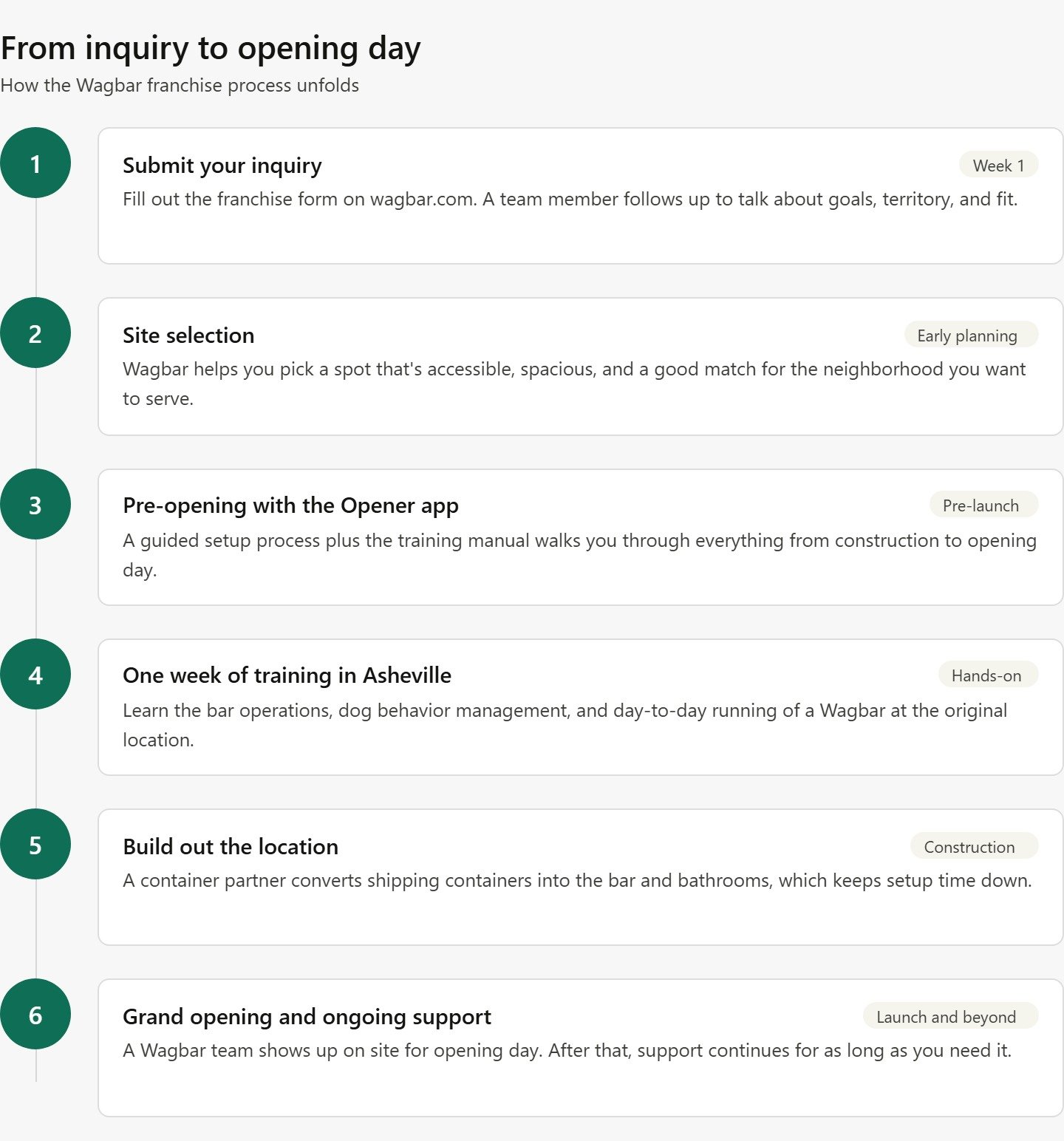
Pre-opening support. Wagbar's proprietary Opener app guides franchisees through the entire setup process from site selection through construction and pre-opening. This isn't a PDF manual. It's an active digital tool built around the specific challenges of getting a dog park bar location open and generating revenue as quickly as possible.
In-person training in Asheville. Every Wagbar franchisee goes through a week of hands-on training at the flagship location in Asheville, North Carolina. The training covers dog behavior management, bar operations, staff training, safety protocols, and the day-to-day mechanics of running a location. For someone coming from outside the hospitality or pet industry, this training represents real transferred expertise they'd otherwise have to acquire through expensive trial and error.
Grand opening support. A Wagbar team is on-site for the opening, which is the highest-stress, highest-stakes period in any new franchise location's life. Having support during opening week significantly reduces the risk of the operational mistakes that plague new independent businesses.
Ongoing operational and marketing guidance. Beyond opening, franchisees receive continued access to Wagbar's operational expertise, marketing materials, and the experience of a franchisor that has built and refined this concept through its flagship Asheville location and its expanding national network. The full breakdown of Wagbar franchise benefits details what that ongoing relationship looks like in practice.
The Marketing Fund: The Second Number You Need to Know
Most franchise royalty discussions focus exclusively on the base royalty percentage. But for most franchise systems, including Wagbar, there's a second ongoing contribution: the marketing fund.
Wagbar's marketing fund contribution is 1% of adjusted gross sales. This goes toward brand-level marketing that benefits all franchisees. National or regional campaigns, digital advertising infrastructure, brand recognition initiatives, and marketing materials all come from this pool.

The marketing fund contribution is not a second royalty. It's specifically restricted to marketing activities that benefit the brand collectively. But it is a real ongoing cost, and the total effective fee is 7% of adjusted gross sales when both are included.
For franchise buyers evaluating total cost of ownership, the combined royalty plus marketing fund percentage is the right number to use in your financial projections, not the royalty percentage alone. When comparing Wagbar's 7% total to other pet industry franchise systems, you're looking for the all-in ongoing fee, not just the headline royalty.
Royalty vs. Going Independent: The Real Comparison
The most useful framing for evaluating a pet franchise royalty isn't "how does Wagbar compare to Competitor X?" It's "what would I spend to build equivalent capabilities independently?"
An independent dog park bar operator starting from scratch needs to:
Develop their own site selection process (consultant fees, market analysis tools, research time)
Build their own operational manual and training program
Create their own marketing systems and collateral
Solve problems no one has documented solutions for yet
Accept the full financial cost of first-year mistakes that a franchise system would have warned them about
The cost of those activities, measured in actual dollars and in the two to three years of learning curve they represent, typically exceeds what a franchise royalty costs over the same period. This isn't a theoretical argument. It's why people buy franchises.
That said, the royalty calculation only favors a franchise when the franchisor delivers real value. A franchise system with weak training, minimal ongoing support, and poor marketing infrastructure doesn't justify a 6% royalty just because the percentage is industry-standard. The quality and depth of the support determines whether the royalty is a good investment or an ongoing drag on earnings. The guide to owning a pet franchise walks through the full ownership experience and what franchisees in the Wagbar system actually receive.
Multi-Unit Math: How the Royalty Looks at Scale
For investors evaluating multiple locations, the royalty conversation includes one more variable: Wagbar's multi-unit discount.
Operators who commit to opening three or more Wagbar locations receive a 50% discount on the franchise fee. The initial franchise fee is $50,000 per location at the standard rate. At the multi-unit discount, that drops to $25,000 per additional location for qualifying operators. The base royalty of 6% continues to apply per location, but the reduced per-unit entry cost changes the overall investment math considerably for portfolio-scale buyers.
For anyone thinking beyond a single location, this structure makes a meaningful difference in the overall cost per unit. The total estimated investment range of $470,300 to $1,145,900 per location applies to each additional unit's build-out and working capital requirements. The franchise fee reduction is applied on top of that. For a full breakdown of how these costs stack up at both single and multi-unit scale, the dog park bar startup cost guide walks through the complete investment picture.
This information is not intended as an offer to sell, or the solicitation of an offer to buy, a franchise. It is for information purposes only. An offer is made only by Franchise Disclosure Document (FDD). Currently, the following states regulate the offer and sale of franchises: California, Hawaii, Illinois, Indiana, Maryland, Michigan, Minnesota, New York, North Dakota, Oregon, Rhode Island, South Dakota, Virginia, Washington, and Wisconsin. If you are a resident of, or wish to acquire a franchise for a Wagbar to be located in one of these states or a country whose laws regulate the offer and sale of franchises, we will not offer you a franchise unless and until we have complied with applicable pre-sale registration and disclosure requirements in your jurisdiction.
Frequently Asked Questions About Pet Franchise Royalty Structures
Is 6% a high royalty for a pet franchise?
Six percent is in the middle of the typical range for pet service franchises, which run from roughly 4% to 10% depending on the category. Dog training franchises often charge 7-10%. Grooming franchises commonly run 6-9%. At 6%, Wagbar sits below the high end of the industry range. The more relevant question is what you receive for the percentage, not whether the percentage is numerically high or low.
What is the difference between gross sales and adjusted gross sales?
Gross sales means all revenue before any deductions. Adjusted gross sales typically excludes specific categories that both parties agree shouldn't be included in the royalty base, such as sales taxes, refunds, or certain ancillary revenue types. The specific definition of adjusted gross sales for any franchise system is documented in the Franchise Disclosure Document. Reading that definition carefully is an important step in understanding your true royalty obligation.
Does the royalty cover marketing expenses?
The royalty and the marketing fund are separate contributions. The royalty funds the operational support, training, and ongoing guidance that franchisees receive. The marketing fund, which is 1% for Wagbar, specifically funds brand-level marketing activities. Individual location marketing costs, like local social media advertising or event promotion, are separate from both.
Can the royalty rate change over time?
Franchise agreements specify the royalty rate and the conditions under which it can be modified. Reading the FDD carefully, particularly the sections covering fees and the term and renewal provisions, tells you exactly what the royalty rate is for the initial term and how renewals are handled. Working with a franchise attorney during due diligence is the standard approach for understanding these terms in full. The Wagbar franchising page is the right starting point for requesting the FDD and beginning that due diligence process.
How do royalties affect breakeven timelines?
Royalties are a variable operating expense that scales with revenue. In breakeven modeling, they belong in the same column as other revenue-dependent costs. A location at $500,000 in annual revenue with a 6% royalty and 1% marketing fund pays $35,000 per year in ongoing franchise fees. Modeling that cost against your fixed expenses, gross margins, and projected revenue gives you an accurate picture of your breakeven timeline.
Bottom TLDR
Pet franchise royalty structures across pet service categories typically range from 4% to 10%, with most dog park, grooming, and boarding systems sitting at 6% to 9%. Wagbar's pet franchise royalty of 6%, plus a 1% marketing fund, totals 7% in ongoing fees and funds training, grand opening support, and ongoing operational guidance. To evaluate any royalty, calculate the annual dollar cost at your projected revenue and compare it to building equivalent support independently.