

Pet Franchise Opportunities in South Carolina
Key Takeaways
South Carolina's pet-owning households spent $1.98 billion in 2024, projected to reach $2.04 billion in 2025 (Capital One Shopping Research).
45.3% of SC households own a dog, representing 1.51 million pet dogs across the state, well above the national average (APPA, 2025).
South Carolina ranked 5th nationally for franchise growth in 2025, with 1,205 new franchise businesses projected and $19.5 billion in franchise economic output (IFA/FRANdata, February 2025).
SC is not a franchise registration state, so franchisors only need to comply with the federal 14-day FDD disclosure rule, keeping the process simple and fast.
Major SC cities with zero off-leash dog bar competition include Columbia, Spartanburg, Rock Hill, and Hilton Head, validated markets waiting for the right operator.
South Carolina is one of the fastest-growing states in the country, and its pet economy is keeping pace. With 91,000 new residents arriving in 2024 alone, the fourth-fastest state population growth in the nation, the customer base for pet-related businesses is expanding in real time. The Palmetto State now holds 5.46 million people, and a remarkable 62% of its households own at least one pet.
For entrepreneurs researching a pet franchise that sits at the intersection of pet services, craft beverage culture, and social community, South Carolina offers something few states can match: strong ownership numbers, favorable business conditions, and multiple major markets that still have no dedicated off-leash dog bar.

South Carolina's Pet Market by the Numbers
The raw data makes a clear case. South Carolina's pet-owning households spent an estimated $1.98 billion in 2024, averaging $1,434 per household, and that figure is projected to climb to $2.04 billion in 2025 (Capital One Shopping Research, December 2025). The state's 1.51 million pet dogs represent one of the Southeast's largest addressable markets for pet franchise opportunities.
Dog ownership at 45.3% of households is meaningfully above the U.S. average. That translates to a critical mass of potential customers in every major metro area, not just the coastal markets. The average dog owner in the U.S. spends over $1,700 annually on their dog, and South Carolina's numbers track closely with that benchmark (AVMA, 2025).
Nationally, the pet industry hit $152 billion in total expenditures in 2024, a new all-time high, driven partly by Gen Z pet ownership growing 43.5% in a single year (APPA, 2025). That generation isn't just buying dog food. They're spending on experiences, events, and community spaces that put their dogs at the center of their social lives. That's the exact market Wagbar was built for.
South Carolina Pet Market at a Glance
Metric South Carolina Context Pet-owning households 62.0% Above U.S. average Dog ownership rate 45.3% Above U.S. average Pet dogs statewide 1.51 million Southeast top five Annual pet spending $1.98 billion (2024) Projected $2.04B in 2025 Avg. spend per pet household $1,434/year Capital One Shopping, 2025 State dog Boykin Spaniel Official since 1985
South Carolina's Business Climate for Franchise Owners
The IFA ranked South Carolina the 5th best state nationally for franchise growth in 2025, with 1,205 new franchise businesses expected to open this year. Franchising already contributes $19.5 billion to SC's economy and supports 215,514 direct jobs (IFA/FRANdata, February 2025). The state has consistently appeared in the top ten for franchise growth year over year.
Several structural advantages make SC genuinely attractive for franchise investment. South Carolina charges a flat 5% corporate income tax on C-corporations. Pass-through entity owners, which describes most franchise structures, can elect to pay active trade or business income at a flat 3% rate, among the most favorable in the Southeast (South Carolina Department of Revenue). Critically, South Carolina charges no separate franchise tax or franchise privilege tax, meaning you're not paying an extra annual fee just for the right to operate here.
SC is also not a franchise registration state. You don't need to file your FDD with the state before awarding franchises. Only the federal 14-day disclosure rule applies. That simplifies the expansion timeline considerably compared to states like Maryland or California.
On population: South Carolina's growth isn't slowing down. The state added 91,000 new residents in 2024, with only Florida, Texas, and Utah growing faster. The Myrtle Beach metro was the third-fastest-growing metro in the entire country at 3.8% growth, and Spartanburg ranked tenth nationally at 2.7% (U.S. Census Bureau, 2025). Those aren't just tourism numbers. Those are permanent residents with dogs who need somewhere to go.
For more on what good pet franchise opportunities look like structurally, the what is a franchise guide covers the full picture from FDDs to royalty structures.
The SC Off-Leash Dog Bar Market: City by City
Understanding where competition exists and where it doesn't is what separates a well-researched franchise decision from a guess. South Carolina's dog bar market is still early. There are two established players, one Wagbar franchise already committed, and four significant markets that have nobody yet.
Market-by-Market Breakdown
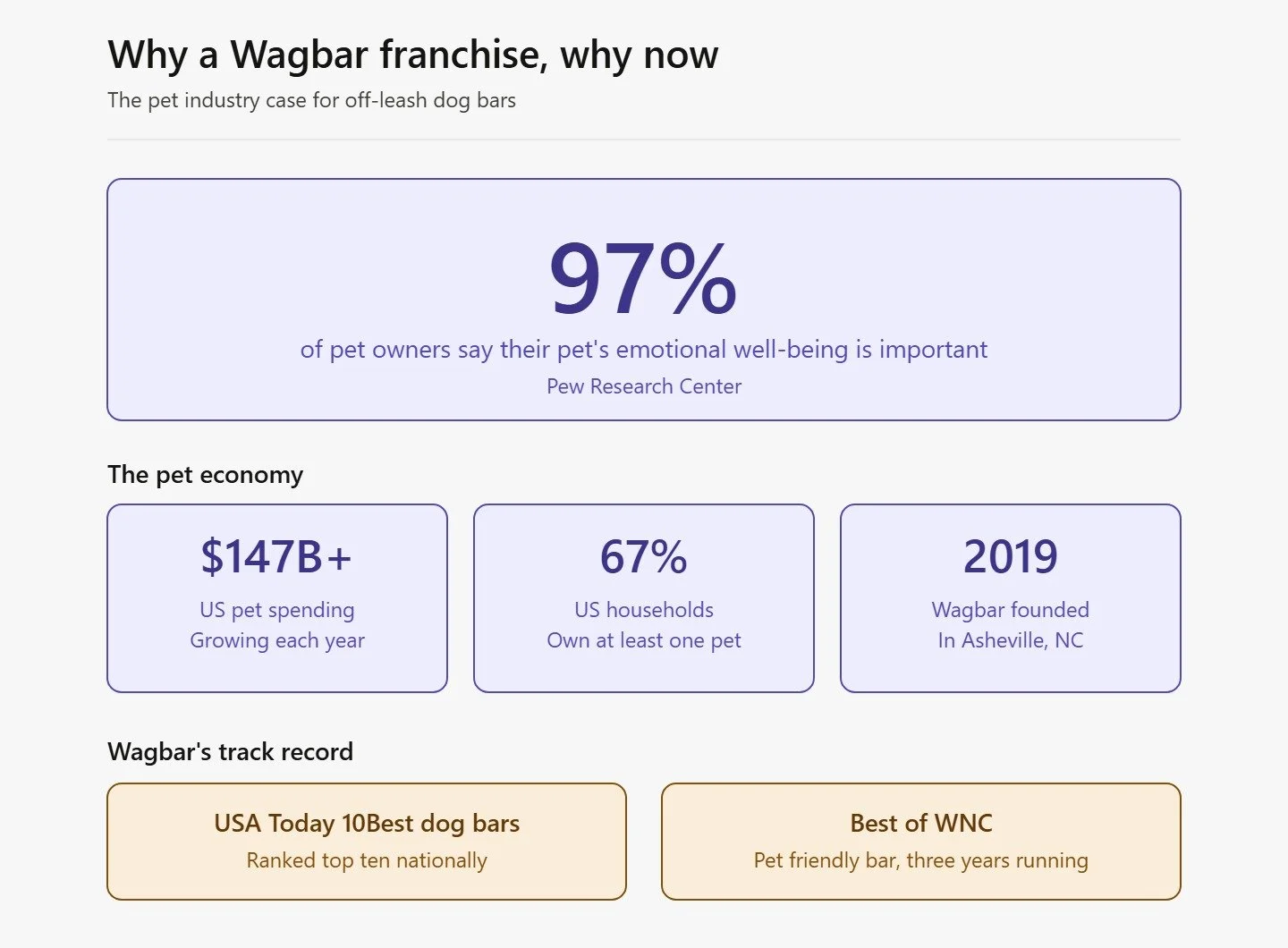
Market Metro Pop. Dog Bar Competitors Status Greenville ~430K Dapper Dog Bark & Brew (active) Established competition Charleston / N. Charleston ~800K Broken Leash (N. Charleston) One competitor Myrtle Beach ~413K Wagbar (franchise signed) Wagbar territory secured Columbia ~830K None Zero competition Spartanburg ~390K None Zero competition Rock Hill / Fort Mill ~270K+ None Zero competition Hilton Head / Bluffton ~110K None Zero competition
Greenville: The Dapper Dog Has Built the Market
Greenville's Dapper Dog Bark and Brew is an active, established business with an off-leash yard, coffee bar, trivia nights, live music, and a membership model. The presence of a competitor here isn't necessarily a red light. It proves the market works. Greenville has built a genuine dog-owner culture around the Swamp Rabbit Trail, its walkable West End neighborhood, and a food and craft beer scene that draws exactly the demographic that spends money at dog bars.
Charleston: One Competitor, Large Market
Broken Leash operates in North Charleston at 8811 Old University Blvd, combining off-leash play with craft beer and wine in a format similar to Wagbar's. The Charleston metro has roughly 800,000 people and strong out-of-state relocation. One competitor serving a market of that size is not saturation. It's early stage. The key here is territory selection within the broader metro.
Myrtle Beach: Wagbar Territory Already Secured
Wagbar franchisees Matt and Taylor are bringing the concept to Myrtle Beach, a market that deserves attention because of its extraordinary growth trajectory. The Myrtle Beach metro population doubled since 2009, reaching 413,000 people in 2024 (U.S. Census Bureau). As a Wagbar location, Myrtle Beach is already off the board, but it validates SC as a target state for the brand.
Columbia: State Capital, Zero Dog Bars
Columbia is the state capital, home to the University of South Carolina's main campus with more than 35,000 students, Fort Jackson military installation, and a downtown revitalization that has accelerated significantly over the past decade. The Richland County area holds over 411,000 people. For all of that, there is not a single dedicated off-leash dog bar in the Columbia market. The pet industry market analysis shows why college-town and military-adjacent markets are particularly strong for membership-based pet businesses.
Spartanburg: Fastest-Growing and Completely Open
Spartanburg is the most compelling pure white-space opportunity in South Carolina right now. The Spartanburg metro ranked 10th fastest-growing in the entire country in 2024, growing at 2.7% year-over-year (U.S. Census Bureau). The Greenville-Spartanburg-Anderson tri-county area has a combined population of 1.4 million. Despite that scale and growth, there is no off-leash dog bar concept operating in Spartanburg.
Rock Hill and Fort Mill: Charlotte Overspill
York County, which includes Rock Hill and Fort Mill, is essentially the southern extension of the Charlotte metro. Fort Mill consistently ranks among SC's fastest-growing municipalities. The population growth here is driven by Charlotte spillover: families and young professionals priced out of Mecklenburg County who bring their dogs and their spending habits with them. No dog bars here yet.
Hilton Head and Bluffton: Affluent, Dog-Obsessed, Underserved
Hilton Head Island and the adjacent Bluffton area have a profile that doesn't often appear in franchise conversations: a highly affluent, heavily dog-oriented population with significant disposable income and no off-leash bar concept within reach. Bluffton has been one of South Carolina's fastest-growing municipalities for years, growing over 1,400% since 2000. The resort town atmosphere supports premium pricing and an experience-first consumer mindset.
Why Wagbar Makes Sense for South Carolina
Wagbar's shipping container bar model was built to move fast and keep startup costs manageable relative to full-scale commercial builds. A traditional dog bar that builds from scratch can push total investment well above Wagbar's $470,300 to $1,145,900 range. The container structure standardizes the physical plant, which makes opening timelines more predictable and site selection more flexible.
Wagbar's training runs out of its off-leash dog bar headquarters in Weaverville, just north of Asheville, NC, roughly two hours from Greenville, Spartanburg, and Charlotte. For a South Carolina franchisee, that proximity matters. You're close enough to the home base that travel for training and ongoing support is manageable, and Wagbar's brand recognition in the Carolinas is already established.
Wagbar's revenue streams, memberships, day passes, and beverage sales, create multiple income channels that a single-service pet business can't match. Membership revenue is especially valuable in SC markets like Myrtle Beach and Hilton Head where the population skews toward people who want belonging in a community, not just a transaction.
The benefits of owning a pet franchise page goes deeper on what distinguishes an experience-based franchise model from traditional pet service businesses.
The Pet Franchise Industry in 2025
The national pet industry hit $152 billion in 2024, up from $147 billion in 2023, and shows no signs of slowing (APPA, 2025). Growth is being driven by an unusual combination of demographic forces: millennials delaying children and treating dogs as family, Gen Z entering the market at a rate 43.5% higher than the year before, and a 94 million household pet-owning base that's never been larger.
The shift toward experience-based pet businesses is the most significant structural trend in the industry. Pet owners increasingly want more than grooming and vet visits. They want places to take their dogs that are also places they want to be. Off-leash dog bars sit exactly at that intersection.
The franchise model itself has a structural advantage over independent startups: the one-year success rate for a new franchise is 6.3% higher than for independent businesses (OneUpWeb). In an industry with proven demand and growing consumer spending, that advantage compounds meaningfully over the first three years of operation.
For a full breakdown of different types of pet franchise opportunities and how the dog bar model compares, the pet industry analysis pages cover the competitive picture in detail.
Frequently Asked Questions

Is South Carolina a good state for a pet franchise?
Yes. The combination of a $1.98 billion annual pet market, 45.3% dog ownership, 5th-place franchise growth ranking nationally, and multiple cities with zero dog bar competition makes South Carolina one of the strongest franchise opportunity states in the Southeast. The 3% pass-through entity tax rate and absence of a franchise tax add to the financial case.
Is South Carolina a franchise registration state?
No. South Carolina does not require franchise registration before awarding franchises. The only requirement is federal: providing a Franchise Disclosure Document at least 14 days before signing. This simplifies and accelerates the process compared to registration states like Maryland, Virginia, or California.
Which South Carolina cities have no off-leash dog bar competition?
Columbia, Spartanburg, Rock Hill, Fort Mill, and Hilton Head-Bluffton currently have no dedicated off-leash dog bar operating in the market. Myrtle Beach already has a Wagbar franchisee in place. Columbia and Spartanburg are the largest unserved markets by population.
What is the SC pet franchise investment range with Wagbar?
The total initial investment for a Wagbar franchise ranges from $470,300 to $1,145,900, with a $50,000 franchise fee. Multi-unit operators receive a 50% discount on the franchise fee for three or more locations. Royalties run at 6% with a 1% marketing fund contribution. The starting an off-leash dog bar guide covers the full investment breakdown and operational setup.
Why is Spartanburg a strong SC target market?
Spartanburg ranked 10th fastest-growing metropolitan area in the country in 2024 at 2.7% growth (U.S. Census Bureau). The Greenville-Spartanburg-Anderson tri-county area has 1.4 million people. Despite that scale and growth trajectory, there is no off-leash dog bar concept in Spartanburg. Growing populations mean growing demand, and first-mover advantage in a market that size compounds quickly.
What makes Hilton Head a viable pet franchise market?
The Hilton Head-Bluffton area has an unusually affluent, dog-oriented demographic, primarily retirees and second-homeowners with high disposable income and a strong appetite for lifestyle experiences. Bluffton has been one of South Carolina's fastest-growing municipalities for decades. No dog bars operate in this market. The premium pricing that Wagbar's membership model supports fits the area's consumer expectations.
Does Wagbar have existing SC locations?
Yes. Wagbar's Myrtle Beach franchise has been signed and is in development, the brand's first foothold in South Carolina. The Wagbar flagship and training headquarters remain in Weaverville, NC, approximately two hours from Greenville and Spartanburg. South Carolina franchise inquiries go through the main franchising page.
South Carolina's Pet Franchise Opportunity, Summarized
South Carolina brings together the ingredients that make a pet franchise work: 1.51 million pet dogs, 62% pet-owning households, nearly $2 billion in annual pet spending, the 5th best franchise growth climate in the nation, and four major cities with zero off-leash dog bar competition. The state's 3% pass-through entity tax, no franchise tax, and non-registration status remove friction from getting started.
Wagbar already has a presence in Myrtle Beach. Columbia, Spartanburg, Rock Hill, and Hilton Head are the remaining opportunities in a market that's growing faster than almost anywhere else in the country.
Read more about pet franchise opportunities or go directly to the franchising page to start the conversation about SC territory availability.
Ready to bring Wagbar to South Carolina? Contact the Wagbar franchising team to check territory availability, receive the FDD, and take the first step in one of the Southeast's strongest pet franchise markets.