

Pet Franchise Break-Even Analysis: The Variables That Determine How Quickly You Reach Profitability

Top TLDR: Pet franchise break-even analysis depends on five key variables: total investment and debt service, real estate costs, staffing, revenue model structure, and membership ramp-up rate. Off-leash dog bar franchises like Wagbar carry different break-even math than single-service concepts because membership revenue builds a predictable monthly income base. All scenarios in this article are hypothetical; request Wagbar's FDD for verified financial data.
Key Takeaways
Break-even timelines for pet franchises depend on total investment size, fixed monthly costs, and how quickly revenue scales.
Membership-based revenue models create a predictable monthly income floor that shortens the path to covering fixed costs.
Concepts with multiple simultaneous revenue streams, like off-leash dog bar franchises, carry different break-even math than single-service pet businesses.
All financial scenarios in this article are hypothetical illustrative examples. Prospective Wagbar franchisees should request the FDD for verified financial performance data.
Disclaimer: All financial scenarios, figures, and break-even projections in this article are hypothetical illustrative examples created for educational purposes only. They do not represent actual performance data, guarantees, or projections for any Wagbar franchise location. Actual results will vary. Prospective franchisees should review Wagbar's Franchise Disclosure Document (FDD) for verified financial information before making any investment decision.
Every prospective franchisee eventually asks the same question: how long until I'm making money? It's the right question, but the honest answer is that break-even timing isn't a single fixed number. It's the result of several variables working together, and understanding those variables is more useful than chasing a generic timeline estimate.

This article breaks down the key factors that shape pet franchise break-even analysis, with specific attention to how the off-leash dog park bar model works relative to simpler pet service concepts. The goal is to give you a clear framework for thinking through your own numbers before you sit down with an FDD and a financial advisor.
What Break-Even Actually Means in a Franchise Context
Break-even is the point at which monthly revenue equals total monthly costs. Before that point, you're drawing down on your working capital reserves. After it, you're generating profit. The sooner you reach it, the less capital you consume during the ramp-up phase and the sooner your investment starts producing returns.
In a franchise context, your monthly costs fall into two categories. Fixed costs don't change regardless of revenue: rent, loan payments, insurance, base staffing, royalties calculated on a minimum baseline, and utilities. Variable costs scale with revenue and activity: supplies, additional staffing hours during high-traffic periods, and royalty payments above your minimum.
The break-even formula is straightforward. Monthly fixed costs divided by gross margin percentage equals the revenue required to cover those fixed costs. For most pet franchise models, the harder part isn't the math itself. It's building accurate estimates for each input.
The Five Variables That Move Your Break-Even Timeline Most
1. Total Investment and Debt Service
How much you borrowed to open your location has a direct and lasting effect on your monthly cost structure. A franchisee who funds 80% of a $700,000 investment through an SBA loan carries significantly higher monthly debt service than one who uses 50% financing or brings more equity to the table.
In a hypothetical illustrative example: a $560,000 SBA 7(a) loan at a 10% interest rate over a 10-year term produces monthly payments of roughly $7,400. That $7,400 is a fixed obligation regardless of whether you have a strong opening month or a slow one. Franchisees who minimize debt service through larger equity contributions or multi-unit discounts on franchise fees see a materially different break-even picture than those who maximize leverage.
For more context on how Wagbar's total investment range interacts with financing options, the pet franchise investment guide covers SBA 7(a) and 504 structures in detail.
2. Rent and Real Estate Costs
Location cost is typically the largest single line item in a pet franchise's monthly fixed cost structure. Rent or land lease payments vary enormously by market, from under $3,000 per month in lower-cost suburban markets to $10,000 or more in high-demand urban areas.
For an off-leash dog park concept, real estate requirements differ from typical retail franchises. You need outdoor space, appropriate zoning for animal use, and a location accessible enough to build a regular membership base from the surrounding community. Those constraints can push you toward specific submarkets where real estate costs land in a predictable range. Selecting the right site involves balancing cost against the population density and dog ownership rates needed to reach your membership targets. Wagbar's franchise development process includes site selection support specifically because this tradeoff is consequential.
3. Staffing Model and Labor Costs
Labor is the other major variable in monthly fixed costs. For Wagbar-model operations, staffing needs to cover park monitoring, bar service, and customer interactions throughout operating hours. A location running six days a week with extended hours may need multiple staff members per shift plus a manager, putting monthly labor expenses in the $15,000 to $25,000 range depending on local wage rates and your specific scheduling model.
Staffing costs are somewhat controllable through smart scheduling and cross-training, but they can't be reduced below the minimum required to operate safely and maintain the customer experience. Cutting staff to save money in a community-based business model tends to reduce the quality of the experience, which affects membership retention and word-of-mouth growth, both of which are more damaging to break-even timelines than the short-term labor savings.
4. Revenue Model Structure
This is where the off-leash dog bar model diverges most sharply from simpler pet service franchises. A mobile grooming franchise has one primary revenue stream: grooming appointments. Every day starts at zero, and revenue depends entirely on how many appointments the van can complete.
A Wagbar location runs three simultaneous revenue streams: dog park membership fees, daily and punch pass access, and bar sales. Each of these operates on a different economic logic. Membership revenue is recurring and predictable. Daily pass revenue responds to foot traffic, marketing, and seasonal patterns. Bar sales track with time-on-site and event programming.
The practical effect on break-even timing is significant. In a hypothetical illustrative scenario, a location with 250 active monthly members generating an average of $55 per month per membership produces $13,750 in predictable monthly revenue before a single walk-in customer or bar tab is counted. Layer in daily pass revenue from non-members and bar sales on a typical operating day, and the total revenue picture changes considerably relative to a single-stream model.
The revenue streams for off-leash dog bars page goes deeper on how these channels interact and compound over time.
5. Membership Ramp-Up Rate
Membership growth is the variable that most directly determines how quickly a Wagbar-model location moves from pre-break-even operations to profitability. The faster you build your active membership base, the sooner your predictable recurring revenue covers fixed costs.
Ramp-up rate is influenced by several factors the franchisee controls: how aggressively you market in the pre-opening period, how well you execute on the community-building programming that drives word-of-mouth, and how consistently you deliver the experience that converts first-time visitors into members. It's also influenced by market factors you don't control: local dog ownership density, nearby competition, and how familiar your target market already is with the off-leash dog bar concept.
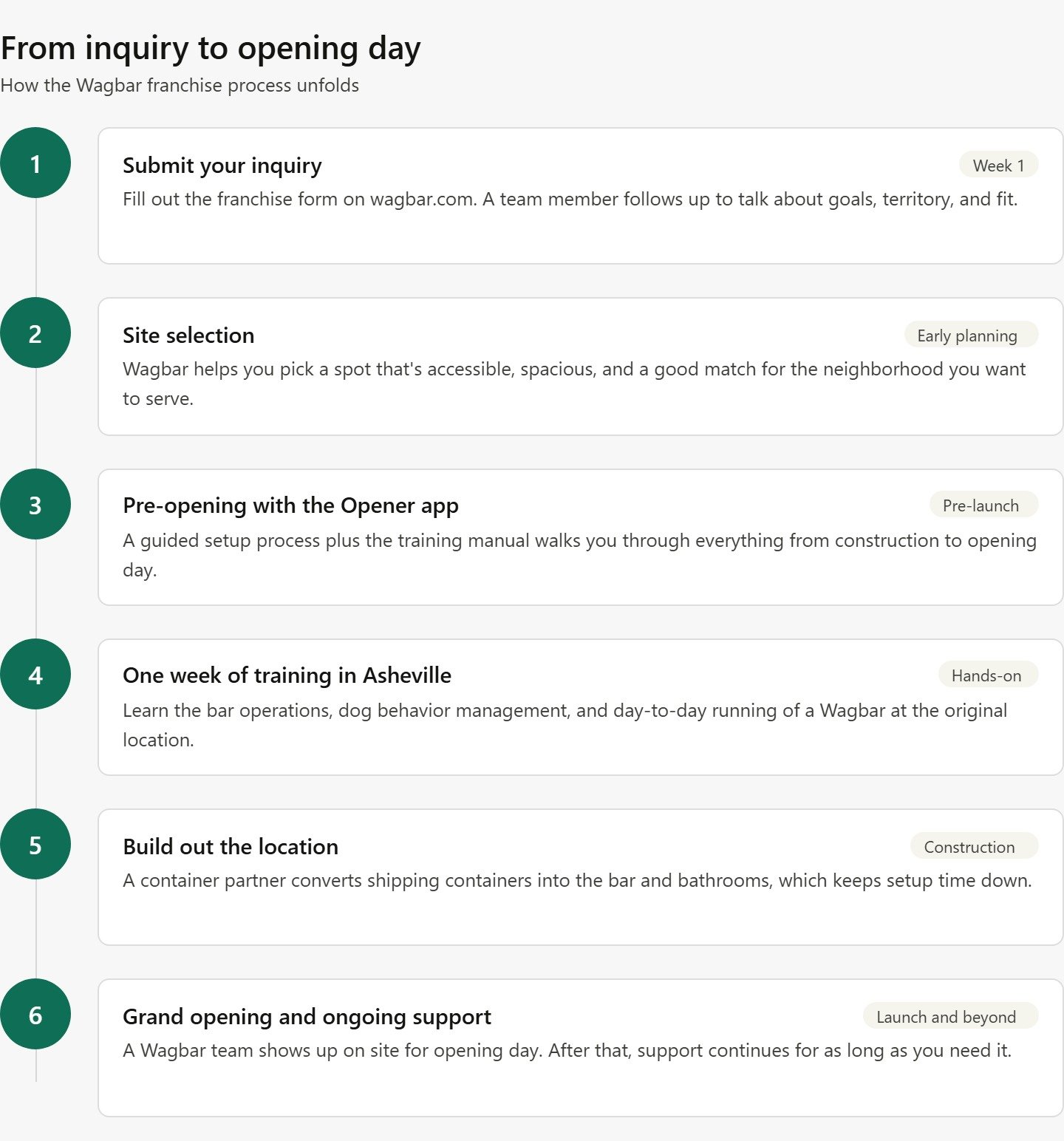
Wagbar's training program addresses membership growth tactics directly as part of the one-week hands-on program at the Asheville headquarters, because the system recognizes that membership ramp-up is the most operationally variable factor in the break-even equation. You can see an overview of what that training covers on the benefits of owning a pet franchise page.
Illustrative Break-Even Scenarios: Three Hypothetical Models
The following scenarios are hypothetical illustrative examples only. They are provided to demonstrate how the variables above interact in practice. None of these figures represent actual Wagbar performance data or financial projections. Consult the FDD and a qualified financial advisor for real performance information.
Scenario A: Conservative Ramp-Up (Hypothetical)
Assumptions: total investment of $600,000 with 70% financed, monthly debt service of $6,300, rent of $5,500, staffing of $18,000, utilities and supplies of $3,500, royalties of 7% on gross sales. Total fixed and semi-fixed monthly cost base: approximately $33,300 (pre-royalty).
At a 7% combined royalty rate, breaking even on total costs requires monthly gross sales high enough to cover the fixed base plus royalties. At a 65% gross margin on the blended revenue mix, break-even revenue would fall in the range of $51,000 to $55,000 per month. If membership ramp-up reaches 200 active members by month 6, that membership base alone contributes roughly $11,000 per month toward that target, with daily pass and bar revenue covering the remainder at moderate traffic levels.
Scenario B: Mid-Range Performance (Hypothetical)
Assumptions: total investment of $750,000 with 60% financed, monthly debt service of $5,900, rent of $7,000, staffing of $21,000, other fixed costs of $4,000, total pre-royalty fixed cost base approximately $37,900. Faster membership ramp-up reaching 300 active members by month 9 produces $16,500 in monthly recurring revenue, with bar and daily pass revenue contributing the balance at moderate daily activity levels. Break-even territory becomes achievable within the first year of operation under this scenario.
Scenario C: Higher-Investment Urban Market (Hypothetical)
Assumptions: total investment of $1,000,000 with 65% financed in a high-rent urban market, monthly debt service of $8,200, rent of $9,500, staffing of $24,000, other costs of $4,500, total pre-royalty fixed cost base approximately $46,200. The higher investment and real estate cost require a larger, faster-growing membership base to achieve break-even. This scenario illustrates why market selection matters so much for this model. A higher-cost market needs to deliver correspondingly higher membership density to justify the investment.
What Affects Break-Even That Most Franchisees Underestimate
Working Capital Runway
Break-even analysis focuses on the point where monthly revenue covers monthly costs. But getting to that point takes time, and during that ramp-up period you're spending money every month without yet covering it through revenue. Adequate working capital reserves are what fund that gap.
Most franchise financial advisors recommend planning for six to twelve months of working capital on top of your buildout investment. Underfunding this reserve is one of the most common early-stage franchise mistakes, because running out of capital before you've hit break-even forces decisions that compromise the business rather than support it.
Wagbar's investment range includes working capital estimates as part of the total disclosed investment figures. The FDD provides the specifics.
Seasonality
Outdoor pet concepts are subject to seasonal traffic variation. Summer months in most markets produce strong attendance. Cold weather months in northern markets can be slower. Planning for seasonality means building your break-even model on annualized figures rather than peak-month projections, and ensuring your working capital can carry you through slower periods in the early years before your membership base is large enough to smooth that variation.
Dog-friendly businesses with strong indoor or covered components, event programming, and active membership communities tend to handle seasonal variation better than those that depend entirely on warm-weather walk-in traffic.
Royalties as a Variable Cost
At 7% combined (6% royalty plus 1% marketing fund), Wagbar's ongoing fee structure means that as revenue grows, the dollar amount going to royalties grows with it. This is worth modeling explicitly. In a hypothetical scenario, a location doing $60,000 per month in gross sales is paying $4,200 per month in combined contributions. At $90,000 per month, that figure is $6,300. This isn't a reason to avoid the franchise model; the system value that comes with those contributions is real. But it belongs in your break-even model with the right variable logic rather than being treated as a fixed number.
How the Franchise System Affects Break-Even Timing
One underappreciated aspect of franchise break-even analysis is that the system itself influences how quickly you can ramp up. A franchisee opening a Wagbar has access to the operational playbook, the pre-opening support from the proprietary "Opener" app, the trained grand opening team, and the marketing materials and brand recognition that an independent operator would need years to develop.
That compressed timeline from lease signing to operational stability matters financially. Every month you spend figuring out logistics that the franchise system has already solved is a month of fixed costs without optimized revenue. The dog business models complete guide covers how franchise and independent models compare on this dimension.
The shipping container bar conversion that Wagbar uses as its standard build approach also directly affects break-even timing by shortening the pre-opening period. Less construction complexity means less pre-revenue time, which reduces the working capital you consume before you open your doors.
Frequently Asked Questions

How long does it typically take a pet franchise to reach break-even?
Break-even timelines vary widely by investment size, market, and execution. Some pet franchise concepts with lower total investments and single-service models can reach break-even within 12 to 18 months. Concepts with larger total investments and more complex operations may take 18 to 36 months. Reviewing actual Item 19 data in the FDD is the most reliable way to assess realistic timelines for a specific franchise system.
Does the membership model actually change break-even math?
Yes. Membership revenue is recurring and predictable, which means it covers a portion of your fixed monthly costs regardless of daily traffic variation. The larger and faster your membership base grows, the smaller the gap between your fixed cost base and what you need to generate from non-member transactions to reach break-even.
What's the biggest mistake franchisees make in break-even modeling?
Underestimating the time and capital needed during the ramp-up phase. Break-even analysis often focuses on steady-state operations, but the path from opening day to break-even involves months of revenue growth. Planning for inadequate working capital is the most common early-stage financial error.
How do royalties factor into break-even calculations?
Royalties are a variable cost that scales with revenue. At Wagbar's 7% combined rate, they need to be modeled as a percentage of gross sales rather than a fixed monthly number. This means your true break-even revenue figure must account for the royalty contribution you'll owe on that revenue.
Is an urban or suburban location better for faster break-even?
It depends on the specific market. Urban locations often have higher real estate costs and competition, but also higher population density and faster membership ramp-up potential. Suburban markets may have lower fixed costs but require a larger geographic draw radius to build the same membership volume. Neither category is categorically better. The right answer depends on specific market analysis.
Where can I get actual performance data for Wagbar franchises?
Wagbar provides financial performance data to qualified prospective franchisees through its Franchise Disclosure Document. Contact the franchising team through the Wagbar franchising page to begin that process.
Using This Framework Before You Review the FDD
The scenarios and variables in this article are designed to help you think clearly about the financial mechanics of a pet franchise break-even analysis before you're looking at real numbers. Understanding how debt service, rent, labor, membership ramp-up, and revenue stream structure interact gives you a better foundation for evaluating the actual disclosed figures when you get to them.
The pet franchise investment guide provides additional context on SBA financing structures and how Wagbar's total investment range compares across pet franchise categories. When you're ready to move from frameworks to verified data, connect with the Wagbar franchising team to access the FDD and complete investment details.
Bottom TLDR: A pet franchise break-even analysis is only as accurate as the variables behind it. Membership ramp-up speed, debt service load, and real estate cost are the levers that most affect how quickly you reach profitability in an off-leash dog bar franchise. To move from hypothetical scenarios to actual performance data, request Wagbar's Franchise Disclosure Document through the franchising page.