

Pet Bar Franchise Opportunities with Wagbar
Top TLDR: Pet Bar Franchise Opportunities with Wagbar bring together an off-leash dog park and a craft beverage bar on one site. Founded in Weaverville, North Carolina in 2019, the business runs on five revenue streams including memberships, day passes, bar sales, events, and food truck share. Total investment is $470,300 to $1,145,900 with a $50,000 franchise fee. Submit an inquiry to request the full FDD.
What Is a Pet Bar Franchise?
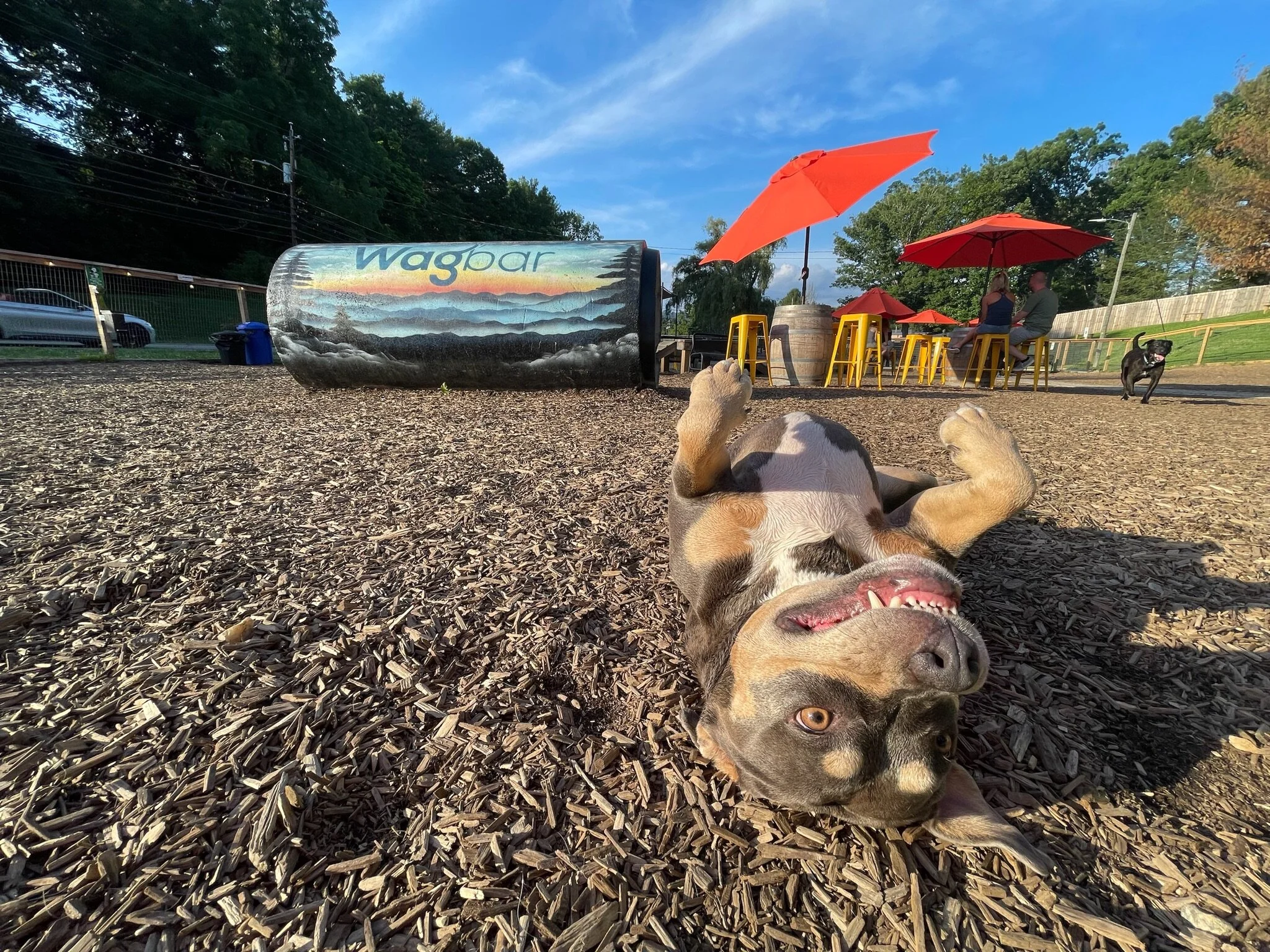
A pet bar franchise is a dog-park-and-bar hybrid business where dogs play off-leash in a secure outdoor space while their owners relax at a bar serving beer, wine, cider, seltzer, and non-alcoholic drinks. The concept takes the social feel of a neighborhood tap room and pairs it with a properly gated, monitored play area. Humans get a place to meet friends. Dogs get a safe place to run.
Wagbar is the original pet bar franchise. Kendal and Kajur Kulp built the flagship in Weaverville, North Carolina in 2019 after Kendal had one too many frustrating visits to standard unstaffed dog parks. The idea was simple: design the space the way it should have been designed, with trained staff, vaccination checks, 18-and-over entry, and a real bar that takes the experience past the chain-link fence.
The flagship has since been voted #10 on the USA Today 10Best Dog Bars list and awarded Best Pet Friendly Bar/Brewery in Western North Carolina three years running. The franchise model rolled out in late 2022, and as of 2026 Wagbar has signed franchisees across North Carolina, South Carolina, Virginia, Arizona, California, Tennessee, Texas, Ohio, Maryland, Florida, and Georgia. See the original Weaverville, North Carolina location for the concept that started it all.
How a Pet Bar Franchise Differs from a Dog Park, Dog Cafe, or Dog Daycare Franchise
Pet bar franchises sit in a category of their own, and the differences matter both for customers and for prospective franchisees evaluating the business model.
Dog daycare franchises are care services. Operators take custody of dogs during the workday, usually 8 AM to 6 PM. Revenue per dog is high, but so is labor cost, and the business runs on weekdays, not weekends. Dogtopia and Camp Bow Wow are the dominant national examples. Pet parents drop off, the business takes responsibility for the day, and the schedule is built around working hours.
Dog cafe franchises sell coffee and light food. Dogs sit with their owners at tables, usually leashed or tethered. There is no off-leash play area and no alcohol. These operations skew small with a coffeehouse footprint and coffeehouse margins. The customer is someone who wants their dog along for a latte, not someone who wants their dog to burn energy.

Traditional municipal dog parks are free and unstaffed. No revenue model exists. Public parks are the baseline these businesses compete against on convenience, and they lose every time on safety and amenities.
A pet bar franchise is different on every axis. The business runs on a bar-forward schedule, peaking on evenings, weekends, and holidays. Revenue comes from memberships and bar sales, not per-dog care fees. Trained staff monitor the play area throughout open hours. There is no dog boarding, no grooming, no training classes as core services. Dogs come to play, humans come to relax, and the two happen side by side in one secure property. Review more animal franchise categories to see how the pet bar model slots into the broader industry.
The Wagbar Pet Bar Franchise Model
A Wagbar location has two zones that share a fence. On one side, a secure off-leash play area hosts anywhere from 15 to 60 dogs at a time depending on site size. On the other side, a bar serves draft beer, canned beer, wine, cider, hard seltzer, and a rotating menu of non-alcoholic options. The property is adults-only on the human side (18 and up) and has a covered patio with seasonal heaters for colder months and fans for summer.
Dog entry rules are strict and posted at the gate. Every dog must show proof of Rabies, Bordetella, and Distemper vaccinations. Dogs must be at least 6 months old and must be spayed or neutered. Owners sign a liability waiver on their first visit. Staff are trained to read dog body language and step in before a tense moment becomes a fight.
Human entry is free. Guests 18 and older can walk in without a dog, grab a drink, and hang out. No membership is required for human-only visits. Dogs pay to play through either a day pass or a membership.
Food comes from rotating local food trucks. Wagbar locations do not run their own kitchens. Partnering with local trucks keeps the menu fresh and the build-out capital down. Food truck revenue share becomes a secondary income stream for the franchisee, and rotating trucks give regulars a reason to come back on different nights. The full off-leash dog bar concept page covers the customer-facing side of the experience.
Revenue Streams in a Pet Bar Franchise
A Wagbar location runs on five distinct revenue streams, which is one of the reasons the business holds up across strong and weak economic conditions.
Memberships are monthly and annual dog memberships sold online and at the front gate. Members get unlimited access for their dog during open hours. This is the most predictable and highest-margin revenue line, and it produces recurring income the franchisee can forecast.
Day passes are single-visit entry for non-member dogs. Priced higher than a visit to a public dog park to reflect staffing, amenities, and safety standards. Day passes also work as a trial that converts to membership.
Bar sales cover beer, wine, cider, seltzer, and non-alcoholic beverages. Standard beverage-industry margins apply. Happy hour, trivia night, live music, and weekends drive the bulk of bar revenue.
Events and private rentals include birthday parties, breed meetups (poodle-and-doodle meetups, smush-face meetups, husky meetups), holiday events like the Bunny Bash or the Howl-o-ween Weekend Bash, and private buyouts for corporate events or adoption drives.
Food truck revenue share is a percentage of food truck gross during scheduled service. Low-effort income that also keeps the bar more attractive to visitors who want to stay longer and have dinner.
The result is a business that can run strong Monday music bingo, Tuesday trivia, Wednesday open mic, Saturday bar traffic, and Sunday brunch with dogs all in a single week. Revenue is diversified enough that a slow beer month alone does not sink the quarter. More on how the math works inside a typical location is covered in the revenue streams for off-leash dog bars breakdown.
Pet Bar Franchise Investment Summary
The Wagbar franchise fee is $50,000. This is a one-time payment that secures territory rights and access to the full Wagbar system.
Total initial investment ranges from $470,300 to $1,145,900. The spread depends on real estate cost, build-out path (container bar versus traditional build-out), and local construction rates. Urban markets push toward the top of the range. Suburban and secondary markets often come in at the midpoint.
The royalty is 6% of adjusted gross sales. This covers ongoing brand access, support, training refreshers, and system improvements.
The brand marketing fund contribution is 1% of adjusted gross sales. This money funds national-level brand marketing that benefits every location.
Multi-unit franchisees get a 50% discount on the franchise fee starting at the third unit. The discount is designed for operators building a regional portfolio. Candidates committing to three or more units pay $50,000 for the first, $50,000 for the second, and $25,000 for every unit from the third onward.
The full application process, qualifications, and next steps live on the main Wagbar franchise application page.
Training and Support from the Wagbar Team
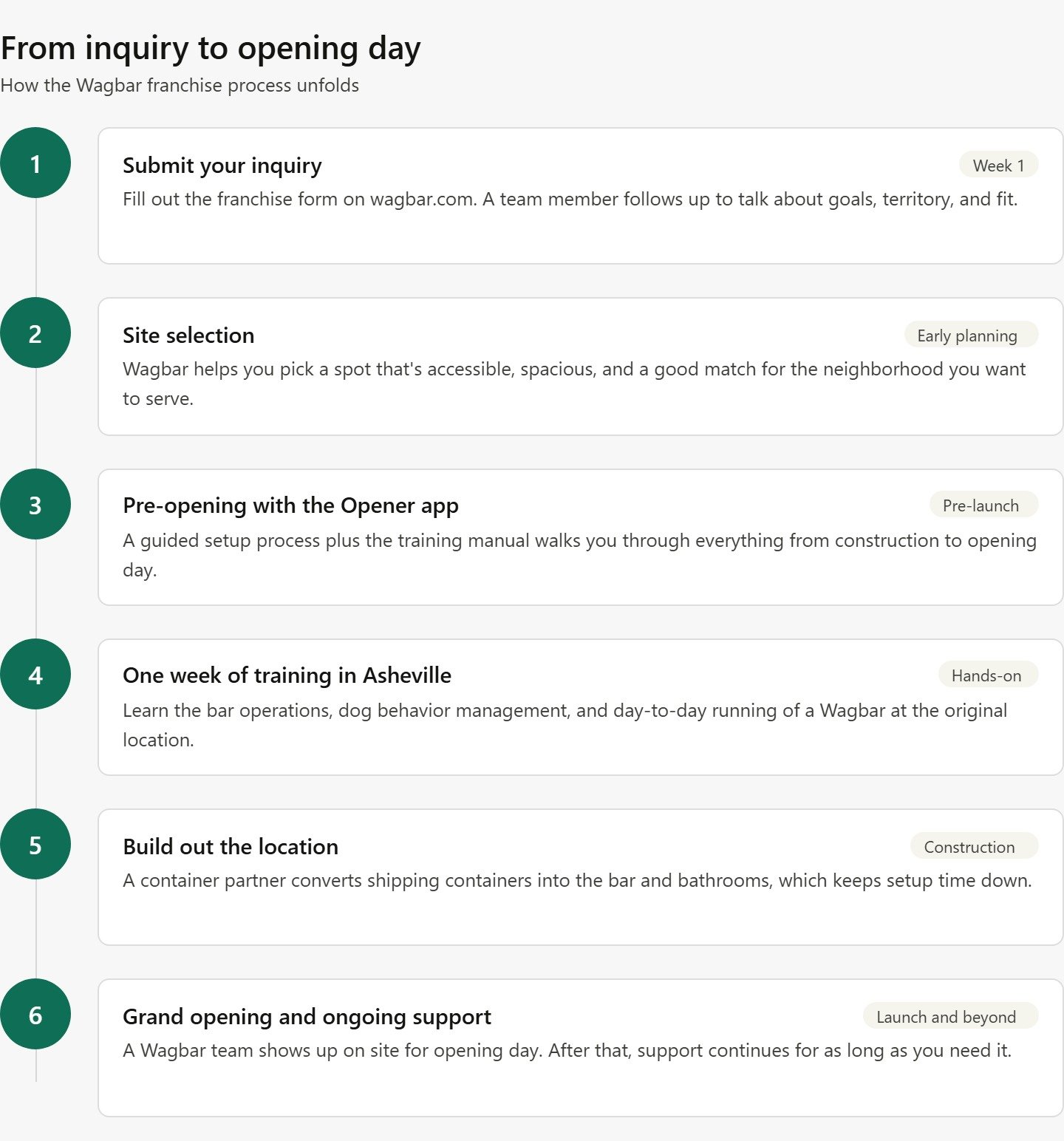
Training starts before you break ground. When a franchise agreement is signed, the franchisee gets access to Opener, Wagbar's proprietary pre-opening app. Opener is a step-by-step digital checklist that walks you through site selection, lease negotiation, permits, build-out, licensing, staffing, and soft launch. It replaces the folder of PDFs and the "call us when you're stuck" approach common at smaller franchise systems.
The hands-on training week happens in Asheville. For one full week before opening, the franchisee and any key operators fly to North Carolina for on-site training at the flagship. The week covers dog behavior management, conflict intervention, bar operations, vaccination verification, point-of-sale, staff hiring, event planning, and local marketing. Franchisees work real shifts at the Weaverville location so they see the actual business, not a classroom version of it.
Grand opening support is on-site. A Wagbar corporate team member flies to the new location for grand opening week. They help with the first waves of customers, staff shakedown, and any last-mile operational fixes. Having experienced eyes on the floor during week one makes a real difference on the revenue trajectory of month one.
Ongoing support runs quarterly. After opening, Wagbar holds quarterly business reviews with every franchisee. These cover revenue trends, staffing issues, marketing performance, and upcoming product or system changes. Franchisees also have access to a shared franchisee community where operators trade what is working in their markets. More detail on what ownership involves sits in the overview of pet franchise ownership benefits.
Who Makes a Good Pet Bar Franchisee
Wagbar has signed a range of backgrounds so far, and the pattern is less about prior industry and more about operating style. Three profiles show up most often.
The semi-absentee investor-operator is someone with capital who wants to own a real operating business but does not plan to bartend shifts. This person hires a strong general manager, handles the strategic direction and financial oversight, and visits the location a few times a week. Most multi-unit franchisees start here.
The manager-operator wants to be in the business day to day. This person runs their own floor, knows every regular dog's name, and builds a tight local community. Single-unit franchisees often start here and sometimes expand to multi-unit later.
The hospitality or pet industry crossover is someone with restaurant, bar, taproom, brewery, or pet services experience who wants a concept that actually uses that background. Both the bar-operations knowledge and the pet-industry instincts show up in this business every day.
What the profiles share is a readiness to meet Wagbar's baseline: sufficient liquid capital, willingness to be either an active owner-operator or to hire a strong manager from day one, and genuine affection for dogs and the people who bring them around. This is not a passive real estate investment. The business performs when the owner cares about the community that forms around it. A useful pre-application read is this post on what to look for when investing in an off-leash dog bar franchise.
The Current Wagbar Pet Bar Franchisee Roster
Wagbar's franchisees come from a mix of industries and regions. Each one is building a location in their home or chosen market.
AJ Sanborn (Richmond, Virginia). A twenty-year financial services veteran from the Boston area, AJ wanted to move from corporate finance into business ownership without opening a standard bar. His fiancée, their current rescue Bibi, and an incoming Bernese Mountain Dog puppy all factor into his location planning. Read his welcome announcement blog post for the full story.
Dianna (Phoenix, Arizona). After a long career in IT sales and earlier experience in the restaurant industry, Dianna wanted a business that would put her back around people and dogs. She is bringing Wagbar to the Phoenix market.
Jennifer (Los Angeles, California). A lifetime animal lover who once dreamed of becoming a veterinarian or marine biologist, Jennifer is opening the LA location after a long corporate career. Her husband and three dogs are part of the plan.
Liz and Shelby (Knoxville, Tennessee). A finance-and-sales partnership building Wagbar Knoxville at the former Creekside Knox property. Knoxville opened in late 2025 and is the second operating Wagbar after the Weaverville flagship.
Brandi and Denise (Charlotte, North Carolina). Partners building a Charlotte location with strong ties to the local dog community.
Matt and Taylor (Myrtle Beach, South Carolina). A couple bringing Wagbar to the Grand Strand coast alongside their dog Mickey. They are first-time business owners moving from traditional careers into franchise ownership.
Additional locations in development include South Asheville (NC), Cary (NC), Savannah (GA), Dallas (TX), Long Beach (CA), Cincinnati (OH), Frederick (MD), and Orlando (FL). As new franchisees sign, their stories get posted on the Wagbar blog so the community can follow along.
Container Bar Build-Out and Site Selection
The container bar is a signature Wagbar build-out option. Wagbar partners with a company that converts shipping containers into fully-equipped bars and bathrooms. The container arrives on-site ready to be placed, plumbed, and powered. This cuts months off the standard bar build-out timeline and compresses capital that would otherwise sit in framing, roofing, and interior finishing.
Franchisees can also choose traditional build-out. Some sites call for a permanent structure because of zoning, lot characteristics, or the local look-and-feel expected by the community. Wagbar supports both options and will steer a franchisee toward whichever path fits the site and the capital plan best.
Site selection is a shared process. Wagbar corporate reviews every site before lease signing. The criteria include minimum lot size (typically between 0.5 and 1 acre for off-leash area plus bar and parking), zoning compatibility for outdoor dining and commercial recreation, water access, neighboring land uses, and proximity to the franchisee's target demographic. Most successful sites sit near residential areas with high dog-ownership rates, in cities with strong outdoor culture and permissive alcohol licensing.
Parking matters more than people expect. A popular Saturday at a Wagbar pulls 80 to 150 cars through the lot. Sites with shared parking or street parking struggle where dedicated lots thrive. The full rundown on site strategy and build-out planning is captured in the pillar on starting an off-leash dog bar business.
Market Validation: Why Independent Dog Bars Prove the Pet Bar Category
When a category is real, independent operators are already running small, locally branded versions of the concept. That is exactly what is happening with pet bars across the country.
Yard Bar in Austin, Texas has run an off-leash-plus-beer concept since 2015 and keeps a waiting list for memberships during peak demand. Yard Bar proved the model in a sunbelt city with a young, dog-heavy demographic.
Skiptown in Charlotte, North Carolina and Raleigh, North Carolina took the concept further with larger footprints, daycare, and boarding bolted onto the bar experience. Skiptown proved the indoor-outdoor hybrid version works in the Carolinas.
Lucky Dog Bark and Brew in Durham, North Carolina has operated since 2014. A decade of consistent traffic in a university town proved the college-market version of the concept.
Two Shepherds Taproom in Minneapolis, Minnesota proved the cold-climate version. The taproom runs year-round with a partially enclosed play yard and high membership renewal rates, even through real midwestern winters.
A few more data points. The Watering Bowl in St. Louis, Fido's Barkery and Pub in Raleigh, Howl at the Moon in Phoenix, and similar independent operators across Los Angeles, Denver, Portland, and Minneapolis all show the same pattern: dog owners will pay a real premium for a safe, staffed, adults-welcome place to bring their dog.
What none of these operators have is a national brand. They are standalone businesses with real local followings but no franchise system, no shared operating playbook, and no way to scale. Wagbar is the first brand attempting to systematize the category across states. For a prospective franchisee, that means lower operating risk than opening an independent, plus real first-mover brand advantage as the category matures. For a closer look at market selection signals, see the analysis of best cities for dog franchise success.
Pet Bar Franchise FAQ
What is the cost of a Wagbar pet bar franchise?
The franchise fee is $50,000. Total initial investment runs from $470,300 to $1,145,900 depending on real estate, build-out choice, and local construction rates. Ongoing royalty is 6% of adjusted gross sales and the marketing fund contribution is 1%. Multi-unit franchisees get a 50% franchise fee discount starting at their third unit. Full financial disclosures sit in Item 7 of the FDD.
How much money do Wagbar franchisees make?
Financial performance information for Wagbar franchisees is disclosed in Item 19 of the Franchise Disclosure Document. The FDD is provided to every qualified candidate during the franchise evaluation process. Wagbar does not publish revenue or profit claims outside the FDD, in line with franchise law.
Do I need bar or pet industry experience to open a Wagbar?
No prior bar or pet industry experience is required. Wagbar's one-week Asheville training program covers bar operations, dog behavior management, vaccination verification, staffing, and marketing. Candidates with a restaurant, taproom, or pet services background will recognize parts of the business, but the training is built for people coming in fresh.
How long does it take to open a Wagbar location?
Typical timelines run between 9 and 18 months from franchise agreement signing to grand opening. The spread depends on how quickly the franchisee secures real estate, how long local permitting takes, and whether the site uses the container bar or traditional build-out path. The Opener app keeps every step tracked against a clear timeline.
Can I run a Wagbar as a semi-absentee owner?
Yes. Wagbar supports both semi-absentee and manager-operated ownership structures. Semi-absentee franchisees hire a strong general manager from day one and stay involved in financial oversight, strategic direction, and community relationships. The business still asks for real ownership attention. It is not a hands-off passive investment.
What states is Wagbar available in?
Wagbar is actively signing franchisees in most US states. Fifteen states require franchise registration before an offer can be made: California, Hawaii, Illinois, Indiana, Maryland, Michigan, Minnesota, New York, North Dakota, Oregon, Rhode Island, South Dakota, Virginia, Washington, and Wisconsin. California is already registered. Additional states get added as demand warrants. Interested candidates in any US state should submit an inquiry and Wagbar will confirm current availability.
Can Wagbar operate in cold-weather markets?
Yes. The Weaverville flagship runs year-round in the North Carolina mountains, which see real winter. Covered patios with heaters, partial enclosures during winter months, and programming shifted toward indoor-friendly events like trivia and music bingo keep traffic strong in cold months. Cold-climate independents like Two Shepherds Taproom in Minneapolis have run the same playbook successfully for years.
How is Wagbar different from Dogtopia or Camp Bow Wow?
Dogtopia and Camp Bow Wow are dog daycare franchises. Dogs are checked in during work hours for supervised play and socialization, and the business runs on weekday daycare fees. Wagbar is a pet bar franchise. Dogs come in with their owners, not without them, and revenue comes from bar sales, memberships, and events rather than daycare fees. Two different customers, two different schedules, two different revenue profiles. More operational answers sit on the general Wagbar FAQ.
Bottom TLDR
Pet Bar Franchise Opportunities with Wagbar offer a proven off-leash dog park and bar model with a $50,000 franchise fee, one-week Asheville training, the Opener pre-opening app, and on-site grand opening support. The royalty is 6% and the marketing fund is 1%, with a 50% multi-unit fee discount from the third unit forward. Request a qualification call through the Wagbar franchise inquiry form.
Important Franchise Disclosure
This information is not an offer to sell, or the solicitation of an offer to buy, a franchise. It is for information purposes only. An offer is made only by Franchise Disclosure Document (FDD). Currently, the following states regulate the offer and sale of franchises: California, Hawaii, Illinois, Indiana, Maryland, Michigan, Minnesota, New York, North Dakota, Oregon, Rhode Island, South Dakota, Virginia, Washington, and Wisconsin. If you are a resident of, or wish to acquire a franchise for a Wagbar to be located in one of these states or a country whose laws regulate the offer and sale of franchises, we will not offer you a franchise unless and until we have complied with applicable pre-sale registration and disclosure requirements in your jurisdiction. Wagbar Franchising LLC, (828) 554-1021, 7 Kent Place, Asheville, NC, 28804.