
Pet Bar Franchise Operations and Day-to-Day Management

Top TLDR: Pet bar franchise operations at Wagbar revolve around three concurrent shifts: the bar, the gate, and the off-leash yard. A small weekday crew handles daily flow, while weekends add extra park monitors and bartenders. Franchisees lean on the Opener app, one-week Asheville training, and quarterly business reviews to keep day-to-day management predictable. Walk your floor daily and log every incident at the gate.
Running an off-leash dog park and bar looks simple from a barstool. Dogs play. People sip. Food truck shows up at 4 p.m. In practice, pet bar franchise operations are a coordinated dance between the gate, the yard, the bar rail, and a rotating cast of food trucks, private event bookings, and seasonal weather. A busy Saturday at Wagbar can see two hundred dogs cycle through in a single afternoon. That volume only works if the systems behind the scenes are built to handle it.
This page walks prospective and new franchisees through what day-to-day management actually looks like at a Wagbar location. You will see how the staffing model flexes from a quiet Tuesday to a packed weekend, how the gate handles vaccine verification, what sits on the bar program, how food truck partnerships replace a back-of-house kitchen, and how the Opener app and quarterly business reviews keep the franchise system humming. For a broader view of the concept before drilling into ops, the off-leash dog bar overview is a good starting point.
A Day in the Life of a Pet Bar Franchisee
Most Wagbar owners do not spend eight hours pulling pints. They spend their day moving between the gate, the bar, the yard, and the back office. A typical weekday morning starts with a walkthrough of the park: check the fencing, pick up anything the cleaning crew missed, hose down surfaces, test the water stations, and set out fresh sanitation supplies. The bar gets its own walkthrough. Keg levels, canned inventory, draft line pressures, ice bins, and point-of-sale stations all get a quick audit before the doors open.
By midday, the owner is usually on the floor. That means greeting regulars by name (and by dog), keeping an eye on new dogs during their first fifteen minutes of play, training newer staff on how to read body language, and handling vendor calls with the beverage distributor or the next food truck on rotation. The afternoon rush starts around 4 p.m. for most locations, with the food truck fired up and the after-work crowd filtering in. Weekends push into a completely different rhythm, which the staffing model below accounts for.

Evening closeout is the mirror image of the morning. The bar reconciles sales, counts drawers, cleans draft lines on the scheduled rotation, and resets for the next day. The park gets a deep clean: all waste picked up, all surfaces rinsed, water stations emptied and refilled, any damaged toys or play equipment flagged for repair. Owners who treat closing as seriously as opening tend to have smoother mornings. For a look at how seasoned operators balance this workload, the real owner stories on profit margins page covers how the numbers flow through the week.
Staffing Model: Who Runs the Floor on a Busy Saturday
Wagbar locations run lean on weekdays and staff up hard on weekends. The exact headcount depends on square footage, bar capacity, and local labor conditions, but the structure is consistent across the system. Three roles anchor every shift: bar staff, dog park monitors, and a shift lead who floats between both.
Bar Staff
Bar staff pour beer, ring up day passes, check IDs for anyone who looks under 40, and handle merchandise sales. Unlike a traditional hospitality concept, Wagbar bartenders do not cook, plate, or run a kitchen. The menu is beverage-focused, which keeps training short and turns over quickly. New bar staff typically shadow for a week, then work a few supervised shifts before taking a solo rail. Most locations cross-train bar staff on the gate so they can cover breaks or handle a rush.
Dog Park Monitors
Dog park monitors are the safety backbone of the concept. These staff walk the yard, break up scuffles before they escalate, watch the water stations for overcrowding, spot dogs who look stressed or overheated, and intervene when a dog is having a rough first visit. They are also the first responders if an owner loses track of their dog or if a dog slips a collar. Monitors are trained on canine body language during onboarding, and Wagbar headquarters provides training materials that cover reading stress signals, recognizing play versus aggression, and de-escalating tense moments. The dog park behavior reference and fight prevention content double as training refreshers for staff.
Weekend Crew and Opening / Closing Shifts
Weekends are a different animal. Saturdays and Sundays can see three to five times the weekday traffic, especially in spring and fall. Most locations double their bar coverage, add at least one extra yard monitor, and assign a dedicated greeter at the gate to handle the steady stream of first-time visitors who need their vaccine paperwork reviewed. Opening shifts tend to stay small (two or three people) since the first hour is quiet. Closing shifts carry extra hands for cleanup, which is the most time-consuming part of the day once the last dog leaves. Franchisees building out their staffing plans can reference the benefits of owning a pet franchise page for how training support factors into the hiring timeline.
Dog Entry Verification: The Gate Is Your First Safety Layer
Every dog entering a Wagbar has to clear the gate. The rules are non-negotiable and apply at every location: proof of current Rabies, Bordetella, and Distemper vaccinations; minimum age of six months; and the dog has to be spayed or neutered. These requirements are baked into the concept because they work. They keep disease out of the yard, cut down on hormone-driven aggression, and make sure young dogs are mature enough to read and respond to play cues.
Owners have two ways to get their dog in. They can buy a day pass, which requires showing vaccine records on every visit, or they can sign up for a membership. Members only show vaccines on their first visit, then get waved through on subsequent visits until their records expire. Most franchisees push hard on membership conversions at the gate because memberships smooth out cash flow, build a recurring revenue line, and cut gate friction during busy hours. The membership page covers the standard tiers (daily, monthly, annual, and a 10-visit punch pass).
The gate is also where you screen for behavior. If an owner mentions their dog has a bite history, the gate staff politely explains Wagbar's policy. Only dogs with no reported history of aggression are accepted as members. It is an uncomfortable conversation the first few times you have it, but every long-term Wagbar operator will tell you the same thing: one bad dog ruins a hundred good visits. The gate is where you protect the park.
Human Entry: Free, Easy, and 18 Plus
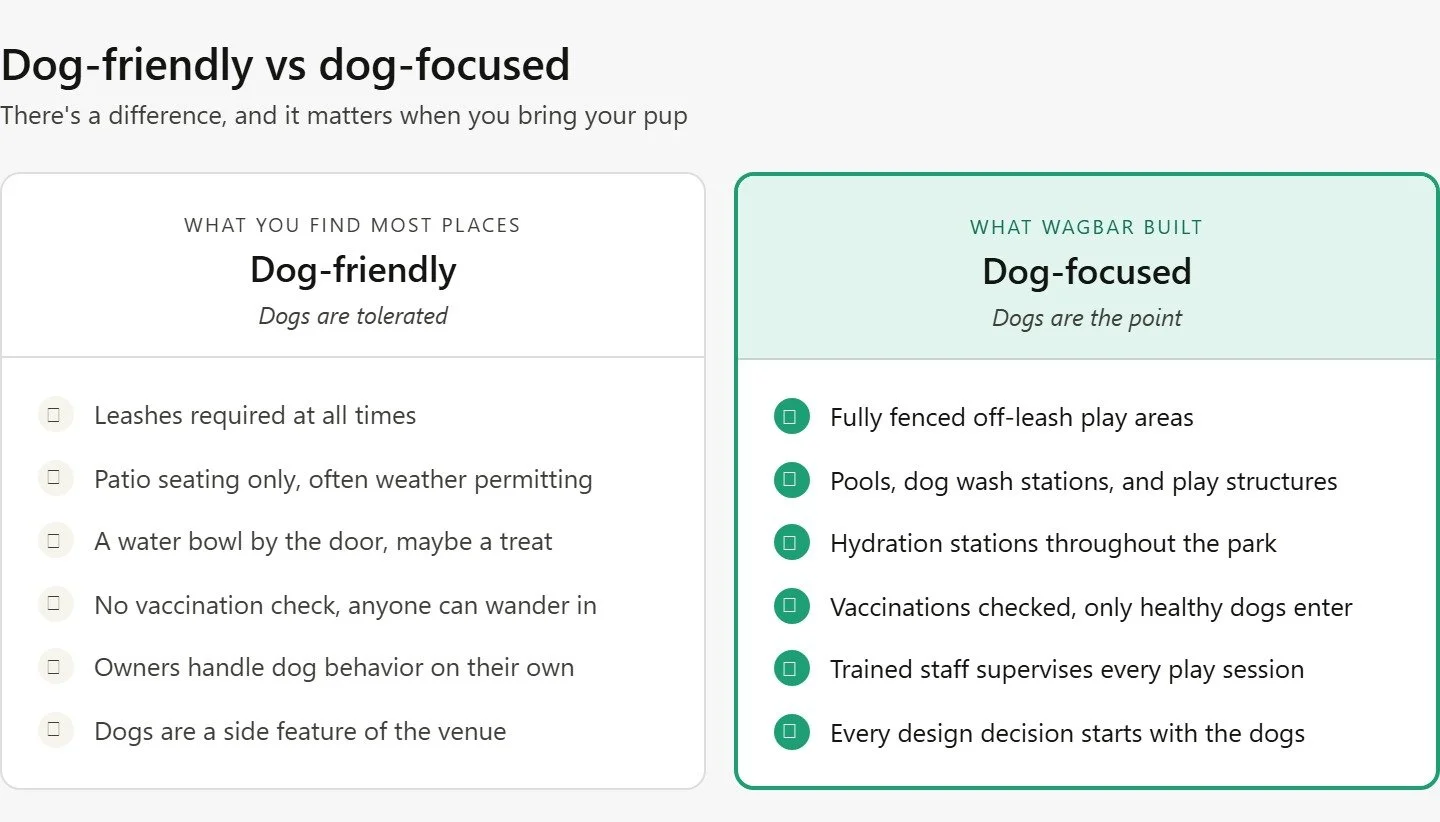
Humans do not pay to get in. This is the single most underrated element of the Wagbar model. Entry is free for any guest 18 and older, whether they bring a dog or not. That means a couple on a first date, a remote worker with a laptop, or a group of friends meeting up after work can all walk through the gate and buy a drink without a cover charge.
That free-entry policy does two things. It keeps the human side of the bar full even on quiet dog days, and it builds a pipeline of future dog-owning members who walked in curious and left hooked. Most locations see a meaningful percentage of their bar revenue come from dogless guests, which is why the bar program matters so much. The FAQ page spells out the 18-plus rule and the rest of the house policies. Locations running private events sometimes close the full park for a rental but usually carve out the bar area while keeping the dog yard open for regulars.
Bar Inventory and Beverage Mix
Wagbar's bar is a full beverage program without being a full kitchen. The draft lineup typically runs six to twelve taps depending on the location's square footage, with a mix of local craft, regional favorites, and a couple of easy-drinking domestics. Canned and bottled options round out the cooler with additional craft options, ciders, and hard seltzers. Wine sells better than most new owners expect, so most locations carry a handful of red, white, and sparkling options. Some locations add wine slushies during warm months.
Non-alcoholic sales are a real line item, not an afterthought. Sparkling water, sodas, coffee, hot drinks in winter, and non-alcoholic beer all move steadily. Designated drivers, people on medications, and parents who brought their dog on a Sunday morning all want something to sip. Running a strong non-alcoholic program also helps with liability on long visits. Bar staff track ounces poured per guest just like any other bar, and cut off anyone who needs it.
Inventory management tends to be the biggest operational pain point for new franchisees. Draft beer spoils if it sits, canned inventory ties up cash if you over-order, and local craft availability shifts week to week. Wagbar headquarters shares order cadence templates during training and pulls performance data during quarterly reviews to help owners dial in their par levels. For franchisees weighing how bar revenue stacks against memberships and events, the revenue streams reference breaks down the contribution of each channel.
Food Truck Partnerships (No Kitchen Required)
Wagbar does not run a kitchen. There is no line cook, no hood vent, no health inspector visit for food prep, and no morning prep shift. Instead, every location runs a rotation of local food trucks that pull in on scheduled days and park in a designated spot near the bar. Owners plate their own food, handle their own payments (or integrate with the bar POS on a revenue share), and keep their own hours.
For the franchisee, food trucks solve a lot of problems at once. The build-out is cheaper because you are not plumbing a commercial kitchen. Labor costs drop because you do not staff cooks, dishwashers, or expo. Menu variety goes up because a taco truck Monday, a pizza truck Wednesday, and a barbecue rig on Saturday keep the offering fresh without any purchasing risk on your end. Guests are also allowed to bring in outside food, which removes any pressure to be a complete dining destination. You are a beverage operator hosting rotating food partners, not a restaurant.
Building the food truck calendar is usually a shared job between the owner and headquarters. New owners get introductions to vendors in their market during the opening ramp. After that, the calendar becomes a marketing asset in its own right. Regulars check social media to see who is serving Saturday, and a good truck rotation drives repeat visits.
The Opener App: Pre-Opening Digital Support
Wagbar's proprietary Opener app is the first piece of software every franchisee sees after signing. It is a structured, step-by-step system that walks new owners through everything from site selection and lease negotiation through construction, permitting, and pre-opening checklists. Think of it as a project management platform built specifically for opening a Wagbar. You work through a series of phases, check off deliverables, and the app surfaces the next thing you need to do.
The app is paired with a deep training manual that covers the operating playbook in detail. Together they compress what could be eighteen months of figuring-it-out into a structured timeline. Franchisees who follow the Opener app closely tend to hit their grand opening dates without the cost overruns that kill a lot of first-time operators. The franchising overview page covers where the Opener app fits into the larger opening sequence.
The app is also a living system. As Wagbar headquarters refines the playbook based on what new franchisees run into, the steps update system-wide. That means a location opening next year benefits from everything the Richmond and Phoenix and Knoxville owners learned the hard way the year before.
One-Week Asheville Training and Grand Opening Support
After the Opener app gets a location close to ready, franchisees fly to Asheville for one week of in-person training at the flagship Weaverville park. The week is hands-on. You practice reading the yard from the seat of a park monitor, running the bar during a rush, handling a difficult conversation at the gate, onboarding new staff, and closing out the day. You also get time with Kendal and Kajur Kulp, Wagbar's father-and-son founding team, who opened the original in 2019.
The week is designed to turn the playbook from the Opener app into muscle memory. You rotate through every role, so when you get home and onboard your own team, you know exactly what good looks like. When your grand opening arrives, a Wagbar team flies out to be on-site with you. They work the first days of operations, troubleshoot issues in real time, and hand you the keys to a fully functional park. For a sense of how the opening sequence actually plays out, the Richmond franchisee announcement for AJ Sanborn offers a look at the kind of operator Wagbar attracts to the system.
Container Bar Build-Out: A Near-Turnkey Buildout Option
Wagbar partners with a company that converts shipping containers into fully-equipped bars and bathrooms. New franchisees who opt into this solution get a pre-built bar structure dropped on their site, which compresses the construction timeline and simplifies permitting in many markets. The container design is also part of the brand signature. The flagship Weaverville location runs on a shipping container bar, and guests frequently mention it in reviews.
This is an optional component. Some franchisees build traditional bar structures because their lease, zoning, or market calls for it. Others take the container route to save time and capital. Either way, the build-out decision is made during the Opener app phase with support from headquarters, and the total initial investment of $470,300 to $1,145,900 spans both approaches.
Quarterly Business Reviews with the Franchisor
Once you are open, you do not go radio silent. Wagbar runs quarterly business reviews with every franchisee. The review looks at sales, membership conversions, food truck performance, labor as a percentage of revenue, marketing spend versus results, and any operational issues that came up during the quarter. Headquarters brings benchmark data from the system, so you get to see how your location compares to similar-sized parks in comparable markets.
The point of these reviews is not a report card. It is a problem-solving session. A slow February gets a conversation about what seasonal programming drove traffic at other locations last year. A soft day-pass-to-membership conversion rate gets a review of your gate script. A labor cost trending the wrong way gets a fresh look at your shift schedule. Franchisees who treat the quarterly review as a working meeting (rather than a compliance check-in) tend to grow faster year over year.
Between reviews, headquarters is always reachable. Most franchisees message the operations team weekly, and the broader franchisee network (Dianna in Phoenix, Jennifer in Los Angeles, Liz and Shelby in Knoxville, Brandi and Denise in Charlotte, Matt and Taylor in Myrtle Beach, AJ in Richmond) forms a peer group that shares what works. For prospective operators comparing ongoing support models across pet concepts, the pet industry franchises reference lays out how Wagbar's structure compares.
Safety Incident Protocols and Dog Behavior Management
The single most important operational system at any Wagbar is the safety protocol. A fenced off-leash yard with dozens of unrelated dogs is inherently unpredictable, and the staff team is what keeps it calm. Wagbar trains every yard monitor on a tiered intervention approach: watch, redirect, separate, remove. Most situations resolve at the first or second step. Only a small fraction ever escalate to removal.
The protocol starts before the dogs meet. Gate staff ask about first-time visits and pay closer attention to new dogs during their first fifteen minutes. Yard monitors are trained to spot the warning signs: stiff body, hard stare, raised hackles, repetitive humping, guarding behavior around water or toys. Interventions are physical but calm. A hand on the collar, a body block between two dogs, a quick redirection to a different corner of the park. Staff call for backup on anything that does not resolve in seconds.
If a scuffle does happen, the protocol is clear. Separate the dogs, check both for injury, get contact information from both owners, document the incident in the system (time, dogs involved, staff present, cause if known, outcome), and make a decision on memberships. Dogs with a first incident typically get a watch flag. A second incident gets a harder conversation. Repeated aggression leads to revoked membership. Wagbar has a zero-tolerance policy on aggressive behavior from both dogs and humans, and franchisees are expected to enforce it consistently. The off-leash training checklist is a useful owner-facing reference, and it doubles as a staff training resource.
Human incidents are rarer but handled the same way. Staff intervene on anyone who is drunk, belligerent, or harassing other guests. The bar is trained on over-service, the gate checks IDs, and private events come with their own contracted terms. Keeping the human side of the yard calm keeps the dog side calm.
Cold-Weather Operations and Seasonal Programming
Wagbar works in cold climates. The flagship is in Asheville, which sees real winters, and franchisees in Cincinnati, Knoxville, Richmond, Frederick, and Charlotte all run year-round operations. The key is seasonal adaptation. Covered patios get propane heaters or infrared overheads. Some locations partially enclose their patios during the coldest months with roll-down clear vinyl panels. The bar shifts toward hot drinks, including coffee drinks and hot toddies where licensing allows.
Seasonal programming is where winter revenue gets made. A Tuesday trivia night in January draws a steady indoor crowd. A Sunday football watch party turns a slow afternoon into a full bar. Breed-specific meetups (huskies and golden retrievers in particular love cold weather) drive mid-week traffic. Holiday events (howl-o-ween weekend, friendsgiving potluck, holiday sweater parties) fill the calendar. Headquarters shares programming calendars during quarterly reviews so that new franchisees are not staring at an empty season.
Summer is the opposite problem. Heat can be rough on dogs, especially short-snouted breeds. Shade structures, misting fans, pools, and dedicated water stations become essential. Staff watch closely for signs of overheating and have protocols for encouraging owners to take breaks inside the air-conditioned bar area. The complete dog park reference covers weather protocols in detail, which operators use as staff refresher material.
Private Events and After-Hours Programming
Most Wagbar locations offer private event rentals, either for the full park or for a partitioned area. Birthday parties for dogs, corporate happy hours, adoption events with local rescues, charity fundraisers, and dog-themed weddings all happen on the property. These bookings add a meaningful revenue line beyond day-to-day bar sales and memberships, and they often convert attendees into members. Franchisees price private events based on local market rates, expected beverage minimums, and whether the rental displaces regular traffic.
Compliance, Insurance, and Paperwork
Off-leash dog bar operations sit at the intersection of a lot of regulatory regimes. Liquor licensing, health department rules for the bar side, animal-control ordinances for the park side, insurance for dog-on-dog and dog-on-human incidents, ADA accessibility for the human portions of the property, and general business licensing all apply. The Opener app covers the sequence of applications for most markets, and the one-week Asheville training includes time with legal and insurance specialists. For a closer look at the regulatory side, the pet business legal reference and zoning and regulations reference are useful reading before you sign a lease.
Frequently Asked Questions
How many staff does a typical Wagbar need on a weekend shift?
Most locations run four to seven staff on a weekend shift: two to three on the bar, two yard monitors, one gate greeter, and a floating shift lead. Exact numbers flex with square footage and expected traffic. Headquarters helps new franchisees build a staffing model during the Opener app phase and refines it in quarterly business reviews after opening.
Do franchisees need prior bar or pet industry experience?
No. Wagbar has franchisees from financial services (AJ Sanborn in Richmond), corporate (Jennifer in Los Angeles), IT sales and restaurant backgrounds (Dianna in Phoenix), finance and sales (Liz and Shelby in Knoxville), and other non-pet-non-bar fields. The one-week Asheville training and the Opener app are built to get any motivated owner operationally ready.
How does Wagbar handle dogs that get into a fight?
Yard monitors separate the dogs, check both for injury, document the incident, and notify both owners. A first incident usually results in a watch flag on the aggressor's membership. Repeated aggression leads to a revoked membership. Wagbar's zero-tolerance policy on aggressive behavior is standard across every location.
What does the initial investment cover?
The initial franchise fee is $50,000. The total estimated initial investment ranges from $470,300 to $1,145,900 and covers licensing, the Opener app and training, grand opening support, build-out (including the optional shipping container bar and bathroom solution), initial inventory, and working capital. Ongoing fees are 6% royalty on adjusted gross sales and 1% to the marketing fund. A 50% multi-unit discount applies if a franchisee commits to three or more units.
Is there an on-site kitchen?
No. Wagbar locations do not run a kitchen. Food is served by a rotating lineup of local food trucks that park on the property on scheduled days. Outside food is also allowed. This keeps build-out costs down and eliminates a major operational burden for the franchisee.
How does year-round operation work in cold climates?
Covered patios with propane heaters, partially enclosed patio spaces in winter, a hot-drink-forward bar program, and event-driven seasonal programming keep locations busy through the cold months. The Asheville flagship sees real winters, and franchisees in cold-weather markets (Cincinnati, Frederick, Richmond, Knoxville, Charlotte) operate year-round with programming support from headquarters.
Bottom TLDR
Pet bar franchise operations at Wagbar come down to running three zones at once: the gate, the bar, and the off-leash yard. Daily management rides on a trained staff team, a simple beverage-only bar (no kitchen), food truck partnerships, and quarterly business reviews with headquarters. Build your staffing around weekend peaks and train every monitor on canine body language before opening day.
Disclaimer: This information is not intended as an offer to sell, or the solicitation of an offer to buy, a franchise. It is for information purposes only. An offer is made only by Franchise Disclosure Document (FDD). Currently, the following states regulate the offer and sale of franchises: California, Hawaii, Illinois, Indiana, Maryland, Michigan, Minnesota, New York, North Dakota, Oregon, Rhode Island, South Dakota, Virginia, Washington, and Wisconsin. If you are a resident of, or wish to acquire a franchise for a Wagbar to be located in one of these states or a country whose laws regulate the offer and sale of franchises, we will not offer you a franchise unless and until we have complied with applicable pre-sale registration and disclosure requirements in your jurisdiction. Wagbar Franchising LLC, (828) 554-1021, 7 Kent Place, Asheville, NC, 28804