

Pet Bar Franchise Market Analysis

Top TLDR: The pet bar franchise market sits at the intersection of a $147 billion pet economy and a rising appetite for shared social experiences, with roughly 66% of U.S. households owning a pet. Dozens of cities have proven the model through independent dog bars, while most mid-size metros still have zero dedicated pet bar. The takeaway: prospective owners should evaluate white-space markets and a proven franchise system before trying to build from scratch.
Pet owners in 2026 aren't just buying kibble and squeaky toys. They're paying for time, experiences, and community for themselves and their dogs. That shift has pulled a new category into the center of the pet industry: the pet bar, an off-leash dog park built around a real bar serving real people. Sometimes it's called a dog bar, a dog park bar, or an off-leash dog bar. The model is the same: dogs play, owners relax, and the business earns on memberships, day passes, beverages, food, events, and private rentals.
The question most prospective owners ask isn't whether dog owners want this. They ask if the numbers work, if the category is already too crowded, and if a pet franchise opportunity makes more sense than going it alone. This analysis walks through the data behind each of those questions.
The Pet Industry at a Glance
U.S. pet owners spent about $147 billion on their animals in 2023, and that figure has climbed every year for more than two decades (American Pet Products Association, 2024). APPA projects continued expansion as pet owners treat dogs and cats more like family members than accessories.
Morgan Stanley's pet industry research has projected the broader U.S. pet economy could reach roughly $277 billion by 2030 (Morgan Stanley, 2022). That forecast rests on a simple trend: people are spending more per pet, not fewer households are owning pets.
Pet services (the slice covering grooming, boarding, training, daycare, and experiences like pet bars) is the fastest-growing category inside that larger number. APPA's 2023-2024 data shows pet services up more than 6% year over year, outpacing food and supplies growth. That's the lane a pet bar franchise sits in.

Why Services Are Growing Faster Than Products
Food and toys plateau. A dog eats what a dog eats. But services scale with what owners want for their pet's life: daycare twice a week, grooming once a month, training classes, birthday parties, and yes, Tuesday night trivia at a bar where the dog doesn't have to stay home. Pet parents consistently report that cutting pet-related spending is one of the last things they'd do in a tight economy (IBISWorld, 2024).
Dog Ownership Reaches Into Roughly 2 of Every 3 Households
About 66% of U.S. households own a pet, and dogs are the most common pet, living in roughly 65 million homes (APPA 2024 National Pet Owners Survey). That's a bigger installed base than homes with kids under 18.
Zoom into Millennials and Gen Z and the numbers get more pointed. Millennials are now the largest generation of pet owners, and they are the group most willing to pay for pet experiences rather than just pet products (Packaged Facts, 2023). They delay having kids, they live in apartments with smaller yards, and they want places to take their dog out of the house.
What This Means for Site Selection
A high pet ownership rate is only half the story. The other half is how the local population uses their dogs. Cities with a mix of strong dog ownership, renter-heavy apartment living, and a walkable bar and restaurant culture tend to have the highest day-pass and membership conversion. That pattern is exactly why Denver is a perfect market for an off-leash dog bar, and it's the same pattern that shows up in cities like Austin, Nashville, Raleigh, and Portland.
Helpful frameworks for evaluating demographic fit live on the best cities for dog franchise success page, which walks through renter ratios, median income, and pet ownership rates side by side.
The Experience Economy Came for Pet Ownership
Spend a few minutes watching a Saturday afternoon at a dog bar and you see the real product: people socializing with other people, while their dogs get exercise and stimulation the owners can't give them in a 700-square-foot apartment.
That's the experience economy at work. Consumers, especially younger ones, consistently pay for experiences over things (Harris Poll/Eventbrite Experience Economy research). A pet bar is one of the few categories that sells the same experience to the dog and the owner in the same visit.
What Owners Are Actually Buying
Pet owners coming into a dog bar are buying four things at once:
Exercise for the dog. Off-leash running, other dogs to play with, water, and shade.
Social time for themselves. Adult conversation, a drink, maybe live music.
Logistical simplicity. One stop covers dog care and the adult night out.
Belonging. Regulars know each other and their dogs by name.
A dog grooming salon sells a haircut. A kennel sells storage for a weekend. A dog bar sells a reason to leave the house on a Tuesday. That's a different kind of unit economics, and it's why more pet-industry analysts are separating "experience" pet businesses from traditional service categories. A deeper breakdown lives on the pet industry market analysis page covering the $261 billion pet economy.
The Pet Services Category Map
Before evaluating a pet bar franchise, it helps to see where the category sits next to other dog-facing businesses. Each category has different revenue patterns, labor models, and customer frequencies.
Category Core Service Visit Frequency Average Ticket Primary Revenue Dog daycare Supervised play during work hours 2-5x per week $30-$45 per day Daycare packages Dog boarding Overnight lodging Episodic (travel) $40-$75 per night Boarding stays Dog grooming Baths, haircuts, nails Every 4-8 weeks $60-$120 Grooming services Dog cafe Food and drink with dog presence Weekly $15-$30 Food and beverage Off-leash dog park (free public) Open-space running Daily $0 None (public) Pet bar / dog park bar Off-leash play plus full bar 1-4x per week $15-$40 per visit Memberships, beverages, events
The pet bar model overlaps with several of these but duplicates none of them. It isn't daycare (owners stay with their dogs). It isn't a traditional bar (dogs are the organizing principle). And it isn't a free public park (membership and beverage sales fund real staff and amenities). The off-leash dog bar concept page breaks down this positioning in more operational detail.
Why the Overlap Is a Feature, Not a Bug
Because a pet bar overlaps categories, it can pull revenue from several customer habits: the Thursday happy hour crowd, the Sunday morning coffee-and-dog crowd, the birthday party crowd, the trivia night crowd, and the every-single-day membership regulars. That's what pet industry analysts call a multi-stream model, and it's a big reason the revenue streams for off-leash dog bars resource spends real time on how memberships, events, and private rentals stack.
Market Validation: Where Pet Bars Already Work
One of the most common due-diligence questions from prospective owners is whether a pet bar is a real category or a pandemic-era novelty. The answer is documented and public.
Independent dog bars have been operating successfully for years in cities including Charlotte, Atlanta, Denver, Philadelphia, Las Vegas, Richmond, and Austin. USA Today's 10Best dog bars list has ranked venues across multiple states for several years running. In its most recent ranking, Wagbar's Weaverville, NC location earned a spot at #10 nationally (USA Today 10Best, 2024).
That matters as market validation. It confirms three things:
Customers will pay for the experience. Independent dog bars survive and grow on memberships and per-visit sales.
Regulators will permit the model. Health departments, liquor boards, and insurance carriers have all approved pet bar operations in multiple states.
The economics are repeatable. Multiple cities with very different climates, demographics, and regulatory environments all support at least one dog bar.
The rise of dog bars as a community hangout trend walks through how this category moved from novelty to recognized format.
Franchisee Interest Signals the Same Thing
Wagbar's franchise pipeline now spans North Carolina, South Carolina, Virginia, Tennessee, Georgia, Ohio, Maryland, Florida, Texas, California, and Arizona, with new partners coming online every few months. Announcements including Richmond's AJ Sanborn, the Cincinnati opening with Tony, and the Myrtle Beach announcement show franchisees buying into markets with very different climates and city sizes.
White-Space Analysis: Where the Gaps Are
The more interesting question isn't where dog bars already exist. It's where they don't.
Consider a short list of U.S. metros with strong dog ownership, high disposable income, and significant apartment-dwelling populations. Many of them have zero dedicated pet bar as of early 2026:
Denver, CO. Consistently ranked a top-five pet-friendly city, thriving craft beverage scene, yet no dominant dog bar brand.
Atlanta, GA. High pet ownership, strong patio culture, Southern hospitality built in.
Jacksonville, FL. Warm-weather market, large dog population, limited dedicated pet bar options.
Charleston, SC. Walkable downtown, tourism plus local demand, minimal direct competition.
Nashville, TN. Tourism, bachelorette and bachelor party volume, strong beer and cocktail scene.
Phoenix, AZ. Massive dog population, outdoor living culture, growing Millennial base.
Wagbar actively publishes territory pages for several of these markets, including Denver, Atlanta, Jacksonville, and Charleston precisely because the demographic and competitive data shows strong first-mover opportunity.
How to Screen a City for Pet Bar Viability
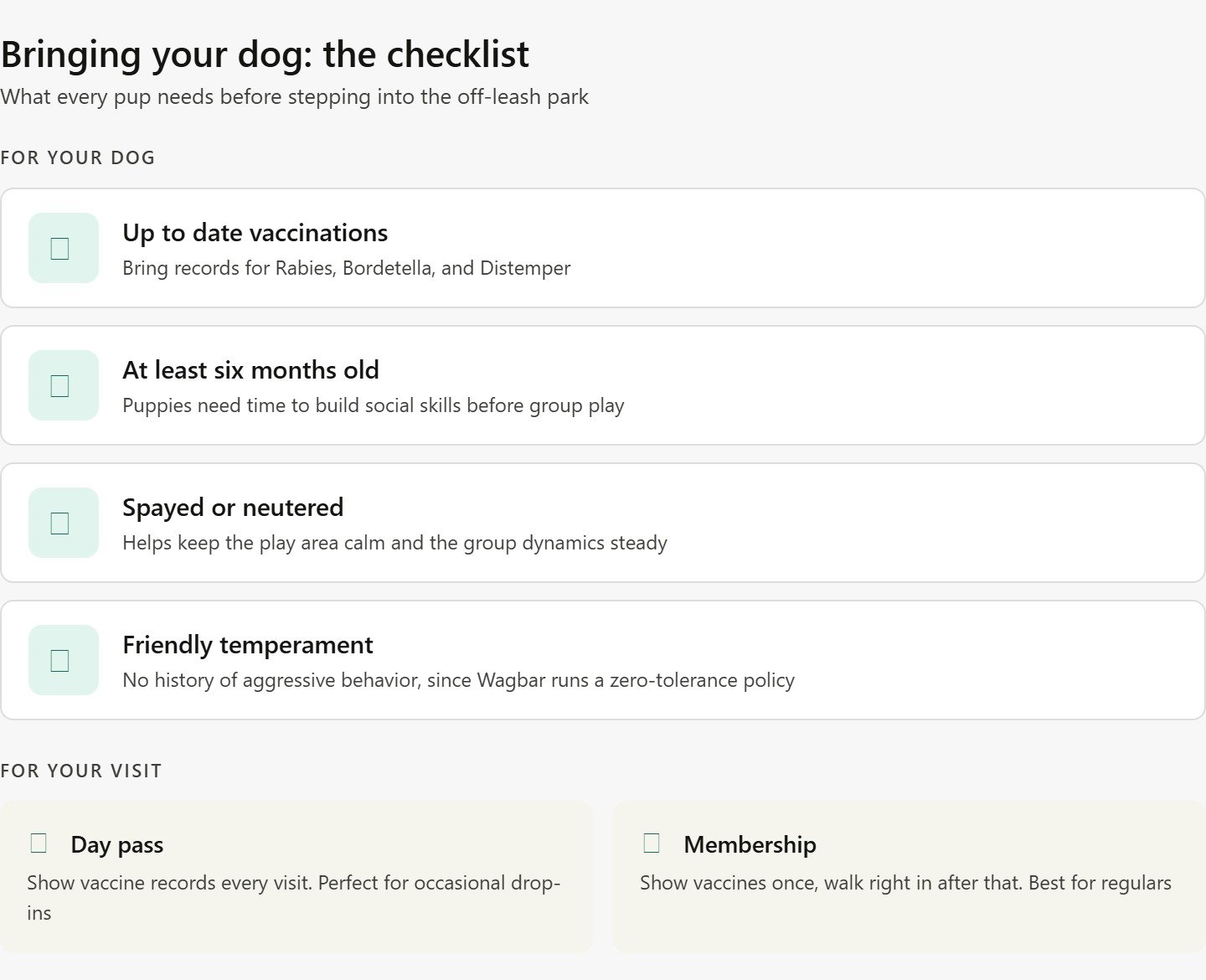
A reasonable first-pass screen uses five data points that are publicly available or easy to source:
Pet ownership rate. At or above the national 66% baseline is a good sign.
Renter percentage. Renters tend to visit pet bars more often than homeowners with yards.
Median household income. Roughly $75K+ tracks well with disposable income for memberships.
Density of pet-friendly bars and breweries. More pet-friendly bars signals cultural permission.
Existing dog bars or cafes. Zero or one is a white-space signal. Three or more is a saturation flag.
That five-point screen is the same backbone most pet industry franchise evaluations use when scoping territories.
Why a Pet Bar Franchise Beats Going Independent
Plenty of pet-loving entrepreneurs walk in wanting to open their own dog bar from scratch. Some do it well. Most underestimate how many distinct businesses are packed into a pet bar: a licensed bar, an outdoor amenity facility, a membership business, an events venue, and a dog safety operation. Running any one of those cleanly is a full job. Stacking all five on top of each other without a playbook is how independent opens fail in year one or two.
A well-built franchise system compresses that learning curve. Here's what that looks like concretely.
1. Site Selection That Isn't a Guess
Independent operators tend to pick a site based on rent and a gut feeling. Franchise systems bring demographic overlays, drive-time analysis, zoning clearance, and parking-to-capacity math. Wagbar's territory approvals lean on the same criteria covered in the best cities for dog franchise success market demographics page.
2. Build-Out That's Been Tested
A pet bar needs proper drainage, shade structures, durable turf, double-gated entries, a full commercial bar, a kitchen or food truck setup, bathrooms, and noise mitigation. Independents redesign all of that themselves. A franchisee follows a container-bar system and a site plan refined across multiple successful locations, which the ultimate guide to starting an off-leash dog bar business spells out in order.
3. Licensing and Regulatory Support
This is where most independents stall for 6-12 months. Liquor licensing plus health department requirements plus municipal zoning plus a dog-specific liability carve-out is four separate regulatory tracks that have to run in parallel. A franchisor with prior approvals in similar municipalities has counsel, forms, and insurance relationships already mapped. Overviews live on the pet business legal guide covering licensing, insurance, and compliance and the zoning and regulations for pet businesses by state and city page.
4. Staff Training for a Two-Sided Customer
Bartenders know bar service. Dog daycare staff know dog behavior. Very few people know both. A pet bar requires a hybrid hire and a standardized training program covering body language reading, fight prevention, fence-line etiquette, and standard bar operating procedures. Franchise-built training systems cut weeks off the learning curve.
5. Marketing That Doesn't Start From Zero
A proven brand brings its own SEO footprint, membership funnel, social playbook, and event calendar. An independent open is writing all of that from scratch while also trying to operate. Prospective partners can see the breadth of this built-out system across the franchising page and the benefits of owning a pet franchise resource.
6. Unit Economics Already Validated
Perhaps the biggest argument for a franchise is the single one independents can't replicate: real operating data from multiple sites. A franchisor can show what memberships do in year one versus year three, how event revenue ramps, and what labor should actually cost. Independent operators learn those numbers the expensive way. More context lives on dog business franchise profit margins with real owner stories.
Barriers to Entry for Independent Pet Bar Operators
It's worth being honest about the specific barriers independent operators run into, because they're the same barriers a franchise system is explicitly designed to absorb.
Liquor Licensing
Liquor licensing is state-by-state and often county or city-by-city on top of that. A pet bar is an unusual license application because the premise involves live animals inside the licensed area, which some states handle fine and others handle by requiring specific variances or covered outdoor licenses. Missing the right license type by one category can set an open back six months.
Liability Insurance
General bar liability covers slip-and-fall, alcohol-related incidents, and property damage. A pet bar also needs coverage for dog-on-dog and dog-on-human incidents, which most carriers don't write as a default endorsement. Finding a carrier who will write it, at a reasonable rate, is a non-trivial exercise for a first-time operator. Franchise systems generally have a short list of carriers already writing this coverage at negotiated rates.
Site Selection and Zoning
Pet bars need outdoor space, which means they need parcels that allow outdoor commercial use of a specific size, drainage that handles hundreds of dogs per day, and noise-buffering distance from the nearest residential neighbor. Many otherwise attractive retail sites don't clear all three. Zoning approval for a pet-specific use frequently requires a special-use permit or conditional-use variance, which takes months and sometimes public hearings.
Staffing and Training
Hiring someone who can read dog body language and also pour a proper IPA is a genuinely small labor pool. Training that hybrid skill set from scratch takes six to twelve weeks per hire in most independent opens. That's a real hidden cost.
Capital and Working Capital Runway
A pet bar open is a mid-seven-figure project when you include land or rent, build-out, liquor license, insurance, marketing, and 9-12 months of working capital. Underestimating the working capital side is the most common reason independent food and beverage concepts close in year two (U.S. Bureau of Labor Statistics small business survival data). A franchisor with clean financial disclosures forces prospective owners to size that number correctly before opening day.
The types of animal franchise opportunities overview and the dog business models complete guide both lay out capital and operating structures by format, which helps prospective owners compare like-to-like.
What the Next Five Years Likely Look Like
A few forecasts worth tracking:
Consolidation. Independent dog bars in strong markets are already being acquired or converted into franchise locations. Expect that to accelerate as national brands build share.
Format expansion. Pet bars are starting to add adjacent revenue lines: dog training classes, small-scale grooming, and branded retail. The strongest operators will stack these without diluting the core experience.
Membership maturity. Annual memberships are becoming the dominant revenue stream, not day passes. This changes unit economics meaningfully and rewards brands with strong retention playbooks.
Tech platforms. Purpose-built booking and vaccination-verification apps are becoming table stakes, which is an advantage for franchise systems with existing tech.
These patterns show up in more detail on the emerging opportunities in the pet industry for 2025-2030 page and the pet industry growth trends and projections through 2030 analysis.
Frequently Asked Questions
How big is the pet bar franchise market right now?
The pet bar category itself is small but sits inside a $147 billion U.S. pet economy that's projected to keep growing at mid-single-digit rates through 2030 (APPA, 2024). Only a few dozen cities in the U.S. have a dedicated pet bar, which leaves most top-50 metros as open territory for a first operator.
Is there enough demand outside of major metros?
Yes, if the demographics are right. Mid-size cities and suburbs of larger metros often have higher dog ownership per household than urban cores, and pet bars work well where renter populations plus a craft beverage scene overlap. Markets like Knoxville, Savannah, and Myrtle Beach have all drawn Wagbar franchise commitments on exactly that logic.
How is a pet bar different from a dog daycare?
A pet bar is not a drop-off business. Owners stay with their dogs the whole visit. That shifts the revenue mix from daycare packages to memberships, beverages, food, and events, and it changes the staffing model because you aren't responsible for the dog without the owner present.
What does a pet bar franchise typically cost to open?
Total investment for an off-leash pet bar concept generally falls in the mid-to-high six-figure to low-seven-figure range, depending on land cost, local build-out pricing, and whether an operator is leasing or buying. Specific numbers vary by system and are spelled out in each franchisor's disclosure documents. The franchising page is the right place to request current figures.
How long does it take to open a pet bar franchise?
Most opens run 9 to 15 months from signed franchise agreement to grand opening, driven primarily by site selection, permitting, and build-out. Markets with faster permitting (some Southeastern cities) can compress that. Markets with longer zoning review cycles (parts of California, for example) take longer.
What happens if a dog incident occurs on-site?
A real pet bar operation has written protocols for separating dogs, managing bites, documenting incidents, and communicating with owners. Franchise systems provide those protocols as part of operations training, along with the insurance structure to handle the rare serious event. Safety discipline is one of the biggest arguments for a franchise over an independent open.
Do I need bar experience to own a pet bar franchise?
No. Many successful pet bar franchisees come from corporate backgrounds, finance, sales, or other industries. What matters more is operational discipline, community-building instincts, and genuine comfort around dogs. Training systems are built to cover the technical bar and dog-management skills.
Which cities are the strongest markets for a new pet bar?
Markets with a combination of high pet ownership, a high renter percentage, strong median income, an active outdoor culture, and low direct competition tend to perform best. That includes several Sunbelt metros, mountain-west cities like Denver, and a long list of Southeastern mid-size cities. The best cities for dog franchise success page breaks down the screening criteria in more detail.
Can I visit an existing pet bar before deciding?
Yes, and you should. Any franchise system worth joining will introduce prospective owners to operating franchisees and schedule on-site visits during the validation phase. The FAQ and about pages are reasonable first stops before booking a discovery call.
Bottom TLDR
Pet Bar Franchise Market Analysis: The pet bar franchise market is backed by a $147 billion pet industry, 66% household pet ownership, and proven independent operators across major U.S. cities, with strong white space in metros like Denver, Atlanta, Jacksonville, and Charleston. A franchise system absorbs the site-selection, licensing, insurance, and staffing barriers that sink most independent opens. The action step: screen target cities on pet ownership, renter share, and income, then request a franchise disclosure from an established system.