

Outdoor Recreation Franchises: The Case for Experience-Based Business
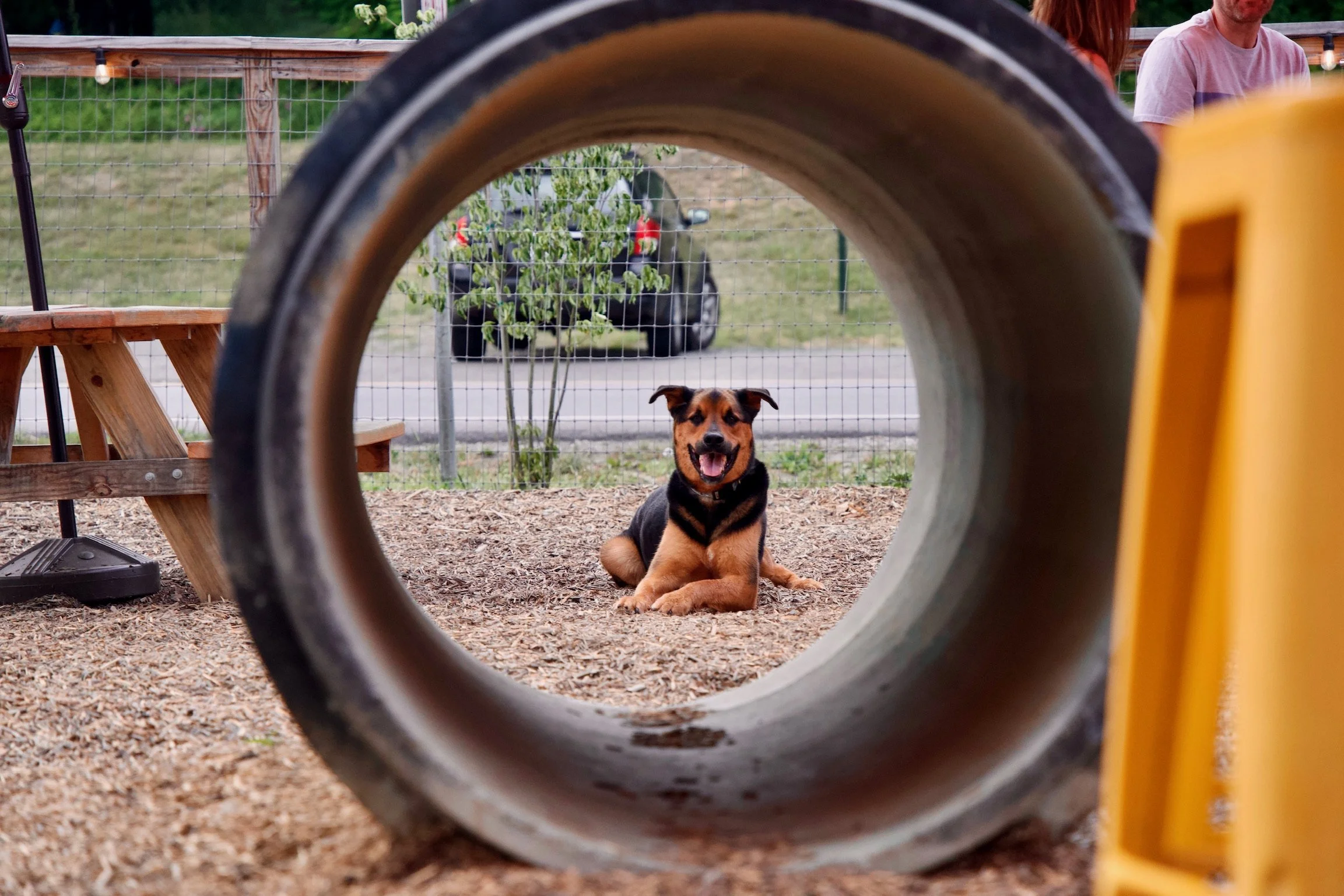
Top TLDR: Outdoor recreation franchises built around experiences generate stronger loyalty, more durable recurring revenue, and deeper competitive protection than service-based models. The off-leash dog park bar category is the clearest example in the pet industry, combining an outdoor social environment with memberships and beverage income. Evaluate any outdoor recreation franchise by asking whether it delivers a genuine experience or simply performs a service outdoors.
Key Takeaways
Outdoor recreation franchises built around experiences rather than services are outpacing traditional pet and leisure service models on customer loyalty, revenue durability, and market differentiation. The shift is driven by a well-documented consumer preference: people increasingly spend on doing things over buying things, and that preference extends directly to how they spend time with their dogs. For franchise investors evaluating the outdoor recreation category, the business model type, experience-based vs. service-based, matters more than the product category itself.
Two franchise investors can both open dog-related businesses and end up with fundamentally different financial outcomes, not because one market is better than the other, but because one is running a service business and the other is running an experience. That distinction, service vs. experience, is the most important variable in the outdoor recreation franchise category and the one that most investors don't examine carefully enough before committing capital.
This page makes the case for experience-based outdoor recreation franchises as a distinct investment category, explains what separates them from service businesses operating in similar markets, and shows why the off-leash dog park bar model sits at the intersection of outdoor recreation and experience-driven pet spending in a way that's difficult for competitors to replicate.

What "Experience-Based Business" Actually Means
The term gets used loosely, but for franchise investment purposes it has a specific meaning. An experience-based business is one where the primary value delivered to the customer is the experience of being there, not the completion of a task or the acquisition of a product.
A dog grooming appointment is a service. The dog gets clean, the owner pays, and the transaction is complete. The customer's relationship with that business is functional and easily transferred to a competitor with comparable quality and a more convenient location.
A Saturday morning at an off-leash dog park bar is an experience. The dog runs with dogs it knows. The owner has a standing conversation with other regulars. The food truck is there, the weather is good, and the two hours before noon become a consistent part of how that person spends their weekend. That customer's relationship with that business is social, habitual, and far harder for a competitor to interrupt.
The economic implications of that difference are significant and measurable. Experience businesses generate higher repeat visit rates, stronger word-of-mouth, and more durable membership retention than service businesses in equivalent markets. That's not an assumption; it's what the customer relationship dynamics produce over time.
The Consumer Shift Driving Experience Business Growth
Consumer spending patterns have been shifting toward experiences and away from products and services for over a decade, and that trend accelerated after 2020. Research across the leisure, hospitality, and retail sectors consistently shows that consumers, particularly those under 45, prioritize spending on experiences they can share over spending on goods they own alone.
This pattern runs through the pet industry as clearly as anywhere. Americans spent an estimated $136.8 billion on their pets in 2024, according to the American Pet Products Association, and the fastest-growing segment of that total is services that combine experience with pet care rather than basic product purchases or routine services. Dog owners are increasingly asking not just "what does my dog need?" but "what do my dog and I get to do together?"
That question is the opening that outdoor recreation franchise concepts are built to answer. The pet industry growth trends and projections through 2030 covers the demographic data behind this shift in detail, but the core dynamic is straightforward: when 97% of pet owners consider their pet's emotional well-being important (Pew Research Center), they're not just buying food and vet care. They're actively looking for experiences that benefit their dog's social life and their own.
Why Outdoor Recreation Amplifies the Experience Effect
Indoor recreation franchises can create experiences. A well-run indoor dog daycare or training studio has genuine customer appeal. But outdoor recreation franchises have a specific structural advantage: the environment itself is part of the product in a way that can't be replicated inside four walls.
Open air, natural light, dogs running freely across real ground rather than turf in a controlled room, owners relaxing at outdoor seating rather than waiting in a lobby. These aren't just aesthetic differences. They're what the customers are actually paying for. The outdoor environment is what makes the visit feel like a destination rather than an errand.
This matters financially because destination businesses generate different customer behavior than errand businesses. Customers don't time their errands; they time their destinations. They plan around them, they bring friends, they stay longer, and they come back because the experience was worth their time rather than because they needed something done.
The outdoor vs. indoor dog business models comparison covers the specific operational and revenue differences between these formats in detail. The short version is that outdoor recreation models in well-matched markets tend to generate higher per-visit revenue, stronger membership retention, and more organic community growth than indoor equivalents.
The Revenue Structure of Experience-Based Outdoor Franchises
What makes experience-based outdoor recreation franchises particularly compelling from an investment standpoint isn't just the customer experience quality. It's the revenue structure that experience businesses naturally produce.
Service businesses generate revenue per transaction. Experience businesses generate revenue per relationship. That difference shows up most clearly in how membership models work within experience-based outdoor recreation concepts.
When a customer becomes a member of an outdoor dog park bar, they're buying access to an ongoing experience, not scheduling a series of appointments. That membership generates monthly income regardless of whether the member visits three times that week or once. The revenue doesn't stop when the service isn't being delivered; it continues because the customer has committed to being part of something rather than receiving something.
Add food and beverage revenue to that base and you have a multi-stream income structure where membership provides the floor, day passes serve customers who haven't committed yet, and beverage sales vary with traffic but are never the only revenue source. Each stream reinforces the others because they all depend on the same thing: customers choosing to spend time at your venue.
The revenue streams for off-leash dog bars page covers how these income streams interact in practice. The membership vs. day pass revenue model guide gets into the specific mechanics of building a recurring revenue base from an experience-driven outdoor concept.
Wagbar as an Outdoor Recreation Franchise: How the Model Works
Wagbar opened its flagship location in Asheville, North Carolina in 2019, built around a concept that founder Kendal Kulp developed after experiencing what a dog park shouldn't be. The idea was specific: create a fully fenced, supervised off-leash play area for dogs, combined with a bar where their owners could relax, have a drink, and actually enjoy the time rather than hovering anxiously at the edge of a chaotic public park.
That combination, open outdoor space, professional supervision, real bar service, rotating food trucks, and a community programming calendar built around breed meetups and seasonal events, is what makes the model work as an experience business. The experience isn't just the dog park. It's the whole environment, and customers pay for access to it through memberships and day passes while the bar and events layer additional revenue on top.
The investment structure reflects the category's positioning. The initial franchise fee is $50,000 with a total estimated investment range of $470,300 to $1,145,900, depending on market, site, and build-out. The royalty is 6% of adjusted gross sales, with 1% to the marketing fund. Franchisees committing to three or more units receive a 50% multi-unit discount on the franchise fee. All figures are for informational purposes only; prospective franchisees should consult the current Franchise Disclosure Document for complete details.
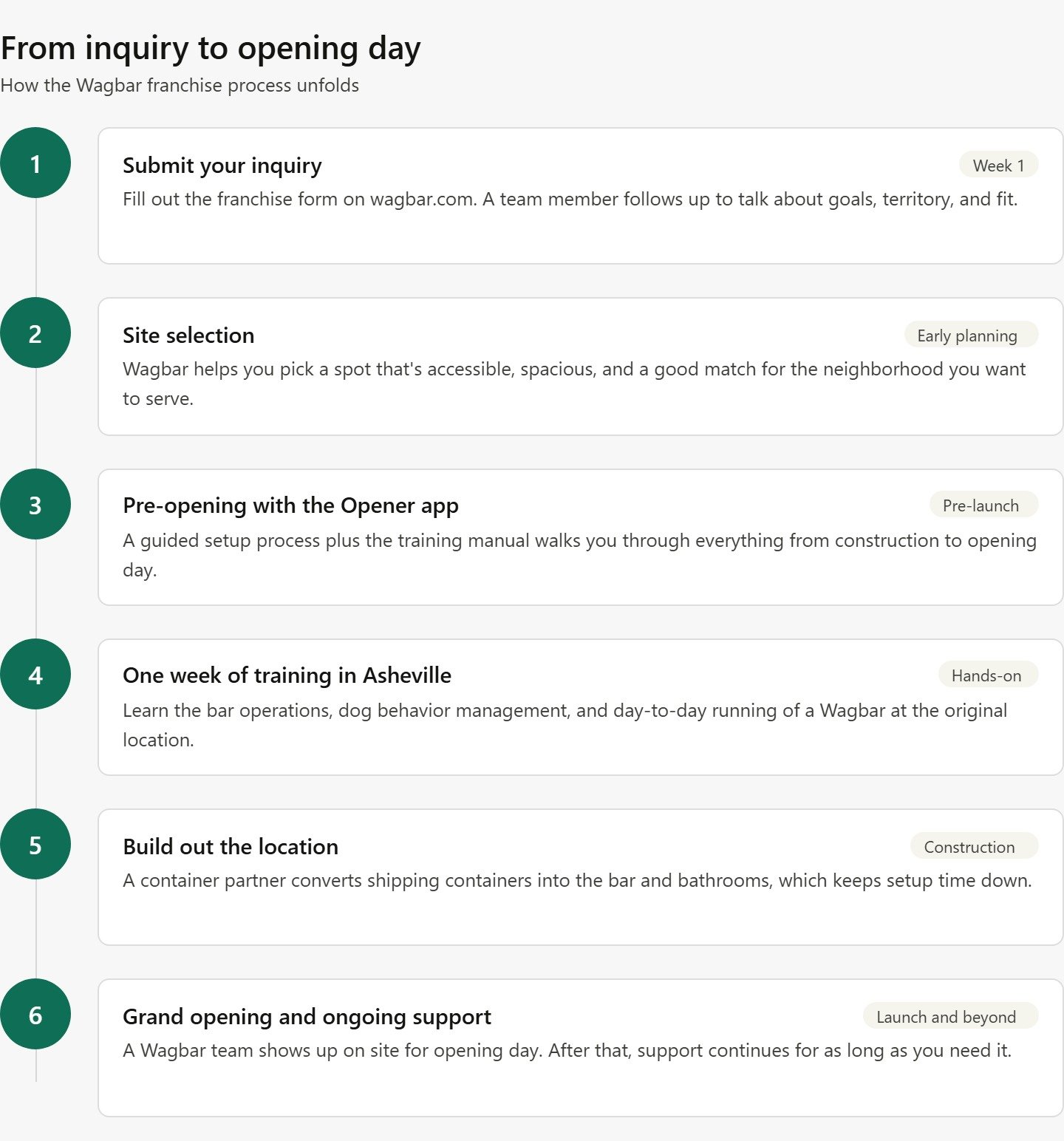
Wagbar's build-out process includes a near-turnkey shipping container bar system, a proprietary "Opener" app that guides franchisees through site selection and pre-opening setup, and one week of intensive in-person training at the Asheville headquarters before launch. On-site support is provided at opening, with ongoing operational and marketing support continuing beyond the grand opening. For a full overview of the training and support structure, dog park franchise training and support covers what franchisees receive at each stage.
Community as a Competitive Moat
Experience-based outdoor recreation franchises build something that service businesses rarely achieve and that takes competitor businesses time and investment to create: a genuine local community.
The customers at a well-run outdoor dog park bar don't just know the business. They know each other. Their dogs have established playmates. They have opinions about which food truck has the best tacos. They show up to breed meetups and trivia nights. The business becomes part of how they socialize, which means switching to a competitor isn't just finding a new service provider. It means leaving a social environment they've built relationships in.
That community dynamic is what franchise operators consistently describe as the most differentiating aspect of operating an experience-based outdoor venue versus a service business. It also happens to be the hardest thing for a new competitor to replicate quickly, because community isn't purchased, it's accumulated over time through consistent operations, good programming, and genuine investment in the experience.
The community building for dog-focused businesses guide covers the mechanics of building and sustaining that kind of loyal customer base.
Which Markets Support Outdoor Recreation Franchise Success
Not every market is equally suited to an outdoor recreation franchise, and being clear-eyed about market fit is part of what separates good franchise decisions from expensive ones.
The markets where outdoor recreation franchises generate the strongest returns share a few consistent characteristics. Moderate to warm climates with predictable sunshine support year-round outdoor operations without the revenue disruption that harsh winters create. High dog ownership rates, typically correlating with above-average household incomes and higher concentrations of younger adults, create the natural customer base. An existing outdoor lifestyle culture, cities where people already eat outside, spend weekends at parks, and organize their social lives around outdoor activities, accelerates the adoption of a new outdoor social venue.
Markets like Charlotte, Richmond, Denver, Nashville, and Phoenix fit this profile consistently. Wagbar's expansion footprint reflects exactly this market logic. For the demographic data behind market selection in the dog franchise category, best cities for dog franchise success covers the specific metrics worth evaluating before choosing a location.
Climate strategy for shoulder seasons and cooler months is also worth understanding before committing to an outdoor recreation model. The climate considerations for year-round pet business operations page covers the practical approach to maintaining revenue through less favorable weather conditions.
What Experience-Based Franchises Ask of Their Owners
Running an experience-based outdoor recreation franchise is different from running a service route, and the difference matters for anyone evaluating the investment.
Service franchise owners primarily manage delivery quality and client acquisition. Experience franchise owners manage a venue, a community, and a programming calendar in addition to the operational basics. That's a broader set of responsibilities, and it suits a specific kind of owner: someone who is genuinely comfortable in a public-facing, community-centered role and who finds building something locally meaningful more satisfying than optimizing a service operation.
Wagbar franchisees come from backgrounds in financial services, technology, sales, and corporate careers. What they share isn't industry experience but the particular combination of business competence and community orientation that makes an outdoor social venue thrive over time. Previous pet industry experience isn't required. The training program covers dog behavior management, bar operations, staffing, and marketing from the ground up.
The benefits of owning a pet franchise covers the full picture of what pet franchise ownership involves personally and financially.
Frequently Asked Questions
What is an experience-based outdoor recreation franchise?
An experience-based outdoor recreation franchise is one where the primary value for customers is the experience of being at the venue, not the completion of a service task. Off-leash dog park bars are a clear example: customers pay for access to an outdoor environment where their dogs can play and they can socialize, not for a service delivered and completed.
Why do experience-based franchises generate stronger customer loyalty than service franchises?
Experience businesses build social habits and community connections that service businesses don't. When customers become regulars at a venue, form relationships there, and build routines around it, the switching cost is social as well as practical. That social switching cost is much harder for competitors to undercut with pricing or convenience alone.
How does Wagbar differ from a standard dog park?
Wagbar combines a fully fenced, supervised off-leash play area with a licensed bar, rotating food trucks, and a community events calendar. Dogs must be vaccinated to enter. The combination creates a destination experience for both dogs and their owners rather than simply providing open fenced space, which is what a standard public dog park typically offers.
Do outdoor recreation franchises work year-round?
Yes, in markets with suitable climate and appropriate facility design. Wagbar locations use covered outdoor seating, fans, and heaters to extend the comfortable operating season beyond what a completely exposed outdoor space would allow. Sunbelt and moderate-climate markets support near-year-round operations.

Learn More About Outdoor Recreation Franchise Opportunities
For investors who want to understand what the outdoor recreation franchise category looks like as a specific investment, the Wagbar franchising page is the right starting point. It covers investment details, the training and support structure, and how to start a conversation with the team about available markets. If you're still comparing business model types across the pet industry, the dog business models complete guide covers the full landscape.
Bottom TLDR: The case for outdoor recreation franchises built on experience comes down to one structural advantage: customers who build social habits around a venue are harder to lose than customers who book appointments. Wagbar's off-leash dog park bar model pairs outdoor recreation with bar service and community programming in markets where dogs and outdoor lifestyle already intersect. Visit wagbar.com/franchising to review investment details and see which markets are available.
Investment figures cited are for informational purposes only and are not an offer to sell a franchise. Prospective franchisees should consult the current Franchise Disclosure Document for complete investment information and terms.