

Outdoor Bar Franchise vs. Indoor Bar Franchise: , Revenue, and Experience

Top TLDR: An outdoor bar franchise vs. indoor bar franchise comparison shows that outdoor concepts like Wagbar cost less to build ($470,300 to $1,145,900 vs. $800,000 to $2.5M+ for indoor), skip commercial kitchens and complex HVAC, and run with 6 to 12 employees instead of 15 to 60+. Wagbar's recurring dog park membership revenue provides financial stability that weather-dependent walk-in traffic at indoor bars can't match. Check Wagbar's franchise cost breakdown to see exactly where the investment dollars go.
When people hear "outdoor bar franchise," they immediately think about weather. That's fair. But the weather question is the wrong place to start. The better question is: what does the build-out cost, what does the customer experience look like, and how does the revenue model hold up across seasons?
Indoor bar franchises have been the default for decades because the infrastructure already exists. There are buildings everywhere, and fitting out an interior space follows a well-known playbook. But that playbook is expensive. Commercial HVAC, full interior construction, kitchen equipment, soundproofing, elaborate lighting systems, and the leasehold improvements to make a raw commercial space feel like a place people want to spend time: all of that costs real money.
Outdoor bar franchises flip the equation. Lower build-out costs. A customer experience built around fresh air and open space rather than four walls. And, in the case of Wagbar's off-leash dog park and bar model, a reason for people to come that has nothing to do with what's on TV or what's on tap.
Build Cost Comparison: Where the Money Actually Goes
Indoor bar franchise build-outs follow a predictable (and expensive) pattern. You start with a raw commercial lease space, typically 2,500 to 5,000+ square feet depending on the concept. Then you build it out: demolition of existing features, new walls and flooring, commercial-grade plumbing and electrical, HVAC systems sized for occupancy loads, restrooms to code, bar construction, seating areas, and all the finishing details (lighting, paint, decor, signage) that make a space feel right.

According to industry data, bar startup costs in 2025 ranged from $150,000 for a basic neighborhood bar to $750,000+ for a full restaurant-bar build-out (Cabaret Design Group, 2026). Most new bars land around $425,000 to $480,000 on average (Toast, 2025). Add a commercial kitchen, and you're looking at another $150,000 to $300,000 on top of that.
Indoor franchise bar concepts typically invest $800,000 to $2.5 million+ in total, depending on the brand, location, and kitchen requirements. A significant chunk of that goes to leasehold improvements: making someone else's building work for your specific bar concept.
Wagbar's total initial investment ranges from $470,300 to $1,145,900, with most franchisees falling in the $600,000 to $850,000 range. The franchise fee is $50,000, and a multi-unit discount of 50% applies when you commit to three or more locations.
Why the Outdoor Model Costs Less
Three factors drive the lower build-out for Wagbar's outdoor bar franchise.
No commercial kitchen. Wagbar operates without a full food operation, which eliminates hood systems, commercial cooking equipment, walk-in coolers for food prep, grease traps, and the specialized plumbing and electrical those systems require. Kitchen build-out is one of the most expensive line items in any indoor bar or restaurant, and skipping it entirely saves $150,000 to $300,000.
Container bar construction. Wagbar uses a proprietary container bar system that arrives largely pre-built and ready for installation. Compare that to constructing a custom bar from scratch inside a leased space, which involves carpentry, plumbing, electrical, countertop fabrication, and weeks of construction time. The container system compresses timelines and reduces construction costs simultaneously.
Simpler interior requirements. An outdoor venue doesn't need commercial HVAC systems sized for a packed indoor space, soundproofing, elaborate interior lighting design, or the leasehold improvements that transform a generic commercial box into an inviting atmosphere. The outdoor setting provides the atmosphere. Trees, sky, fresh air, and dogs playing off-leash do what thousands of dollars in interior design try to accomplish: they make people feel relaxed and happy.
The Wagbar Knoxville location, for example, leveraged an existing outdoor venue (the former Creekside Knox) with approximately 7,000 square feet of combined indoor/outdoor space. Total investment was estimated at $650,000 to $750,000, benefiting from existing infrastructure that reduced build-out costs compared to ground-up construction.
Seasonal Revenue: The Question Everyone Asks First
Let's address it directly. Yes, outdoor bars face weather variability. And no, that doesn't make the model unworkable. Here's why.
Dogs Don't Care About the Weather (Much)
This is a point that indoor bar franchise owners don't have to think about, but it works entirely in Wagbar's favor. Dogs need exercise and socialization every day. Not just on nice days. Not just in spring and fall. Every day.
Dog owners with Wagbar memberships don't stop visiting because it's 45 degrees outside. Their dog still needs to run. The behavioral driver that brings people to a dog bar, their pet's daily exercise needs, operates independently of weather conditions. That's fundamentally different from an indoor bar where the only driver is "do I feel like going out tonight?"
Weather Mitigation Is a Solved Problem
The outdoor dining and hospitality industry has developed effective weather mitigation for every climate challenge. Wagbar locations use covered areas that provide shade in summer and rain protection in cooler months. Patio heaters extend comfortable operating temperatures well below what most people assume. Fans and misting systems handle summer heat. The National Restaurant Association found that full-service restaurant operators report an average of 44% of daily sales coming from outdoor dining, and 49% of operators are actively extending their outdoor dining season with heaters and coverings.
Wagbar's climate considerations guide addresses seasonal strategies for different markets. The reality is that most U.S. locations where Wagbar operates or is expanding, including markets across North Carolina, Tennessee, South Carolina, Georgia, Texas, California, Virginia, Ohio, Maryland, Florida, and Arizona, have climates that support year-round outdoor operation with proper weather mitigation.
Revenue Stability Through Membership
Here's where the outdoor bar franchise model with recurring membership revenue has an advantage that pure weather analysis misses.
Indoor bars depend entirely on walk-in traffic. Every dollar of revenue requires convincing someone to leave their house and choose your bar over every other option. When it's cold outside, that's harder. When it's a slow Tuesday, that's harder. When there's nothing going on, that's harder.

Wagbar's recurring membership model generates revenue regardless of daily foot traffic fluctuations. Members pay monthly or annually for park access. Even during a weather-impacted week, membership revenue continues. It doesn't disappear because of a rainy Wednesday. This creates a financial stability that indoor bars, ironically, don't have despite being weather-protected.
The combination of membership revenue, event programming, and beverage sales creates multiple revenue streams that compensate for any weather-related dips. Live music, breed meetups, holiday events, and community programming at the Weaverville flagship drive attendance spikes that layer on top of the membership base.
Customer Experience: Why Outdoor Wins on Feel
Here's something the financial analysis doesn't fully capture: outdoor bar experiences consistently score higher on customer satisfaction than indoor equivalents. There's a reason patios are always the most requested seating at restaurants. People want to be outside.
The Dog Factor
At Wagbar, the customer experience includes watching your dog have the time of its life. That's not something an indoor bar can offer. The joy of seeing your dog sprint across an off-leash park, make friends with other dogs, and come back panting and happy while you sip a craft beer under the open sky: that's an emotional experience that creates loyalty no drink menu can match.
Dogs are social connectors. At an indoor bar, you sit with the people you came with and maybe exchange a few words with the bartender. At a dog bar, your dog runs up to another dog, the owners start talking, and within 20 minutes you've made a friend you'll see again next week. That social connection is what turns first-time visitors into regulars and regulars into members.
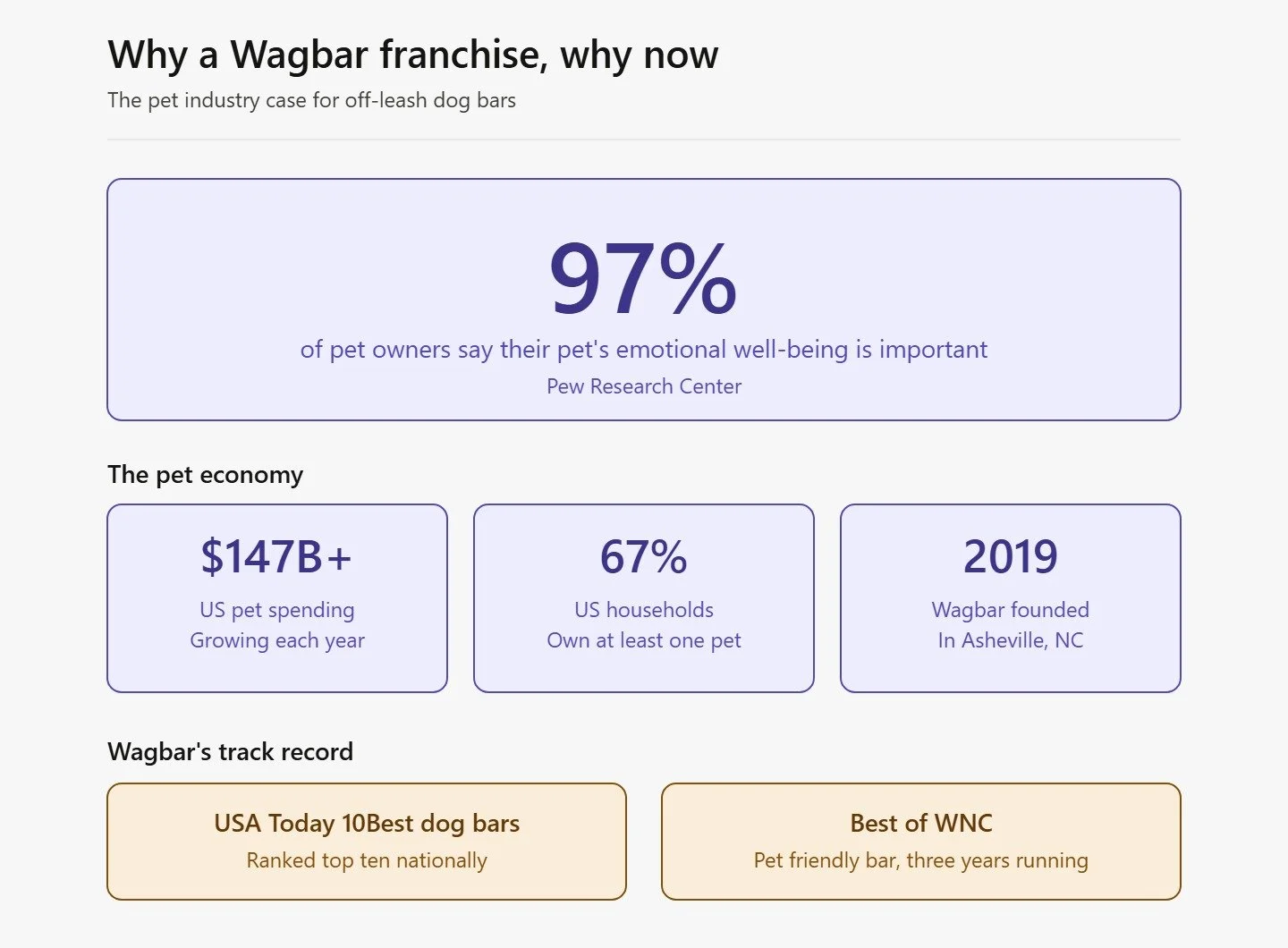
Wagbar earned recognition as one of USA Today's top 10 dog bars in the country and has won Best of WNC awards multiple years running, including first place for Pet Friendly Bar and Brewery three straight years. That kind of recognition doesn't come from the beverage menu. It comes from the experience.
The Space Advantage
Indoor bars compete for attention in a confined space. Music, screens, crowds, noise. The atmosphere is manufactured. Outdoor bars let the environment do the work. Natural light during the day. Stars at night. A breeze. Space to move. The feeling of not being boxed in.
For dog bars specifically, the outdoor space is the product. The off-leash play area needs room for dogs to run, and that space creates the open, relaxed atmosphere that draws people in. You can't replicate a dog park inside a 3,000-square-foot commercial lease.
Staffing and Operational Simplicity
The outdoor bar model, particularly without a kitchen, creates a leaner operation.
Indoor bar franchises with kitchens typically employ 15 to 60+ people depending on the concept. Line cooks, prep cooks, dishwashers, servers, bartenders, hosts, bussers, and managers. Labor runs 25% to 35% of revenue.
A Wagbar franchise operates with 6 to 12 employees: bartenders, park attendants who manage dog safety and behavior, and a manager. Labor costs run 15% to 22% of revenue. No kitchen staff. No hosts. No bussers. No dishwashers.
The Wagbar royalty fee is 6% of adjusted gross sales with a 1% marketing fund contribution. The simpler operating model means less can go wrong on any given day. No kitchen equipment breakdowns. No food safety emergencies. No grease trap maintenance. Fewer moving parts means fewer problems, which means less time spent firefighting and more time spent building your community.
Wagbar's training program covers both bar operations and dog behavior management, and franchisees from non-hospitality backgrounds including financial services, IT sales, and corporate management have successfully transitioned into dog bar ownership. The learning curve is shorter because the operation is simpler.
The Pet Economy Tailwind
Indoor bar franchises compete in the mature U.S. bar and nightclub industry. It's a $38 billion market (IBISWorld, 2025), but growth is slow and competition is fierce.
Wagbar operates at the intersection of hospitality and the pet economy. The pet industry generated over $147 billion in U.S. spending in 2023, and pet services spending is growing at rates that outpace traditional hospitality. Sixty-seven percent of U.S. households own a pet (American Pet Products Association), and urban dog owners increasingly need quality off-leash spaces where they can also enjoy a social experience.
An outdoor bar franchise tied to this growing market has a different growth trajectory than an indoor bar competing for share in a flat market. Early franchise movers benefit from better territory selection and first-mover positioning in their local market before the category matures.
Frequently Asked Questions
Does an outdoor bar franchise cost less to build than an indoor one?
In most cases, yes. Outdoor concepts skip expensive interior build-outs, commercial HVAC, and often commercial kitchens. Wagbar's total investment runs $470,300 to $1,145,900, compared to $800,000 to $2.5 million+ for many indoor bar franchise concepts. The savings come from container bar construction, no kitchen infrastructure, and simpler technology requirements.
How does an outdoor bar handle bad weather?
Covered structures, commercial patio heaters, fans, and misting systems address most weather conditions. Wagbar's climate strategy guide covers year-round approaches for different markets. Most Wagbar locations operate in climates that support year-round outdoor use with proper mitigation. Membership revenue continues regardless of daily weather, providing financial stability that purely walk-in indoor bars don't have.
What makes the customer experience different at an outdoor bar franchise?
Outdoor settings provide natural atmosphere that indoor bars spend tens of thousands trying to manufacture. At Wagbar, the off-leash dog park adds an emotional experience no indoor bar can replicate: watching your dog play freely while you relax with a drink. Dogs also act as social connectors, turning strangers into friends and first-time visitors into long-term members.
How many employees does an outdoor bar franchise like Wagbar need?
Wagbar runs with 6 to 12 employees: bartenders, park attendants, and a manager. No kitchen staff, no hosts, no bussers. Compare that to 15 to 60+ for indoor bar franchises with kitchens. Labor costs run 15% to 22% of revenue versus 25% to 35% for traditional indoor concepts.
Do I need restaurant experience to run an outdoor bar franchise?
Not with Wagbar. The franchise training program covers bar operations and dog behavior management for owners from any background. Current franchisees come from financial services, IT, and corporate careers. The simpler operating model (no kitchen, smaller team) means a shorter learning curve than full-service indoor restaurant-bar concepts.
Where is Wagbar opening outdoor bar franchise locations?
Wagbar is expanding across multiple states including North Carolina, Tennessee, South Carolina, Georgia, Texas, California, Virginia, Ohio, Maryland, Florida, and Arizona. The Weaverville, NC flagship and Knoxville, TN location are open and operating. Territory availability changes as franchisees commit, so reach out early if you have a specific market in mind.
Bottom TLDR: The outdoor bar franchise vs. indoor bar franchise decision comes down to build cost, customer experience, and revenue predictability. Wagbar's outdoor off-leash dog park and bar model eliminates kitchen expenses, uses container bar construction to reduce timelines, and generates recurring membership revenue tied to the $147 billion pet economy rather than competing in the saturated indoor bar market. Request Wagbar's Franchise Disclosure Document to review financial performance data and territory availability.