

Off-Leash Dog Bar in San Diego: Southern California Off-Leash Options
Top TLDR: An off-leash dog bar in San Diego works because the city's year-round mild climate, dog-saturated population, and craft beer culture combine in a way few markets can match. Existing dog beaches and breweries handle parts of the experience separately, but no single venue delivers all of it. Talk with Wagbar's franchising team about San Diego site evaluation.
San Diego's Off-Leash Reality: Beaches, Parks, and What's Missing
San Diego is one of the best off-leash dog cities in the country, but most of that reputation comes from beaches and a handful of dedicated parks rather than indoor or commercial venues. Coronado Dog Beach, Ocean Beach Dog Beach, Del Mar's Rivermouth, Fiesta Island, and Dusty Rhodes Dog Park give local dogs real off-leash time in spectacular outdoor settings. What none of those places offer is a place to sit down with friends, order a drink, watch live music, or stay past sunset. The dog gets the workout, but the owner has to leave to do anything else.
That gap is the opening for an off-leash dog park and bar model like Wagbar in San Diego. The concept doesn't replace the beaches or the dog parks. It adds the social piece those places don't include, in a controlled environment where the membership structure, vaccination checks, and trained staff create predictability the public dog beaches can't.
For owners who don't live close enough to walk to a dog beach (which is most of San Diego County), the value proposition gets stronger. A neighborhood-scale off-leash bar gives them a Tuesday-night-after-work option that isn't a 30-minute drive to Ocean Beach.
Why San Diego Has the Best Climate for an Off-Leash Dog Bar
Climate is where San Diego separates from every other major U.S. market evaluating this concept. Average daytime highs sit between 65 and 78 degrees year-round, with very little rain, low humidity, and predictable evening cool-down. That means an outdoor dog yard in San Diego runs at full capacity essentially every day of the year. There's no winter shutdown, no summer heat retreat to evening hours only, and no seasonal revenue cliff.

For comparison, the original Wagbar in Asheville and the announced Knoxville location have to plan operations around four distinct seasons. A San Diego location plans around one. That kind of weather predictability changes the unit economics meaningfully because seating capacity, member visit frequency, and event scheduling all stabilize across the calendar. A look at how diversified revenue streams shape an off-leash dog bar's profitability shows why year-round outdoor capacity matters for this format.
San Diego Demographics That Match the Concept
San Diego County has more than 3.3 million residents, and the city itself sits at roughly 1.4 million. Median household income across the metro tracks above the national average, the share of residents with a bachelor's degree is high, and the population skews young, active, and outdoor-oriented. Those characteristics consistently correlate with premium pet spending behavior.
Dog ownership rates in San Diego County run above the California state average and are well above national norms. The city's reputation for being dog-friendly is more than a slogan: most major employers allow dogs in the office, hotels in Mission Bay and downtown actively market to dog travelers, and patio culture across virtually every neighborhood includes dogs as a default. Dog-loving residents, dog-loving visitors, and a year-round outdoor lifestyle make San Diego one of the higher-fit cities for the Wagbar pet franchise model.
A Craft Beer Capital That Already Welcomes Dogs
San Diego is one of the top three craft beer markets in the United States by brewery count. The city has 150 plus independent breweries and tasting rooms, many of which already operate dog-friendly indoor or patio policies. That infrastructure matters because the bar component of the off-leash dog bar concept is already culturally normalized in San Diego. Locals are entirely comfortable spending Saturday afternoons at a brewery, a tap room, or an outdoor beer garden. Adding a fenced off-leash play yard to that backdrop is a small step, not a big one.
Wagbar's drink menu fits the local pattern: draft and canned beer, wine, cider, hard seltzer, cocktails without hard liquor, and non-alcoholic options. Food trucks rotate through, outside food is permitted, and seating is built around being outside. That format reads as completely normal in neighborhoods like North Park, South Park, and Mission Hills, where craft beer-driven outdoor venues already define the scene.
Neighborhoods Worth Evaluating for a San Diego Wagbar
Site selection in San Diego comes down to balancing three things: enough fenced outdoor land for a real off-leash play yard, parking that supports membership traffic, and proximity to the dog-owning households most likely to convert into regular customers. Areas that fit consistently include:
North Park, South Park, and University Heights: dense, walkable, craft beer-anchored, and packed with the young professional and creative-class population that drives premium pet spending.
Hillcrest and Mission Hills: established neighborhoods with high household incomes and strong patio culture.
Pacific Beach and Ocean Beach: coastal, dog-saturated, and already part of the city's existing dog beach traffic pattern. Real estate is tight but visibility is high.
Mission Valley and Kearny Mesa: more land available, easier parking, and located between several high-income residential corridors.
Encinitas, Carlsbad, and Oceanside (North County): suburban-leaning options with bigger commercial lots, family-heavy demographics, and lower build-out costs per square foot.
Chula Vista and Eastlake (South Bay): rapidly growing suburban dog-owner population that's largely underserved by current off-leash venues.
The Wagbar build-out includes a turnkey shipping container conversion option for the bar and bathrooms, which speeds up timelines and helps in San Diego neighborhoods where traditional commercial construction permitting can stretch on for many months. More on what site selection looks like inside the system is laid out in the step-by-step approach to starting an off-leash dog bar.
Investment Range and What's Included
The initial franchise fee for a Wagbar location is $50,000, with total estimated initial investment between $470,300 and $1,145,900 depending on real estate, build-out scope, and California construction costs. San Diego sits at the higher end of that range because of land prices and labor rates compared to the national average. The royalty fee runs at 6% of adjusted gross sales, with another 1% of adjusted gross sales contributed to the brand marketing fund. Wagbar offers a 50% multi-unit discount on the franchise fee for franchisees who commit to opening three or more units, which is worth weighing for a candidate looking at San Diego plus a second Southern California market.
The investment includes licensing, the proprietary Opener pre-opening app, one full week of in-person training in Asheville, on-site grand opening support, quarterly business reviews, and ongoing operational guidance. A more detailed look at what comes with owning a Wagbar pet franchise walks through what each of those support layers covers.
California Is a Franchise Registration State: What That Means
California is one of the 15 states that require franchise pre-sale registration, which means Wagbar has already completed the registration process under the California Franchise Investment Law. For a San Diego prospect, that's actually a positive: the registration is already done, and the legal path to becoming a California franchisee is already cleared at the state level. The CFPI registration notice above is the standard statutory language California requires whenever investment figures are presented to California residents.
A San Diego candidate still has to work through local permitting in the City of San Diego or the relevant municipal jurisdiction (Carlsbad, Encinitas, Oceanside, Chula Vista, etc.), zoning verification for an outdoor commercial use with on-premise alcohol service, and California ABC beverage licensing. The pet business legal and compliance overview covers the broader categories of licensing and insurance that apply, with California-specific items such as workers' compensation requirements adding to the standard list.
How Wagbar Compares to Existing San Diego Off-Leash Options
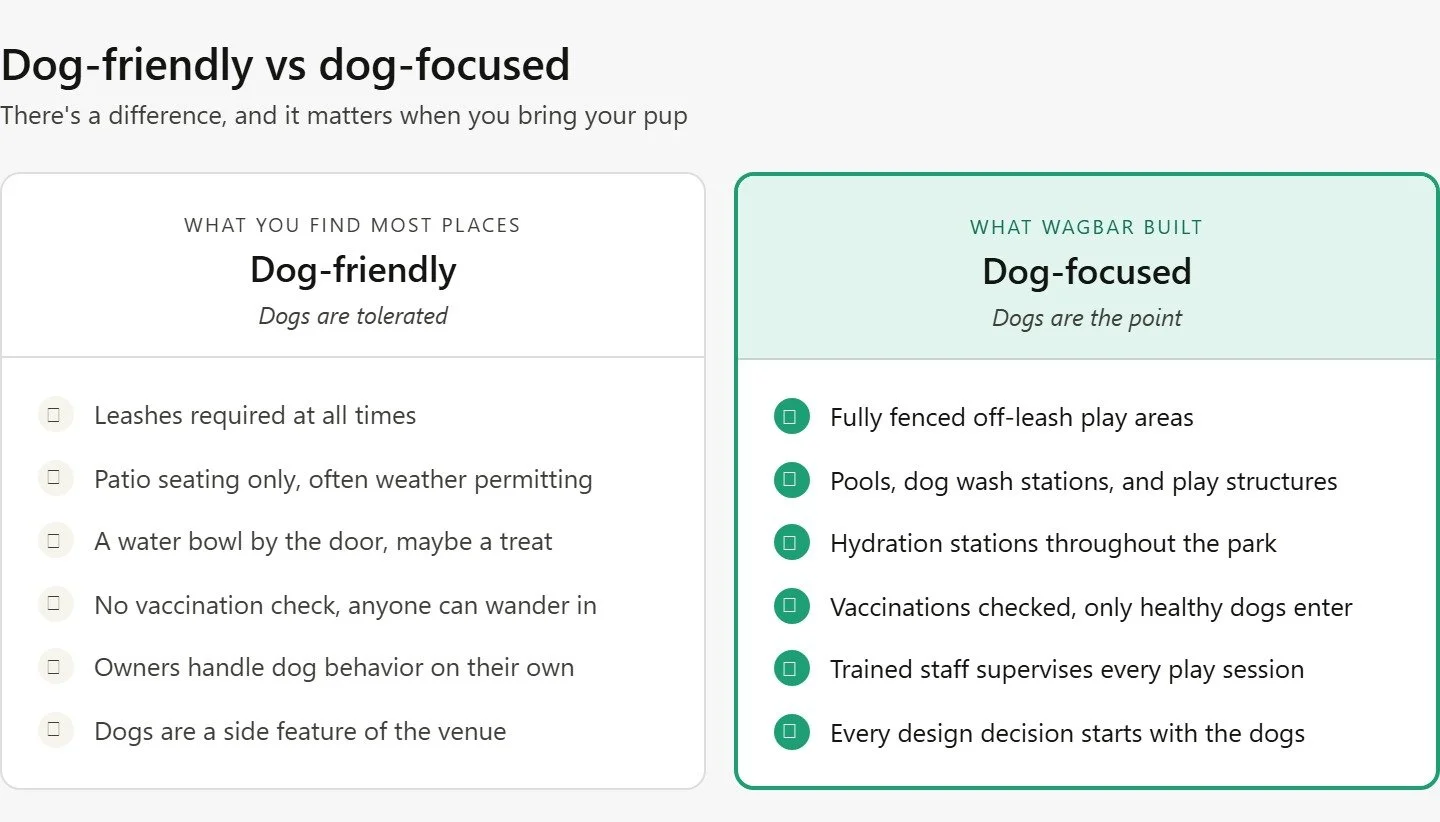
The honest comparison for San Diego isn't to other branded off-leash dog bars (the category is still developing in the city), it's to the dog beaches, public dog parks, and the dog-friendly breweries that already serve part of this need. Each of those has limits.
Dog beaches are unmatched for raw outdoor experience but they're geographically concentrated, can be crowded, and offer nothing for the human side of the visit. Public dog parks are free but unstructured, with no vaccination verification at the gate and no staff supervising play. Dog-friendly breweries permit dogs but require leashes, which means the dog isn't actually getting off-leash time and the owner is managing the leash all afternoon.
A Wagbar location combines what each of those venues delivers separately. The play yard is fenced and trained-staff supervised. Dogs need to be at least six months old, spayed or neutered, and current on rabies, bordetella, and distemper vaccinations to enter. Owners get a real bar with seating, food, and events. Human entry is free for guests 18 and older. That's the combined product the existing San Diego options can't match individually. More on the broader dog franchise opportunity model is on the franchising overview pages.
The California Connection: LA and Long Beach Set the Stage
Wagbar Los Angeles and Wagbar Long Beach are both already franchise locations in development, which puts two California peer markets a San Diego prospect can study directly. The LA location is led by franchisee Jennifer, whose announcement is detailed in the Coming Soon: Wagbar Los Angeles post. With three California markets in motion (LA, Long Beach, and a future San Diego), the brand has the start of a Southern California cluster that simplifies marketing, supplier relationships, and grand opening logistics.
For a multi-unit candidate, pairing San Diego with a second California or Arizona market is a credible path. The 50% multi-unit franchise fee discount applies once a candidate commits to three or more units. Phoenix is also already in development under franchisee Dianna, which means the Southwest cluster is forming alongside the Southern California one.
What Membership Demand Looks Like in San Diego
Membership is the recurring-revenue backbone of any Wagbar location, and San Diego's profile supports it strongly. The metro has high household incomes, a high concentration of dogs per capita, year-round patio weather, and a cultural willingness to spend on experience-based pet services. Local breed clubs, rescue networks, and dog-walking groups are unusually active across the county. Day-pass traffic from tourism (San Diego draws roughly 32 million visitors per year) layers on top of the resident membership base. A look at how pet spending patterns vary by region confirms that Southern California consistently scores in the higher tiers for pet-related spending.
Frequently Asked Questions
Is there already an off-leash dog bar in San Diego?

San Diego has dog beaches, public off-leash dog parks, and many dog-friendly breweries, but the off-leash dog bar category (a fenced play yard combined with a real bar in one venue) is still a developing category locally. Most current options provide either off-leash space or alcohol service, not both in the same controlled environment.
How does California's franchise registration affect a San Diego prospect?
California is one of 15 states that require franchise pre-sale registration. Wagbar has already completed that registration with the California Department of Financial Protection and Innovation, so San Diego candidates can move forward through the standard FDD process. The CFPI statutory notice in the investment section is required language whenever California-related franchise materials are presented.
Can a Wagbar location operate every day of the year in San Diego?
Yes. San Diego's climate is among the most stable in the United States, with year-round daytime highs typically between 65 and 78 degrees and minimal rainfall. Outdoor capacity for the play yard and bar runs at near-full capability essentially every day of the year, which is rare for an outdoor-format business model.
What kind of property works for an off-leash dog bar in San Diego?
The ideal site has a fenced outdoor footprint large enough for safe off-leash play, parking that supports membership traffic, and zoning that permits an outdoor commercial use with on-premise alcohol service. Suburban or fringe-urban sites with bigger lots often work better than dense commercial corridors, especially in North County and South Bay. The Wagbar system includes a container-based bar build option that fits a range of property types.
What does it take to qualify for a Wagbar franchise?
Wagbar candidates typically combine personal capital with SBA-backed financing, and in some cases ROBS structures, to fund the initial investment. Hospitality, pet industry, or general business operating background helps but isn't required. The qualification process is handled by Wagbar's franchising team, which walks each prospect through the FDD and the broader application sequence.
Bottom TLDR
An off-leash dog bar in San Diego pairs perfect outdoor weather with a high-income, dog-loving population and a craft beer scene that already welcomes dogs. With Wagbar Los Angeles and Wagbar Long Beach already in development, the California cluster is taking shape. Request the FDD through Wagbar's franchising team to evaluate San Diego sites.