

North Carolina Pet Franchise Opportunities
Key Takeaways
41.3% of NC households own dogs, roughly 2.785 million dogs, and NC pet owners spent $3.95 billion in 2024 (Capital One Shopping/APPA, 2025).
North Carolina is the #1 Top State for Business in 2025 (CNBC) and the #2 state for franchise growth (IFA/FRANdata), with a corporate tax rate declining to 0% by 2030.
Wagbar was founded in Asheville, NC. This is the brand's home state, with an active location in Weaverville and Cary and Charlotte in development.
Wilmington, Fayetteville, and Durham have zero dedicated off-leash dog bar competitors despite significant and growing populations.
NC is not a franchise registration state, with no state FDD filing required beyond the standard federal 14-day disclosure window.
North Carolina is Wagbar's home. The brand was built in Asheville, tested in Weaverville, and has grown from those Western NC roots into a national franchise concept now operating across multiple states. That context matters when you're choosing where to open a franchise. There's something worth saying for a brand that has already proven itself in the state where it started.
The broader NC market adds weight to that foundation. The state has a $3.95 billion annual pet economy, ranks among the top three most pet-friendly states in the country, and is the number one state for doing business according to CNBC's 2025 rankings. It's also adding more than 100,000 new residents every year. For someone looking at a pet franchise in a market with momentum, North Carolina is as strong a starting point as exists in the Southeast.
North Carolina's $3.95 Billion Pet Economy
North Carolina households own an estimated 2.785 million pet dogs, with 41.3% of NC households owning at least one (Capital One Shopping/APPA, 2025). Including all pet types, 58.6% of North Carolina households are pet-owning. These numbers put North Carolina ahead of the national average and firmly in the tier of high-priority states for any pet franchise opportunity.
Total pet spending by NC households reached $3.95 billion in 2024, with projections of $4.08 billion in 2025, a $130 million year-over-year increase (Capital One Shopping, 2025). The average NC pet-owning household spent approximately $1,500 on their pets in 2024. Winston-Salem dog owners spend an average of $2,784 annually on doggie daycare alone, the highest figure in the country (Forbes Advisor). NC dog owners aren't looking for bargains.
North Carolina has earned consistent recognition as one of the best places in the country to own a pet. SafeWise ranked NC the #3 most pet-friendly state nationally, and Forbes Advisor placed Raleigh #2 among the best cities for pet owners out of 91 major U.S. cities. The broader pet industry hit $152 billion nationally in 2024 and is on track for $157 billion in 2025 (APPA).
The generational shift accelerating all of this is real. Gen Z dog ownership jumped 43.5% between 2023 and 2024, reaching 18.8 million households nationally (APPA 2025). Gen Z pet owners spend an average of $178 per month on their animals, well above older generations. North Carolina is exactly where that demographic energy is concentrating. PetRadar specifically cited NC as projected to see the highest growth in pet ownership among all 50 states over the next five years.
Why NC Is the Right State for Your Next Franchise
North Carolina was named America's #1 Top State for Business in 2025 by CNBC, the third time in four years it has claimed that ranking. It ranks fourth in workforce, fourth in business friendliness, and third in economy. These numbers matter for franchise operators because they reflect a state that is genuinely good at letting businesses get started and grow.
The IFA's 2025 Franchising Economic Outlook ranked North Carolina #2 in the nation for franchise growth, projecting 1,397 new franchise businesses opening in 2025 with a total franchise economic contribution of $35.5 billion to the state. That's not abstract. It means your prospective customers, your landlord pool, your labor market, and your regulatory environment are all tilted toward new business success.
On the tax side, NC's corporate tax rate is currently 2.5% and declining to 0% by 2030, the lowest trajectory of any state with a corporate income tax. The individual income tax rate is a flat 4.5% in 2025 and declining further. North Carolina holds AAA bond ratings from all three major agencies and has run budget surpluses for over a decade.
For franchise operators specifically, North Carolina is not a franchise registration state. No state-level FDD filing, no registration waiting period. The federal 14-day disclosure requirement applies, but beyond that you can move at the pace the opportunity demands. The complete guide to franchising breaks down what the disclosure process looks like from start to finish.
The Competitive Landscape: Where Wagbar Fits
North Carolina has more dog bar competition than Alabama or Georgia, which makes sense given that Wagbar started here and the concept has had more runway. Knowing the competitive map matters more in NC than almost anywhere else.
Charlotte: Active Market, Development Underway
Charlotte is North Carolina's largest city and one of the most competitive dog bar markets in the Southeast. Skiptown operates a 24,000-square-foot facility in the South End neighborhood with a full bar, daycare, and boarding. Lucky Dog Bark and Brew has multiple Charlotte-area locations. Thirsty Social Club operates in Belmont just outside city limits. Wagbar already has a Charlotte franchise in development, with active expansion underway in this market.
Raleigh / Triangle: Saturating Quickly
Raleigh is the fastest-moving secondary market in NC. West Street Dog opened in early 2024 with a members-only indoor model. Doggos Dog Park and Pub is expanding from its Greensboro home base into the Triangle. The Yard, a shipping container-based concept, was in development for late 2025. Pals added further competition. Wagbar's Cary franchise page targets the affluent Cary and Research Triangle submarket specifically because it sits adjacent to this competitive zone without being directly inside it.
Greensboro: Established Competition
Doggos Dog Park and Pub has operated in Greensboro since 2019, with 10,000-plus square feet of indoor and outdoor space and a loyal membership community. The market here has one well-established operator.
Winston-Salem: One Competitor
Tucker's Tap Yard opened in August 2022 with 12,000 square feet of indoor-outdoor space and 12 taps of North Carolina craft beer. It's the first and only dog bar concept in the city. Winston-Salem's market is validated but not saturated.
Wilmington, Fayetteville, Durham: Clear White Space
Three of North Carolina's major markets have no dedicated off-leash dog bar concept at all.
Wilmington (city population ~130,000; metro ~320,000) is NC's fourth-largest city and a destination coastal market drawing retirees, remote workers, and UNCW's 17,000-plus students. Dogs are welcome at breweries and on patios all along the Wilmington waterfront, but there's no dog bar concept here. Zero.

Fayetteville (population ~208,000; metro ~400,000) is anchored by Fort Liberty, the largest military installation in the world by population, with over 50,000 soldiers and 30,000-plus civilian employees and contractors. Military communities are historically strong markets for the kind of consistent, recurring membership model Wagbar runs. Dog ownership is high among military families, and there's no dog bar here.
Durham (population ~290,000; metro ~660,000 with Chapel Hill) sits at the center of the Research Triangle alongside Raleigh and Chapel Hill. Duke University and UNC generate a dense, educated, socially active population with high discretionary income. Durham's downtown has seen substantial investment over the past decade. No off-leash dog bar concept operates here.
Market Metro Pop. Competition Opportunity Wilmington ~320,000 None High Fayetteville ~400,000 None High Durham ~660,000 (Triangle) None dedicated High Winston-Salem ~700,000 metro Tucker's Tap Yard (1) Moderate Cary / Apex / Holly Springs Part of 1.4M Raleigh metro Minimal outside Raleigh core Good (Wagbar in development) Charlotte 2.8M metro Skiptown, Lucky Dog, Thirsty Social Competitive (Wagbar in development) Raleigh proper 1.4M metro West Street, Doggos, The Yard, Pals Saturating
What Makes Wagbar's NC Story Different
Wagbar was founded in Asheville, North Carolina. The concept was built at the Weaverville location and refined there before being franchised. Every single thing Wagbar knows about what a great off-leash dog bar looks and feels like was figured out in this state. That's not a marketing claim. It's the history.
That matters for NC franchisees because the brand isn't arriving from somewhere else and trying to adapt. The off-leash dog bar concept already has community roots here. The flagship is already operating here. The training program runs out of Asheville. If you want the deepest connection between a franchise concept and its home market, North Carolina is it.
On the structural side, Wagbar's container-based build-out keeps construction timelines and costs lower than competitors like Skiptown who are working with full-scale commercial builds. That flexibility is part of why Wagbar can serve both urban markets like Charlotte and submarket targets like Cary. The membership model, which creates recurring monthly revenue rather than depending on day-pass volume, gives operators a more predictable financial foundation from month one. The real franchise profit margin data breaks down how the revenue structure works across markets before you have a formal conversation.
Getting Started: North Carolina Franchise Process
Because NC is not a franchise registration state, the process is straightforward. You'll receive the Franchise Disclosure Document at least 14 days before signing anything, that's the federal requirement. There's no state-level filing and no waiting on state approval.
Investment ranges from $470,300 to $1,145,900 depending on market and build-out, with a $50,000 franchise fee. Multi-unit operators committing to three or more locations receive a 50% discount on that fee. Royalty is 6% of adjusted gross sales. Contact the franchise team directly for territory-specific figures.
If you're evaluating the broader case for this type of concept, the benefits of owning a pet franchise and what to look for when investing in an off-leash dog bar franchise are both good starting points. And if you're comparing concepts across the industry, the direction toward experiential, membership-based models is consistent with the broader pet franchise trends playing out nationally.
Frequently Asked Questions
Is North Carolina a good state for a pet franchise?
Yes, by most measures it's one of the top two or three states in the country. NC has the #1 business climate ranking (CNBC 2025), the #2 franchise growth outlook (IFA/FRANdata 2025), $3.95 billion in annual pet spending, and three major metros with zero dog bar competition. It's also not a franchise registration state.
Does Wagbar already operate in North Carolina?
Yes. Wagbar was founded in Asheville and its active flagship location is in Weaverville. Franchised locations are in development for Cary and Charlotte. Wagbar is actively seeking franchise partners for additional NC markets, particularly Wilmington, Fayetteville, and Durham.
How competitive is the NC dog bar market?
It varies significantly by city. Charlotte and Raleigh are the most competitive, with multiple established operators. Greensboro and Winston-Salem each have one established competitor. Wilmington, Fayetteville, and Durham have zero dedicated dog bar concepts despite meaningful populations.
Do I need to register a franchise in North Carolina before operating?
No. North Carolina is not a franchise registration state. Only the standard federal FTC Franchise Rule applies, requiring a 14-day disclosure period. There is no state-level FDD filing, registration fee, or state approval process.
What is the corporate tax rate for a franchise business in North Carolina?
North Carolina's corporate income tax rate is 2.5% in 2025, among the lowest of any state. It is scheduled to decline to 0% by 2030, meaning the tax burden on franchise operations will keep decreasing over your initial franchise term.
Which NC markets does Wagbar consider strongest for new franchises?
Wilmington stands out for its coastal positioning, university population, and zero competition. Fayetteville is compelling given Fort Liberty's large military community and high dog ownership rates. Durham offers Research Triangle demographics with no dedicated competitor. The Cary market in the Triangle suburbs is already in development.
How does Wagbar's NC history affect the franchise opportunity?
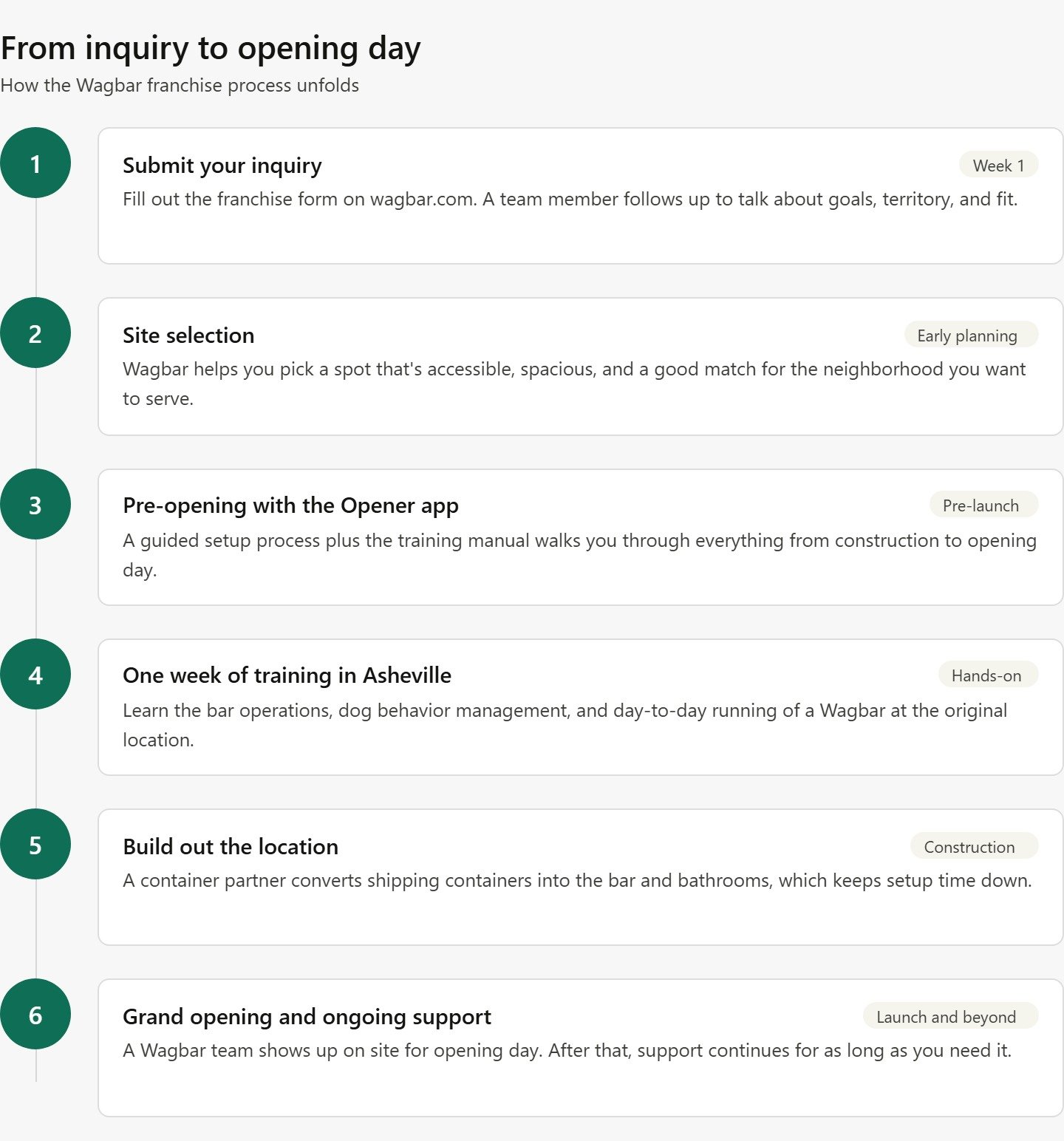
Wagbar's flagship is in North Carolina. The training program runs out of Asheville. The brand has community roots and regional recognition in the state that most franchise concepts can't replicate. For a North Carolina franchisee, you're starting with a brand that is genuinely from here.
North Carolina's Pet Franchise Opportunity, Summarized
North Carolina's pet market is one of the most compelling in the country: $3.95 billion in annual spending, 2.785 million dogs, top-tier national rankings for pet friendliness, and the #1 business climate in the country for 2025. Three major cities have zero off-leash dog bar competition. The corporate tax rate is heading toward zero. And the brand itself was built here.
The pet franchise opportunities page has the full overview. The franchising page is where you start the real conversation about territory, investment, and timing.
Ready to bring Wagbar to North Carolina? Contact the Wagbar franchising team to check territory availability, receive the FDD, and take the first step in one of the strongest pet franchise markets in the Southeast.