

Multi-Unit Pet Franchise Investment: When Buying Two or Three Locations Makes Financial Sense
Top TLDR: Multi-unit pet franchise investment makes financial sense when a system's fee discount, shared operational costs, and marketing efficiency offset the higher capital requirements and management complexity of running multiple locations. Wagbar offers a 50 percent franchise fee discount on additional units for franchisees committing to three or more locations, reducing per-unit upfront costs by $25,000 each. Review Wagbar's FDD for full investment details and development schedule requirements before committing to any multi-unit agreement.
If you have looked at the cost of opening one pet franchise location and then multiplied it by two or three, your first reaction was probably sticker shock. Multi-unit development is a bigger commitment, a bigger financial obligation, and a bigger operational lift than opening a single location. That part is true, and any honest guide to multi-unit ownership should start there.
What is also true, and what makes this worth a closer look, is that the economics of running two or three pet franchise locations are structurally different from running one. Per-unit costs drop in specific, measurable ways. Revenue efficiency improves as marketing and brand recognition compound across a territory. And for systems like Wagbar that offer multi-unit franchise fee discounts, the upfront savings on additional locations create a financial advantage that single-unit buyers simply do not have access to.
This walkthrough covers the financial logic behind multi-unit pet franchise development, what Wagbar's specific discount structure saves in practice, how Area Development Agreements work and what the legal framework looks like, the capital requirements and financing structures that multi-unit development demands, and the operational conditions that need to be in place before adding a second or third location makes sense for your situation.
The Basic Math Behind Multi-Unit Franchise Fee Savings
Franchise fees are a one-time cost paid upfront per location. For most franchise systems, that fee is fixed regardless of how many units you open. Some systems, including Wagbar, offer meaningful discounts on the franchise fee for franchisees who commit to developing multiple locations from the start.

Wagbar's Multi-Unit Discount Structure
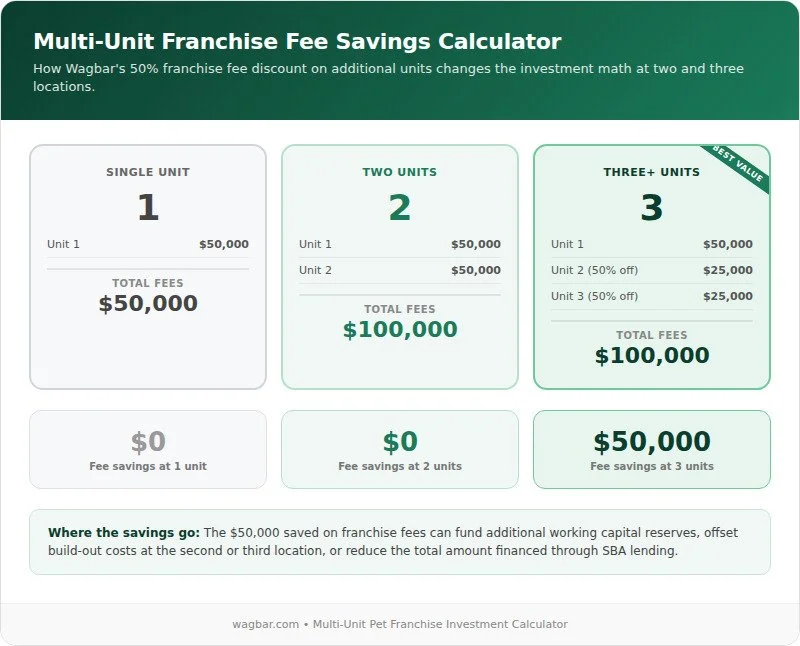
Wagbar's franchise fee is $50,000 per unit at the standard single-unit rate. For franchisees who commit to opening three or more locations, Wagbar offers a 50 percent discount on the franchise fee for each additional unit beyond the first.
In concrete terms, a three-unit commitment means paying $50,000 for the first location and $25,000 each for the second and third. That is a total franchise fee outlay of $100,000 instead of $150,000, saving $50,000 in upfront fees compared to opening the same three locations as separate single-unit agreements. For a four-unit commitment, the savings grow to $75,000. For five units, the savings reach $100,000.
That $50,000 to $100,000 in fee savings is real capital that can be redirected toward working capital reserves, build-out costs at the second or third location, marketing for grand openings, or debt service reduction. It is not a trivial amount, especially when considered alongside the other financial advantages that multi-unit development produces over time.
What the Discount Does Not Cover
The multi-unit franchise fee discount applies specifically to the initial franchise fee, not to ongoing royalties or marketing fund contributions. Each Wagbar location pays 6 percent of adjusted gross sales in royalties and 1 percent to the marketing fund, regardless of how many units the franchisee operates. The multi-unit advantage is concentrated on the front end, in the form of reduced franchise fees, and in the back end, through the operational cost efficiencies that shared infrastructure produces.
Two-unit commitments do not trigger the discount under the current Wagbar structure. That does not mean two units is the wrong goal. It means the economic case for two units rests on operational advantages and revenue synergies rather than reduced franchise fees. Owners who want the fee discount should plan for three or more from the start. For owners exploring the broader pet franchise category, multi-unit structures vary across brands, and the specifics of each brand's development incentives appear in Item 5 of the current Franchise Disclosure Document.
Illustrative Total Investment for Multi-Unit Development
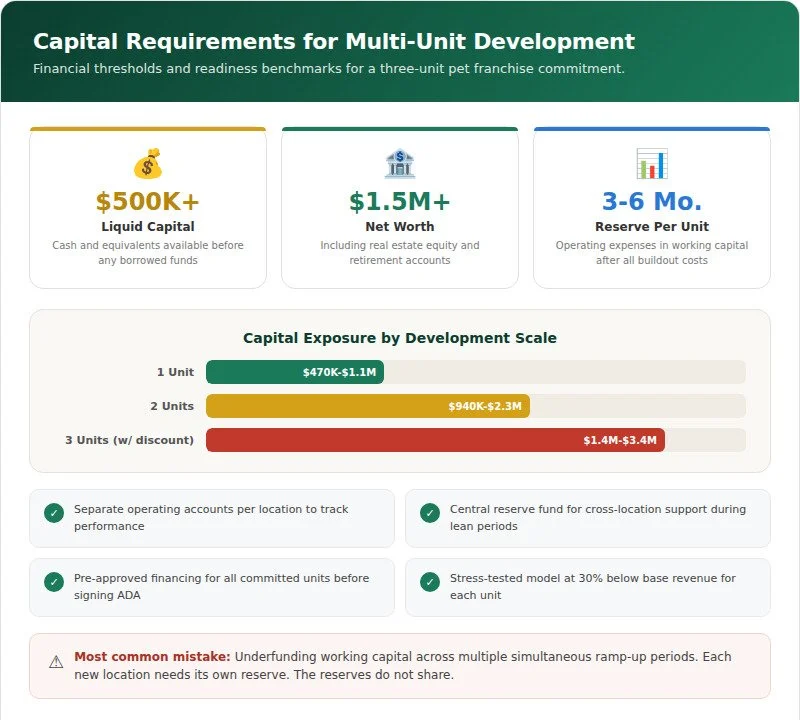
The illustrative total investment range for a three-unit Wagbar development, based on the disclosed range of $470,300 to $1,145,900 per location, would be approximately $1.4 million to $3.4 million across all three units, net of the fee discount. The wide range reflects real estate variation and market-specific buildout costs. This is a hypothetical illustrative range for planning purposes. Actual investment totals depend on specific site costs and local market conditions and are disclosed in the FDD.
For prospective owners first weighing the broader ownership commitment, the benefits of pet franchise ownership page covers what the franchise model offers before moving into the multi-unit decision.

Why Two Units Changes the Business Structure
A single pet franchise unit is typically structured around an owner-operator or a very active owner supported by a small management team. The owner is usually the most expensive labor in the building, and the business functions best when that owner is physically present several days a week.
The second unit forces a fundamentally different structure. One person cannot credibly run two dog bars operating in different neighborhoods or cities at the same time. This sounds like a limitation, but it is actually where the economics start to improve. The two-unit operator can now justify hiring a general manager at one location while remaining active at the other, or hiring two strong managers and stepping into a multi-unit owner role that focuses on strategy, hiring, and financial oversight rather than day-to-day bar operations.
The Operational Advantages at Two Locations
Several line items change materially at two units, and the changes work in the operator's favor.
Accounting and bookkeeping costs spread across two revenue streams. A single-unit franchisee paying $2,500 per month for part-time bookkeeping does not pay $5,000 when they add a second location. The incremental cost is typically $700 to $1,200, because the systems, software, and processes are already in place. The bookkeeper adds a second set of books to the same workflow rather than starting from scratch.
Insurance programs often price more favorably. When multiple units are covered under the same policy structure, carriers offer volume pricing that reduces per-location premiums. General liability, property coverage, and workers compensation can all benefit from multi-unit packaging, and the savings compound across each policy line.
Training and staffing pipelines serve both locations. Hires who are cross-trained to work at different locations provide scheduling flexibility and reduce the operational disruption of turnover at any one site. An experienced employee at Location A who is looking for more hours can pick up shifts at Location B without requiring a separate hire. This staffing flexibility does not exist in a single-unit operation.
Vendor relationships strengthen with volume. A two-unit operator buying beer, merchandise, cleaning supplies, and food items is a larger buyer than a single-unit operator. That volume translates into small but real cost improvements through better pricing, priority service, and sometimes favorable payment terms that improve cash flow.
Marketing spend works harder across two locations. A social media campaign, a local radio spot, or a community event promotion reaches potential customers for both locations simultaneously rather than for one. Brand recognition compounds across the territory, and the cost per acquired customer tends to decline as the operator adds locations in the same region. The community building for dog-focused businesses resource covers how community-driven marketing compounds over time, which directly supports the multi-unit marketing efficiency point.
The cumulative effect is a meaningful improvement in unit-level profitability once both locations hit stride. The first unit in a two-unit operation is not inherently more profitable than a standalone unit by itself, but the combined operation produces synergies that would not exist with two separate single-unit owners operating independently.
For context on how single-unit economics look at baseline, the Wagbar franchise overview covers the investment structure that all pet franchise decisions build from.
How Shared Infrastructure Reduces Per-Unit Operating Costs Over Time
The fee discount is the most visible financial advantage of multi-unit development, but shared infrastructure across locations often produces more lasting cost savings over the life of the investment. These savings do not appear on day one. They develop as the operator builds systems that serve all locations from a single foundation.
Management and Administrative Costs
A single-unit franchisee typically handles all day-to-day management responsibilities themselves or hires a dedicated manager for the one location. A three-unit franchisee can hire a general manager who oversees operations across all locations under one employment arrangement, spreading that management cost across multiple revenue streams rather than charging the full cost to one.
The same logic applies to bookkeeping, scheduling, payroll processing, and administrative functions. These are not costs that triple as you add locations. They grow, but not proportionally. A three-unit operator paying $4,000 per month for a full-time bookkeeper-office manager is paying roughly $1,333 per location, compared to the $2,500 per month a single-unit owner might pay for less comprehensive coverage.
Marketing Efficiency at Scale
Local marketing for a dog park bar concept builds community recognition and drives membership growth. When you operate multiple locations in a regional market, your marketing investment works harder per dollar spent. A branded vehicle wrap drives awareness for all your locations. A partnership with a local pet rescue generates goodwill that benefits the brand across the territory. A social media account with 15,000 followers promotes events at all locations from a single platform.
This structural advantage compounds over time and becomes one of the most significant economic benefits of multi-unit operation. Single-unit operators in the same system do not benefit from this effect, and the marketing cost gap between single-unit and multi-unit operators widens as the multi-unit operator's brand presence deepens in the community.
Staffing Depth and Flexibility
Multi-unit operators build deeper staffing pools than single-unit owners. When a bartender calls out sick at Location A, the multi-unit operator has a roster of trained employees at Locations B and C who can cover the shift. Single-unit operators have to scramble for coverage or work the shift themselves.
This staffing depth also reduces hiring costs. Multi-unit operators can hire at a portfolio level, posting once for positions available across locations, and can offer employees more total hours by splitting shifts across sites. In a labor market where part-time availability is common, the ability to offer 30 to 40 hours across two locations instead of 15 to 20 at one location makes the position more attractive and reduces turnover.
Capital Requirements for Multi-Unit Pet Franchise Development
Multi-unit pet franchise investment sounds attractive until you work through what it demands on the capital side. The advantages above are real. So are the requirements below, and underestimating them is the most common mistake prospective multi-unit operators make.
Front-Loaded Capital Commitment
When you commit to a multi-unit development agreement, you are committing to open all contracted locations within a specified development schedule, not just one. This means your capital planning needs to account for multiple location build-outs, potentially overlapping in their pre-opening periods, not just the first one.
A franchisee who opens Location 1, reaches profitability, reinvests that profit into Location 2, and later funds Location 3 from operations is on a very different financial timeline than one who commits to all three upfront and needs to fund them through a combination of equity and debt. Both approaches can work. They require very different capital structures and very different risk tolerance levels.
Specific Capital Benchmarks for Multi-Unit Development
Multi-unit operators typically need to meet several financial thresholds before lenders and franchisors will approve a multi-unit commitment. While specific requirements vary by lender and by system, the general benchmarks for a three-unit pet franchise development include the following.
Liquid personal capital of $500,000 or more. This is the cash and cash-equivalent assets available before considering any borrowed funds. Lenders want to see that the operator has meaningful skin in the game beyond the borrowed amount.
Net worth above $1.5 million. This includes real estate equity, retirement accounts, and other assets. SBA lenders underwriting multi-unit franchise deals use net worth as a measure of the borrower's overall financial stability and ability to weather setbacks.
Post-closing liquidity sufficient to cover three to six months of operating expenses across all operating units. This is the cash that remains after all franchise fees, build-out costs, and pre-opening expenses have been paid. Running short on working capital during the ramp-up period is the single most avoidable cause of multi-unit development failure.
Debt Service Across Multiple Locations
If you are financing a significant portion of a multi-unit development through SBA or conventional lending, your monthly debt service multiplies with each location. Three locations financed at 65 percent each means three loan payments, and those payments exist regardless of whether each location has reached break-even.
A single underperforming location in a three-unit portfolio creates a deficit that the other two must absorb or that you must fund from outside the business. This is the most significant risk factor in multi-unit development, and it is the one most often underestimated during the evaluation phase. The pet franchise investment guide covers how debt service affects the path to profitability at the individual location level, which is the right foundation before modeling a multi-unit scenario.
Working Capital Must Cover Multiple Ramp-Up Periods
Each new location goes through a ramp-up period where revenue is building toward break-even. The working capital reserves that fund that gap for one location must be multiplied when two or three locations are ramping up in close proximity. Underfunding working capital at a single location is a common mistake. Underfunding it across a multi-unit development can be genuinely damaging to the entire portfolio.
Most franchise financial advisors recommend a minimum of six months of operating expenses in working capital per location, in addition to buildout and pre-opening costs. For a three-unit multi-unit pet franchise investment, that is three times the reserve required for one location, and the total working capital requirement can exceed $300,000 depending on the market and the development timeline.
Operators who pursue multi-unit growth without sufficient capital usually end up slowing their development schedule, which can trigger the territory-loss provisions in the Area Development Agreement. Better to commit to what you can actually fund than to sign an ambitious development agreement you cannot execute. For prospective owners weighing the financing structure, the pet franchise opportunity page covers the broader qualification profile lenders and franchisors expect.
Area Development Agreements and the Legal Framework
Multi-unit commitments are typically structured through an Area Development Agreement, commonly called an ADA. An ADA is a separate agreement that sits alongside the individual franchise agreements for each location and specifies how the multi-unit development will unfold. Understanding this document is essential because it governs your obligations, your territory rights, and the consequences of falling behind schedule.
What an Area Development Agreement Contains
A typical ADA includes several critical provisions that shape the entire multi-unit relationship.
Number of units. The ADA specifies the total number of locations the developer commits to opening. This is a binding commitment, not an aspiration. Signing an ADA for three units means you are contractually obligated to open three units within the agreed timeline.
Geographic territory. The ADA defines the exclusive territory in which the developer has the right to open units. Within this territory, the franchisor agrees not to grant additional franchises to other operators, giving the developer a protected area for growth. The territory definition matters enormously because it determines how much market you have to work with and how much competition you face from within your own system.
Development schedule. The ADA includes specific open-by dates for each unit. Missing these dates has consequences, which is why the schedule deserves careful attention during negotiation. A three-year schedule to open three units is a very different commitment than a six-year schedule for the same three units. The right timeline depends on your capital structure, your management depth, and your market's real estate availability.
Milestone consequences. Most ADAs specify what happens if the developer misses a milestone. The most common consequence is loss of exclusive territory rights for units not yet opened. In severe cases, missed milestones can be grounds for termination of the ADA entirely. Understanding these provisions before signing is essential because they define the downside risk of falling behind.
Fee structure. The ADA specifies how franchise fees are paid across the development. Some systems collect all fees at signing. Others collect fees as each unit opens. The timing of fee payments affects your cash flow planning and should be modeled explicitly in your capital plan.
Why the Development Schedule Is the Most Important Provision
The development schedule is the most operationally important piece of any ADA because it determines the pace at which you must deploy capital, hire staff, secure real estate, and build out locations. An aggressive schedule can work when the market supports it and the operator has the bandwidth, but missed milestones can trigger default provisions that strip protected territory rights.
Conservative schedules preserve optionality at the cost of paying for territory you may not fully use during the early years. Aggressive schedules capture territory faster but create pressure that can lead to poor site selection or rushed build-outs if the operator feels compelled to hit dates rather than find the right locations.
Any Area Development Agreement should be reviewed by a franchise attorney before signing. Review costs for ADAs are typically $2,000 to $5,000 on top of the initial franchise agreement review, and the money is well spent given the multi-year financial commitment involved. For more on the broader due diligence side, the investment checklist for off-leash dog bar franchises covers the signal set worth weighing before any signing.
Territory Structure and Protection
Territory protection under an ADA gives the multi-unit developer exclusive rights within a defined geographic boundary. This protection is valuable because it prevents the franchisor from placing another operator in your market and guarantees that your locations will not compete with other units in the same system.
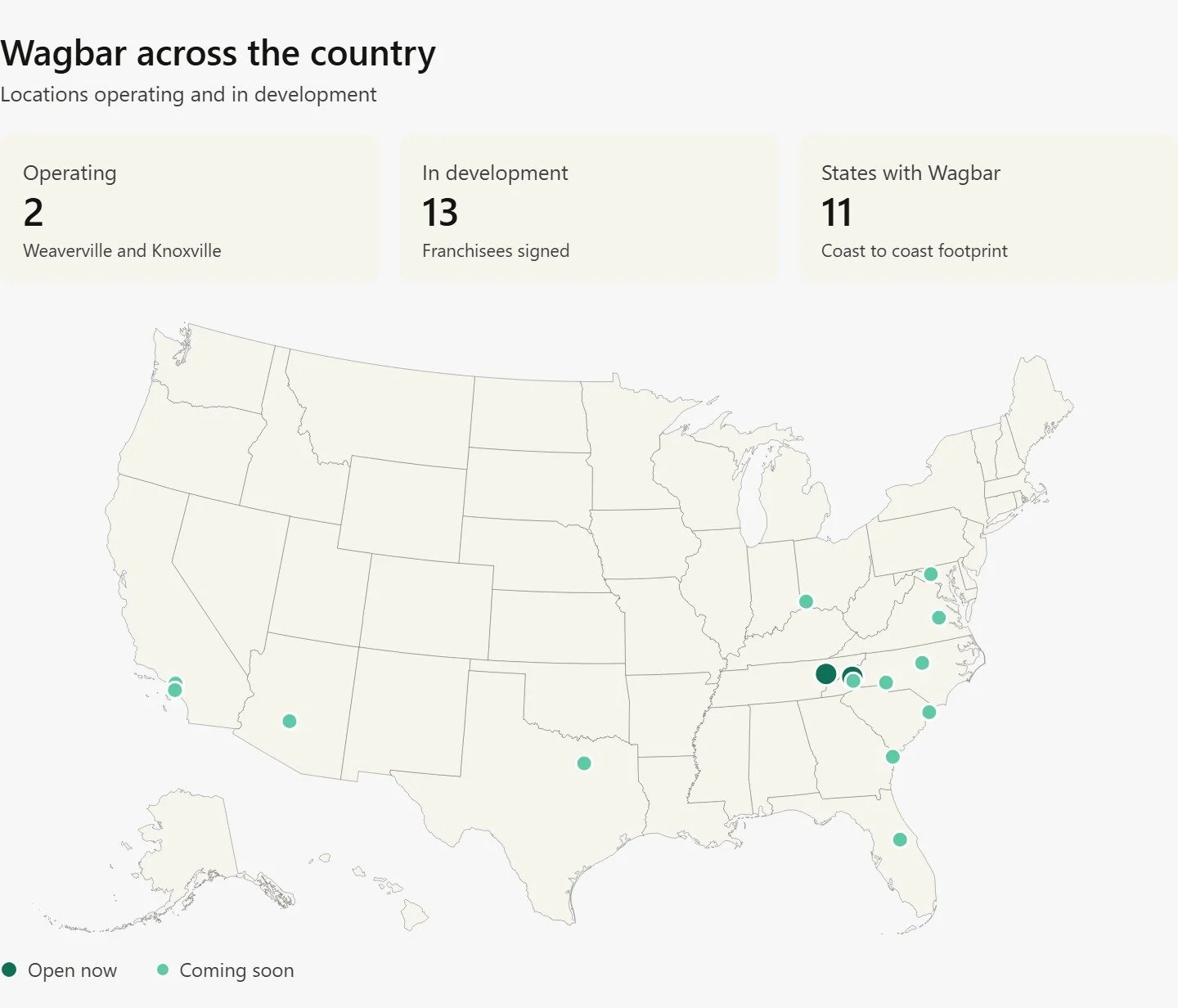
Typical multi-unit territories cover a specific metro area, county, or defined geographic boundary. Developers pursuing units in multiple metro areas usually sign separate agreements for each market. The current Wagbar locations map shows how existing developments are distributed across markets and can help prospective multi-unit operators identify available territory.
Understanding how your territory is defined, what exceptions exist for online sales or alternative formats, and whether the franchisor retains any rights within your boundary are questions your franchise attorney should address during the ADA review. Territory definitions that seem generous at first reading sometimes contain exceptions worth understanding before committing.
When Multi-Unit Development Actually Makes Sense
Given the capital demands and legal commitments above, the financial advantages of multi-unit development make the most sense when specific conditions are in place. Not every investor who can afford multi-unit development should pursue it, and the self-assessment required before committing is as important as the financial analysis.
You Have Existing Operational Experience
The best multi-unit candidates in the franchise world are typically operators who already have experience running at least one location in the same system, or executives with demonstrated multi-unit management experience from another franchise or retail context. Operating a dog park bar is a specific skill set. Running three of them simultaneously is a management challenge that compounds quickly without a foundation of operational confidence.
For first-time Wagbar franchisees, opening one location well and building from there is typically the stronger path. For experienced operators with hospitality or retail management backgrounds, or for investors who plan to hire experienced general management from the start, multi-unit development from the beginning is a viable approach.
Franchisors evaluating multi-unit candidates typically want to see prior multi-unit management experience, significant hospitality or pet industry operating experience, or a strong operating partner on the team. First-time franchise buyers without multi-unit backgrounds can still pursue multi-unit commitments, but the franchisor will usually work closely with the buyer on staffing and systems before approving more aggressive development schedules.
Your Market Has Room for Multiple Locations
Committing to three locations means identifying three viable sites in markets that can each sustain the membership targets required for profitability without cannibalizing each other. A region with one strong market and two weaker adjacent markets is a different three-unit investment than three separate strong markets within a reasonable management radius.
The demographic factors that support successful dog park bar locations include median household income, dog ownership rates, population density in the trade area, and the competitive landscape for pet entertainment and socialization. Understanding the best cities for dog franchise success and these demographic factors helps frame the market analysis question before committing to a multi-unit development area.
Your Financing Structure Can Handle the Load
Access to capital at favorable terms is a precondition for multi-unit development that works financially. SBA 7(a) loans can fund each location individually, but each loan is underwritten based on the business's ability to service the debt from that location's projected revenue. Lenders will assess your combined debt load across all committed locations and will want to see that your combined projected cash flows can service the total obligation with reasonable margin.
Working with a lender experienced in franchise financing, before you commit to a multi-unit agreement, is essential. SBA financing for multi-unit franchise development can be structured as individual loans per location or, in some cases, as a portfolio loan. The approach depends on the lender, your total investment amount, and how your development schedule is structured. Working with a lender who specializes in franchise financing and understands multi-unit development is important for getting the structure right.
Sequenced vs. Simultaneous Multi-Unit Development
Not all multi-unit development happens at the same time. There are two primary approaches, and the financial logic is different for each. Prospective multi-unit operators face this strategic choice early, and the answer depends on their capital position, operational experience, and market conditions.
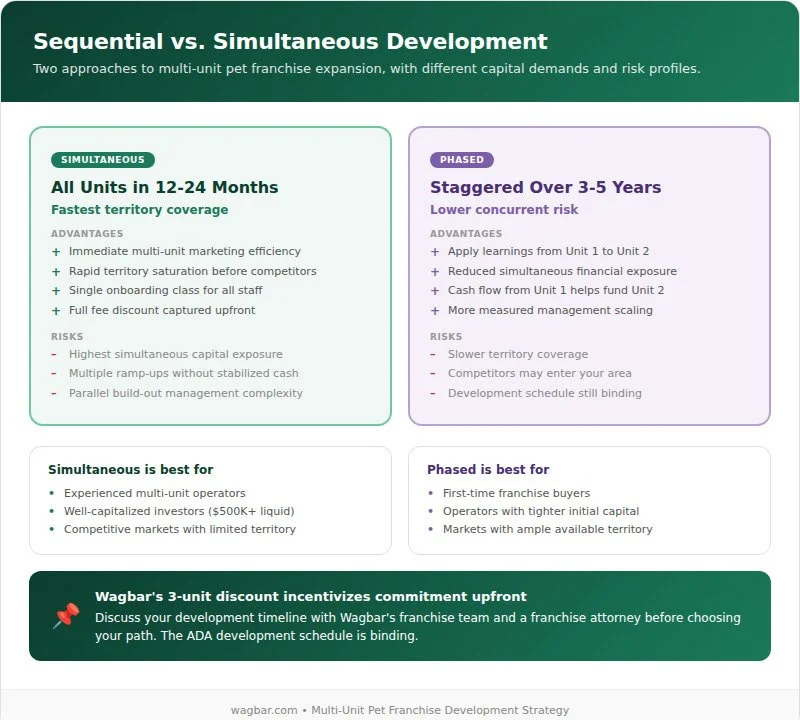
Simultaneous Development
Opening all committed locations within a compressed timeline, typically 12 to 24 months across all units, maximizes the brand-building and marketing efficiency benefits but requires the largest upfront capital commitment. It is appropriate for well-capitalized investors with strong management infrastructure who are entering a market and want to establish territory quickly before competitors can enter the space.
The advantages of simultaneous development include faster territory saturation, immediate multi-unit marketing efficiency, the ability to hire and train staff across all locations as a single onboarding class, and the psychological momentum of a rapid market entry. The risks include higher simultaneous capital exposure, the possibility of multiple locations ramping at the same time without any stabilized cash flow to support them, and the management complexity of running multiple build-outs and grand openings in parallel.
Phased Development
Opening the first location, reaching operational stability, and then using that location's cash flow alongside additional capital to fund subsequent openings is the more conservative approach. It reduces simultaneous financial exposure and lets you apply real operational learnings from Location 1 to the buildout and opening of Location 2.
The trade-off is a slower timeline to full territory coverage and potentially different terms if the system changes its discount structure between your first and subsequent openings. Phased development also means your territory remains partially undeveloped for a longer period, which can be a concern in competitive markets where other operators or competing brands might establish a presence in your undeveloped sub-markets.
Choosing Between the Two Approaches
Neither approach is objectively better. Sequential growth usually makes sense for first-time business owners, first-time franchise buyers, or operators with tighter personal capital. Upfront multi-unit commitment usually makes sense for experienced multi-unit operators, for well-capitalized investors, or for markets where the territory is competitive and delay could mean losing access to the best trade areas.
Wagbar's multi-unit discount applies to franchisees who commit to three or more units upfront, which creates a natural incentive toward simultaneous or rapid phased development rather than single-unit sequential expansion. Understanding exactly how the development schedule is defined in your franchise agreement, and what happens if timelines slip, is a question for your franchise attorney before signing. The Wagbar franchise breakdown covers the baseline terms and documents that apply to every unit.
Operational Considerations at Two and Three Units
Running multiple pet franchise units is not simply "more of the same." The operational complexity compounds in specific ways that require deliberate planning and management infrastructure.
Staffing Pipelines Become a Strategic Priority
At one unit, turnover in a single manager position is painful but survivable. At three units, turnover is a constant operational reality, and building an internal pipeline for manager-level talent becomes a strategic priority rather than a reactive exercise. Multi-unit operators typically promote from within when possible because internal hires already understand the brand, the systems, and the guest experience standards.
The staffing model for a three-location portfolio typically requires at least one experienced general manager or area manager overseeing all locations, with location-level managers at each site. The staffing model depends on your operating hours, market size, and how geographically concentrated your locations are. Wagbar's training program addresses operations management as part of franchisee preparation.
Systems and Standards Tighten
What works informally at one unit breaks at three. Inventory counts, cash handling procedures, maintenance schedules, and customer incident reporting all need written procedures enforced consistently across every location. Multi-unit operators who skip this step produce inconsistent guest experiences across their locations, which damages the brand locally and undermines the marketing investment that is supposed to benefit all sites equally.
The transition from informal to systematized operations is one of the biggest culture shifts multi-unit operators face, and it usually needs to happen before the second location opens, not after. Operators who wait until the third location to build systems find themselves trying to standardize while simultaneously managing three different operational cultures.
Time Allocation and Management Structure
A single-unit owner who spends 40 hours a week in the business can allocate that time however makes sense. A three-unit owner spending 40 hours a week is dividing that time across three locations plus portfolio-level work, and the calculus becomes very tight very quickly.
Many three-unit operators hire a district manager or area director once the third location opens, which is an additional $70,000 to $100,000 annual cost to model. This cost is real and should appear in your multi-unit financial model from the beginning, not as a surprise after the third location opens. The decision to hire a district manager versus managing all three locations yourself is a question about how you want to spend your time and what kind of business you are building.
Cash Flow Timing Across Multiple Units
Single-unit cash flow is lumpy but manageable. Multi-unit cash flow combines revenue curves that do not necessarily align. A location in ramp-up mode can drag on a stabilized location's cash flow if the operator is not careful about how reserves are structured at each unit.
Smart multi-unit operators maintain separate operating accounts for each location and a central reserve fund that can support any unit during lean periods. Co-mingling cash across locations without clear accounting makes it nearly impossible to identify which units are performing and which are underperforming, and it creates a situation where one struggling location can quietly drain the resources of the healthy ones.
For a closer look at how the day-to-day operations actually play out, the guide to starting an off-leash dog bar business covers the operational foundation that multi-unit ownership builds on.
When Two Units Is the Right Stopping Point
Not every multi-unit operator wants three or more locations. For some owners, two units is the optimal structure that captures most of the operational efficiency available in multi-unit ownership without committing to the full complexity of portfolio management.
At two units, the owner can still be active in both locations, can still personally know many of the regular customers, and can still make real-time operational decisions without layering in a district manager. The business is large enough to justify real systems but small enough to remain personal. For an owner whose goal is a strong local business rather than a multi-city portfolio, two units is often the right stopping point.
Two-unit ownership also makes sense as a staging plan for eventual three-unit growth. Opening unit two, stabilizing it, and then signing an ADA for units three through five later is a legitimate path. The fee discount is only available when the multi-unit commitment is made, so the economics are slightly different than a single upfront commitment, but the operational approach can be more measured.
For context on how real operators describe the growth path in the pet category, the real owner stories on profit margins page adds useful perspective on what second and third units actually produced for earlier franchisees.
The Exit Value Consideration
Multi-unit franchisees generally command a premium over single-unit operators in franchise resale markets. This consideration matters most for investors who are building with a defined exit horizon, whether that is a sale to another operator, a private equity buyer, or a family transfer.
Why Multi-Unit Portfolios Sell at Higher Multiples
A portfolio of three operating Wagbar locations with established membership bases, documented cash flows, and a track record of operational performance is a meaningfully different asset than a single location. Buyers acquiring a multi-unit portfolio are purchasing economies of scale and management infrastructure that would take years to build independently.
The franchise resale market for established multi-unit concepts in growing categories like off-leash dog park bars tends to produce higher EBITDA multiples than standalone single-unit sales, all else being equal. The reasons are structural. A multi-unit portfolio has diversified revenue streams across locations, reducing the buyer's concentration risk. It has management systems already in place, reducing the operational lift required after acquisition. And it has territory protection that gives the new owner room to grow without competing against other franchisees in the same system.
Planning for Exit From the Start
Investors who are building toward an exit should think about resale value from the beginning of the development. That means maintaining clean financial records at each location, building systems that can transfer to a new owner without the current owner's personal involvement, and developing a management team capable of running the business during a transition period.
The dog business models complete guide provides additional context on how different ownership structures and business models affect long-term value in the pet franchise space.
Building a Multi-Unit Financial Model
A multi-unit financial model is not simply a single-unit model multiplied by the number of locations. It requires additional line items, different assumptions about shared costs, and a more complex cash flow timeline that accounts for staggered openings and overlapping ramp-up periods.
Key Differences From Single-Unit Modeling
The multi-unit model should include the discounted franchise fees for units beyond the first, shared management and administrative costs spread across all operating locations, marketing budgets that reflect the efficiency gains of multi-unit brand presence, separate ramp-up timelines for each location showing month-by-month revenue projections, consolidated debt service across all financed locations, and a central working capital reserve that can support any location during lean periods.
Revenue Assumptions by Location
Not all locations will perform identically. Your financial model should assign different revenue assumptions to each location based on its specific trade area demographics, competitive environment, and expected ramp timeline. The strongest location in your portfolio might reach break-even at month 8 while the weakest might not reach break-even until month 14. Your model needs to reflect this variation rather than assuming uniform performance across all sites.
Stress Testing the Multi-Unit Model
The most important exercise in multi-unit financial modeling is the stress test. What happens if one location underperforms your base case by 30 percent for the first 18 months? Can the other locations and your reserve fund absorb that deficit without putting the entire portfolio at risk? If the answer is no, your capital structure is too thin for multi-unit development and you should either raise additional equity, reduce the number of committed locations, or extend the development timeline to reduce simultaneous exposure.
The pet franchise investment guide covers the single-unit financial modeling framework that serves as the foundation for multi-unit analysis.
Frequently Asked Questions About Multi-Unit Pet Franchise Investment
Does Wagbar offer a discount for two-unit commitments? Under the current Wagbar franchise structure, the 50 percent franchise fee discount applies when the owner commits to three or more units. Two-unit commitments pay the standard $50,000 initial fee per unit. Two-unit owners still benefit from operational synergies and shared back-office costs, but the fee discount specifically is structured for three-plus commitments.
How far apart can multi-unit locations be? Territory structure under Wagbar's Area Development Agreements is defined in Item 12 of the current Franchise Disclosure Document. Typical multi-unit territories cover a specific metro area, county, or defined geographic boundary. Developers pursuing units in multiple metro areas usually sign separate agreements for each market. Ask the franchise development team about specific territory definitions during the qualification conversation.
Can I add a third unit later if I start with two? Yes, subject to territory availability. Adding a third unit after opening your first two requires executing a new franchise agreement and potentially an Area Development Agreement for the additional units. The fee discount rules apply to the three-or-more commitment structure, so adding a third unit later does not retroactively discount the earlier fees. Plan the path you want from the start to capture the full financial benefit.
What happens if I miss a development milestone in my ADA? Area Development Agreements typically include specific consequences for missed milestones, most commonly loss of the exclusive territory rights for units not yet opened. In severe cases, missed milestones can be grounds for termination of the ADA. Conservative development schedules reduce this risk, but they come at the cost of paying for territory you may not fully use during the early years. The specifics of default provisions appear in the ADA itself and should be reviewed by a franchise attorney.
Do multi-unit operators have lower royalty rates? Not under the current Wagbar structure. Royalty rates remain at 6 percent of adjusted gross sales across all units, with the 1 percent marketing fund contribution also unchanged. The multi-unit savings come through the franchise fee discount and through operational scale, not through royalty reductions. This is standard across most pet franchise systems.
How much operating experience do I need to qualify for multi-unit ownership? Franchisors evaluating multi-unit candidates typically want to see prior multi-unit management experience, significant hospitality or pet industry operating experience, or a strong operating partner on the team. First-time franchise buyers without multi-unit backgrounds can still pursue multi-unit commitments, but the franchisor will usually work closely with the buyer on staffing and systems before approving more aggressive development schedules.
Can I finance a multi-unit development through a single SBA loan? SBA financing for multi-unit franchise development can be structured as individual loans per location or, in some cases, as a portfolio loan. The approach depends on the lender, your total investment amount, and how your development schedule is structured. Working with a lender who specializes in franchise financing and understands multi-unit development is important for getting this right.
What management structure does a three-unit operation need? A three-location portfolio typically requires at least one experienced general manager or area manager overseeing all locations, with location-level managers at each site. The staffing model depends on your operating hours, market size, and how geographically concentrated your locations are. Wagbar's training program addresses operations management as part of franchisee preparation.
Is multi-unit development riskier than single-unit ownership? Multi-unit development carries higher absolute financial risk because more capital is at stake and multiple locations can experience challenges simultaneously. However, it can carry lower per-unit risk once all locations are operating because revenue diversification across sites means that a slow month at one location does not determine the entire portfolio's performance. The risk profile depends almost entirely on the operator's capital adequacy, management capability, and market selection.
Where can I start the multi-unit development conversation with Wagbar? Connect with Wagbar's franchise development team through the franchising page to discuss multi-unit territory availability, development timeline requirements, and the full investment disclosure in the FDD.
Building a Multi-Unit Strategy That Holds Up
Multi-unit pet franchise investment makes financial sense when the fee savings are real, the management infrastructure is in place before the second location opens, the market can support multiple locations without internal competition, and the capital structure is strong enough to carry multiple ramp-up periods simultaneously.
For investors evaluating a Wagbar multi-unit development, the 50 percent franchise fee discount for three or more units is a concrete financial advantage that changes the total investment math meaningfully. Whether the rest of the conditions are in place is a question that requires honest self-assessment alongside market analysis and a thorough FDD review with a qualified franchise attorney.
The dog franchise opportunity page describes the general profile that franchisors look for in multi-unit candidates. The benefits of owning a pet franchise page and the dog business models complete guide provide additional context on what the Wagbar system offers operators at any unit count. The Wagbar FAQ page covers common prospective-franchisee questions and the early-stage research steps most serious candidates take.
When you are ready to explore multi-unit territory options and begin the formal evaluation process, the Wagbar franchising page is where that conversation starts. Contact franchising@wagbar.com to discuss multi-unit development opportunities.

Bottom TLDR: The financial case for multi-unit pet franchise investment rests on three pillars. Front-end fee savings through Wagbar's 50 percent discount on franchise fees for three or more units, lower per-unit operating costs through shared infrastructure and marketing efficiency, and compounding brand value that produces higher EBITDA multiples at resale. The model holds up only with adequate capital reserves, management depth in place before the second location opens, and a development schedule matched to what you can realistically execute. Connect with the Wagbar franchising team to discuss multi-unit territory options.
FDD disclaimer: This information is not intended as an offer to sell, or the solicitation of an offer to buy, a franchise. It is for information purposes only. An offer is made only by Franchise Disclosure Document (FDD). Currently, the following states regulate the offer and sale of franchises: California, Hawaii, Illinois, Indiana, Maryland, Michigan, Minnesota, New York, North Dakota, Oregon, Rhode Island, South Dakota, Virginia, Washington, and Wisconsin. If you are a resident of, or wish to acquire a franchise for a Wagbar to be located in one of these states or a country whose laws regulate the offer and sale of franchises, we will not offer you a franchise unless and until we have complied with applicable pre-sale registration and disclosure requirements in your jurisdiction. Wagbar Franchising LLC, (828) 554-1021, 7 Kent Place, Asheville, NC 28804.