

Millennial Franchise Buyers: Why Younger Investors Are Choosing Experience-Based Pet Businesses

Top TLDR: Millennial franchise buyers now represent 18% of all franchisees, up from 12% just one year prior, and experience-based pet businesses are among the fastest-growing categories they're choosing. This generation owns more pets, spends more per pet, and actively seeks franchise investments that align with personal values and community building. If you're a younger investor exploring the pet franchise space, Wagbar is built around exactly that combination.
Something has shifted in who is buying franchises, and the numbers are hard to ignore. Millennial ownership of franchise businesses jumped 49% in a single year according to Guidant Financial's 2024 Franchise Trends Survey. That's not a rounding error or a blip. It reflects a real generational transfer of entrepreneurial energy from corporate employment into business ownership, and a meaningful chunk of that energy is flowing toward one specific category: experience-based pet businesses.
This piece looks at why that's happening, what it tells us about where consumer spending is going, and why the off-leash dog bar concept sits at the center of it all.
The Numbers Behind the Generational Shift in Franchising
Millennials now make up 18% of all franchisees in the United States, according to Guidant Financial's 2024 survey data. That compares to 12% in 2023 and roughly 4.6% in 2022. The acceleration is striking. In three years, millennial franchise ownership has roughly quadrupled as a share of the total franchise population.
Franchise inquiry data tells a similar story from the demand side. According to Franchise Insights, millennials surpassed Baby Boomers among first-time franchise seekers, now accounting for 24.7% of all franchise inquiries. The Franchise Sidekick "Best Damn Franchise Report," which tracked more than 140,000 candidates and 73,000 buyers, found that the average franchise buyer is 43 years old, and 72% are still employed in corporate jobs while exploring ownership. Franchise investment, for most millennial buyers, is a planned exit from a career that no longer fits, not a desperate improvisation.
What's driving them out of corporate roles and into franchising? Guidant's survey identified the top motivations: being one's own boss (28%), freedom from corporate employment (22%), and pursuing a passion (13%). But there's a values dimension here too. A PwC survey found 88% of millennials want to work for a company that reflects their personal values. A Cone Communications study reported 75% would take a pay cut to do so. For this generation, the investment thesis for a business is inseparable from whether the business itself means something.

The Wagbar franchising model attracts buyers exactly at that intersection: a community-driven concept built around dogs, social connection, and local neighborhood investment.
What the Experience Economy Actually Means for Pet Franchises
The term "experience economy" gets used a lot, but the underlying data justifies the attention. WiseGuy Reports valued the global experience economy at $778.7 billion in 2024, with projections reaching $1.2 trillion by 2035. Mastercard Economics Institute tracked a 65% increase in experience-related spending between 2019 and 2023, while spending on physical goods grew just 12% over the same period. A January 2026 Harris Poll found 67% of Americans now prioritize experiences over material purchases, with that number rising to 70% among millennials specifically.
The Eventbrite and Harris Poll research that helped define this generational pattern found 78% of millennials would choose to spend money on a desirable experience over buying something desirable, and 72% wanted to increase their experiential spending over time. This isn't a fringe preference. It's the dominant spending orientation of the largest generation in the workforce.
For franchise investors, this creates a meaningful question: which business concepts are positioned on the right side of this trend? A pet supply store sells products. A dog training service provides a service. But an off-leash dog park and bar offers something neither of those can: a recurring, social, emotionally resonant experience that people and their dogs come back to week after week.
That's the structural advantage of the off-leash dog bar concept as a franchise investment. It's not a transaction-based business. It's a membership and day-pass model layered on top of a bar revenue stream, all wrapped around an experience customers genuinely want to repeat. The revenue streams that support off-leash dog bars reflect that experience-first design.
Millennials Own More Pets and Spend More on Them Than Any Prior Generation
The American Pet Products Association reported U.S. pet industry spending hit $158 billion in 2024, with projections reaching $165 billion in 2026 and $192 billion by 2030. The industry supports 2.8 million American jobs and contributes an estimated $312 billion to the overall economy when downstream effects are counted. Pet ownership now touches 71% of U.S. households.
Millennials account for 30% of all pet-owning households, making them the largest generational cohort of pet owners. Combined with Gen Z, younger generations own roughly half of all pets in the country. What matters more for franchise investors is what they spend. A May 2024 Harris Poll survey of 2,125 adults found millennials spend an average of $5,150 annually on their pets, meaningfully above the overall average of $4,366. Bureau of Labor Statistics data confirms that millennials are the only generation to have increased pet spending every year since 2016.
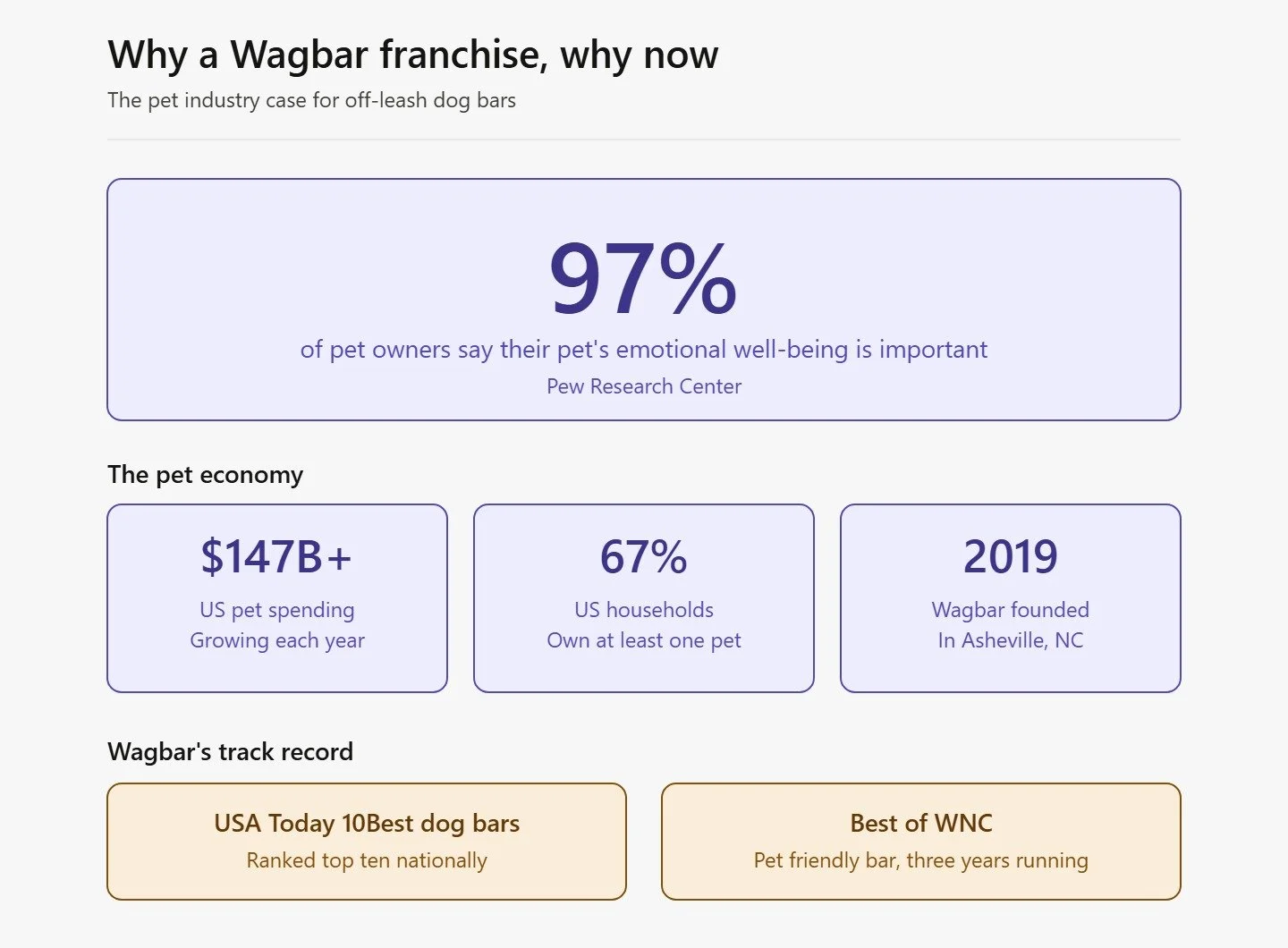
The cultural dimension of this spending is worth understanding. Pew Research Center's 2023 survey of more than 5,000 adults found 97% of pet owners consider their pets part of the family, with 51% saying their pets are as much a family member as any human in the household. A 2024 Harris Poll State of Pets report found 82% of pet owners say their pet is "like my own child." Among millennials specifically, 75% identify their pets as "fur babies" according to Statista survey data.
This is not a niche sentiment. It's a mainstream cultural shift that creates durable demand for businesses that treat dogs as the social and emotional priority they've become in their owners' lives. The 2024 Harris Poll also found 75% of pet owners wish there were more pet-friendly places to take their animals.
That's the market signal behind Wagbar's growth into cities like Richmond, VA, Charlotte, NC, Dallas, TX, and Los Angeles, CA. Each market was selected partly on the basis of strong millennial and professional demographics alongside high dog ownership rates.
Why Experience-Based Pet Businesses Appeal to Millennial Investors Specifically
The alignment between what millennial franchise buyers want and what a dog bar franchise offers is more specific than it might first appear. It's not just that millennials like dogs and experiences. It's that several structural features of this investment type map onto their priorities in ways that other franchise categories don't.
Community ownership over transactional business. Millennial franchise buyers consistently rank community impact alongside financial return when evaluating opportunities, per Franchise Business Review research. An off-leash dog bar is, by design, a community hub. Regulars come back multiple times a week. Staff know members and their dogs by name. The business builds genuine relationships rather than processing individual transactions.
Passion-to-business alignment. Guidant Financial's data shows 13% of millennial franchise buyers list passion as their primary motivation. For dog owners considering franchise investment, the pet franchise opportunity at Wagbar offers a rare chance to operate a business centered on something they already care about deeply.
Flexibility and lifestyle integration. Franchise Insights reported that work schedule flexibility ranks as the top non-financial characteristic franchise prospects seek, with younger buyers driving that preference. An owner-operated dog bar with a clear operational playbook and an established franchise training and support system creates more schedule autonomy than most corporate roles.
Recession-resistant categories. Millennial franchise buyers, many of whom entered the workforce during the 2008 financial crisis, prioritize downside protection. The pet industry has demonstrated strong resilience through economic downturns. Americans maintained or increased pet spending through both the 2008-2009 recession and the 2020 pandemic. That track record matters to a generation that has lived through two major economic shocks before turning 40.
The Wagbar off-leash dog park bar starting guide covers the concept's operational model in detail, and the benefits of owning a pet franchise page addresses many of the questions younger buyers bring to the evaluation process.
The Career Transition Pipeline Is Getting Younger
The profile of who is leaving corporate employment for franchise ownership is shifting alongside the broader millennial trend. Franchise Insights reported in early 2025 that over 53% of franchise prospects are exiting full-time jobs, citing return-to-office mandates, automation anxiety, and cost-cutting as accelerants. Guidant Financial's surveys have consistently found 22-24% of franchise owners cite freedom from corporate life as their primary motivation, second only to autonomy.

Wagbar's own franchisee network reflects this pattern. AJ Sanborn spent 20 years in financial services before choosing Wagbar for the Richmond, Virginia market. In the announcement introducing him as a franchisee, Wagbar noted he considered opening a traditional bar before his passion for animals led him to a concept that felt like a better fit for the life he wanted to build. Jennifer, the Los Angeles franchisee, left a long corporate career to open Wagbar in her hometown. Dianna, the Phoenix franchisee, came from years in IT sales before seeking a business that matched both her restaurant background and her passion for working with people and dogs.
These aren't outliers. They're representative of how the experience-based pet franchise draws precisely the buyer demographic that the broader research describes: mid-career professionals with real business experience, values-driven investment motivations, and a desire to build something meaningful in their community.
The Franchise Sidekick report identifies this buyer as "Freedom Freddie," a career-shifter ready to exit the 9-to-5, typically still employed while exploring options, and looking for a proven system that reduces the risk of going independent. Wagbar's container bar build-out solution, week-long Asheville training program, and ongoing operational support are designed specifically to answer that buyer's concerns.
What the Pet Services Market Actually Looks Like Right Now
Pet services, the segment most relevant to an off-leash dog bar investment, has been the fastest-growing subcategory within the broader pet industry. APPA data shows pet services spending more than doubled from $5.76 billion in 2013 to $14.3 billion in 2024, with projections reaching $17 billion by 2030. Grand View Research values the global pet services market at $60 billion in 2024, growing at 8.58% annually toward $125.8 billion by 2033.
Experience-based pet venues occupy an emerging but clearly signaled position within that market. Consumer appetite is documented: 75% of pet owners want more pet-friendly places, and 80% believe pets should have broader access to shops and establishments, per the 2024 Harris Poll State of Pets report. The dog bar and pet social venue category is growing to meet that demand, with Wagbar now operating across 16 locations from North Carolina to California.
For prospective investors, the pet industry market analysis and pet industry growth trends pages on Wagbar provide a detailed look at the economic forces driving demand. The emerging opportunities in the pet industry page addresses where the next growth is expected to come from specifically.
The franchise investment requires real capital. Wagbar's initial franchise fee is $50,000. Total estimated investment ranges from $470,300 to $1,145,900 depending on location and build-out. The royalty fee is 6% of adjusted gross sales, with an additional 1% contributed to the Wagbar marketing fund. For franchisees committing to three or more units, a 50% multi-unit discount on the franchise fee applies.*
These figures are estimates only and not a guarantee of investment performance. Full financial details are disclosed in the Wagbar Franchise Disclosure Document (FDD). Wagbar Franchising LLC, 7 Kent Place, Asheville, NC 28804. This is not an offer to sell a franchise.
Frequently Asked Questions
Are millennial franchise buyers actually choosing pet businesses at higher rates?
Pet and animal-related franchises consistently rank among the top industries for younger franchise buyers, alongside fitness, food, and service businesses. The alignment between millennial pet ownership rates (30% of all pet-owning households), millennial spending patterns ($5,150 annually per pet), and millennial investment motivations (passion, community, lifestyle) makes pet franchises a natural fit for this buyer group.
What makes experience-based pet businesses different from traditional pet franchises?
Traditional pet franchises, including grooming, boarding, and retail, are primarily service or product-based. Experience-based pet businesses like Wagbar generate revenue through memberships, day passes, and beverage sales while centering the visit around a social, recreational experience for both dogs and their owners. The recurring membership model creates more predictable revenue than transaction-based concepts.
How much does it cost to open a Wagbar franchise?
The initial franchise fee is $50,000. Total estimated investment ranges from $470,300 to $1,145,900. Royalties are 6% of adjusted gross sales plus 1% to the Wagbar marketing fund. These are estimates; the Franchise Disclosure Document provides complete financial detail. A 50% multi-unit discount applies when committing to three or more locations.*
Not an offer to sell. Offer made only by FDD.
Is the pet industry recession-resistant enough for franchise investment?
The pet industry has maintained growth through both the 2008-2009 recession and the 2020 pandemic. Americans historically maintain or increase pet spending during economic downturns. While no investment is without risk, the pet services segment has shown stronger resilience than many other consumer categories over the past two decades.
What types of professionals are becoming Wagbar franchisees?
Wagbar's franchise network includes former financial services professionals, IT sales executives, corporate career veterans, and entrepreneurs from a range of backgrounds. The common thread is a passion for dogs and community, combined with business experience and a desire to build something meaningful in their local market rather than continue climbing a corporate ladder.

Where is Wagbar expanding?
Wagbar currently has active or in-development locations across the Carolinas, Tennessee, Virginia, Georgia, South Carolina, Texas, California, Ohio, Maryland, and Arizona. Markets in development include Phoenix, Knoxville, Myrtle Beach, Cincinnati, and Frederick, MD, among others.
Bottom TLDR: Millennial franchise buyers are choosing experience-based pet businesses at a measurably higher rate because the category aligns their investment dollars with their values, their spending habits, and the lifestyle they're building outside corporate employment. With U.S. pet spending at $158 billion and millennial franchise ownership up 49% in a single year, the market signals point in one direction. Explore the Wagbar franchise opportunity at wagbar.com/franchising to see whether the numbers work for your market.