

Is a Pet Franchise Right for You? A Self-Assessment for Dog Owners Considering Business Ownership

Top TLDR: This pet franchise self-assessment covers five questions dog owners should answer honestly before pursuing business ownership: financial readiness, people management experience, lifestyle fit, knowledge of off-leash dog environments, and motivation. Working through each question clearly is faster than discovering gaps after you've committed. Visit wagbar.com/franchising to start a direct conversation once your answers are solid.Wanting to build a business around your love of dogs is a reasonable starting point. But wanting something and being ready for it are two different things. Before you start comparing franchise systems or running numbers on territories, there's a more honest set of questions to work through — ones that have nothing to do with market trends or investment ranges.
This self-assessment is built around five questions that experienced franchise owners consistently say they wish they'd asked themselves before signing anything. They're not meant to talk you out of it. They're meant to help you get clear on what you're actually committing to, and whether this particular path fits the life you're building.
Work through each one genuinely. The goal isn't a pass/fail score — it's an accurate picture of where you stand.
Question 1: Is Your Financial Situation Genuinely Ready, or Just Close Enough?
This is the question most people answer too quickly. "Close enough" is a common response. It's also how people end up in real trouble during the ramp-up phase when a new location takes longer to reach steady membership revenue than they expected.
A Wagbar franchise requires a total estimated initial investment between $470,300 and $1,145,900, with a $50,000 initial franchise fee included in that range. Beyond opening, there's a 6% royalty on adjusted gross sales and a 1% marketing fund contribution. Those aren't barriers — they're the cost of buying into a system that removes enormous amounts of startup complexity — but they require honest accounting.
The specific questions to sit with:
What's your actual liquid capital position? Not retirement accounts you'd have to liquidate under penalty, not home equity you're "pretty sure" you could access, not a business loan you haven't been approved for yet. What do you have available right now or through a realistic, documented financing path?
What does your income replacement plan look like? A new franchise location doesn't immediately generate enough revenue to pay you what you were making at your previous job. Some owners plan for 12 to 24 months of reduced or no personal income drawn from the business. If that's not feasible for your household, that's important information before you commit — not after.
Do you have reserves for the unexpected? Build-outs run long. Permits take longer than anticipated. Your first three months of membership growth might be slower than your projections. Owners who go into opening with exactly the capital they need and no cushion tend to face pressure that owners with adequate reserves simply don't.
If your honest answer to any of these is "not quite yet," that's not a reason to abandon the idea — it's a reason to identify a timeline and specific milestones before moving forward. The complete guide to owning a pet franchise covers financial preparation in more detail.

Question 2: Have You Ever Actually Managed People?
A lot of potential franchisees have strong professional backgrounds in individual contributor roles — analysts, salespeople, consultants, account managers. Those skills transfer in meaningful ways. But running a Wagbar location means hiring, training, scheduling, and managing a team of people who are often younger, working hourly roles, and need clear direction to perform consistently.
The question isn't whether you've managed people in a formal sense. It's whether you're genuinely comfortable doing it, and whether you've had enough experience to handle the situations that come up: an employee who stops showing up reliably, a staff conflict that affects customer experience, a busy Saturday when two people call in and you have to figure it out in real time.
Think through your honest history here:
Have you hired someone and made a mistake? If yes, that experience is valuable — you probably learned something about what to look for. If you've never hired anyone, you haven't made that mistake yet, and you will.
Are you comfortable giving direct feedback? The staff at a dog bar are representing your brand, managing safety in the park, and serving customers at the bar simultaneously. When someone isn't doing those things well, it's your job to address it clearly and quickly. Some people find this natural. Others find it deeply uncomfortable. Knowing which you are matters.
Can you manage people whose work style is different from yours? Hospitality and recreation staff are often not corporate-professional in their orientation. That's fine — it's a feature of the environment, not a problem. But it requires a management style that meets people where they are rather than expecting them to adjust to yours.
If people management isn't a strength you have yet, it can be built. The Wagbar training program covers staff management directly. But going in with realistic self-awareness about where you are on this dimension is better than discovering the gap mid-operation. The benefits of owning a pet franchise page outlines what the training and support system specifically addresses.
Question 3: Does the Lifestyle Actually Work for Your Life?
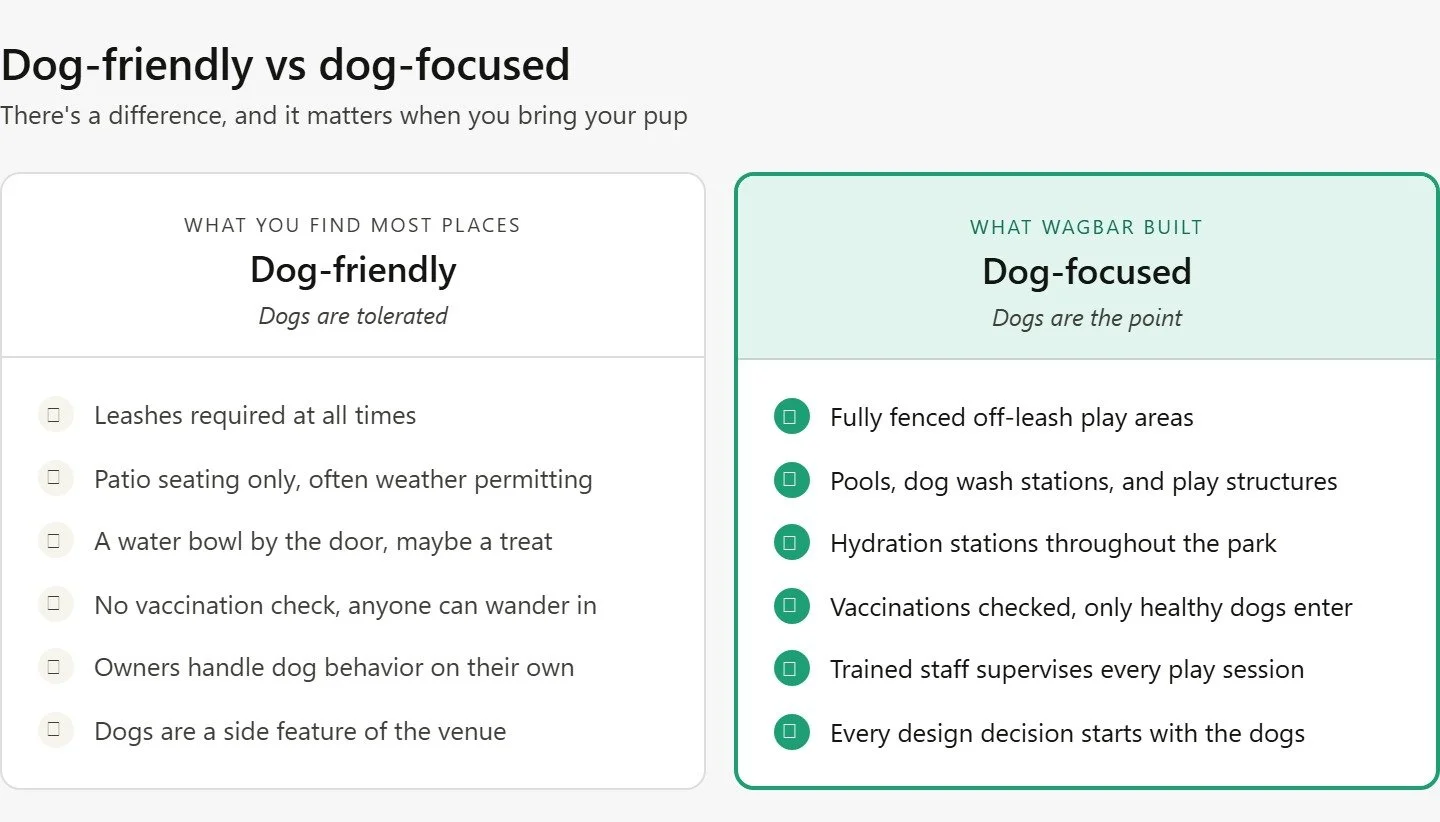
Dog bars run when dog owners have free time. That means afternoons, evenings, and weekends are your busiest hours. A thriving Saturday at a Wagbar location means you or a trusted manager is on-site, actively present, handling whatever comes up.
That schedule is a feature, not a flaw — it's why the customer base is strong and the social environment is vibrant. But it creates a real lifestyle consideration that's worth mapping out explicitly before you're past the point of reconsidering.
What does your current life look like on weekends? If you have young children, aging parents, a partner with a demanding schedule, or other commitments that rely on your consistent availability on weekends, an off-leash dog bar franchise will create direct conflicts. Those conflicts aren't necessarily dealbreakers — many owners manage them with strong operational staff — but they need to be planned for, not discovered.
Are you an "on-site" or "off-site" owner in your mental model? Some franchise owners imagine they'll be largely absent once the operation is running smoothly. That's a possible long-term state, but it's not the realistic early-stage picture. The first year or two requires your presence at a level most people underestimate. Owners who are genuinely engaged in those years tend to build stronger teams and more loyal member bases.
Can you sustain the pace? A community-focused business is socially demanding in a specific way. You're not just managing operations — you're the face of the place. Regular members know who you are. The energy of the space reflects yours. Some people find that energizing. Others find it draining. Both are legitimate reactions, and knowing which you are will tell you something about whether this particular model is a long-term fit.
Question 4: What Do You Actually Know About Running a Dog Environment?
This is where a lot of dog lovers discover the gap between being a passionate dog owner and being equipped to manage an off-leash social environment with dozens of dogs at once.
Owning one or two dogs — even doing it really well, even knowing a lot about dog behavior — is genuinely different from monitoring a park where 20 to 40 dogs of mixed breeds, ages, temperaments, and socialization histories are interacting simultaneously. Reading that environment accurately, identifying tension before it escalates, and intervening appropriately requires a specific kind of trained observation.
The honest assessment here:
Can you read dog body language with confidence? Do you know the difference between play behavior and the early signals of stress or arousal that precede a conflict? If you had to describe what tense body posture looks like in a dog vs. relaxed body posture, could you do it specifically? These aren't trick questions. The dog body language decoder is a practical resource if you want to build this foundation before your training.
Have you been around large groups of dogs in an off-leash setting? There's a real difference between knowing your dogs and being comfortable in a high-energy, multi-dog environment. Visiting a Wagbar location as a customer before you commit to opening one is genuinely useful — not just as a product evaluation, but as a personal calibration.
Are you prepared to enforce rules and remove dogs when necessary? Wagbar has a zero-tolerance policy for aggressive behavior. That means you or your staff will sometimes ask paying customers to leave because their dog isn't safe to have in the park. That's not optional — safety is the foundation the whole experience is built on — and it requires confidence and clarity that some people find uncomfortable to exercise.
None of this is a reason to walk away if you're not there yet. Wagbar's training is specifically designed to close these gaps. What matters is going in with realistic self-knowledge rather than assuming your love of dogs automatically translates into operational readiness for a managed off-leash environment. The complete dog park guide and dog park behavior guide are good starting points for understanding the operational complexity you'd be managing.
Question 5: Why This Business, and Why Now?
This is the question that sounds soft but often reveals the most. People make franchise decisions for a wide range of reasons, and the reasons tend to predict how they perform — especially when things get hard, which they will, temporarily, for virtually every new franchise owner.
The answers that tend to produce durable motivation:
You genuinely want to build a community space. Not because "community" sounds good on paper, but because you find real meaning in being a consistent presence in people's lives — a place they come back to, a space they introduce their friends to, a part of the regular rhythm of a neighborhood. Wagbar's founder, Kendal Kulp, built the original Asheville location on exactly that orientation. That's not a coincidence.
You want work that reflects what you actually care about. Many Wagbar franchisees came from careers that were professionally successful but felt disconnected from anything they cared about deeply. AJ Sanborn spent 20 years in financial services before his love of animals led him to Wagbar and a Richmond, Virginia franchise. Dianna brought years of IT sales experience but wanted a business that combined her background with something she genuinely valued. That kind of alignment is a real and legitimate reason to make a move.
You're building toward something long-term. Owners who think about their franchise as a 5-to-10-year investment — not a quick financial play — tend to make better early decisions, manage the slow periods more steadily, and build the kind of loyal member base that actually makes the business work.
The answers that tend to create problems:
Buying a franchise primarily to escape a job you dislike, without having examined what you're moving toward. Expecting the passion for dogs to carry you through the operational realities. Planning to be largely absent in an owner-dependent business.
If your answer to "why this business" is clear, grounded, and connects to something you'd find genuinely meaningful over the long term, that's a strong signal. If it's mostly "I love dogs and want a change," that's a starting point, not a complete answer.
What This Self-Assessment Is Actually For
Running through these five questions isn't about finding reasons to say no. It's about making a better decision faster.
Most people who take the time to think clearly about financial readiness, management experience, lifestyle fit, dog environment knowledge, and their underlying motivation come out of that process either more confident — because they have honest answers they feel good about — or clearer on what they need to do before they're ready to move forward.
Both of those are good outcomes.
If you've worked through this and your answers are largely solid, the next step is a direct conversation with the Wagbar franchise team. Visit wagbar.com/franchising to start the inquiry process and get full details on territories, the Franchise Disclosure Document, and what the path from inquiry to opening day looks like.
If a few answers surfaced gaps, that's useful information. The pet franchise opportunities page and the broader dog franchise opportunity resources can help you understand the landscape while you work on the areas that need more preparation.
The best Wagbar franchise owners didn't all start perfectly ready. They started with clear eyes about what they had, what they needed to build, and why it was worth doing.
Frequently Asked Questions
Do I need prior pet industry experience to qualify for a Wagbar franchise?
No. Wagbar does not require prior pet or hospitality industry experience. The franchise training program is built to equip owners with the operational skills they need — including dog behavior management, bar operations, and staff training — regardless of professional background. Strong business experience in any field is an asset.
What's the minimum liquid capital recommended before pursuing a Wagbar franchise?
Wagbar's total estimated initial investment ranges from $470,300 to $1,145,900. Prospective franchisees should have sufficient liquid capital to cover the investment, absorb a ramp-up period of reduced personal income, and maintain operational reserves. Full financial details are provided through the Franchise Disclosure Document to qualified candidates.
Is it possible to operate a Wagbar franchise as an absentee owner?
Not realistically in the early stage. The off-leash dog bar model performs best when the owner is present and engaged, particularly during the first one to two years of operation. Owners who are visible in their locations tend to build stronger team cultures and higher member retention. Reduced owner involvement may be possible once a strong team and operational rhythm are established.
How does Wagbar's training prepare owners who aren't familiar with dog behavior?
Wagbar's training program includes hands-on dog behavior management instruction during an intensive week at Asheville headquarters, covering how to read group dynamics, identify and de-escalate tension, and enforce safety standards. On-site grand opening support continues that training in your specific location. Resources like Wagbar's dog body language and dog park behavior guides also provide a strong foundation to build before training begins.
What ongoing support does a Wagbar franchisee receive after opening?
Wagbar franchisees receive continuing support through quarterly business reviews, marketing guidance, technology infrastructure, operational updates, and access to the franchisee network. Support is not limited to the opening period — the relationship continues throughout the franchise agreement.
Bottom TLDR: A pet franchise self-assessment that surfaces honest answers across five dimensions — capital position, management experience, schedule fit, dog environment readiness, and underlying motivation — is the most practical first step before any franchise inquiry. Dog owners who work through these questions thoroughly make better decisions and enter the franchise process with fewer surprises. If your answers are solid, the next step is visiting wagbar.com/franchising to review territories and begin the formal process.