

How to Validate a Franchise Opportunity: The 10 Questions to Ask Existing Franchisees

Top TLDR: Asking existing franchisees the right questions is the most reliable way to validate a franchise opportunity before you buy. The 10 questions in this guide cover investment accuracy, ramp-up timelines, training quality, corporate support, and what franchisees would do differently. Contact information for current and former franchisees is available in Item 20 of any Franchise Disclosure Document, no permission required.
Talking to existing franchisees is the most reliable way to validate a franchise opportunity, because they've already done what you're considering doing.
Item 20 of every Franchise Disclosure Document lists current and former franchisees with their contact information; you don't need permission to reach out.
The right questions focus on the gap between what the franchisor promised and what ownership actually looks like in practice.
To connect with Wagbar's team and start the discovery process, visit the franchising page.
When you're evaluating a franchise, the franchisor will tell you all the reasons it's a great investment. That's their job. Your job is to find out whether those claims hold up.
There's no better way to do that than calling people who signed the agreement before you. Current franchisees have gone through the same process you're in. They've opened locations, hired staff, dealt with problems the sales materials didn't mention, and now have real opinions about whether they made the right call. Talking to them isn't just useful. For any serious buyer, it's non-negotiable.
This guide covers the ten questions worth asking, why each one matters, and how to read the answers you get. It applies to any franchise you're evaluating, with Wagbar-specific context throughout so you can see how to apply this to an off-leash dog bar franchise specifically.

How to Get Franchisee Contact Information
You don't need to ask the franchisor to connect you with franchisees, though they'll often offer to. Item 20 of the Franchise Disclosure Document lists every current and former franchisee by name, location, and contact information. That list is yours to use however you want.
The distinction matters. When a franchisor gives you a list of franchisees to call, they're likely steering you toward their most satisfied owners. Item 20 gives you the full picture, including people who left the system. Former franchisees who chose not to renew or sold their locations can be some of the most informative conversations you have, because they have no ongoing relationship with the franchisor and less reason to soften their answers.
Call as many as you can reasonably reach. Five conversations will teach you more than fifty hours of reading sales materials.
For more foundational context on how franchise agreements and disclosure documents work, the complete franchise guide covers the structure of the relationship between franchisor and franchisee in plain language.
The 10 Questions to Ask
Question 1: "Knowing what you know now, would you sign again?"
Start here. This is the most direct summary question available, and it cuts through nuance quickly. The answer isn't always a clean yes or no, but how someone responds tells you a lot.
A franchisee who says "yes, without hesitation" is a different data point than one who says "probably, but I'd negotiate a few things differently" or "honestly, I'm not sure." You want to understand the full sentence, not just the word.
Pay attention to tone as much as content. Someone who says yes but spends the next ten minutes listing grievances is giving you useful information. So is someone who says the first year was harder than they expected but now genuinely loves what they built.
Question 2: "Was the total investment estimate accurate?"
Item 7 of the FDD gives a range for total investment. That range exists because real costs vary, but the question is whether franchisees' actual experience fell inside it, at the top of it, or exceeded it.
Construction costs, permitting timelines, working capital requirements in the first six months, unexpected site preparation needs: these are the categories where actual costs most often diverge from estimates. Asking multiple franchisees this question and averaging their answers gives you a more realistic starting budget than the FDD range alone.
For Wagbar, the estimated total investment runs between $470,300 and $1,145,900, which covers licensing, training, buildout, equipment, and working capital. Wagbar's container bar partnership, a system that converts shipping containers into fully-equipped bars and bathrooms, is designed specifically to reduce construction uncertainty. It's worth asking franchisees directly whether they used that solution and how it affected their actual buildout costs.
Question 3: "How long did it take you to break even?"
Ramp-up time is one of the most important financial variables in any franchise, and it's rarely discussed as directly as it should be. You need to know how long it took a location to cover its monthly costs from revenue, and separately, how long the path to recovering the initial investment looked.
A business model with strong recurring revenue, like Wagbar's membership-driven structure, tends to reach operational break-even faster than one dependent entirely on walk-in traffic, because each new member creates predictable monthly income from that point forward. But ramp-up still depends on how fast membership volume builds in a given market.
Asking franchisees in markets of different sizes gives you a range of realistic timelines rather than a single optimistic figure. The revenue streams for off-leash dog bars page explains how memberships, day passes, bar sales, and events layer together to build that monthly revenue base.
Question 4: "What did training prepare you for well, and what did it miss?"
Every franchisor describes their training program in positive terms. Franchisees can tell you whether that description matches reality.
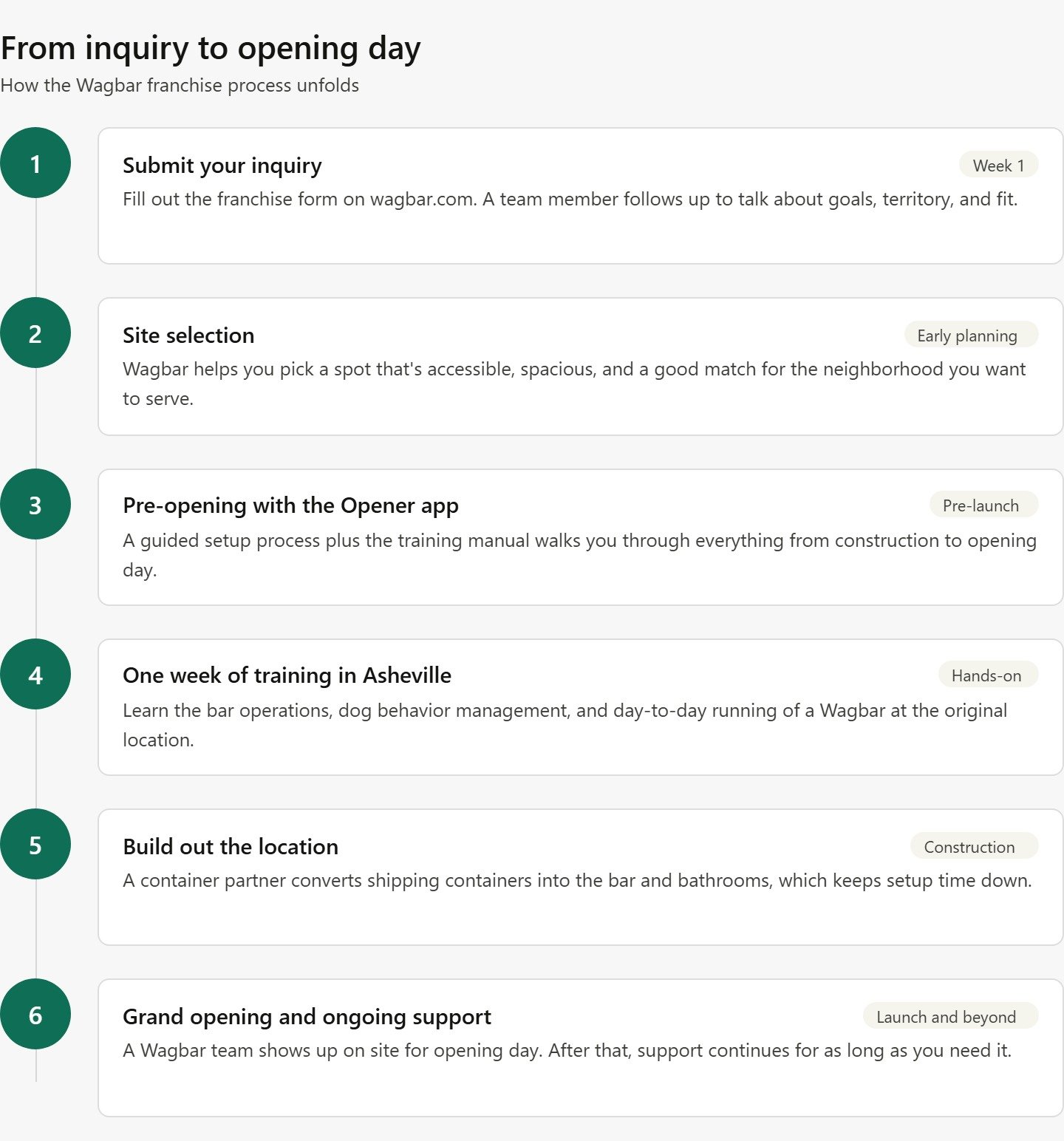
Wagbar's training includes the "Opener" app for pre-opening guidance, a one-week hands-on session at the Asheville headquarters covering dog behavior management, bar operations, staff training, and customer experience, and on-site support during grand opening. That's a structured program with clear components. The question is whether franchisees felt genuinely prepared after completing it, or whether they hit situations in the first few months that the training hadn't addressed.
Gaps in training are common and not necessarily a dealbreaker. What matters is whether the franchisor was responsive when those gaps showed up and whether franchisees felt supported in figuring things out.
Question 5: "How responsive is corporate when you have a problem?"
This question gets at the post-signing relationship more directly than anything in the sales materials. Every franchisor promises ongoing support. Franchisees can tell you what it actually looks like.
The specifics to probe: How long does it take to get a response? Do you reach a person or a ticket system? Is the support substantive, or do you end up figuring most things out yourself? Has the level of support changed as the franchise system has grown?
Wagbar's support structure includes quarterly business reviews, marketing assistance, technology infrastructure, and access to a growing franchisee network. Whether that translates into real responsiveness when an individual owner has a pressing operational question is exactly what the franchisee conversation is designed to verify.
For more on what the ongoing franchisee relationship looks like, the benefits of owning a pet franchise page covers the support components in more detail.
Question 6: "What's your relationship with other franchisees like?"
Franchise systems where owners communicate and support each other tend to outperform those where franchisees operate in silos. A healthy franchisee network is a form of collective problem-solving that supplements whatever corporate provides.
Ask whether there are informal channels, group chats, annual meetups, or peer-to-peer relationships that have been useful. Ask whether the culture feels collaborative or competitive. And ask whether franchisees in the network are candid with each other, or whether there's a social pressure to project success.
Wagbar's growing network of owners, spanning markets from Myrtle Beach and Richmond to Savannah and Cincinnati, gives newer franchisees access to people who've already worked through opening-year challenges. That knowledge transfer is hard to quantify but genuinely valuable.
Question 7: "Were there any territory or competitive surprises?"
Territorial rights can look protective in the FDD and still create unexpected complications in practice. Ask whether any competing concepts opened nearby after the franchisee signed. Ask whether the franchisor has other brands or formats that could theoretically operate in a franchisee's market. Ask whether the defined territory turned out to be the right size for the target customer base.
For a concept like Wagbar, where membership radius and drive-time are real factors in how big a market a location can serve, this question is worth asking in detail. A territory that looks sufficient on a map can be constrained by traffic patterns, neighborhood character, or competing uses of outdoor space.
Question 8: "What's the biggest challenge you didn't see coming?"
This is the most open-ended question on the list, and often the most informative. It invites franchisees to tell you something the franchisor either didn't think to mention or chose not to emphasize.
Answers vary by market, by operator background, and by timing. Common themes across franchise systems include hiring and retaining good staff, managing the gap between the pre-opening timeline and reality, and building early membership volume before word-of-mouth has had time to develop.
For Wagbar specifically, running a location that involves both alcohol service and off-leash dog management has its own operational texture that most franchisees haven't encountered in prior careers. Asking how franchisees got comfortable with that combination is a useful version of this question.
Question 9: "How do your actual sales compare to what you projected going in?"
If Item 19 of the FDD includes financial performance representations, you have some benchmark to work from. If not, franchisee conversations are your primary data source for understanding realistic revenue expectations.
Ask about first-year sales, the trajectory in year two, and whether the location is performing in line with, above, or below the expectations the franchisee set when they signed. Ask what drove any major differences. And ask whether they wish they'd been more or less conservative in their initial projections.
The dog business franchise profit margins page provides broader context on how pet-related franchise businesses perform financially, including the factors that separate profitable operations from struggling ones.
Question 10: "What would you do differently if you were starting over?"
This question captures the accumulated wisdom of someone who's already made the mistakes. It's different from "what do you wish you knew," because it asks for specific decisions rather than general knowledge.
Common answers across franchise systems include things like: choosing a different site, hiring a general manager earlier, investing more in local marketing before opening, or negotiating certain lease terms more aggressively. For a concept that relies heavily on community building, you might also hear things about how they'd approach early membership drives or grand opening programming differently.
AJ Sanborn, Wagbar's Richmond franchisee who came from a 20-year career in financial services, represents the kind of operator who brings structured thinking to questions like this. His background, choosing Wagbar over opening a traditional bar because of his passion for animals, reflects the common thread in Wagbar's franchisee base: people who see this as more than a financial transaction. Reading his story on the Richmond franchisee announcement gives useful context on the kind of person who tends to pursue this opportunity.
How to Interpret What You Hear
Getting honest answers requires asking well, but it also requires listening without filtering everything through confirmation bias. If you're already excited about a franchise, you'll unconsciously lean toward the positive signals. Guard against that.
A few practical notes on reading franchisee conversations:
One unhappy franchisee is a data point. Several with the same complaint is a pattern. One person who had a bad experience with corporate support might reflect a personality mismatch. Four people saying the same thing is worth taking seriously.
Watch for what doesn't get said. If you ask about profitability and someone changes the subject to how much they love the community they've built, that's worth noting. Good operators can love their business and still be honest about the financial reality.
Former franchisees are worth the extra effort to reach. They've stepped outside the relationship and often speak more directly. Item 20 includes contact information for owners who left in the past three years.
Franchisees in your target market type are more relevant than others. A location that opened in a dense urban neighborhood and a location in a mid-sized college town may have very different experiences with membership ramp-up and bar revenue. Try to talk to franchisees in markets that resemble yours.
Applying This to a Wagbar Evaluation
If you're running this process on a Wagbar dog franchise opportunity, you'll find a growing pool of franchisees across diverse markets and backgrounds. The Knoxville location, led by a mother-daughter team with roots in animal rescue and finance, brings a different operating perspective than a franchisee coming from corporate sales or hospitality. That variety is actually useful during validation, because it tells you something about whether the model works for different operator profiles.
What you're listening for across all those conversations is consistency. Consistent praise around specific things (training quality, brand recognition, the membership loyalty dynamic) and consistent complaints around others (whatever those might be) will give you the clearest picture of what you're actually getting into.
The what to look for when investing in a dog bar franchise post from Wagbar covers the evaluation criteria from the franchisor's perspective, which is a useful complement to what you hear from franchisees.
FAQ: Questions to Ask When Validating a Franchise
Can I contact any franchisee listed in the FDD, or just the ones the company recommends?
You can contact any franchisee listed in Item 20, including former franchisees. You don't need the franchisor's permission or introduction. Using the full list rather than a company-curated shortlist gives you a more complete picture.
What if a franchisee declines to talk?
Some will. That's their right. Move on to the next name on the list. If a large number of franchisees in a system are unwilling to speak with prospects, that pattern itself is worth paying attention to.
Should I ask the same questions to every franchisee?
Yes, especially the core financial questions. Asking the same questions across multiple franchisees lets you aggregate answers and spot patterns. You can also let conversations go wherever the franchisee takes them, but having a consistent baseline makes comparisons meaningful.
What's the best way to open a franchisee conversation?
Be direct and honest. Explain that you're evaluating the franchise system, that you got their contact information from Item 20 of the FDD, and that you'd appreciate 20-30 minutes of their time. Most franchisees who've been through this process themselves are willing to pay it forward.
Does talking to franchisees replace reading the FDD?
No. The FDD and franchisee conversations cover different things. The FDD gives you legal structure, financial data, and contractual terms. Franchisees give you operational reality and lived experience. Both are necessary for a complete picture.
Where do I start with Wagbar's franchisee discovery process?
The Wagbar franchising page is the first step to requesting the FDD and beginning formal conversations with the team. The FAQ page also covers common questions about the franchise system for prospective owners.
Talking to existing franchisees is the part of the validation process that most separates serious buyers from casual ones. It takes time, it requires some directness, and it occasionally produces answers you didn't want to hear. That's exactly why it's worth doing. The information you get from those conversations is something no document, no website, and no sales presentation can fully replicate.
Start the Wagbar discovery process at wagbar.com/franchising.
Bottom TLDR: Validating a franchise opportunity through franchisee conversations gives you real operational data that no sales presentation can match. These 10 questions cover the financial and operational gaps between what franchisors promise and what ownership actually looks like in practice. To start the Wagbar discovery process and request the FDD, visit wagbar.com/franchising.