

How Much Cash Do You Actually Need to Open a Dog Franchise? Liquid Capital Requirements Explained
Key Takeaways
Opening a dog franchise requires more immediately accessible cash than most investors initially expect. Liquid capital covers your down payment, pre-opening costs, and working capital reserves — and it has to be in hand before a lender or franchisor will approve you. For a franchise in Wagbar's investment range, plan for a minimum of $100,000 to $150,000 in verifiable liquid assets, and more if you're self-funding a larger portion of the build-out.
When people ask how much money they need to open a dog franchise, they're usually thinking about the total investment figure. That's a reasonable starting point, but it's not the number that determines whether you qualify. What lenders and franchisors actually look at is your liquid capital — the cash and near-cash assets you can access immediately without selling property or taking out a loan.
The distinction matters more than most people realize. You might have a net worth of $500,000 that includes a paid-off home, a retirement account, and a car — and still not meet the liquid capital threshold a franchisor requires. Understanding what counts, what doesn't, and how to structure your assets before you apply can be the difference between a smooth qualification process and being told to come back in a year.
What "Liquid Capital" Actually Means (and What It Doesn't)
Liquid capital is money you can access quickly — generally within a few days — without significant loss or penalty. The most common forms include:
Checking and savings accounts
Money market accounts
Stocks, mutual funds, and ETFs held in taxable brokerage accounts
Certificates of deposit with near-term maturity dates
Treasury bills and other short-term government securities
401(k) or IRA funds accessed through a ROBS structure (Rollover for Business Startups)

What does not count as liquid capital in most franchise qualification contexts:
Home equity (unless you've already taken out a HELOC and the funds are sitting in cash)
Retirement accounts unless accessed through ROBS or accepted as pledged collateral
Real estate equity
Business equipment or inventory
Money owed to you but not yet received
The reason for this distinction is practical. A franchisor needs to know you can cover your obligations without a crisis in the first several months of operations. A lender needs to see that you have enough accessible cash to service the equity injection requirement on any loan. Neither of them can rely on illiquid assets to keep your business running if revenue is slower than projected in your opening months.
The Full Investment Range for a Wagbar Dog Franchise
Wagbar's total estimated initial investment is $470,300 to $1,145,900, with a $50,000 franchise fee.* That range reflects real variation — different markets, different site conditions, different lease structures, and different build-out costs produce materially different totals.
Understanding what goes into a Wagbar franchise investment helps clarify where the liquid capital requirement comes from. The investment covers the franchise fee, site development and construction, equipment, the container bar build-out, technology systems, initial inventory, pre-opening marketing, and working capital to sustain operations before membership and day-pass revenue reaches a stable level.
Not all of those costs require cash on day one. Leasehold improvements and equipment are often financed. Working capital is typically drawn from reserves over time. But the franchise fee, a portion of pre-opening costs, and the down payment on any financing all have to come from liquid capital that you actually have — not from the loan you're trying to qualify for.
How Much Cash You Need Depends on How You Finance the Rest
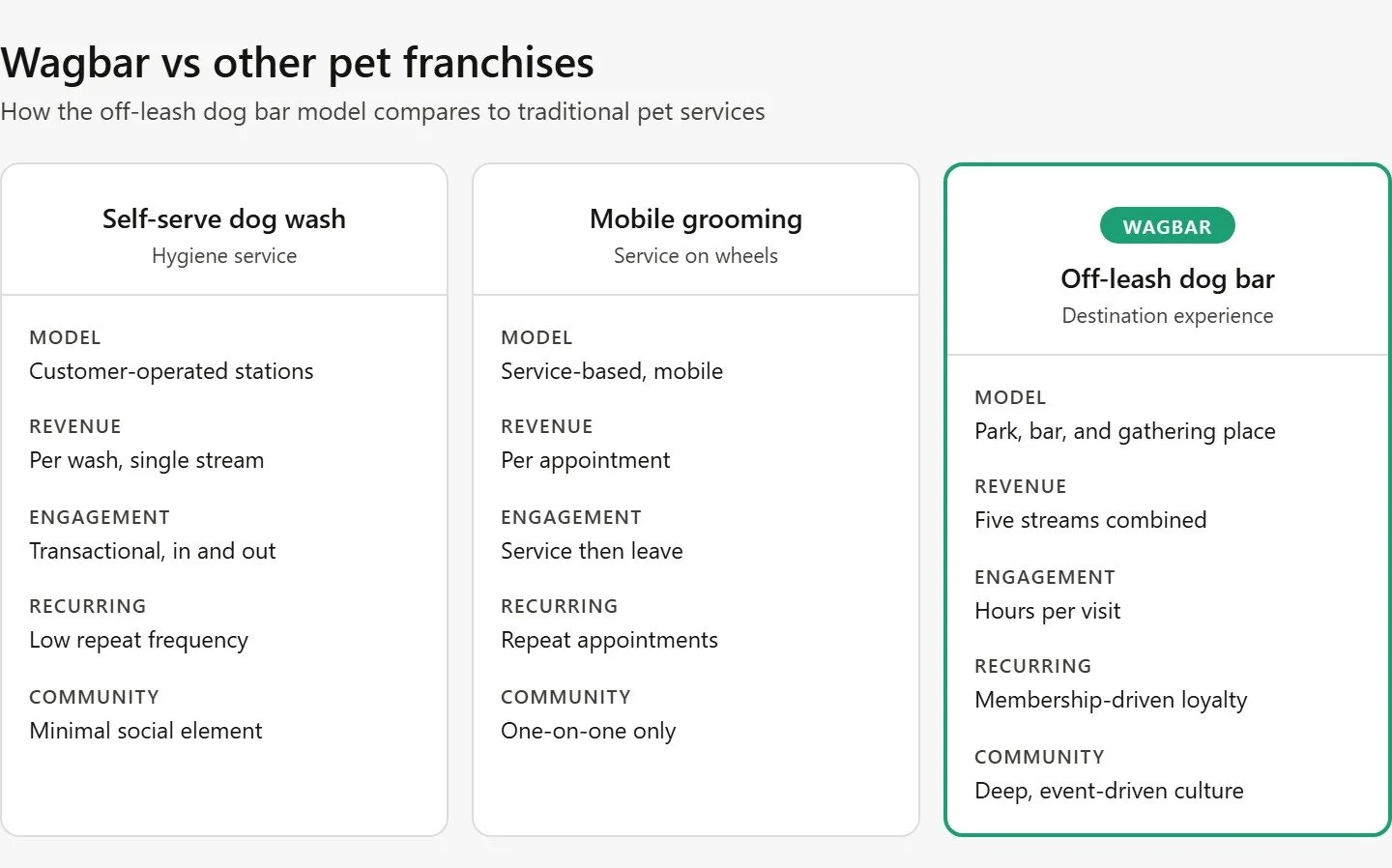
The honest answer to "how much liquid capital do you need" is: it depends on your financing structure. Here's how the math shifts across the three most common approaches.
If You Use an SBA Loan
An SBA 7(a) loan requires a minimum 10% equity injection from the borrower, though lenders in practice want 20–30% for new franchise locations without operating history. On Wagbar's lower investment range of $470,300, a 20% equity injection means you need roughly $94,000 in verifiable liquid capital just to satisfy that requirement. On a $750,000 mid-range investment, 20% is $150,000. That equity injection has to come from your liquid assets — it can't be borrowed.
Beyond the down payment, most SBA lenders also want to see that you have 3–6 months of operating expenses in reserve above and beyond the equity injection. That reserve doesn't necessarily have to stay in cash forever, but it does need to be verifiable at the time of application. How SBA loans work for dog franchise investors covers the full qualification requirements, but the practical implication for liquid capital is significant: plan for $100,000 to $200,000 in accessible assets for a lower-range Wagbar investment using SBA financing, and $200,000 to $400,000 for a larger location.
If You Use ROBS
A ROBS structure — Rollover for Business Startups — allows you to use 401(k) or IRA funds as liquid capital for a franchise investment without triggering early withdrawal taxes or penalties. In this scenario, retirement assets become functionally liquid for qualification purposes, because the structure converts them into business equity rather than a taxable distribution.
The minimum threshold most ROBS providers work with is $50,000 in eligible retirement savings, though investors rolling over $150,000 or more can cover meaningful portions of a Wagbar investment — potentially the full lower range. Using a ROBS to fund a dog franchise without debt walks through the four-step process, the real risks, and how to evaluate providers. The key point here: if you have retirement savings you've excluded from your liquid capital calculation because you assumed they were locked up, they may not be.
If You're Primarily Self-Funding

Some investors bring enough liquid savings to cover the majority of a franchise investment without external financing. In this case, the liquid capital requirement is simply the investment amount itself, minus any financing you do choose to use. The advantage is speed and simplicity — no waiting on loan approval, no personal guarantee, no debt service affecting early cash flow. The risk is concentration: all of your available capital is in one business, leaving no cushion for surprises.
For most investors, some combination — personal equity plus SBA financing, or ROBS plus a smaller SBA loan — produces the most financially sound structure.
What Your Liquid Capital Actually Has to Cover
It helps to think about liquid capital as serving three distinct purposes, each of which a franchisor or lender will evaluate separately.
The equity injection. This is the cash you put into the project as your ownership stake. For SBA loans, it's the down payment. For self-funded investments, it's everything. It demonstrates that you have financial skin in the game and reduces the lender's risk.
Pre-opening costs not covered by financing. Franchise fees, professional fees, permits, pre-opening marketing, training travel, and initial supplies often fall outside the scope of what a construction or equipment loan covers. These costs hit before revenue starts, and they require cash on hand.
Operating reserves. Revenue in a new franchise location rarely reaches break-even in the first month. The period between opening day and stable membership and day-pass revenue can run three to six months depending on market conditions, marketing effectiveness, and how quickly word spreads in the local dog-owner community. Liquid capital held in reserve bridges that gap. The revenue streams available to an off-leash dog bar — memberships, day passes, bar sales, and private events — build over time, and your reserve needs to cover operating expenses until they do.
Most franchise consultants and SBA lenders recommend keeping operating reserves equal to at least three months of projected expenses — and preferably six — above and beyond the equity injection. For a Wagbar location projecting $30,000–$50,000 per month in operating costs, that's $90,000–$300,000 in reserve. Not all of that has to stay in cash after funding, but it needs to be verifiable before your loan closes.
Why Franchisors Set Liquid Capital Minimums
Franchisors set minimum liquid capital requirements because undercapitalized franchisees fail at higher rates — and that failure creates problems for the whole network. A location that runs out of operating capital in month four has to close or ask for help, both of which damage the brand, the franchisee's credit, and the customers who've already paid for memberships.
Requiring a minimum liquid capital threshold is one of the most effective ways franchisors protect the health of their network. It's not a gatekeeping exercise — it's a practical requirement tied to real operational risk. When you look at what to look for when investing in an off-leash dog bar franchise, financial transparency from the franchisor is one of the markers of a well-run system, and liquid capital requirements are part of that transparency.
Wagbar's franchise disclosure document specifies financial qualification criteria for prospective franchisees, including guidance on the liquid capital and net worth expectations associated with the investment. Prospective investors should review that document carefully and discuss their specific financial picture with Wagbar's franchising team at franchising@wagbar.com before drawing conclusions about eligibility.
How to Know If You Qualify Financially
A basic self-assessment covers five questions:
1. What is your total liquid capital right now? Add up checking, savings, brokerage accounts, and any near-term CDs. Do not include home equity, retirement accounts (unless you're considering ROBS), or illiquid real estate.
2. Do you have retirement funds that could be deployed through a ROBS? If so, add those to your accessible capital for the purpose of this exercise — but read through the structure and risks first.
3. What portion of the total investment are you prepared to finance? If you're planning an SBA loan, you need at minimum 10–20% of the total investment in liquid capital for the equity injection, plus reserves.
4. How much of a monthly payment can your household absorb if revenue is slower than projected? Loan payments continue regardless of how the business is performing. Your liquid reserves need to be large enough to cover several months of those payments if needed.
5. Is your credit above 680? Liquid capital and credit work together in loan qualification. Having $150,000 in liquid assets but a 620 credit score creates a bottleneck on the financing side that liquid capital alone can't resolve.
Understanding the benefits of owning a pet franchise is part of the picture, but so is entering that ownership with enough financial runway to let the business develop. Dog franchise profit margins and what real owners report give useful context for modeling your break-even timeline before you finalize your capital plan.
The pet industry's scale — $147 billion in annual U.S. spending, 67% household pet ownership — supports the long-term demand case. But liquid capital is about surviving the short term while that demand translates into a profitable location.
Frequently Asked Questions
What is the typical minimum liquid capital requirement for a dog franchise?
For franchises in Wagbar's investment tier ($470,300–$1,145,900), most investors need between $100,000 and $350,000 in verifiable liquid capital depending on their financing structure. Investors using SBA financing with a 20% equity injection on a lower-range investment need approximately $94,000–$150,000 for the down payment alone, plus additional reserves. Self-funding investors need liquid capital closer to the full investment amount. Prospective Wagbar franchisees should review the FDD* and speak directly with the franchising team to confirm the specific thresholds for their situation.
Does home equity count as liquid capital?
Not on its own. Home equity is illiquid — you can't access it without taking out a loan (HELOC or cash-out refinance). If you've already taken out a HELOC and the funds are sitting in a checking or savings account, that cash counts. But equity sitting in your home's value does not. Some lenders will accept pledged home equity as collateral in addition to liquid capital, but it doesn't substitute for the cash requirement.
Can I count my 401(k) or IRA as liquid capital?
In a standard loan application, retirement accounts are generally not counted as liquid capital because early withdrawal penalties make them costly to access. However, if you're using a ROBS structure, your retirement funds become equity in your business and effectively satisfy the liquid capital requirement. This is one of the primary reasons ROBS is popular among franchise investors — it unlocks capital that would otherwise sit excluded from the qualification calculation.
What happens if I open undercapitalized?
Undercapitalization is one of the leading causes of early franchise failure. If you open with just enough to cover the equity injection but insufficient reserves, a slow first quarter — slower membership growth than projected, an equipment issue, a delay in your opening marketing taking hold — can create a cash crisis that's very hard to recover from. Franchisors set minimum liquid capital requirements specifically because the risk of undercapitalization is real and well-documented. If your current liquid assets fall short, it's worth waiting and saving rather than pushing forward on minimum capital.
How does market selection affect how much liquid capital I need?
Market selection affects your investment range, which directly affects your liquid capital requirement. A Wagbar location in a lower-cost market with favorable lease terms might fall at the lower end of the $470,300–$1,145,900 range, requiring proportionally less liquid capital. A high-cost urban market with premium construction costs and longer timelines to stable revenue may push toward the upper range and require larger reserves. Markets with the strongest demographics for dog franchise success often reach break-even faster, which affects how long your reserves need to last.
Is net worth the same as liquid capital?
No, and confusing the two is one of the most common financial qualification mistakes. Net worth is your total assets minus your total liabilities — it includes your home, your retirement accounts, your car, and any real estate. Liquid capital is the subset of those assets you can access quickly without selling property or triggering penalties. You can have a high net worth and low liquid capital, which is why franchisors and lenders evaluate both. Most franchise qualification requirements specify a minimum net worth and a separate minimum liquid capital figure.
Summary
Dog franchise liquid capital requirements go beyond the down payment. You also need to cover the equity injection on any financing, pre-opening costs outside loan scope, and operating reserves for the early months. For Wagbar's $470,300 to $1,145,900 range, plan for $100,000 to $350,000 in liquid assets. Review the FDD, assess your accessible capital honestly, and consider ROBS if retirement funds are your largest available asset.
*This information is not intended as an offer to sell, or the solicitation of an offer to buy, a franchise. Investment figures are provided for informational purposes only. An offer is made only by Franchise Disclosure Document (FDD). Currently, the following states regulate the offer and sale of franchises: California, Hawaii, Illinois, Indiana, Maryland, Michigan, Minnesota, New York, North Dakota, Oregon, Rhode Island, South Dakota, Virginia, Washington, and Wisconsin. Wagbar Franchising LLC, (828) 554-1021, 7 Kent Place, Asheville, NC 28804.